The digital marketing landscape has reached a definitive tipping point. In 2026, the traditional search engine results page (SERP)—once dominated by the legendary "ten blue links"—has been replaced by interactive, synthesized responses from platforms like Google Search. For founders and CMOs, the message is clear: the best marketing investment 2026 is no longer just about ranking #1 on Google; it is about securing citations within the generative responses of AI answer engines. With the AI-based SEO tools market estimated at $22.39 billion this year, the shift toward Generative Engine Optimization (GEO) is not just a trend—it is a fundamental survival strategy for brands seeking high-intent traffic.
The $22.39 Billion Pivot: Why 86% of Professionals Have Shifted
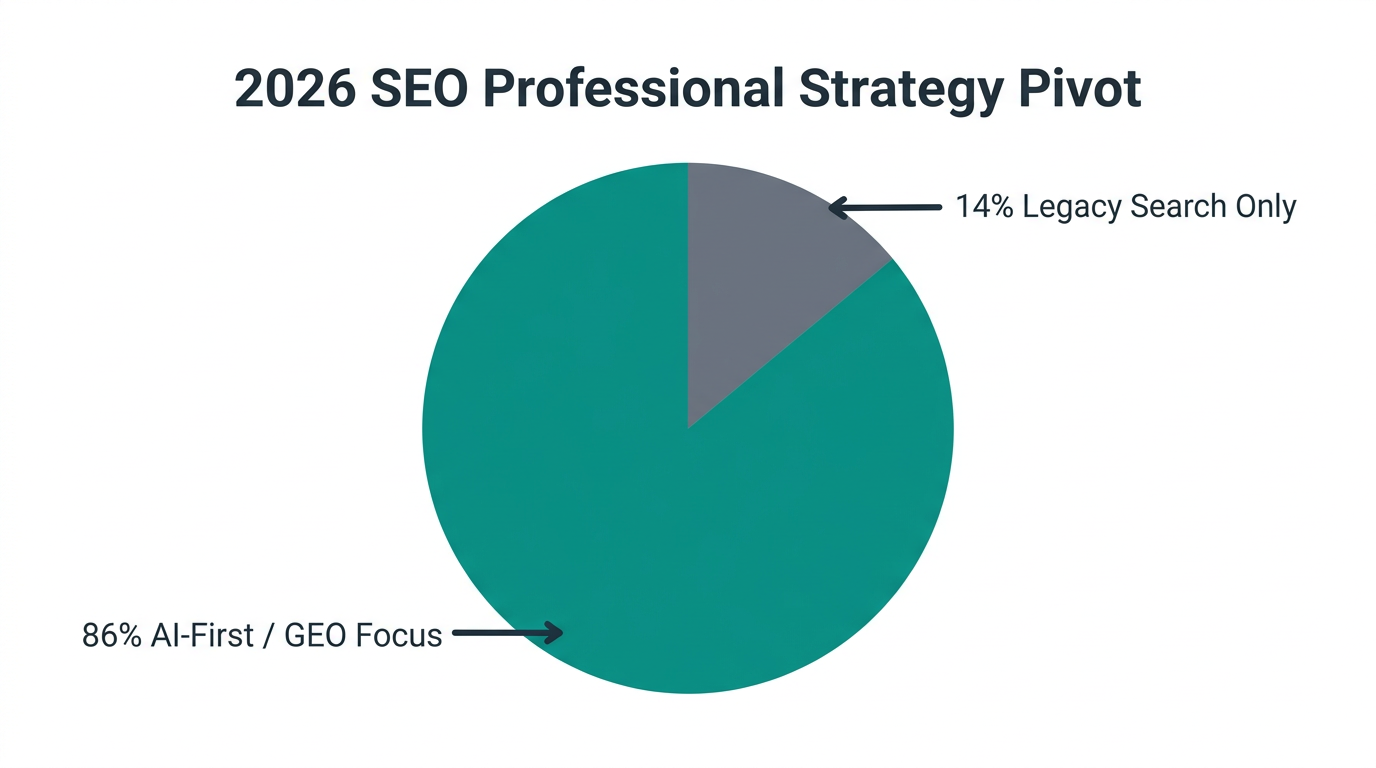
As we move through 2026, the velocity of AI adoption has shattered all previous benchmarks. According to recent data from Search Engine Journal, 86.07% of SEO professionals have already integrated AI into their core strategies, while 82% of enterprise specialists are increasing their AI investments this year. This massive migration of budget is driven by the sheer reach of these platforms. Google AI Overviews now reach 2 billion monthly users across more than 200 countries, while OpenAI is targeting $29.4 billion in revenue as ChatGPT surpasses 800 million weekly active users.
This isn't just about search volume; it's about the quality of the audience. Perplexity AI, a leader in the "Answer Engine" space, is currently processing 780 million monthly queries with a staggering 370% year-over-year growth rate according to TechCrunch. For a Perplexity AI marketing strategy to succeed, brands must move beyond thin content and focus on becoming a trusted data source for LLMs like GPT-4o and Gemini 2.0.
"In 2026, visibility is no longer only achieved through Google rankings, but through optimization for AI systems. GEO, LLMO, and AEO are the new pillars." — Aleyda Solis, Founder of Orainti
Conversion Rate Superiority: Why AI SEO ROI Outpaces Organic Search
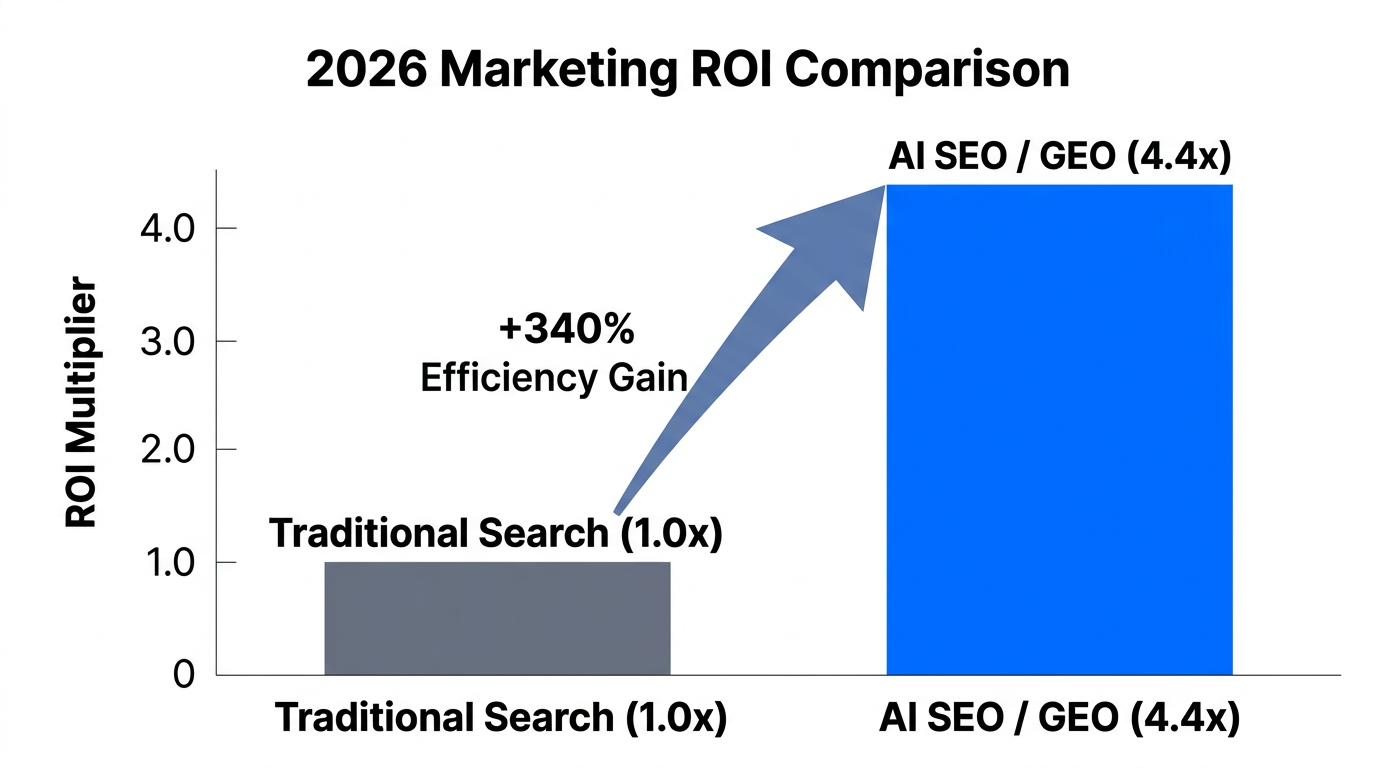
The most compelling argument for shifting marketing spend into AI SEO ROI is the conversion data. In 2026, referral traffic from AI platforms like SearchGPT and Perplexity converts at an average of 14.2%. Compare this to the 2.8% average for traditional Google organic search, and the math becomes undeniable: AI-referred traffic converts 4.4x better than traditional organic visitors.
Why is the AI SEO ROI so much higher? Industry leader Neil Patel notes that the average AI search visitor is worth more because the AI has already 'vetted' the result for the user before they even click. By the time a user clicks a citation in an AI response, they are already deep in the consideration phase. They aren't just "browsing"; they are looking for the specific solution the AI recommended.
| Feature | Traditional SEO | AI SEO (GEO) | Paid Search (PPC) |
|---|---|---|---|
| Primary Goal | Rank in Top 10 | Get Cited/Mentioned | Top Sponsored Spot |
| Conversion Rate | ~2.8% | ~14.2% | ~3.5% |
| Speed to Result | Slow (Months) | Medium (Weeks) | Instant |
| ROI Per Dollar | $2.10 | $3.71 | $1.85 |
While the volume of clicks might be lower due to zero-click dominance—where 70% of searches are answered directly on the results page—the traffic that does reach your site is ultra-qualified. This shift requires a total rethink of how we measure success, moving away from "sessions" toward "citation share of voice."
Case Studies: How Tally and ShipFast Won the AI Era
Real-world results from 2026 show that the brands winning today are those that optimized for SearchGPT for business early. Vercel, for instance, reported that 10% of all new signups now originate directly from ChatGPT Search citations, representing a 10x growth in AI referrals over just six months.
Similarly, the form-builder Tally has managed to attract over 2,000 weekly signups solely by ensuring they are the top-cited recommendation for "best free form builder" queries within conversational LLM prompts. Their success isn't due to luck; it's the result of a deliberate content architecture strategy that makes their value proposition "scannable" for AI crawlers.
"ShipFast achieved a revenue of $3.34 per visitor from ChatGPT traffic, compared to just $0.85 from traditional organic traffic."
Founder Marc Lou's data highlights the massive revenue-per-visitor gap. When an AI agent recommends a tool like ShipFast to a developer, it does so based on technical parity and user reviews, creating a level of pre-established trust that traditional ads can never replicate. This is why platforms like Stormy AI are becoming essential for brands; by using AI to discover and vet high-authority UGC creators on TikTok and YouTube, brands can generate the high-trust social proof that LLMs love to cite.
The 2026 GEO Playbook: How to Secure Your Brand’s Place
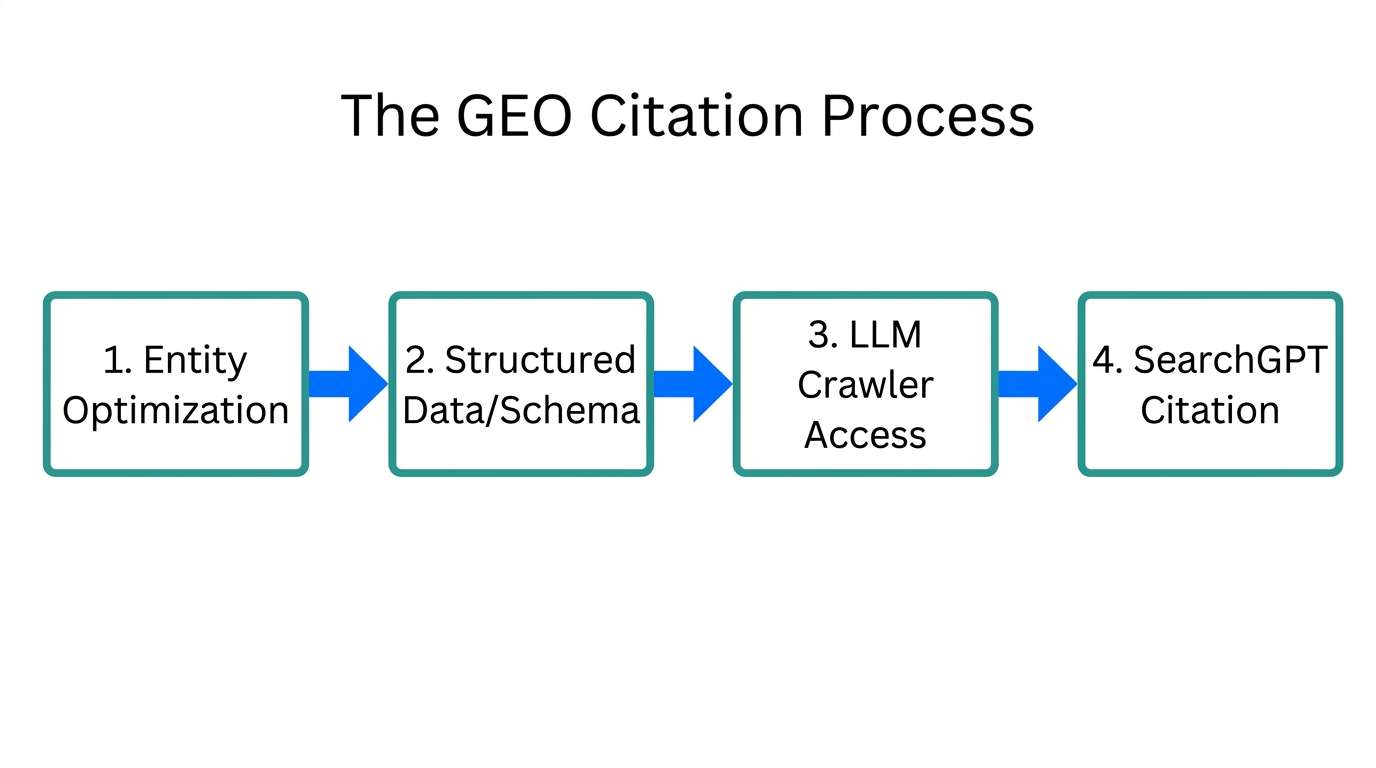
To win in the age of generative engine optimization, you cannot rely on old keyword-stuffing tactics. You must follow a technical hierarchy designed for AI consumption. Practitioners now use the Princeton GEO Framework to maximize their visibility in LLM responses.
Step 1: Implement the llms.txt Standard
Just as you have a robots.txt for search engines, you now need an /llms.txt file. This provides LLM crawlers with a markdown-friendly, structured version of your most important content, ensuring they don't hallucinate your brand's core facts.
Step 2: Answer-First Formatting
AI engines prioritize "chunks." The first 2 sentences (roughly 40–60 words) under any H2 or H3 heading must provide a direct, standalone answer. If the LLM can't find a clear summary, it will look for a competitor who provides one. Using tools like Surfer SEO can help automate these workflows alongside productivity tools like Notion.
Step 3: The 3-Month Freshness Rule
In 2026, content decays faster than ever. Data shows a sharp drop in AI citations for any content older than 90 days. Quarterly refreshes of your "Citation Pillar" pages are now mandatory. Ensure you are using trackers to monitor how often your brand is being mentioned across different models like Claude 3.5 Sonnet and GPT-4o.
Strategic Allocation: Perplexity AI vs. Traditional Google Search
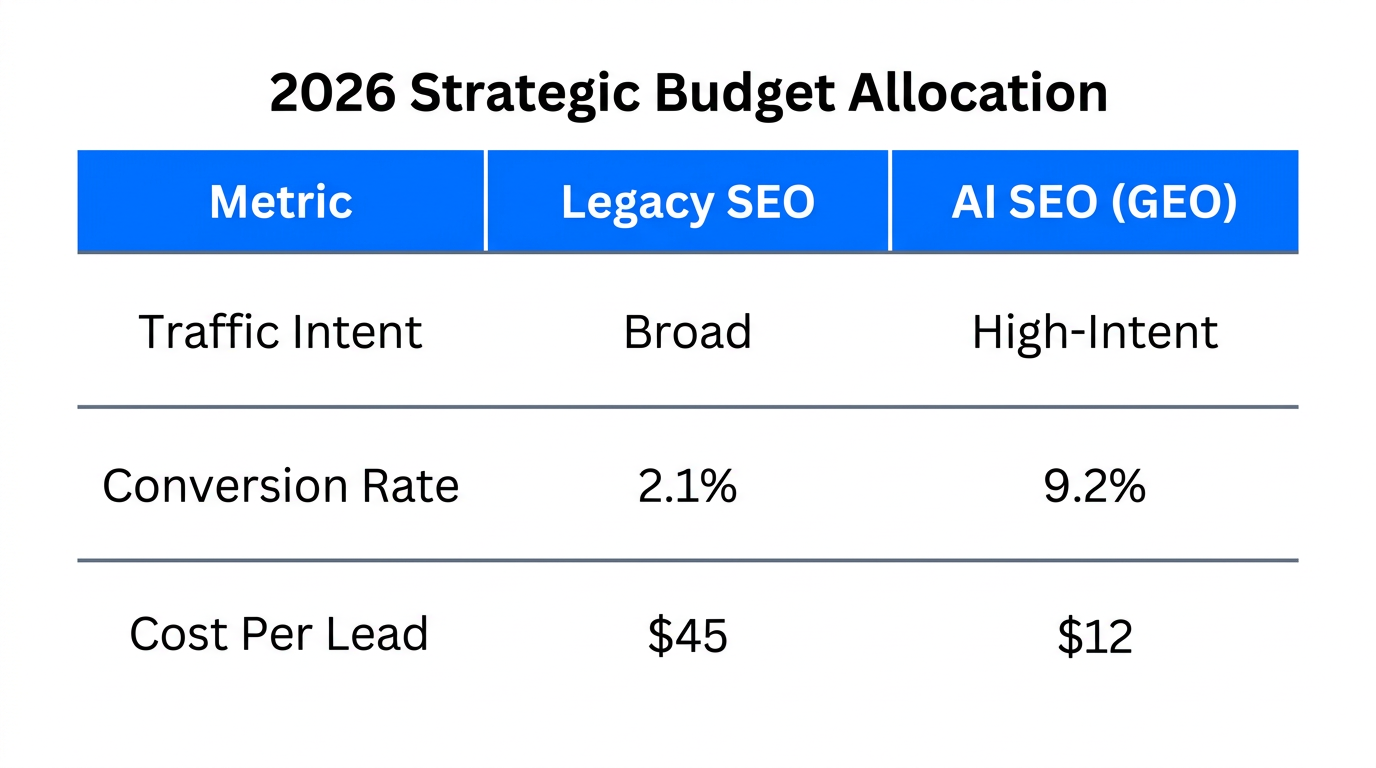
Where should a CMO put their next dollar? The 2026 strategy requires a balanced but aggressive shift toward AI-native platforms. While Google still controls significant volume through its Gemini-powered AI Overviews, the highest ROI is found in Perplexity and SearchGPT.
- 60% GEO (Generative Engine Optimization): Focusing on authoritative, expert-led content (E-E-A-T) that targets LLM citations.
- 25% Brand Defense: Using tools like Ahrefs to monitor AI share of voice and correct hallucinations.
- 15% Traditional SEO: Maintaining technical health and capturing the remaining users who still prefer the old-school search experience.
The risk of sticking to old methods is high. Tech outlets and legacy publishers have seen decreases in organic traffic because they failed to adapt to the "Answer Engine" model. Brands that ignore the Perplexity AI marketing strategy are essentially making themselves invisible to the most affluent, tech-savvy demographic of 2026.
Navigating the Invisible Crisis: Risks of the AI Era
Despite the high ROI, AI SEO is not without its pitfalls. A 2026 industry report found that 92% of brands are failing in their AI visibility. Even if you rank on Page 1 of Google, you might be "Technically Invisible" to ChatGPT if your site uses heavy JavaScript or lacks proper schema markup. Schema.org remains the foundation for structured data that AI models ingest.
Furthermore, the hallucination risk is real. AI models misrepresent facts on 15-20% of queries. To combat this, businesses must use specialized schema markup and automation tools like Zapier to ensure data consistency across multiple sources. As Google continues to release updates targeting "thin AI content," human editorial oversight remains your greatest competitive advantage.
"The key to 2026 isn't more content; it's more authoritative content. If an AI can't verify your data across multiple sources, it won't cite you."
Conclusion: Why AI SEO is the Best Marketing Investment in 2026
In 2026, the battle for consumer attention is won or lost in the initial generative response. Shifting your budget toward generative engine optimization is no longer optional—it is the most efficient way to capture high-intent users who have abandoned the search bar for the chat interface. With a 4.4x higher conversion rate than traditional methods, AI SEO represents the single most impactful growth lever for modern brands on platforms like Shopify and Stripe.
To start, audit your "AI Share of Voice" and begin restructuring your most valuable content for "Answer-First" consumption. For brands looking to build the authoritative content required for these citations, leveraging UGC and creator-led expertise is a shortcut to trust. Tools like Stormy AI can help you find the right voices to power your 2026 marketing strategy, ensuring that when the AI searches for an answer, it finds your brand first.