Setting Up Shopify Agentic Storefronts: The 2026 Guide to Universal Commerce Protocol
Learn how to set up Shopify Agentic Storefronts using Universal Commerce Protocol and JSON-LD for SGE product discovery in our definitive 2026 technical guide.
In 2026, the digital storefront is no longer a destination for humans to browse—it is a data node for autonomous AI agents to negotiate. We have officially entered the era of Agentic Commerce, where the primary "customer" for your Shopify store is often a personal AI assistant like ChatGPT, Google Copilot, or a dedicated shopping agent. According to Printful and Market.us, the global dropshipping market has exploded to $590 billion this year, driven largely by these machine-to-machine transactions.
For DTC brands, the challenge has shifted from "getting clicks" to "securing agentic visibility." If your store isn't optimized for the Universal Commerce Protocol (UCP), you are effectively invisible to the 37% of Gen Z consumers who now use AI agents to find and purchase products, as reported by Triple Whale. This guide provides the technical playbook for configuring your Shopify store for the agent-first economy of 2026.
Understanding the Universal Commerce Protocol (UCP)
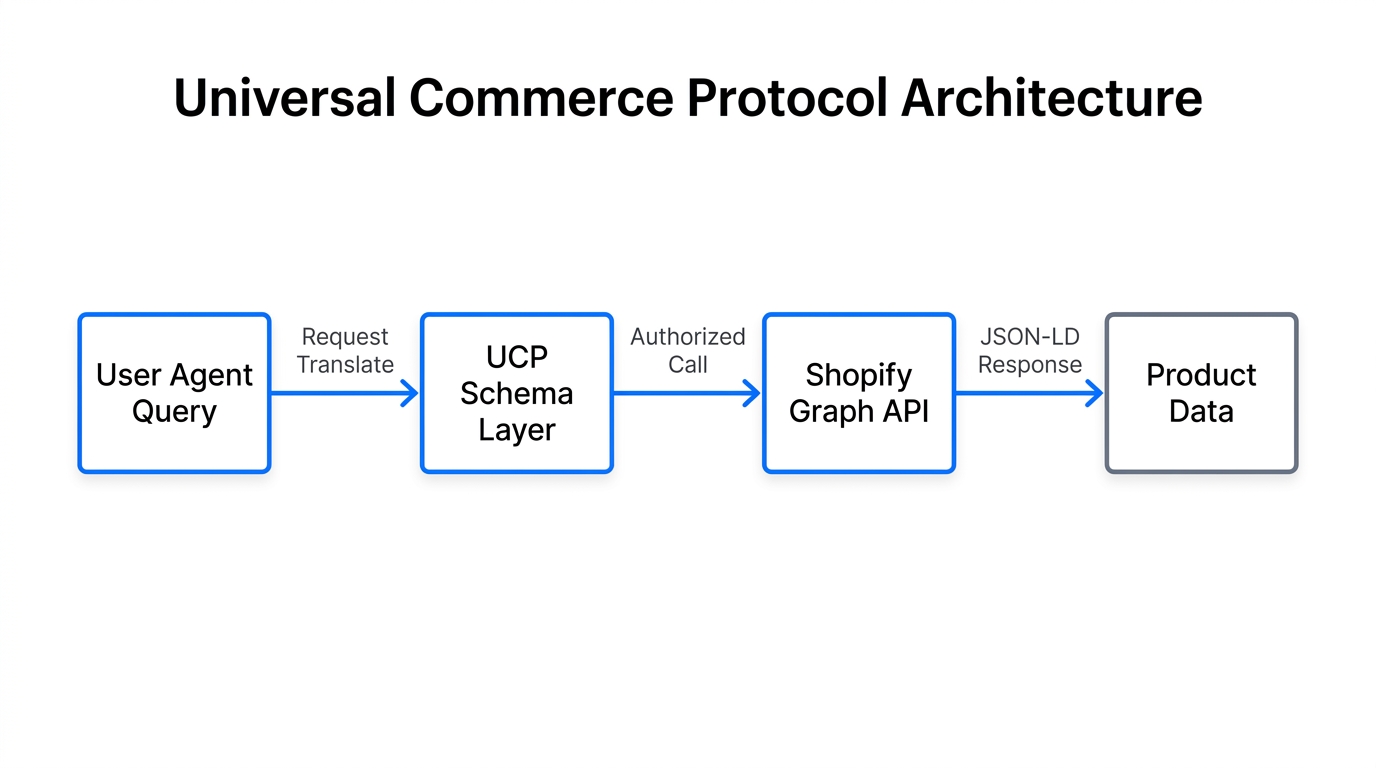
Announced on January 11, 2026, by Shopify and Google, the Universal Commerce Protocol (UCP) is the new global standard that allows AI agents to negotiate pricing and complete checkouts without a human ever visiting a website. As Shopify Engineering notes, UCP turns every product page into a structured API endpoint that autonomous agents can query for real-time inventory, shipping speed, and bulk discounts.
In the past, an AI could only "read" your site. In 2026, it can interact. If a customer tells their AI assistant, "Find me a sustainable leather jacket under $300 that can arrive by Friday," the agent uses UCP to ping dozens of stores, compare technical specs, and even ask for a first-time buyer discount. This is why Shopify Sidekick has evolved into an active co-pilot, managing these incoming agent queries in the background.
"By 2026, 20% of consumers will convert only when a product is recommended by their personal AI assistant." — Stord Analysts
Managing this level of technical overhead is exactly where an AI ecommerce employee like Stormy AI excels. While you focus on brand strategy, Stormy AI can monitor your UCP health, ensuring your product data is always accurate and that AI agents aren't getting blocked by legacy firewalls or bot-detection scripts.
How to Enable Agentic Storefronts in Shopify
Configuring your store for machine-to-machine commerce requires moving beyond basic SEO. Shopify has introduced a dedicated Agentic Storefronts module within the admin dashboard to facilitate this. Follow these steps to ensure your store is UCP-compliant:
- Navigate to Settings: Go to
Admin > Settings > Agentic Storefronts. - Enable AI Discovery: Toggle on "Allow Autonomous Agent Discovery". This adds a machine-readable
/ai-manifest.jsonto your root directory, similar to howrobots.txtworks for search engines. - Set Negotiation Parameters: Define the limits for AI-driven discounts. You can allow agents to automatically apply a 10% discount for orders over $100 if the agent belongs to a verified ecosystem like OpenAI or Google.
- Verify UCP Handshake: Ensure your store successfully completes the UCP handshake. This allows agents to reserve inventory for up to 5 minutes while they finalize the user's intent.
| Feature | Legacy Storefront (Pre-2025) | Agentic Storefront (2026) |
|---|---|---|
| Discovery | Human Search (Google/Meta) | SGE & Agent Negotiation |
| Checkout | Manual Form Entry | One-Click UCP Handshake |
| Pricing | Static / Manual Coupons | Real-time AI Price Negotiation |
| Maintenance | Manual Updates | Autonomous AI Employee Ops |
As you enable these features, Stormy AI acts as your back-office sentinel. It can watch the "Pulse" of your agentic traffic, alerting you if a specific AI agent (like ChatGPT-6) is repeatedly failing to complete checkouts due to a configuration error in your shipping zones.
Agentic Storefronts SEO: Implementing Advanced JSON-LD
Traditional keyword stuffing is dead. In 2026, Agentic Storefronts SEO is entirely about structured data. To rank in Google’s Search Generative Experience (SGE) and ChatGPT’s browsing tool, you must implement deep JSON-LD (JSON for Linked Data). This isn't just about "Product Name" and "Price" anymore; it’s about providing the context that LLMs crave.
Your schema markup should now include:
- Sustainability Metrics: Carbon footprint per SKU, as 2026 consumers prioritize eco-conscious AI recommendations.
- Real-time Availability: High-frequency updates that reflect warehouse stock levels within seconds.
- Comparative Value: Data points that help an agent understand why your product is superior to competitors (e.g., "2x longer battery life than Industry Standard").
Tools like Omnisend and Ringly.io emphasize that 80% of retailers are now using Generative AI to manage these data feeds. Without an AI teammate like Stormy AI to audit your schema daily, your store risks being de-indexed by SGE for "hallucinating" price or stock data.
"Traditional SEO is dead; stores now prioritize JSON-LD Structured Data as the primary ranking signal for Google’s Search Generative Experience."
Managing the API 2026-04 Idempotent Mandate
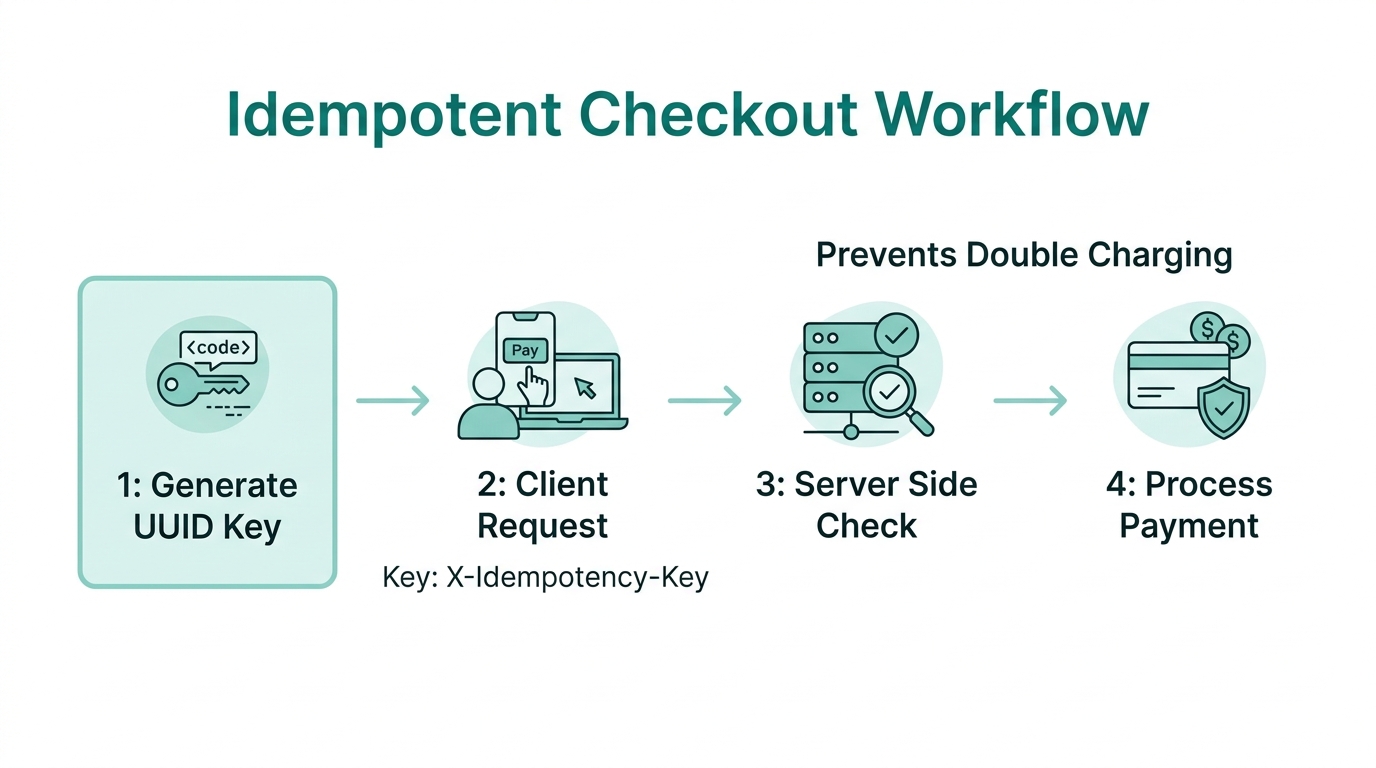
One of the biggest technical hurdles in 2026 is preventing double-billing by AI agents. When an autonomous agent attempts a transaction, network latency can lead to "retry loops" where the agent sends the same purchase command multiple times. To solve this, Shopify’s API 2026-04 update mandates Idempotent Transactions.
An idempotent operation is one that has no additional effect if it is called more than once with the same input parameters. For ecommerce, this means if an AI agent sends an ORDER_CREATE request, Shopify checks for a unique idempotency_key. If that key has already been processed, the system returns the original success message without charging the customer again.
Implementing this requires your developers (or your AI agent) to navigate to the GraphQL header and include the @idempotent directive. This is a "business killer" if ignored—merchants who fail to comply with the 2026-04 mandate are seeing chargeback rates spike as AI agents accidentally order ten items instead of one. Stormy AI can automatically audit your API logs to ensure every transaction includes the mandatory idempotency headers, protecting your merchant standing on platforms like Shopify and TikTok Shop.
Using the Shopify AI Toolkit with Claude Code and Cursor
Maintenance in 2026 is no longer about manual coding; it's about vibe coding and agent orchestration. The Shopify AI Toolkit, released in April 2026, provides a suite of Model Context Protocol (MCP) servers. This allows AI coding agents like Claude Code and Cursor to connect directly to your store's GraphQL schema.
Instead of hiring a developer to fix a broken variant display, you can now use a natural-language prompt: "Claude, connect to my Shopify MCP server, identify why the 'Size' variant is missing in the UCP feed, and push a fix to the live theme."
Playbook for Automated Maintenance:
- Install the Toolkit: Download the Shopify AI Toolkit from GitHub.
- Link your Schema: Connect your store's API credentials to Claude Code. This gives the AI a map of your entire data structure.
- Set Up Autonomous Audits: Ask Stormy AI to trigger a weekly "Health Check" using the toolkit. Stormy will scan for broken links, suppressed listings on Amazon, and missing JSON-LD fields.
- Automate Creative Updates: Connect your Shopify URL to Creatify.ai via the toolkit to automatically generate 10 video ad variations every time a new SKU is added.
The 2026 Performance Benchmarks: ROI of Agentic Commerce
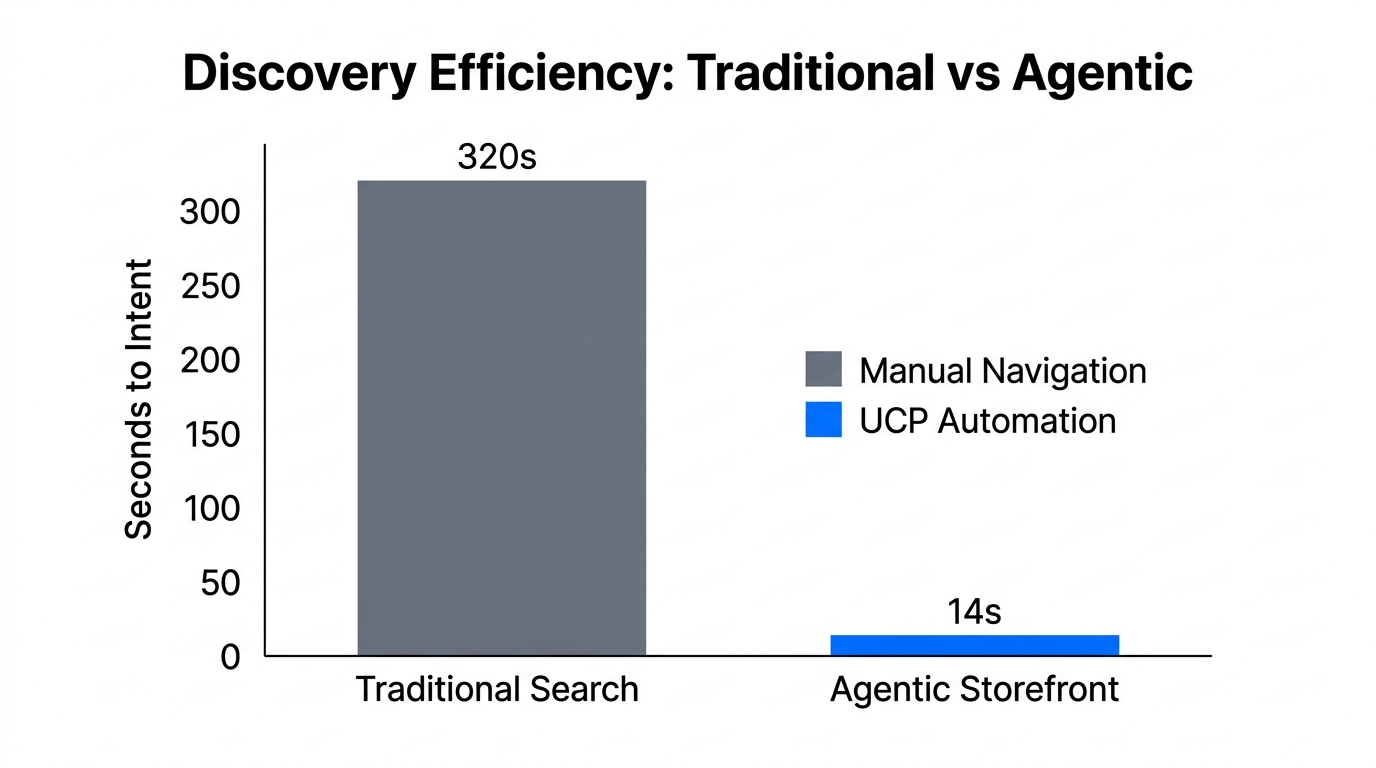
Is the technical investment worth it? The data from Q1 2026 suggests a massive performance gap. According to Cubeo AI, the average conversion rate (CVR) for stores that have NOT optimized for UCP has stagnated at 1.4%. However, the top 10% of performers—those who have fully embraced agentic storefronts—are seeing CVRs of 4.7% or higher.
Ad costs have also skyrocketed, with blended CAC now sitting between $68 and $84 across most niches (Forbes). This inflation makes the efficiency of an AI ecommerce employee vital. While Stormy AI handles the back-office inventory and UCP configuration, your human team can focus on "Reality Validation"—creating the authentic UGC that separates a real brand from "AI slop."
"The arrow of progress is moving toward ambient businesses that run with zero daily human input, managed by agents hiring other agents."
By leveraging tools like Zendrop for rapid fulfillment and Stormy AI for operational autonomy, you can build a high-efficiency enterprise that thrives in the machine-to-machine economy. The era of the human-only storefront is closing; the era of the Agentic Storefront has begun. Ensure your Shopify store is ready to answer the call of the agents before the next API update leaves your brand in the digital dark ages.