Automating Shopify Customer Support with Gorgias and Tidio Lyro: 2026 Setup Guide
Learn how to automate 70% of Shopify customer support using Gorgias AI and Tidio Lyro. This 2026 guide covers training agents, autonomous returns, and CIPA legal risks.
In 2026, the Shopify ecosystem has moved far beyond simple chatbots. We have entered the era of Agentic Commerce, where AI is no longer a bolt-on feature but the core infrastructure of the modern storefront. According to Shopify CTO Mikhail Parakhin, AI adoption among merchants is approaching 100%, driven by the need for unlimited reasoning in every business workflow. For customer support leads, this means a fundamental shift: your job is no longer to manage people answering tickets, but to manage the AI agents that resolve 70% of inquiries autonomously. This guide provides the operational playbook for setting up a world-class support engine using Gorgias AI and Tidio Lyro in 2026.
Gorgias AI vs. Tidio Lyro: Choosing Your 2026 Helpdesk
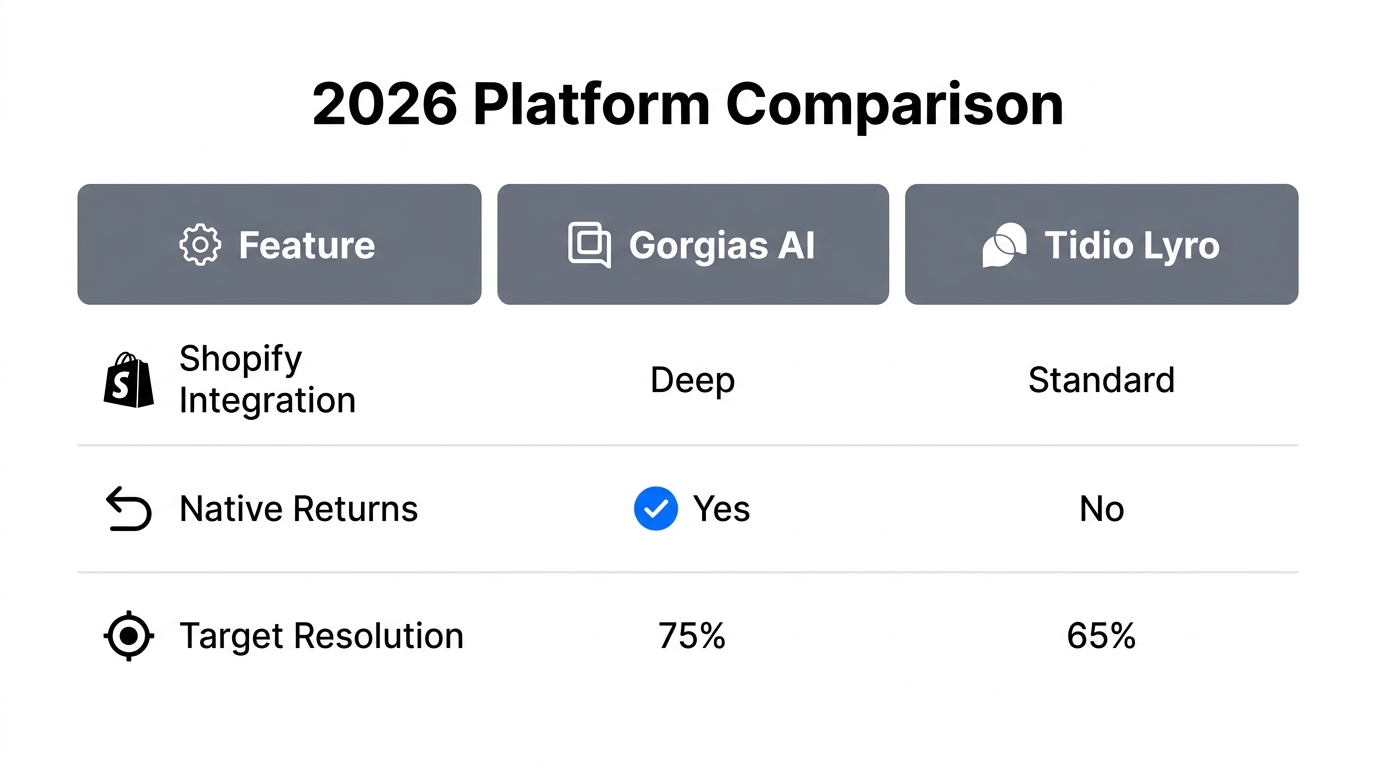
Choosing the right conversational AI depends on your store's volume and technical needs. By 2026, the market has split into the "Enterprise Standard" and the "Mid-Market Leader." While Gorgias offers the deepest Shopify integrations for complex actions, Tidio Lyro has become a favorite for its ease of training and lower price point.
| Feature | Gorgias AI | Tidio Lyro |
|---|---|---|
| Market Position | Enterprise / High-Volume | Mid-Market / Scale-Up |
| Shopify Integration | Native & Deep (Cancellations, Returns) | Operational (Order Status, FAQ) |
| Training Source | Help Center + Ticket History | PDFs + URL Scraping |
| 2026 Pricing | Starts ~$300/mo for AI features | ~$99/mo (AI features) |
| Human Handoff | Advanced Logic/Routing | Simple Chat Interface |
While these tools handle the customer-facing side, many merchants now use an AI ecommerce employee like Stormy AI to handle the back-office coordination. While Gorgias talks to the customer, Stormy is in the background updating your Luca AI finance dashboards or checking inventory in Prediko.
The Anti-Hallucination Playbook: Training AI on Custom Data
The biggest risk in 2026 remains "confidently wrong" AI agents. To prevent your chatbot from promising unauthorized 50% discounts or mislabeling allergens—risks that legal experts warn can lead to brand liability—you must move beyond generic LLM knowledge.
Step 1: Sanitize Your Catalog
Messy product tags lead to "Dirty Data" hallucinations. Use a tool like XgenTech to ensure every product has a structured taxonomy. If your Shopify tags are inconsistent, the AI won't know the difference between "vegan leather" and "real leather," a common failure point for agents in high-volume DTC stores.
Step 2: Upload Custom PDFs and Policies
Tidio Lyro allows you to upload PDFs directly to its brain. Do not just link your website. Instead, upload your internal SOPs, shipping carrier SLAs, and precise return rules. This ensures the AI uses your private truth rather than its public training.
"The top 10 percentile of merchants are growing significantly faster because they treat AI as a daily infrastructure, not a one-off tool." — Mikhail Parakhin, Shopify CTO
Configuring Autonomous Returns and Cancellations
In 2026, "Where is my order?" (WISMO) tickets are solved. The new frontier is Agentic Returns. Gorgias AI can now actually execute actions inside the Shopify Admin, but you must configure the guardrails carefully.
Step-by-Step Configuration:
- Define Eligibility Rules: Set thresholds in your helpdesk (e.g., only allow AI to process returns for orders under $200 and within 14 days).
- Connect Your Returns Portal: Integrate your AI agent with ShipStation or ShipBob. When a customer asks for a return, the AI should generate the label and update the Shopify order status automatically.
- Enable Size Recommenders: To reduce returns before they happen, implement Kiwi Sizing. AI apparel recommenders are proven to reduce return rates by 15-20% in 2026.
When an order is stuck or a shipment is late, Stormy AI acts as the triage layer. While Gorgias handles the customer's frustration, Stormy automatically wakes up to check the supplier's latest spreadsheet, email the warehouse, and update the internal status row so your human team knows exactly why the delay occurred.
Navigating the 2026 Legal Landscape: Avoiding CIPA Risks
The FTC has begun aggressively fining brands for "AI Washing" and privacy violations. One of the biggest risks this year is Zombie Privacy—a term for 1960s-era wiretap laws (like CIPA in California) being applied to modern AI chatbots. If your bot records a session without explicit consent, you are at risk for a class-action lawsuit.
To mitigate this, implement a consent window that triggers before the AI agent begins processing the request. This is particularly important for brands scaling globally, as EU and US regulations have converged around strict transparency for automated decision-making.

Using Stormy AI as Your Back-Office Triage Layer
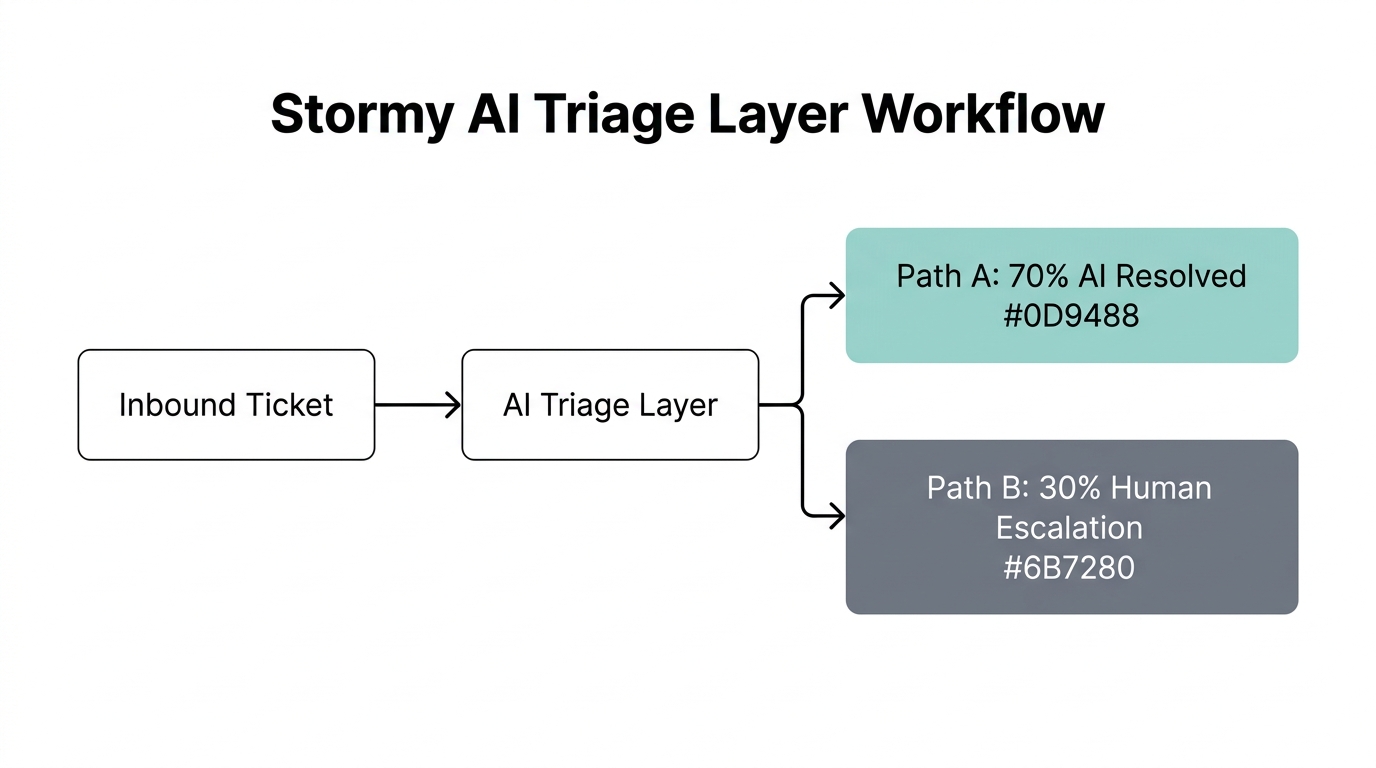
The most efficient 2026 support teams separate the Front-Office (Customer Interaction) from the Back-Office (Ops Execution). This is where Stormy AI excels as your AI ecommerce employee.
Imagine a customer asks Gorgias for an update on a backordered item. Instead of a human support agent having to email the supplier, Stormy AI handles the messy back-office follow-up. Stormy pulls the campaign performance from Meta Ads and Google Ads to see if the item is still being promoted, checks the latest shipment deadlines in your shared spreadsheet, and drafts a polite follow-up to the supplier if they haven't replied. Stormy keeps the operation running while your support agents focus on complex human empathy cases.
"20% of commerce by 2030 will be machine-to-machine. We are already seeing the first wave in 2026 with autonomous support agents talking to autonomous fulfillment bots."
The 90-Day Automation Rollout Playbook
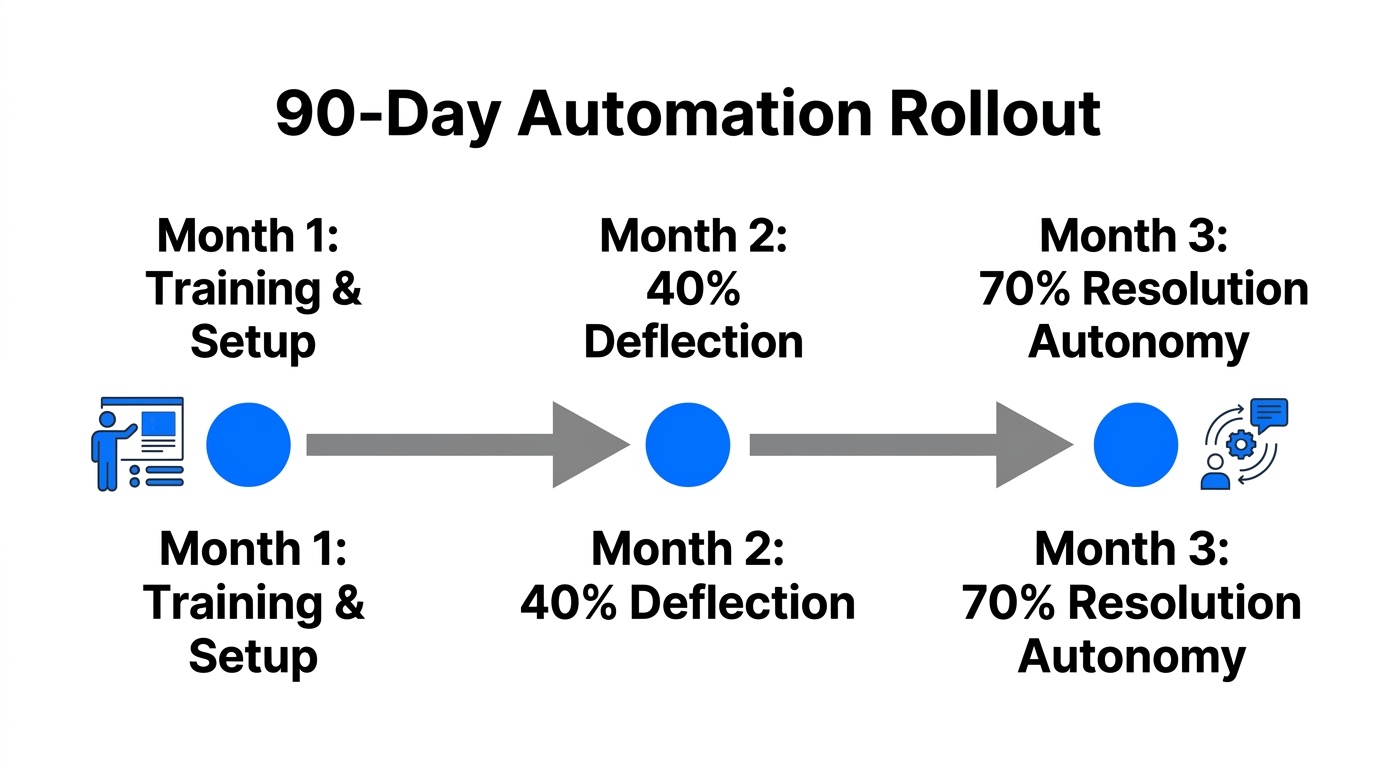
Scaling to 70% automation doesn't happen overnight. Use this phased approach to safely implement AI agents without alienating your customer base.
- Days 1–15: Identify your highest volume, lowest complexity workflow (e.g., "Where is my order?"). Connect Tidio or Gorgias to your Shopify store and set up basic FAQ grounding.
- Days 16–45: Integrate AI rules for autonomous cancellations and returns. Define your approval thresholds and implement size-recommendation tools like Kiwi Sizing.
- Days 46–90: Layer in predictive intelligence. Use Klaviyo's AI to predict churn risk and have your support agent proactively offer solutions to at-risk customers.
By the end of this cycle, your store will be operating on ambient business principles—running with minimal human daily input. While your customer support agents use Gorgias to solve high-value problems, Stormy AI will be in the background, monitoring inventory levels in Prediko and flagging stockout risks before they ever turn into a support ticket.
Conclusion: The Future is Agentic
In 2026, the competitive advantage for Shopify brands is no longer just a better product—it's operational efficiency. By automating 70% of your customer support with tools like Gorgias and Tidio, and using an AI ecommerce employee like Stormy AI to run the messy back office, you can scale your revenue without ballooning your headcount. The transition from manual to agentic commerce is no longer optional; it is the new standard for the "top 10 percentile" of merchants who will own the next decade of retail.