Scaling Your Real Estate Business with OpenClaw CRM: A 2026 Growth Guide
Discover how OpenClaw CRM and agentic AI are transforming real estate in 2026. Learn to automate lead management, admin tasks, and scale your proptech strategy.
By 2026, the real estate industry hasn't just adopted AI—it has been fundamentally reorganized around it. The era of agents spending 70% of their time on administrative back-office tasks is over. We have entered the Agent Economy, where autonomous software agents manage the heavy lifting of lead follow-up, document filing, and market analysis. At the center of this revolution is OpenClaw, an open-source framework that has surpassed 270,000 GitHub stars to become the most significant software release of the decade. For real estate professionals, OpenClaw CRM represents the ultimate growth lever, allowing small teams to operate with the efficiency of massive brokerages without the traditional SaaS tax.
The 2026 Agentic Disruption: Why Real Estate First?
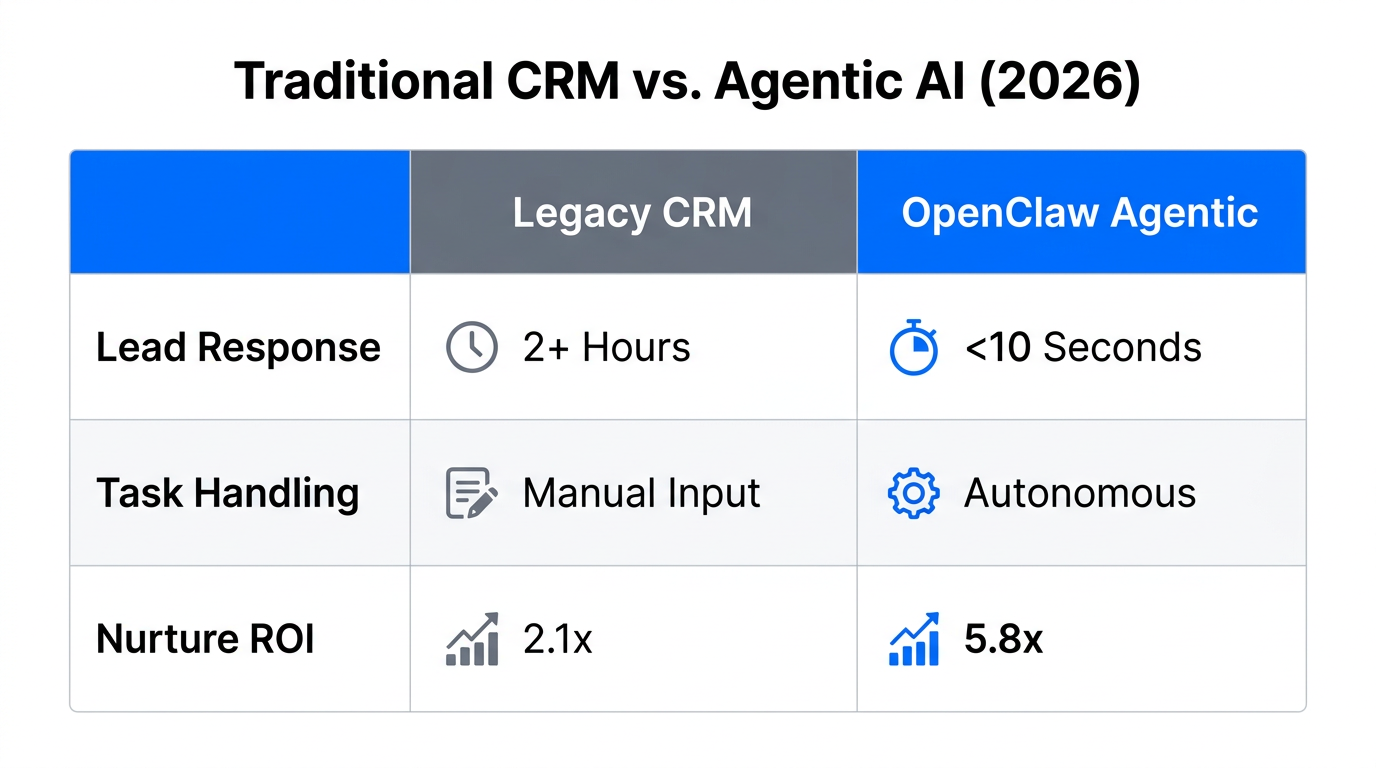
Real estate is uniquely positioned as the first industry to be fully disrupted by agentic systems like OpenClaw. Unlike legacy chatbots that simply answer questions, these agents are designed for execution. According to the Stanford AI Index (2026), agentic systems now complete multi-step research and CRM tasks 3.5x faster than skilled human researchers. In an industry where a 10-minute delay in lead response can decrease conversion by 400%, this speed is the difference between a closed deal and a lost opportunity.
Nvidia CEO Jensen Huang recently hailed OpenClaw as "the single most important release of software probably ever," noting how it shifts the focus from simple text generation to inference-side execution. For a real estate agent, this means your CRM isn't just a database; it's a digital employee that monitors your Gmail, qualifies leads against your criteria in Notion, and updates deal stages without human intervention.
"OpenClaw is the AI that actually does things. It doesn't just write your listing description; it posts it, monitors the leads, and schedules the showings."
Building the 'Homie' Style Automation Stack
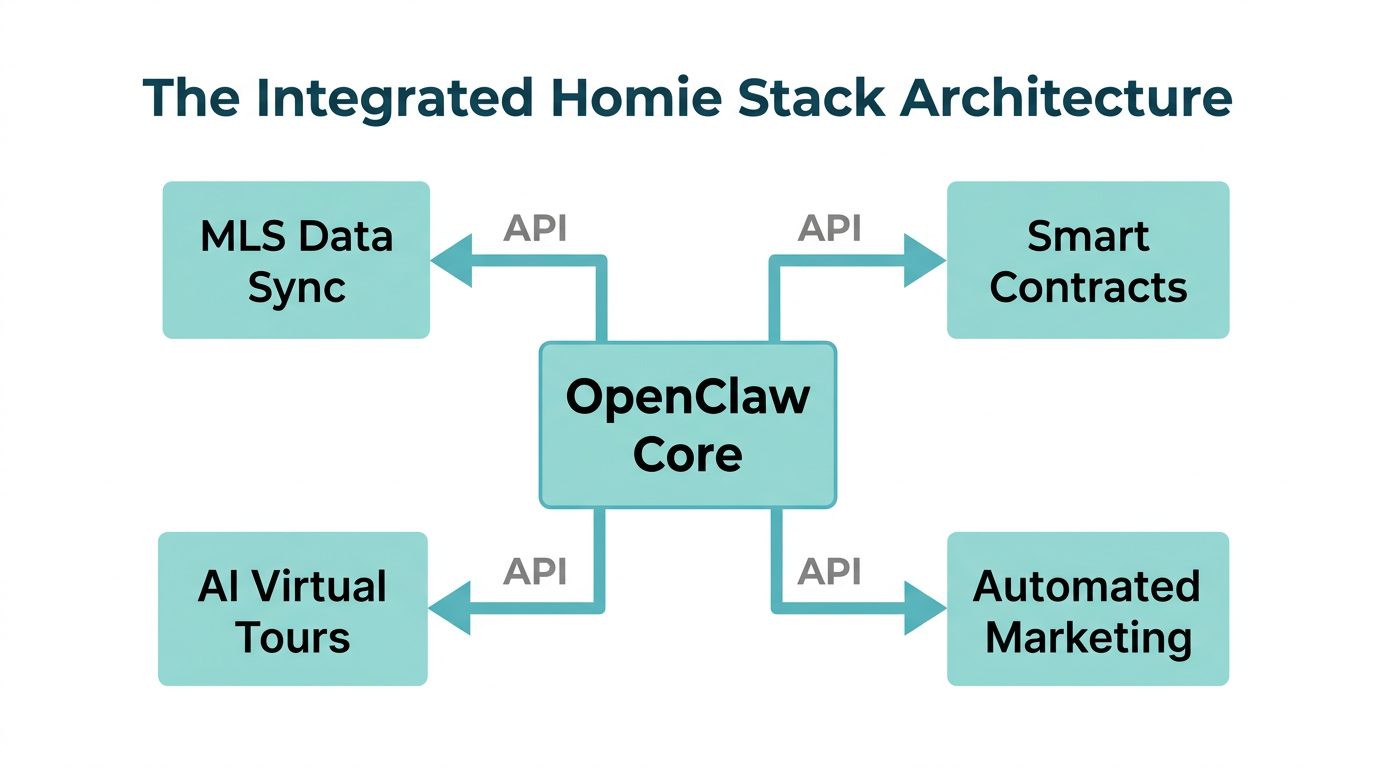
The most successful agencies in 2026 are moving away from monolithic, expensive SaaS platforms in favor of a "Homie" style stack. This strategy involves using OpenClaw as an intelligent middleware layer that bridges specialized tools like Follow Up Boss and kvCORE. By integrating these platforms through an agentic core, you create a unified system where data flows seamlessly between your front-end marketing and back-end operations.
| Feature | Legacy CRM Model | OpenClaw Agentic Stack |
|---|---|---|
| Lead Response | Manual or canned templates | Autonomous, personalized AI follow-up |
| Admin Costs | $200+ per user/month | $10-$20/month (Self-hosted) |
| Data Ownership | Stored in vendor clouds | Local-first (Full privacy control) |
| Task Execution | Requires human clicks | 3.5x faster autonomous execution |
This stack relies on the "B2A" (Business-to-Agent) marketing philosophy. Instead of just optimizing your listings for human eyes, you are now providing data in formats that autonomous agents can parse instantly. Tools like Supabase are often used alongside OpenClaw to provide local-first data storage, ensuring that your client's sensitive financial information never leaves your controlled environment.
Automating the Administrative Burden Without a VA
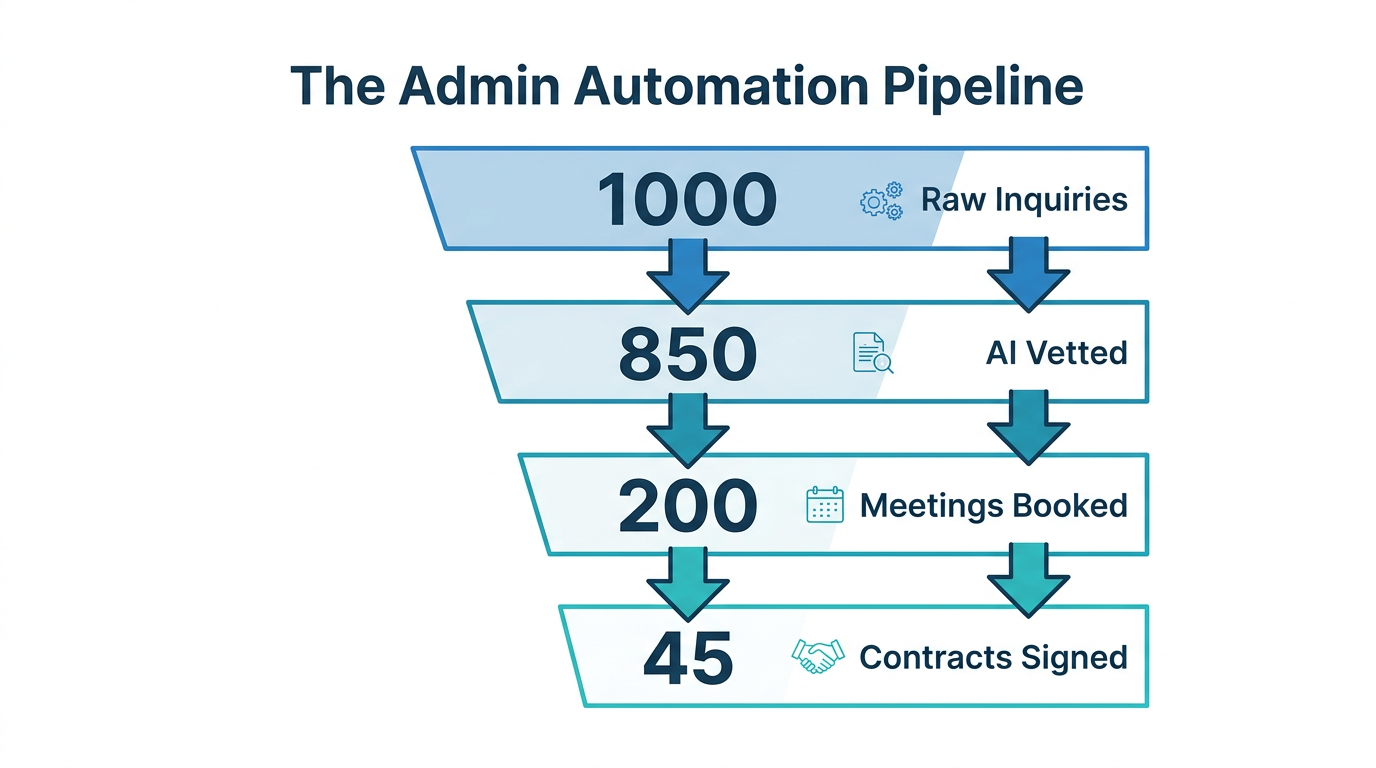
Historically, scaling a real estate business meant hiring more Virtual Assistants (VAs) to handle data entry and calendar management. In 2026, OpenClaw CRM has made this role largely redundant. While platforms like Stormy AI have automated creator outreach and influencer discovery, OpenClaw has done the same for the back office. By configuring an AI agent to handle the low-level administrative grunt work, agents can focus entirely on high-value activities like negotiation and relationship building.
Step 1: Automated Lead Management
Using OpenClaw's ability to monitor messaging channels like WhatsApp or Telegram, you can set up a system that instantly qualifies every lead. The agent analyzes the lead's intent, checks their budget against your current inventory, and either routes them to a human agent or continues the nurturing sequence. Real estate expert Daniel Foch emphasizes that this "unclouding" of the lead funnel allows agents to avoid the heavy subscription fees of legacy lead-gen platforms.
Step 2: Intelligent Document Filing
OpenClaw can be given system-level access via Docker to monitor your downloads folder. When a purchase agreement or disclosure form is received, the agent automatically renames the file according to your SOP, uploads it to the correct transaction folder, and notifies the escrow officer.
"The key to 2026 growth isn't more leads—it's the ability to process the leads you have without increasing your headcount."
The Real Estate 'Skill Spec': Neighborhood Analysis at Scale
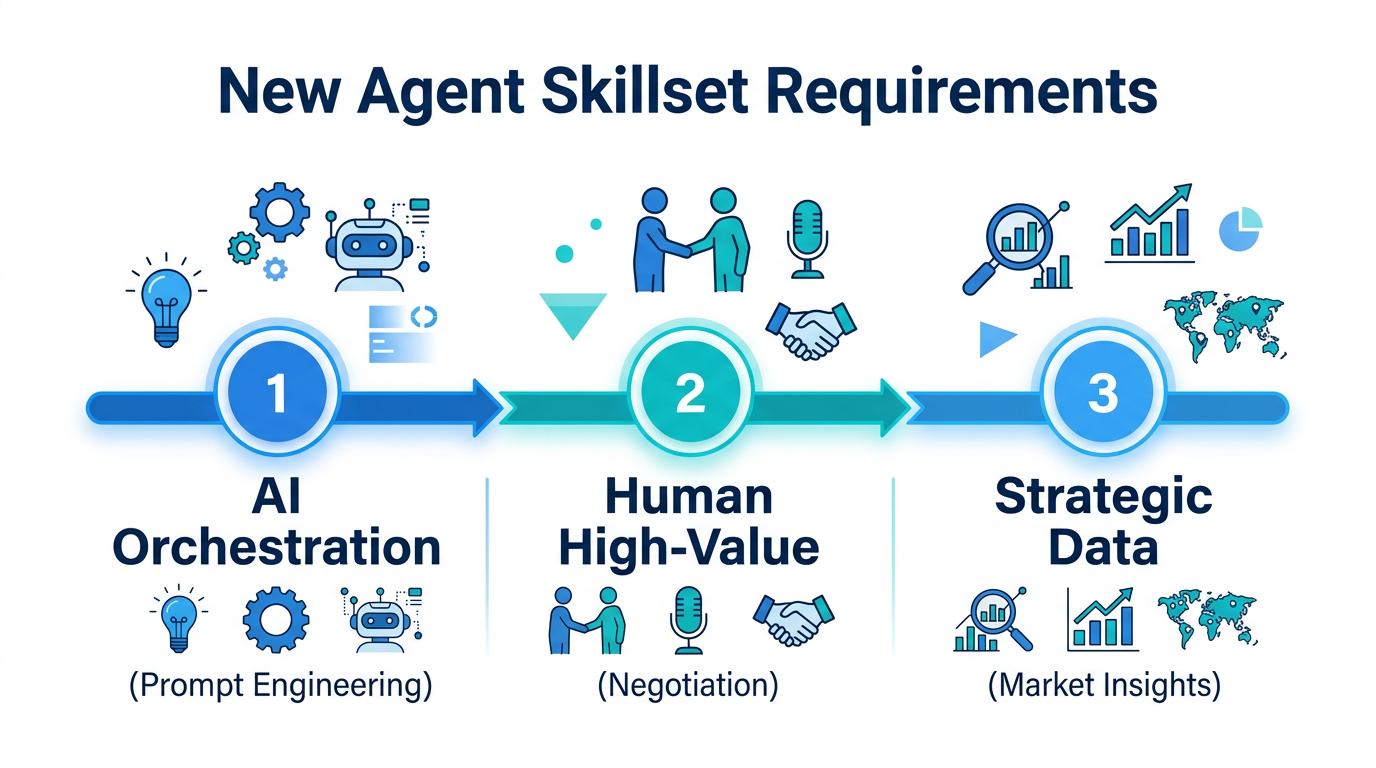
One of the most powerful features of the OpenClaw ecosystem is the ability to use "Skill Files." These are pre-configured templates that give your AI agent specific capabilities. For real estate, this means creating an OpenAPI spec that allows the agent to pull data from property tax records, school district rankings, and recent sales comps instantly.
By dropping a neighborhood-specific skill file into your `config.yml`, your agent can perform complex property research in seconds. For example, if a client asks about the investment potential of a specific zip code, the agent can scrape current market trends, calculate projected ROI, and generate a branded PDF report before you've even finished reading the email.
Privacy and Security: Best Practices for 2026
With great power comes great responsibility. Giving an AI agent root-level access to your business data is a double-edged sword. To scale safely, real estate professionals must adopt a security-first mindset. This starts with moving away from shared cloud environments and toward dedicated, self-hosted instances on platforms like Tencent Cloud Lighthouse or Hostinger.
- Isolate with Docker: Always run your OpenClaw agents in isolated containers to prevent them from accessing files they shouldn't.
- Human-in-the-Loop (HITL): Never allow an agent to send a final contract or sensitive client email without a manual review. As the saying goes, "AI doesn't have a reputation; you do."
- Secret Management: Use environment variables or tools like 1Password to store your API keys rather than keeping them in plain-text configuration files.
When you need to supplement your digital operations with high-quality visual content, such as finding UGC creators for neighborhood tours or property walk-throughs, platforms like Stormy AI provide the perfect discovery engine. You can search for local creators who specialize in real estate content and manage the entire collaboration through an AI-powered workflow that mirrors the efficiency of your OpenClaw setup.
"Security in 2026 isn't about building a wall; it's about building a sandbox where your AI can be productive without being a liability."
The Path to Proptech AI Growth
The transition to automated lead management in real estate is no longer a luxury—it is a survival requirement. By deploying OpenClaw CRM on a private VPS, you are taking ownership of your data and your time. The cost efficiency of this approach, running as low as $10/month for an entire team, makes it the most viable proptech AI growth strategy for the modern era.
Start by identifying your most time-consuming administrative task. Is it responding to Zillow inquiries? Is it organizing property photos? Whatever the bottleneck, there is an OpenClaw skill or agent configuration ready to solve it. In the competitive landscape of 2026, the agents who win won't be those who work the hardest, but those who build the most intelligent systems.