Reducing Customer Acquisition Costs with Photoroom: An AI Photography Playbook for 2026
Learn how to reduce customer acquisition costs in 2026 using this AI product photography playbook. Master Photoroom for ecommerce and mobile-first marketing.
By 2026, the digital marketplace has reached a tipping point where the visual quality of your product catalog isn't just a design choice—it is the primary driver of your financial efficiency. For mobile-first ecommerce entrepreneurs, the battle against rising ad costs is being won or lost in the creative studio. Traditional photoshoots, once the gold standard, have become a bottleneck that inflates overhead and slows down speed-to-market. The solution lies in an AI product photography playbook that leverages tools like Photoroom to drastically reduce customer acquisition costs (CAC) by automating the most expensive parts of the visual supply chain.
The Economics of AI-Driven Visuals in 2026
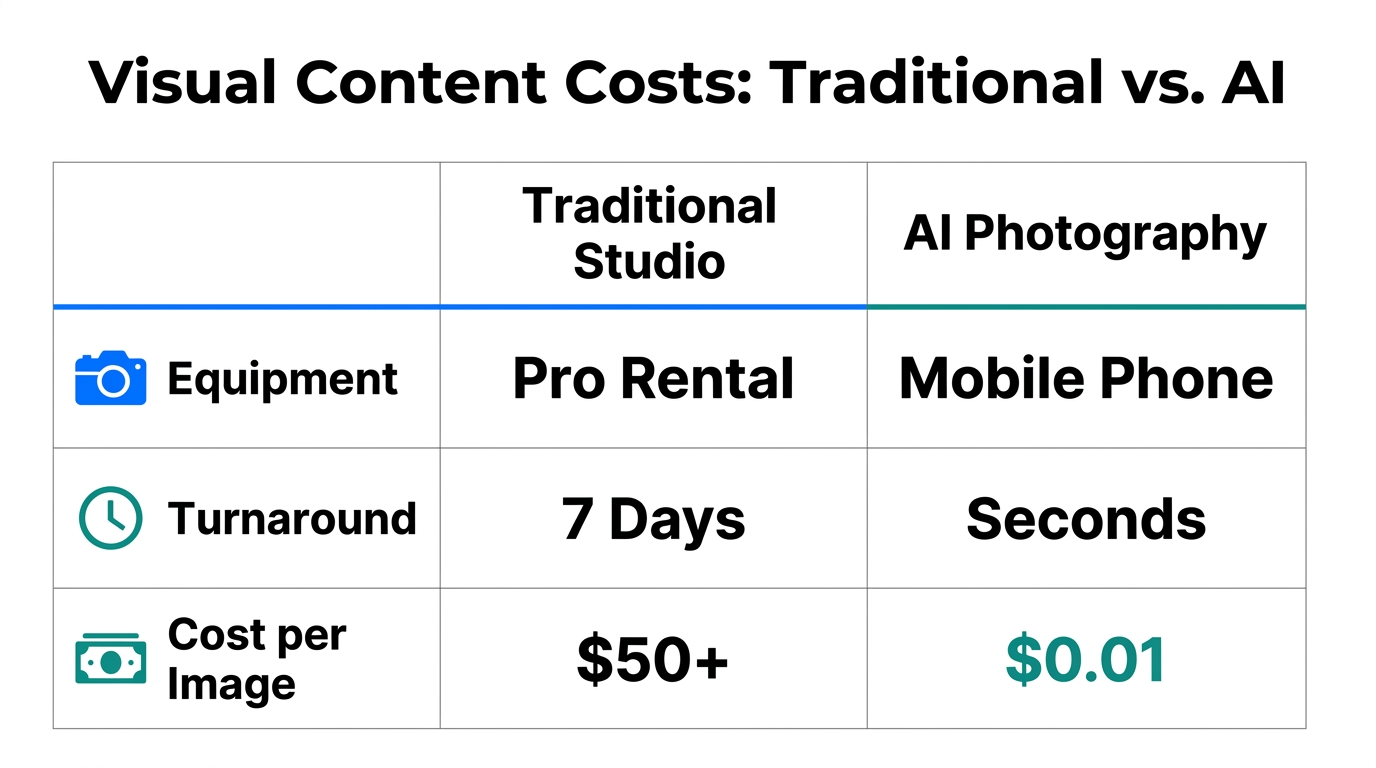
The financial impact of AI on the ecommerce sector is no longer theoretical. Data from reports by Grand View Research suggests that the AI product photography market, which was valued at $450 million in 2024, is on a trajectory to hit $5 billion by 2035. This 24.5% CAGR is driven by a simple reality: brands using AI-driven image production can reduce photography logistics costs by 40% to 90%. By eliminating physical studio rentals, sample shipping, and large on-site crews, startups are redirecting those saved thousands into their Meta Ads Manager budgets, effectively lowering their ecommerce overhead in 2026.
"In 2026, your camera is no longer just hardware; it is a gateway to a generative AI ecosystem that builds high-converting assets in seconds rather than weeks."
Beyond simple cost-cutting, the performance of these images is superior. High-quality visuals are cited by 75% of online shoppers as the most influential factor in their buying decisions, according to research from consumer behavior experts at Salsify. Brands that have successfully integrated professional-grade AI editing via Claid.ai report a 30%–58% increase in conversion rates. When your conversion rate climbs, your CAC naturally falls, making your entire marketing engine more sustainable. Utilizing Pixelcut for rapid design iteration allows small teams to behave like global agencies.
Mobile-First Batch Editing: Scaling with Photoroom
For the modern entrepreneur, the smartphone is the primary workstation. Photoroom for ecommerce has revolutionized the workflow by moving professional-grade retouching from the desktop to the palm of your hand. The most critical feature for 2026 is AI-powered batch editing. Instead of manually removing backgrounds from 500 new SKUs, mobile-first marketing tools now allow you to upload an entire collection and apply uniform background removal, lighting adjustments, and shadows in one tap. This is essential for maintaining a clean, professional aesthetic on platforms like Shopify or Instagram Shop.
| Strategy Phase | Recommended AI Tool | Primary Benefit |
|---|---|---|
| Background Removal | remove.bg | Instantly isolates products for clean listings. |
| Mobile Batch Edits | Photoroom | Processes 100+ images on a smartphone in minutes. |
| Scene Generation | Pebblely | Places products in hyper-realistic lifestyle settings. |
| 3D Visualization | PixCap | Creates interactive 3D assets for higher engagement. |
Uniformity is the silent architect of brand trust. As highlighted by experts at Style3D, consistent lighting and styling across a 1,000+ item store build significantly more credibility than fragmented, amateur photography. When a customer scrolls through your collection and sees a perfectly aligned grid with matching shadows and white balances, their subconscious perception of your brand’s quality skyrockets. This trust translates directly into lower bounce rates and higher lifetime value (LTV).
Integrating AI Visual Optimization for Higher CTR
Paid social advertising is a game of attention. In 2026, static images often struggle to compete with the dynamic nature of short-form video. However, tools like PicCopilot allow you to optimize static product shots specifically for high click-through rates (CTR). By using Generative Scene Placement, you can take a basic product photo and place it in a variety of hyper-realistic environments—such as a skincare bottle on a sun-drenched marble counter—without ever hiring a set designer. This allows for rapid A/B testing of different aesthetics to see which resonates most with your target demographic on TikTok Ads Manager.
To further enhance performance, brands are increasingly pairing these AI-generated product shots with authentic user-generated content. For instance, you might use an AI-optimized image for your main carousel and then find and discover creators on Stormy AI to provide the "social proof" videos that close the sale. This hybrid approach—combining the clinical perfection of Photoroom with the raw authenticity of UGC—is the ultimate formula for reducing customer acquisition costs in 2026.
"The most successful brands of 2026 use AI for the 'perfection' and creators for the 'connection'. Mastering both is the superpower of modern commerce."
A Framework for a Multi-Layered AI Strategy
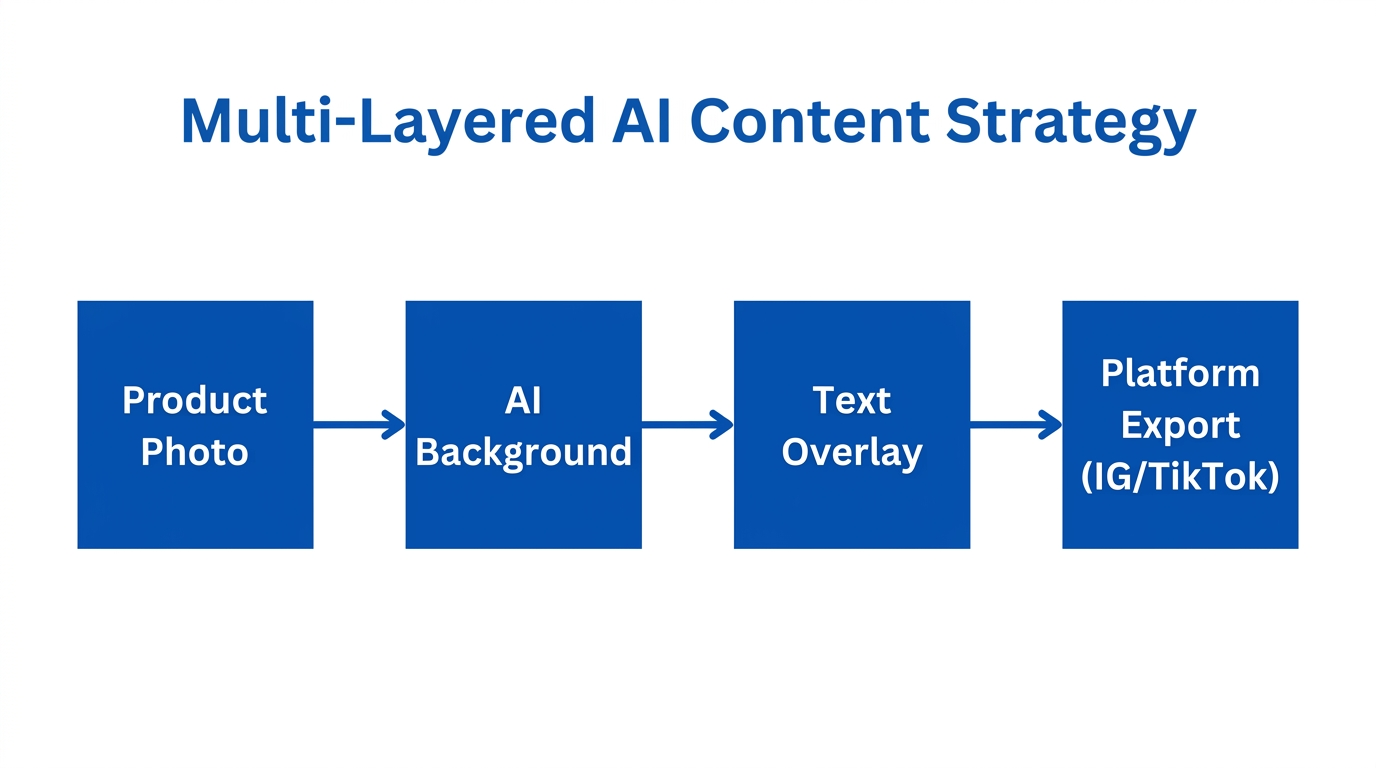
To truly scale, you need a playbook that moves beyond simple filters. A sophisticated AI workflow involves several layers of processing to ensure the final asset is indistinguishable from a high-end editorial shoot. Following this sequence ensures your visuals remain high-resolution and platform-compliant:
- The Base Capture: Use your smartphone to take a high-resolution photo in natural light. Avoid busy backgrounds, but don't worry about perfection.
- Isolation & Cleaning: Use remove.bg or Photoroom to isolate the product. This creates your "master transparent asset."
- Resolution Enhancement: If the original photo was slightly soft, run it through Let's Enhance to upscale the resolution. Marketplace giants like Amazon and Shopify now frequently require 2000px+ for zoom functionality.
- Environment Staging: Use Adobe Firefly or Pebblely to generate a background that matches your brand's seasonal campaign theme.
- Model Integration (Fashion Only): For apparel brands, tools like Botika or Modelia can turn flat-lay photos into realistic on-model images, saving thousands on model fees and hair/makeup stylists.
Common Pitfalls: Avoiding the 'Uncanny Valley'
While AI is powerful, it is not a "magic button" that works without oversight. One of the biggest mistakes seen in 2026 is the "Uncanny Valley" effect, where images are over-processed to the point of looking plastic. This can alienate customers and hurt brand trust. Expert retouchers at Luminar Neo suggest that while AI should handle the heavy lifting, the human eye must ensure that product textures and colors remain 100% authentic to the physical item.
Another critical area is Platform Compliance. Many marketplaces, including the eBay Seller Center, have strict rules against adding text, logos, or watermarks to your main product image. While it’s tempting to use AI to add "Best Seller" badges directly onto your photos for social media, keep your primary marketplace listings clean and compliant to avoid account suppression.
The Future: From 2D to 3D and Beyond
As we look deeper into 2026, the playbook is expanding into 3D Product Visualization. Leading brands like Nike and IKEA are already using AI to create photorealistic 3D assets that customers can rotate or place in their homes via AR. Using platforms like PixCap, even small-scale entrepreneurs can now generate 3D renders from a handful of 2D photos. This level of immersion is the ultimate lowering of ecommerce overhead because it drastically reduces return rates—customers know exactly what they are getting before it arrives at their door.
To stay ahead, entrepreneurs must treat their visual stack as a living ecosystem. Start by mastering Photoroom for ecommerce to handle the daily volume, then gradually integrate advanced tools for campaign-grade art direction. By automating the visual production line, you free up the mental and financial capital needed to innovate, scale, and ultimately dominate your niche in the competitive landscape of 2026.
"The future belongs to the agile. Those who can go from a product idea to a high-converting ad in under 60 minutes will own the market."
The Bottom Line for 2026
The goal of any AI product photography playbook is simple: more sales for less spend. By adopting mobile-first marketing tools and a multi-layered AI workflow, you can slash your creative costs by up to 90% while simultaneously increasing your conversion rates. Whether you are using Photoroom for batch background removal or iFoto for visual optimization, the result is a leaner, more profitable business model. As CAC continues to challenge the industry, pairing these assets with targeted creator partnerships via Stormy AI will be your greatest competitive advantage.