The 2026 OpenClaw and Shopify Playbook: Building Your First Autonomous Digital Employee
Learn how to build a 2026-ready digital employee using the OpenClaw Shopify tutorial. Deploy autonomous AI agents for inventory and support with this practical guide.
In 2026, the definition of a "small business owner" has fundamentally shifted. We are no longer just managing software; we are managing fleets of autonomous digital employees. The shift toward Agentic Commerce has moved from experimental hype to a core operational standard for high-growth merchants. According to research by Mordor Intelligence, the market for agentic AI in e-commerce is estimated at a staggering $60.43 billion this year, driven by the transition from static automation to autonomous reasoning. For Shopify merchants, this isn't just about chatbots anymore; it's about deploying a system that can think, act, and resolve issues without constant human oversight.
The Agentic Landscape: Why OpenClaw in 2026?
As of early 2026, 84% of e-commerce leaders rank AI as their top strategic priority, with a third having fully integrated AI agents into their core operations, as reported by Cubeo AI. While native tools like Shopify Sidekick offer a safe, managed experience, many technical founders are turning to OpenClaw (formerly known as Clawbot) for its sheer power and customization. OpenClaw recently surpassed 247,000 GitHub stars, making it the infrastructure backbone for merchants who want a bespoke "Digital Warehouse Manager" or "Support Lead" [Source: GitHub].
"Just as DevOps reshaped software deployment, AgentOps will reshape AI operations in 2026... managing fleets of AI agents for reliability and compliance." — Joao Moura, CEO of CrewAI
| Feature | OpenClaw (Self-Hosted) | Gorgias/Intercom (Managed) |
|---|---|---|
| Control | Full; open-source and customizable. | Limited to vendor's ecosystem. |
| Setup Time | 2–6 hours (requires technical skill). | 30 minutes (plug-and-play). |
| Cost | ~$50/mo (VPS + API tokens). | $300–$1,000+/mo (Seat + Usage). |
| Best For | Developers, tech-savvy founders. | Mid-market brands, non-tech teams. |
Step 1: Selecting Infrastructure—Oracle Cloud vs. Mac Mini M4
To run a digital employee that works 24/7, you need reliable hosting. In 2026, two primary paths have emerged for the digital employee setup. Many merchants opt for the Oracle Cloud Free Tier (offering 4 OCPU and 24GB RAM), which provides enough horsepower to run local models without a recurring monthly fee. However, for those processing massive amounts of data or concerned about privacy, the Mac Mini M4 has become the gold standard for local hosting at a one-time cost of $599, as noted by Apple and reviewed by Adven Boost.
Regardless of your hardware choice, isolation is non-negotiable. You must run OpenClaw inside Docker containers to prevent the AI from accessing your local file system. This containerization ensures that even if an agent encounters a "hallucination" or a malicious prompt, its reach is limited to the environment you've defined. Systems like Tencent Cloud Lighthouse have also become popular for their streamlined Docker deployments for agentic workloads.
Step 2: The Model Context Protocol (MCP) Bridge
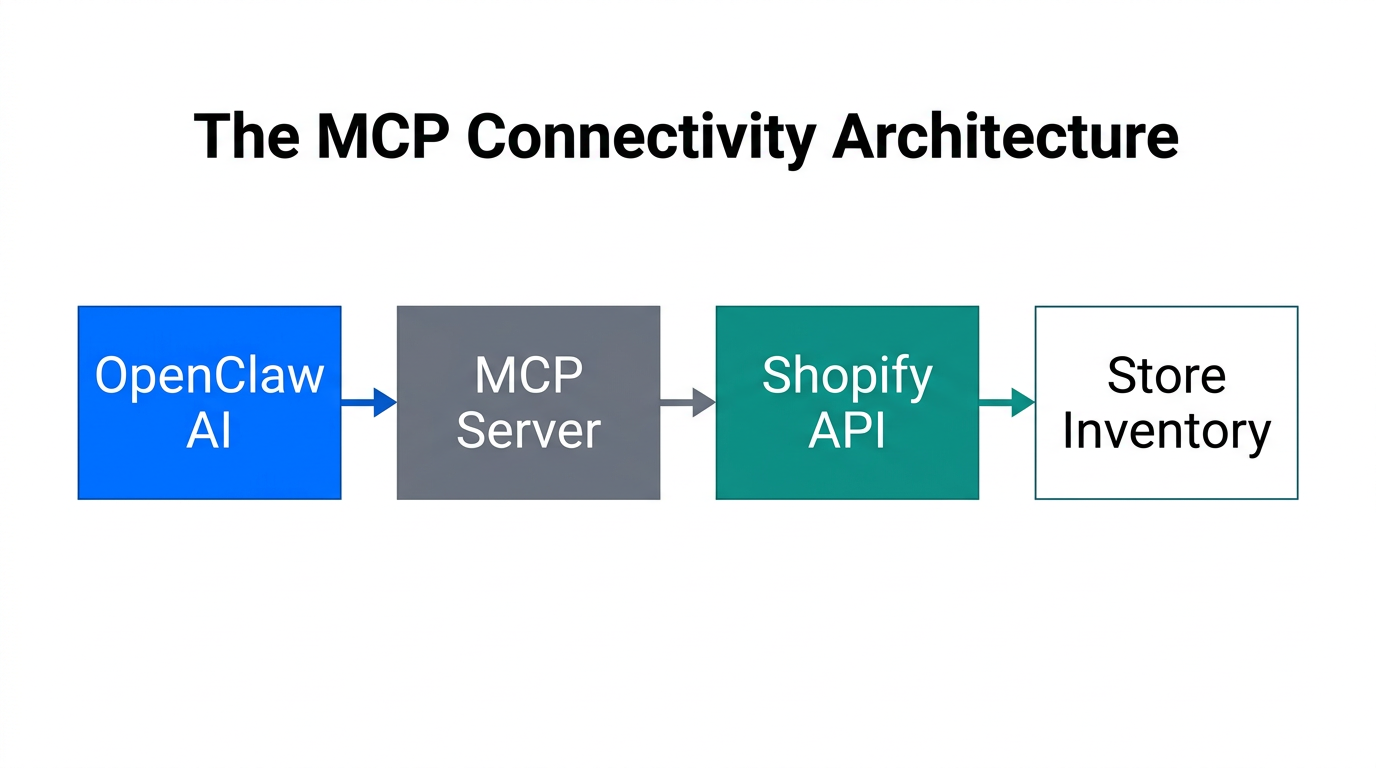
The secret sauce of a successful Composio Shopify integration is the Model Context Protocol (MCP). Think of MCP as the "USB-C for AI." It allows your OpenClaw agent to read inventory levels, access order history, and modify product listings without you having to write a single line of custom API code. By installing the Composio plugin, you grant your agent a secure window into your store's brain.
To connect your store, you’ll typically use a configuration block like this in your OpenClaw environment:
{ "plugins": { "entries": { "composio": { "enabled": true, "config": { "consumerKey": "ck_your_key" } } } } }This simple bridge allows your agent to perform complex queries, such as "Find all orders from the last 24 hours that haven't shipped and check if the items are in the East Coast warehouse." This level of autonomous reasoning is what separates a 2026 digital employee from a 2024 automated script.
Step 3: The 'Safety First' Implementation
A shocking 76% of businesses fail in their AI journey because they attempt to automate customer-facing marketing agents before stabilizing their back-office tasks. According to discussions in the r/Solopreneur community, "hallucination public surface area" is a real threat. If an agent hallucinates a 90% discount code to a customer, it’s a PR disaster; if it miscalculates an internal stock transfer, it’s a fixable internal error.
Start your building AI agents for business journey with low-risk, high-impact tasks:
- Inventory Sync: Cross-referencing Shopify stock with third-party logistics (3PL) providers.
- Invoice Matching: Using OpenClaw to scan incoming PDFs and match them against purchase orders.
- Carrier Selection: Optimizing shipping costs. Brands like Doe Beauty have saved $30,000 per week by letting AI agents dynamically reroute orders during network congestion, as highlighted by Stormy AI.
"2026 is the 'Year of the Builders,' where AI agents handle the complexity of the back-end, allowing merchants to focus solely on brand identity." — Harley Finkelstein, President of Shopify
Step 4: Configuring the 'Thumb-Up' Approval Workflow
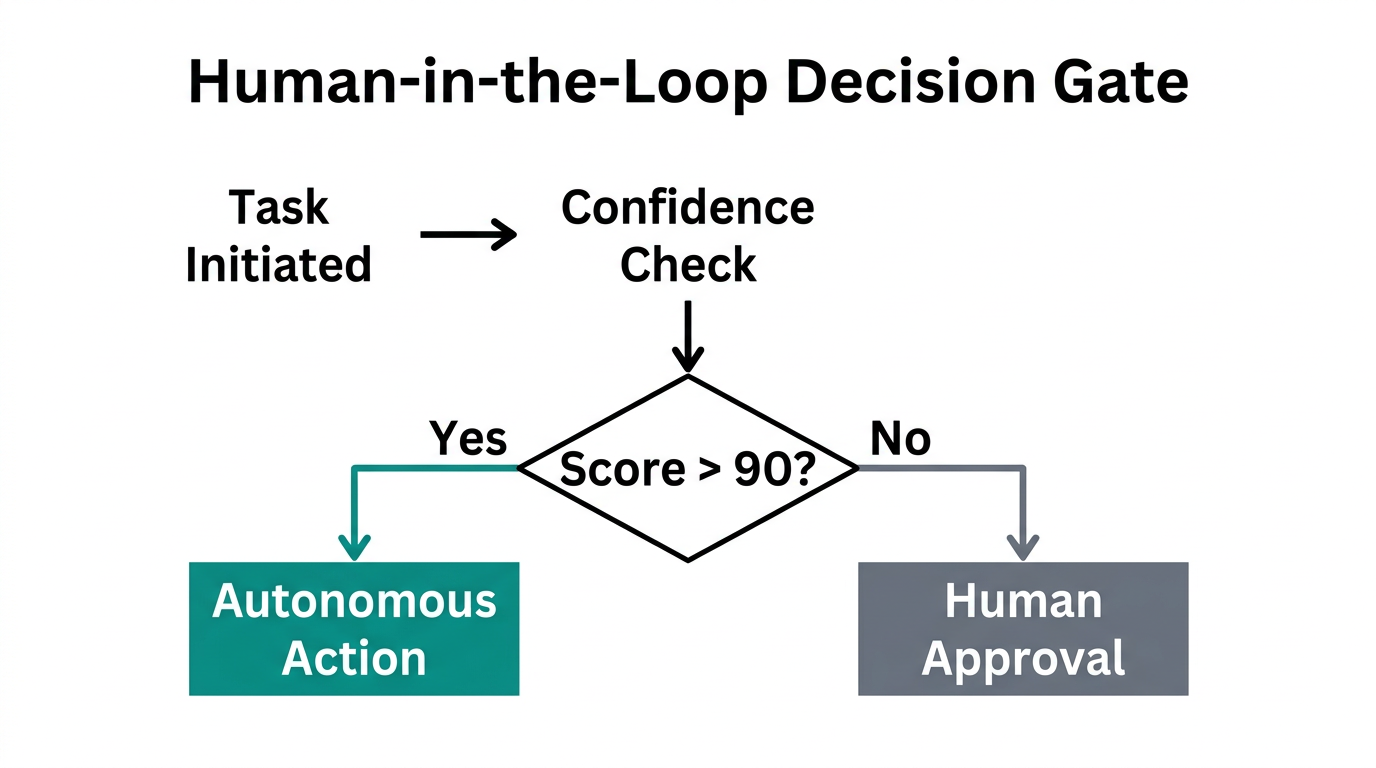
To maintain control over your digital employee, you must implement a human-in-the-loop (HITL) system. For sensitive logic—like issuing a refund over $50 or deleting a product variant—your agent should be configured to send a message to a Slack or Telegram bridge. This allows you to manage your business with a simple "thumbs up" emoji reaction.
While tools like eesel AI provide zero-hallucination support layers, OpenClaw requires you to define these boundaries manually. By setting up a triage system, the agent monitors all store signals but waits for human verification before executing high-risk actions. This hybrid approach significantly reduces the risk of unmonitored API costs, which can exceed $400 overnight if an agent gets stuck in a recursive loop using premium models like GPT-5, according to SentiSight.
Step 5: Addressing the 'ClawJacked' Security Crisis
In early 2026, the e-commerce world was rocked by the "ClawJacked" crisis (CVE-2026-25253). As reported by Immersive Labs, this vulnerability allowed malicious websites to hijack locally running OpenClaw agents via WebSocket hijacking. For a non-technical founder, this is the digital equivalent of leaving your warehouse keys in the front door lock.
To secure your agentic infrastructure, follow these three rules:
- Disable Local File Access: Use the
--no-local-file-accessflag when running your OpenClaw instance. - Audit Your Plugins: Avoid downloading "Skills" from unverified repositories. Research shows that 7.1% of third-party skills on public hubs contain malicious payloads like "Atomic Stealer" malware.
- Rotate API Keys: Use a secrets manager like HashiCorp Vault rather than hardcoding keys into your Docker environment.
Conclusion: From One Agent to a Fleet
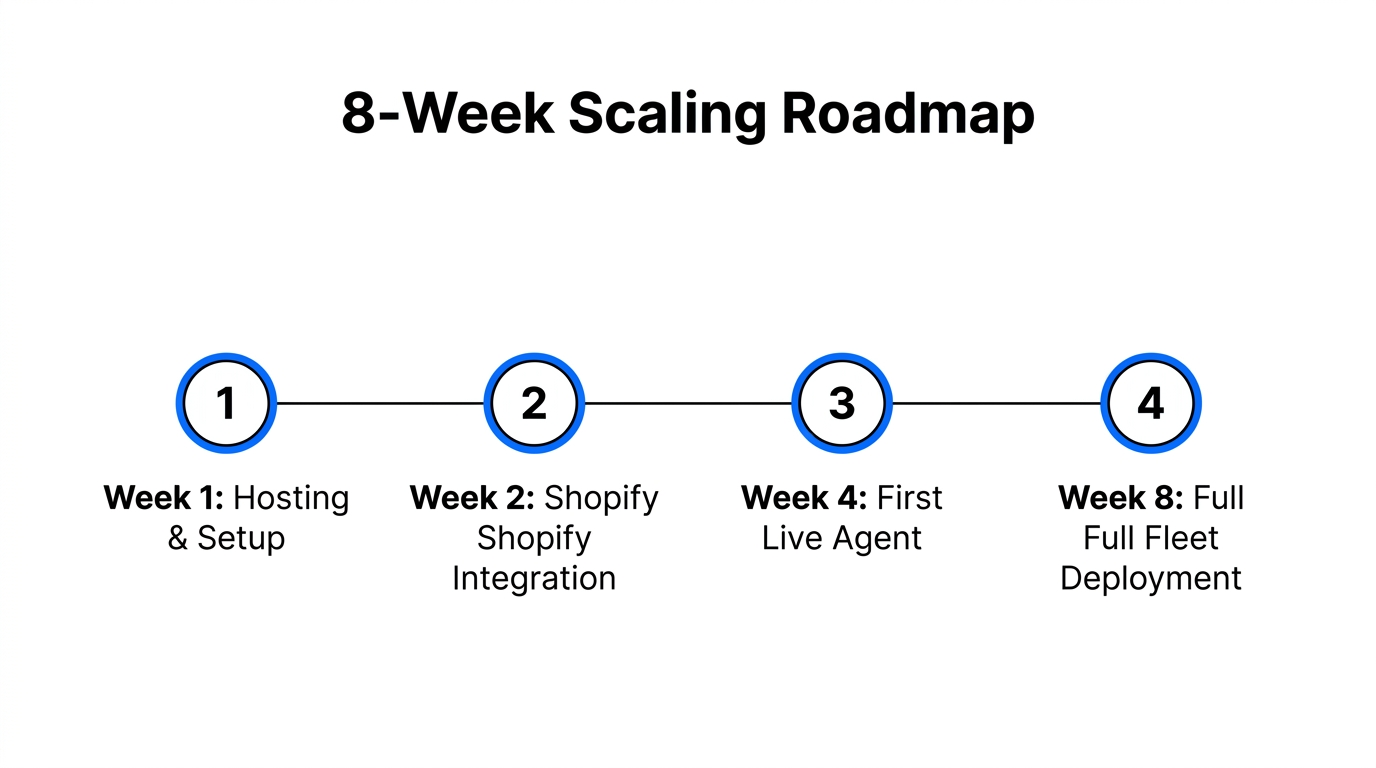
Building your first digital employee using the OpenClaw Shopify tutorial is just the beginning. As your agent stabilizes, you can begin to branch out into customer-facing roles or marketing automation. For example, while OpenClaw manages your warehouse, you can use Stormy AI to deploy an autonomous agent that discovers, outreaches, and follows up with influencers on a daily schedule—fully automated.
The successful merchant of 2026 is no longer the one who works the hardest, but the one who builds the best systems. By leveraging the Model Context Protocol ecommerce standards and maintaining a safety-first implementation, you can reclaim your time and focus on the one thing AI can't replicate: your brand's unique vision and identity. Are you ready to hire your first digital employee?