Mastering Gorgias and AI Automation to Scale Customer Experience for Shopify in 2026
Learn how to leverage Gorgias AI automation and Zipchat AI to automate 90% of support tickets, improve Shopify customer retention, and scale LTV in 2026.
The e-commerce landscape in 2026 has officially moved past the era of reactive support. As we navigate this year, the integration of AI into the Shopify ecosystem has transitioned from an experimental 'nice-to-have' to the fundamental engine of growth. According to recent data from Shopify, there has been an 11x increase in AI-driven orders and a 7x rise in AI-originated traffic since the start of last year. For merchants, this shift means that customer experience is no longer a cost center—it is a retention machine. In a world where 78% of consumers demand AI-driven personalization, according to Salesforce research, the brands winning the market are those mastering tools like Gorgias and Zipchat AI to deliver instantaneous, hyper-relevant service.
The Rise of Agentic Commerce and 2026 Consumer Expectations
In 2026, we are witnessing the full-scale emergence of Agentic Commerce. This represents a shift from static tools to autonomous AI agents that don't just 'assist' but actually 'execute.' These agents, powered by deep integrations with platforms like Shopify Magic, are now capable of checking inventory, finding specific product variants, and even completing checkouts autonomously on behalf of the user.
"AI is now a baseline expectation for operational efficiency. We are moving toward Declarative Commerce, where merchants state their goals and AI manages the execution." — Tobi Lütke, Shopify CEO
The consumer of 2026 is less patient than ever. With 64% of shoppers expecting AI assistance during their journey, as noted in the Zendesk CX Trends Report, the speed of resolution is the primary driver of Shopify customer retention. If a customer has to wait more than five minutes for a 'Where is my order?' (WISMO) response, you aren't just losing a ticket—you're losing a lifetime value (LTV) opportunity. Brands that utilize Gorgias AI automation are seeing resolution rates skyrocket because the AI can access live tracking data and respond in milliseconds.
Automating 90% of WISMO Queries with Gorgias and Zipchat AI
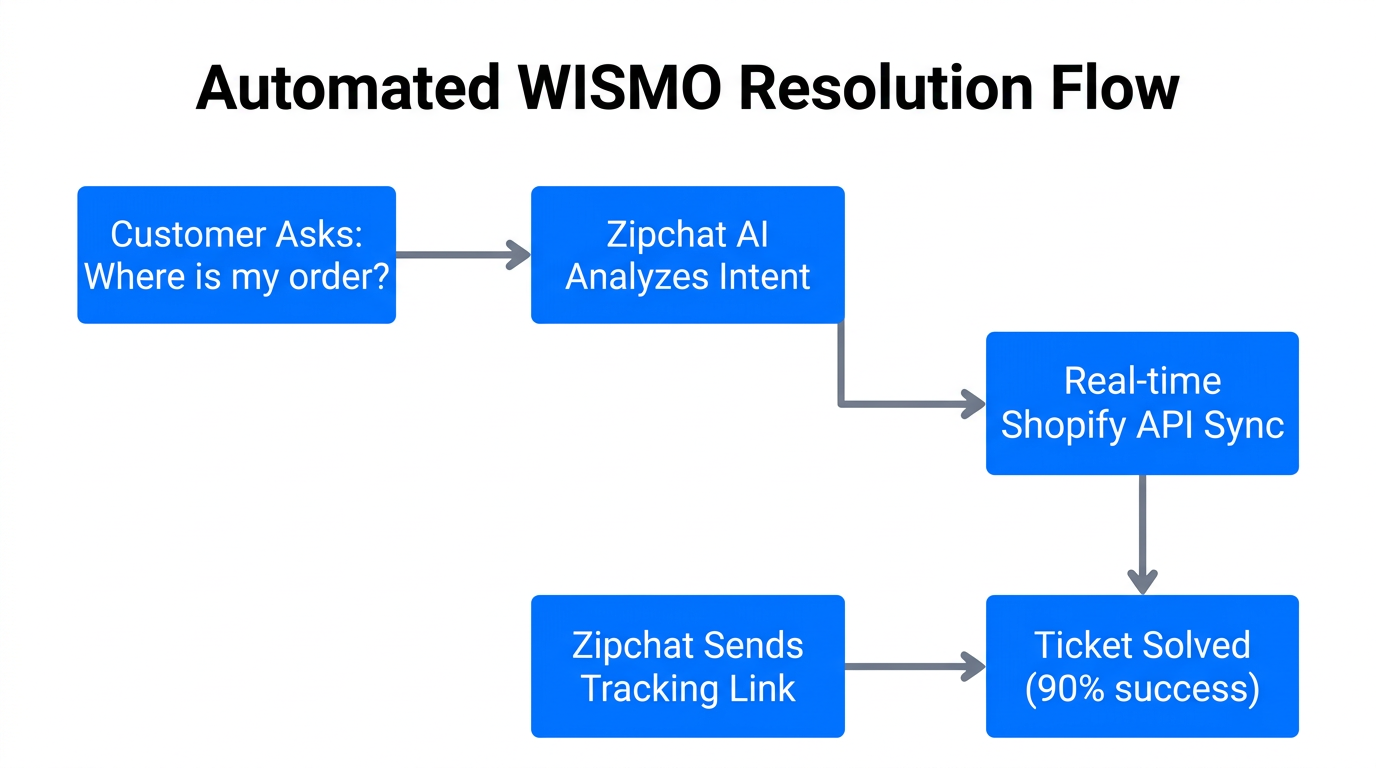
The most common drain on support resources is the repetitive 'Where is my order?' query. In 2026, ecommerce support automation has reached a point where AI can now resolve up to 93% of these customer questions without any human intervention. By combining the ticketing power of Gorgias with the conversational prowess of Zipchat AI, merchants can create a seamless support loop.
Why Zipchat AI for Shopify?
While Gorgias handles the backend ticket management, Zipchat AI Shopify integration acts as the front-end 'brain.' It uses advanced natural language processing to understand the nuance of a customer's frustration. Instead of a robotic 'Your order is in transit,' Zipchat can provide context: 'I see your order is currently in Chicago and should arrive by Thursday. Would you like me to send a SMS update once it’s out for delivery?'
- Instantaneous Tracking: AI agents pull live data from 3PLs like ShipBob to provide real-time updates.
- Automated Order Tracking 2026: Modern systems use predictive delivery windows based on current weather and logistics data.
- RTO Reduction: Tools like Shipway work alongside AI to reduce 'Return to Origin' rates by proactively messaging customers about failed delivery attempts.
By automating 90% of these low-value tasks, your human agents are freed up to focus on high-impact sales conversations and complex problem-solving, which are the real drivers of brand loyalty. This is where you can use Stormy AI to find creators who can produce authentic UGC explaining your shipping process, further reducing support friction before the customer even buys.
Case Study: How The Ridge Processes 60% of Tickets via AI
One of the best examples of gorgias ai automation in practice is the accessories brand, The Ridge. As an industry leader, The Ridge recognized that scaling meant removing the bottleneck of manual ticket handling. By implementing sophisticated AI agents that pull live Shopify data, they now process 60% of their support tickets entirely through AI.
| Metric | Before AI Automation | With Gorgias & AI Agents (2026) |
|---|---|---|
| WISMO Resolution Time | 4-6 Hours | < 10 Seconds |
| Human Agent Workload | 100% of Tickets | 40% of Tickets |
| Customer Satisfaction (CSAT) | 82% | 94% |
| Return Processing Time | 2 Days | Instant (Automated) |
Sean Frank, CEO of The Ridge, notes that AI transforms the entire team into 'data scientists.' Instead of spending hours on manual data entry, the team uses AI to analyze Shopify reports instantly, identifying patterns in returns or product defects before they become widespread issues. This proactive approach is the cornerstone of Shopify customer retention in 2026.
"AI agents have turned our support staff from ticket-closers into brand ambassadors. We don't just solve problems; we use the data AI gives us to prevent them." — Sean Frank, CEO of The Ridge
Building a 'Human-in-the-Loop' Returns Process
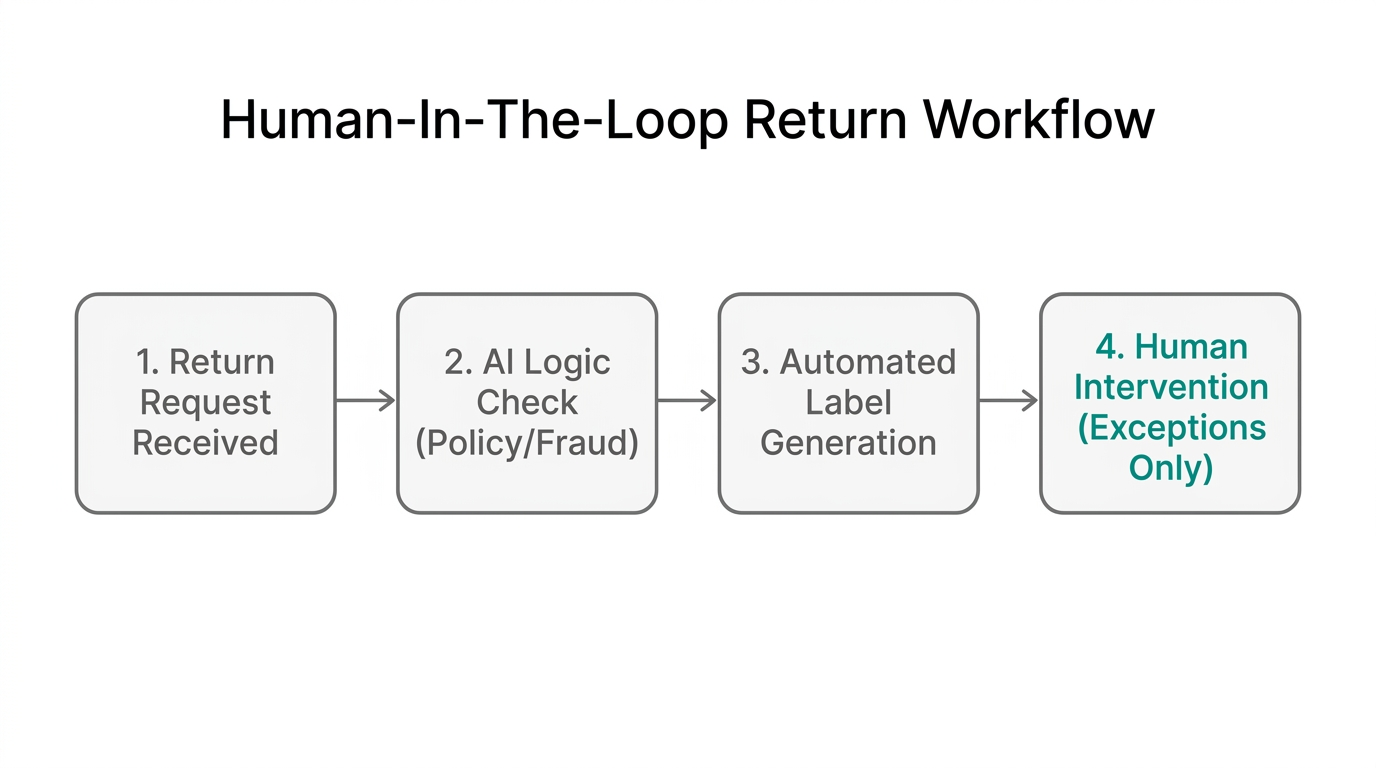
While speed is essential, 2026 has also taught us the dangers of over-automation. Total reliance on AI can lead to a 'cold' brand experience. In late 2025, several major retailers, including Klarna, shifted their strategy to re-introduce humans for complex quality control after finding that 100% AI support struggled with high-value, nuanced disputes.
A 'Human-in-the-Loop' (HITL) model ensures that your brand maintains its soul. Here is how to structure it:
- Tier 1: AI Auto-Pilot. AI handles WISMO, simple exchanges, and address changes. It generates return labels instantly via Order Fulfillment Guru.
- Tier 2: AI Triage. AI analyzes the sentiment of a ticket. If a customer is clearly upset or the order value is over $500, the AI tags the ticket for 'Priority Human Review' in Gorgias.
- Tier 3: Human Concierge. A human agent takes over for high-stakes resolutions, such as damaged luxury items or complex warranty claims, providing the empathy and nuance that AI cannot replicate.
By using Shopify Flow, you can set up automated logic that triggers these escalations. For example, if a customer mentions 'disappointed' or 'legal' in their query, the AI stops responding and alerts a senior support lead immediately.
Predictive Inventory and Autonomous Checkout Execution
Beyond support, AI is revolutionizing how Shopify merchants manage stock. In 2026, we are using Predictive Inventory Allocation. Instead of waiting for a product to sell out, AI analyzes social media trends, local weather patterns, and historical data to decide where stock should live before orders are even placed.
Tools like MESA and Alloy Automation allow for multi-app fulfillment workflows that sync inventory across urban micro-fulfillment centers. This ensures that a customer in New York can receive their package via next-day delivery, meeting the high standard set by robotic warehousing and 'Chuck' robots from 6 River Systems.
Step-by-Step AI Implementation Playbook
- Audit Your Data: AI is only as good as its data. Clean up your SKU names and ensure your inventory records are consistent across all warehouses to avoid AI 'hallucinations.'
- Set Up Smart Routing: Use Order Fulfillment Guru to automatically route orders to the warehouse nearest the customer, saving up to 20% on logistics costs.
- Implement Predictive Reordering: Configure Shopify Flow to trigger alerts when sales velocity spikes, ensuring you never face a stockout on high-demand items.
- Integrate Your Tech Stack: Avoid tech silos. Ensure your support platform (Gorgias), your AI agent (Zipchat), and your automation engine (Make.com) are all sharing the same data pool.
"The future of fulfillment is invisible. AI ensures the product is there before the customer even knows they want it, and the support is there before they have to ask."
Conclusion: Scaling Retention in the AI Era
Scaling a Shopify store in 2026 requires a relentless focus on removing workflow friction. By mastering gorgias ai automation and leveraging conversational tools like zipchat ai shopify, you aren't just cutting costs—you are building a foundation for Shopify customer retention that is impossible for competitors to beat through manual labor alone.
Remember that the goal of ecommerce support automation isn't to replace humans, but to empower them. As AI handles the 90% of mundane tasks, your team can focus on building the community and brand identity that keeps customers coming back. To fuel that growth even further, consider how Stormy AI can help you source the creators who will tell your brand's story to the right audience, while your AI-powered backend handles the rest.
The era of 'standard' customer service is over. Welcome to the era of autonomous, personalized, and hyper-fast commerce. The merchants who embrace these tools today are the ones who will dominate the market in 2026 and beyond.