Automating EDI and Drop Ship Orders: Using Logicbroker with ShipStation in 2026
Scale your drop shipping with this 2026 Logicbroker ShipStation tutorial. Automate EDI 850/856/810 workflows for Wayfair, Walmart, and Macy's to end manual entry.
In 2026, the gap between a growing e-commerce brand and a household name is often defined by a single acronym: EDI. As major retailers like Wayfair, Macy's, and Nordstrom expand their drop ship programs, the demand for instantaneous, error-free data exchange has reached a fever pitch. For many founders, the journey into big-box retail begins as a dream but quickly turns into a logistical nightmare of 'swivel chair' data entry—manually copying orders from vendor portals into shipping software. However, by bridging ShipStation with Logicbroker, brands are now automating the entire lifecycle of retail fulfillment. This allows lean teams to act like enterprise giants, while an AI ecommerce employee handles the messy back-office monitoring, ensuring that every EDI document is filed and every inventory level is synced without human intervention.
The EDI Mandate: Why 2026 Requires Automation
Electronic Data Interchange (EDI) is no longer an optional tech stack for high-growth brands. According to recent 2026 market data, the logistics automation market is projected to reach $67.14 billion this year, with the retail and e-commerce vertical accounting for 35.6% of that growth. Retailers use EDI as a standardized language to communicate with thousands of suppliers simultaneously. Without EDI ecommerce automation, you are forced to navigate the 'extranet' of each individual retailer, a process that is not only time-consuming but fraught with the risk of chargebacks.
When you partner with a retailer like Walmart or Target, they don't just want your product; they want your data. They require specific documents to move in a precise sequence. If you miss a deadline for an Advanced Shipment Notice (ASN) or send an invoice with a 10-cent discrepancy, you won't just get a phone call—you'll get a financial penalty. This is why 2026's most successful brands are moving away from manual portals and toward an integrated drop ship shipping software strategy.
"2026 is the year of AI enablement. We are moving from manual dashboards to autonomous orchestration where the software is the decision-maker, not just the printer."
Understanding the Big Three: EDI 850, 856, and 810
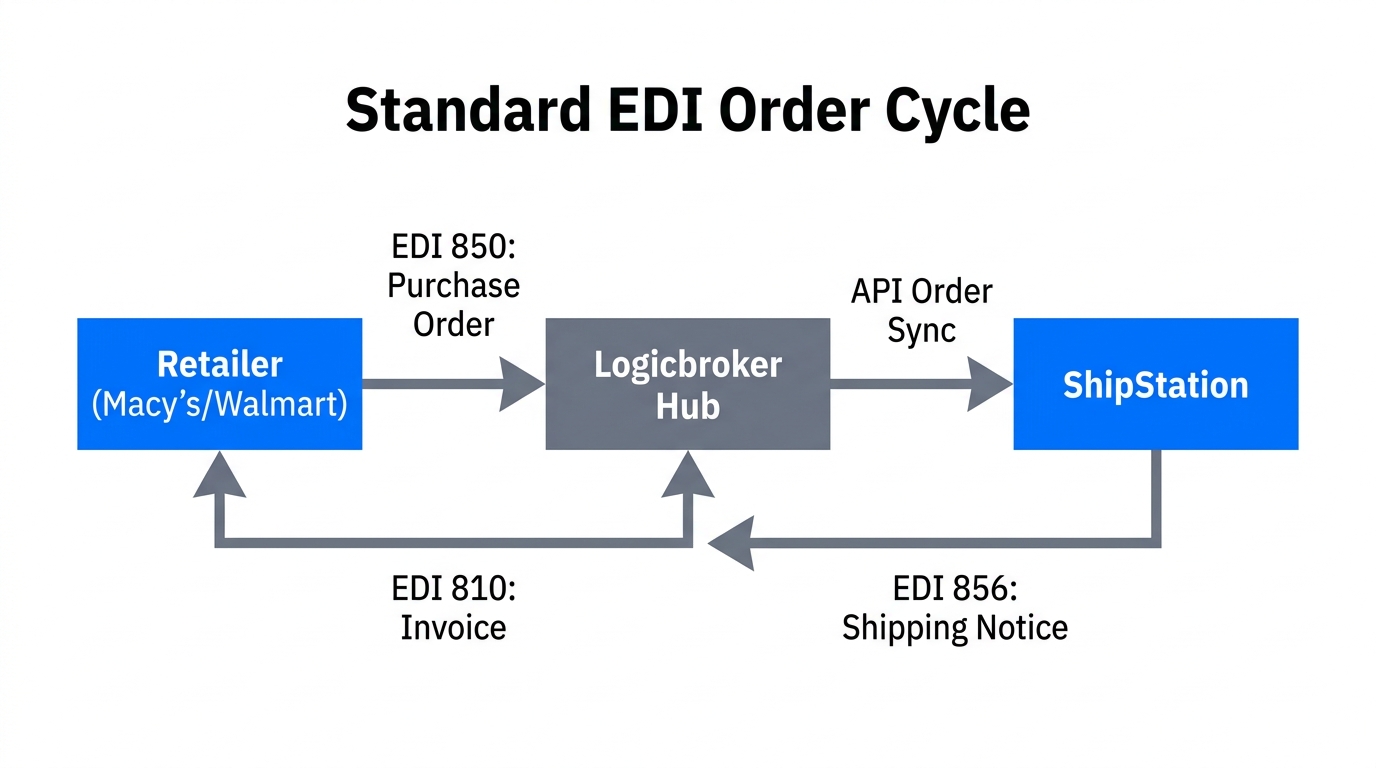
To master the Logicbroker ShipStation tutorial, you must first understand the three core documents defined by GS1 standards that keep the retail world turning. These documents represent the 'conversation' between your brand and the retailer.
- EDI 850 (Purchase Order): This is the retailer telling you that a customer has placed an order on their site. In a manual world, you'd download this as a PDF. In an automated world, Logicbroker receives this 850 and instantly pushes it into ShipStation as a new order.
- EDI 856 (Advanced Shipment Notice/ASN): This is the most critical document for compliance. It contains the tracking number and carrier details. Once you click 'Ship' in ShipStation, Logicbroker pulls that data and sends the 856 back to the retailer, triggering the 'Your order has shipped' email to the end customer.
- EDI 810 (Invoice): This is how you get paid. Once the 856 is confirmed, an 810 is automatically generated and sent to the retailer's accounting department.
By automating these three documents, you eliminate the risk of 'fat-fingering' a tracking number. Stormy AI can sit on top of this workflow, monitoring for any 850s that haven't been acknowledged or 856s that are pending, escalating issues before they become vendor scorecard strikes. You can even ask Stormy AI to pull a weekly report from your shared workbook to see which retailers are your most profitable after chargebacks.
Connecting Logicbroker to the ShipStation API
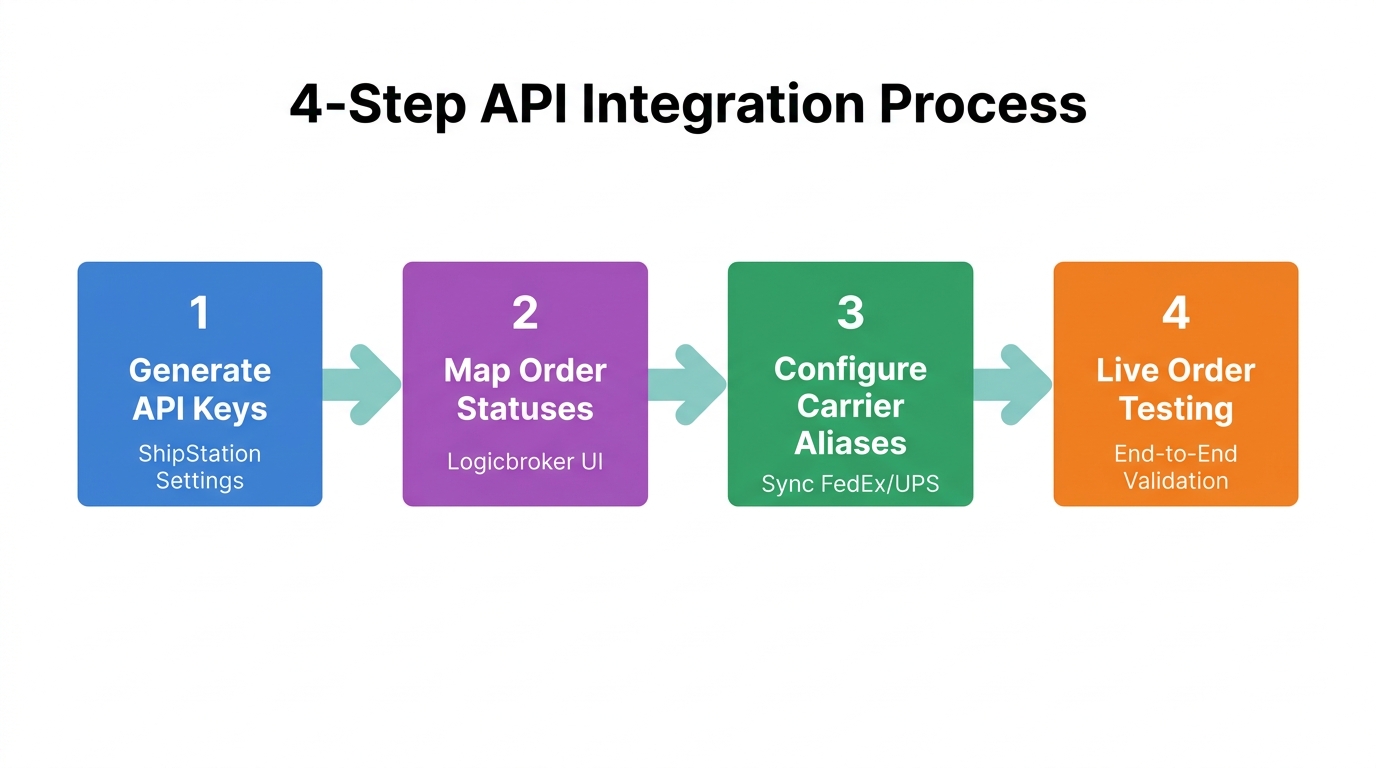
The magic happens through a lightweight API connection. Unlike legacy ERP implementations that take months, the Logicbroker and ShipStation integration can often be live in 2-6 weeks. This connection turns ShipStation into your order fulfillment command center, centralizing all inbound retail orders alongside your Shopify or Amazon sales.
Step 1: Obtain Your API Credentials
In your ShipStation account, navigate to Settings > Account > API Settings. You will need to generate your API Key and API Secret. This is the 'handshake' that allows Logicbroker to push orders and pull tracking data via the ShipStation API.
Step 2: Map Your Retailer Stores
Inside Logicbroker, you will create a unique Store ID for each retailer (e.g., 'Wayfair_DropShip' or 'Macy_EDI'). When an order flows from Wayfair into ShipStation, it will appear under that specific store, allowing you to apply automation rules tailored to that retailer's shipping requirements.
| Feature | Manual Portal Entry | Logicbroker + ShipStation |
|---|---|---|
| Order Entry Time | 5-10 Minutes | Instant (Automated) |
| Tracking Updates | Manual Swivel-Chair | Real-time via API |
| Inventory Sync | Daily Spreadsheet Upload | Automated EDI 846 |
| Chargeback Risk | High (Human Error) | Near Zero |
Automating Inventory Updates (EDI 846) to Prevent Chargebacks
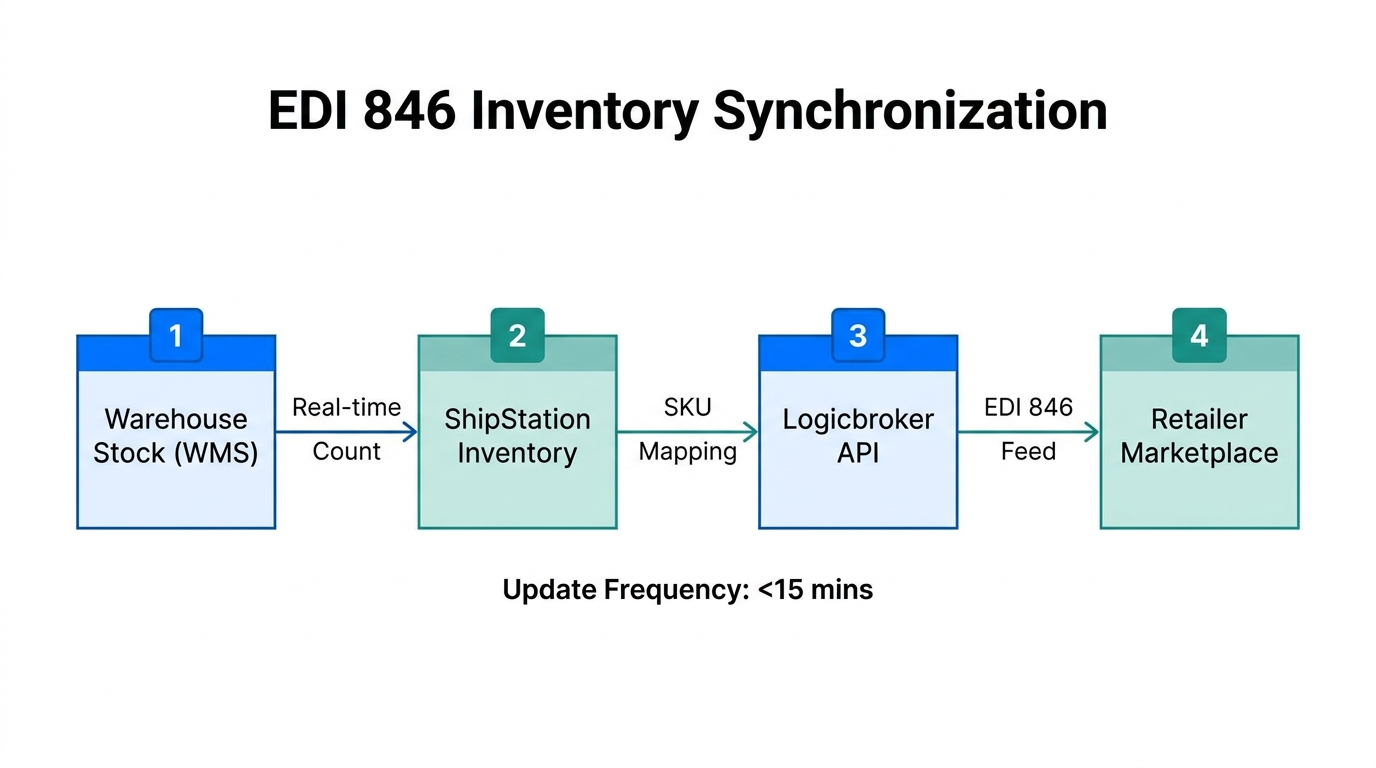
One of the fastest ways to lose a retail partnership in 2026 is to accept an order for a product that is out of stock. Retailers like Walmart and Target treat stockouts as a major failure. To prevent this, you must utilize the EDI 846 (Inventory Advice) document.
Logicbroker pulls your latest inventory levels from your warehouse or Shopify and broadcasts them to all your retail partners. This ensures that if you only have 5 units of a best-selling SKU left, the retailer's website updates before the 6th person tries to buy it. An AI employee excels here—it can monitor these 846 transmissions, flag stockout risks in your supplier spreadsheet, and even automatically draft restock POs when levels dip below a certain threshold.
"The 'Delivery Expectations Gap' is real—60% of consumers want free 2-day shipping, but only 35% of retailers can do it without losing money. Automation is the only way to close that gap." [Source: Forrester Research]
Generating Retailer-Compliant Branded Packing Slips
When you drop ship for a major retailer, the customer shouldn't know you exist. They bought from Wayfair; they expect a Wayfair experience. This means you cannot include your own branded 'Thank You' note or a Shopify packing slip. You must use branded packing slips that feature the retailer's logo and return policy.
Using ShipStation's advanced automation rules, you can set a rule that says: "If Order Source is Wayfair, use Packing Slip Template 'Wayfair_Standard'." This ensures that your warehouse team never accidentally sends a Nordstrom box to a Macy's customer. Logicbroker can even provide the raw data needed to generate these PDFs on the fly, keeping you 100% compliant with 2026 retail standards.
Case Study: How Dell Hudson Designs Saved 6 Hours Daily
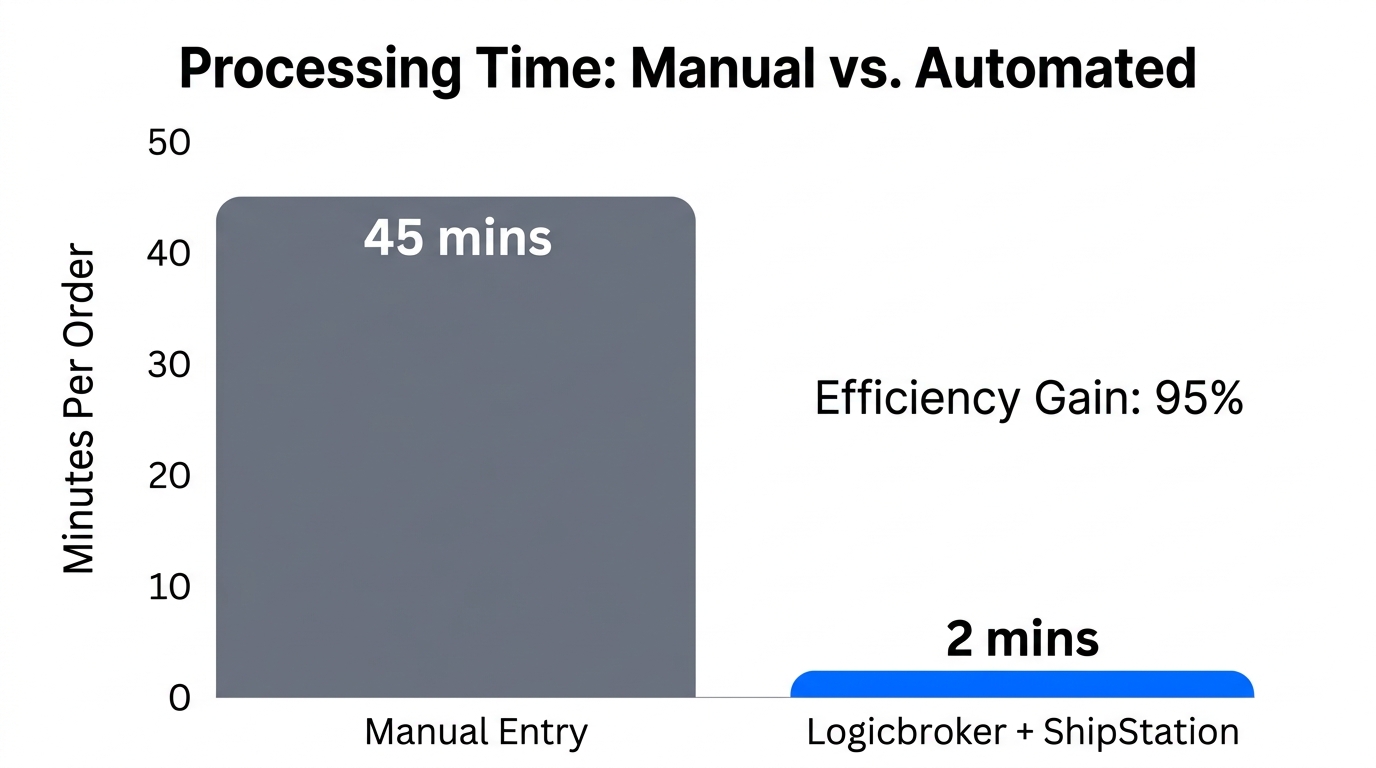
Before implementing the Logicbroker and ShipStation integration, Dell Hudson Designs, a high-end furniture manufacturer, was trapped in a manual cycle. Their COO was spending six hours every single day logging into Wayfair's portal to data-enter orders and upload tracking numbers. On weekends, the backlog grew even worse, leading to shipping delays and costly chargebacks.
After switching to an automated Wayfair EDI integration, the results were transformative:
- Data Entry Eliminated: Manual order entry dropped from 6 hours to zero.
- Compliance: Chargebacks related to tracking errors were completely eliminated.
- Scalability: The brand was able to add multiple new channels like Hayneedle and Amazon without hiring additional headcount.
By automating the back office, the team was able to reallocate their time to revenue-generating tasks like product design and marketing, rather than clerical work. Today, Stormy AI could take this a step further by triaging the few remaining manual support tickets and monitoring carrier performance to ensure Dell Hudson's vendor scorecard remains perfect.
The Future of Retail Fulfillment: Agentic AI in 2026
As we move through 2026, the definition of "automation" is shifting. It is no longer enough to have rules that say "If X, then Y." The rise of Agentic AI means your shipping software is becoming a decision-maker. Features like ShipStation Intelligence now evaluate carrier performance in real-time, automatically switching from UPS to a regional carrier if a specific hub is experiencing weather-related delays.
This is where an AI ecommerce employee like Stormy AI becomes your most valuable teammate. While Logicbroker moves the data, Stormy watches the exceptions. If a supplier email arrives mentioning a delay, Stormy can update the status in your master spreadsheet, notify the retailer via the Logicbroker portal, and draft a polite follow-up to the supplier—all before you've even opened your laptop for the day.
"Intelligence is the new decision layer. It’s no longer about who has the cheapest label, but who has the most resilient data-driven workflow."
Conclusion: Taking the Leap into Automated Retail
Automating your EDI and drop ship orders isn't just about saving time; it's about de-risking your growth. In the competitive landscape of 2026, a single week of manual errors can result in being 'de-listed' from a major retailer. By combining the EDI power of Logicbroker with the fulfillment agility of ShipStation, you create a foundation that can scale from 50 to 5,000 orders a day without breaking.
Ready to reclaim your time? Start by auditing your current manual touchpoints. If you're spending more than 30 minutes a day in a vendor portal, it's time for an integrated solution. And if the thought of managing another tool feels overwhelming, remember that you don't have to do it alone. An AI teammate like Stormy AI can handle the messy back-office ops, keeping your spreadsheets updated and your suppliers in check while you focus on building the next great e-commerce brand.