5 Klaviyo AI Features Every Ecommerce Founder Must Automate in 2026
Discover 5 essential Klaviyo AI automation features for 2026. From Smart Send Time to AI subject lines, learn how to boost ecommerce ROI with these tactical wins.
In 2026, the gap between high-growth brands and those struggling to stay afloat is no longer just about product quality—it is about execution speed and personalization at scale. According to research from McKinsey, companies that excel at personalization generate 40% more revenue from those activities than their average competitors. For ecommerce founders, the "batch and blast" era of email marketing is officially dead. Today, the platform of choice for sophisticated brands, Klaviyo, has evolved into an AI-driven marketing copilot that handles the heavy lifting of optimization while you sleep.
Automation is the primary engine behind this growth. Data from Klaviyo indicates that automated email flows generate 30x more revenue per recipient than standard manual campaigns. However, simply having a "Welcome Flow" is no longer enough. To win in 2026, you must leverage the specific AI-powered tools within the Klaviyo ecosystem that provide immediate ROI with minimal manual oversight. This article provides a tactical checklist of the five Klaviyo AI features you must automate today to maximize your retention and lifetime value (CLV).
1. Smart Send Time (SST) Optimization: Personalized Delivery
One of the most common mistakes in email marketing is sending a campaign to your entire list at a fixed time (e.g., Tuesday at 10:00 AM). This ignores the fact that your customer base is likely spread across time zones and has vastly different digital habits. Smart Send Time (SST) Optimization uses machine learning to analyze when individual subscribers are most likely to open and engage with your content.
Instead of guessing, Klaviyo smart sending runs an initial test on your list to gather data and then automatically adjusts the delivery for every single recipient. This ensures your message lands at the top of their inbox exactly when they are scrolling. This tactical shift is critical for maintaining high deliverability scores and maximizing open rates without requiring a strategist to manually segment by time zone.
"The key to retention in 2026 is moving away from global schedules and toward individual behavioral rhythms. If they shop at midnight, your email should be there at midnight."
2. AI Subject Line Assistant: Outperforming Human Copy
The first hurdle of any email campaign is the subject line. Even the best offer will fail if the email is never opened. The AI subject line generator within Klaviyo is no longer just a gimmick; it is a high-performance tool that analyzes your brand's historical data to identify which keywords and emotional triggers actually drive clicks for your specific audience.
By using the AI Subject Line Assistant, you can instantly generate dozens of variations based on your campaign goals—whether that is urgency, curiosity, or a direct offer. Marketers using AI are 46% more likely to exceed their goals because these tools identify patterns that human eyes often miss. For example, the AI might find that your audience responds 20% better to emojis in the afternoon but prefers plain-text subject lines in the morning.
| Feature | Manual Approach | AI-Automated Approach |
|---|---|---|
| Send Time | Fixed time for all users | Smart Send Time (SST) per user |
| Subject Lines | Guessing based on intuition | AI-Generated from historical data |
| Product Selection | Static manual selection | Dynamic AI Feeds based on behavior |
| A/B Testing | Manual setup and analysis | Autonomous AI Feedback Loops |
3. Dynamic Product Feeds: 'Products You May Also Like'
Static product displays are a relic of the past. To drive significant revenue, your emails must feel like a personalized storefront. Klaviyo’s Dynamic Product Recommendations allow you to insert personalized blocks that show items based on a user’s specific browsing and purchase history on platforms like Shopify or BigCommerce.
According to Klaviyo Benchmarks, AI-powered product recommendations lift email click-through rates (CTR) to 3.75% on average, while top performers can see spikes up to 8.79%. This automation ensures that if a customer just bought a pair of running shoes, the next email they receive doesn't show them the same shoes, but rather the matching socks or a GPS watch they previously viewed.
4. Automated A/B Testing: Letting AI Handle the Feedback Loop
Manual A/B testing is often the first thing busy founders abandon. It requires constant monitoring, statistical analysis, and manual implementation of the winner. Klaviyo’s Automated A/B Testing removes this friction by handling the entire cycle autonomously within your flows.
David Visser, CEO of Zyber, predicts that 2026 will be the year AI handles the "heavy lifting" of execution. By setting up automated tests for your subject lines, button colors, or even CTA phrasing, the AI can divert traffic to the winning variant in real-time. This creates a self-optimizing revenue machine that improves every day without any additional input from your team. This is particularly effective when combined with traffic driven from UGC campaigns, where tools like Stormy AI can help you find the right creators to funnel high-intent users into these optimized flows.
"AI-driven segments, such as predictive churn and CLV models, can increase revenue per recipient by up to 45%." — Raleon
5. Exclusion Group Logic: Maintaining Brand Integrity
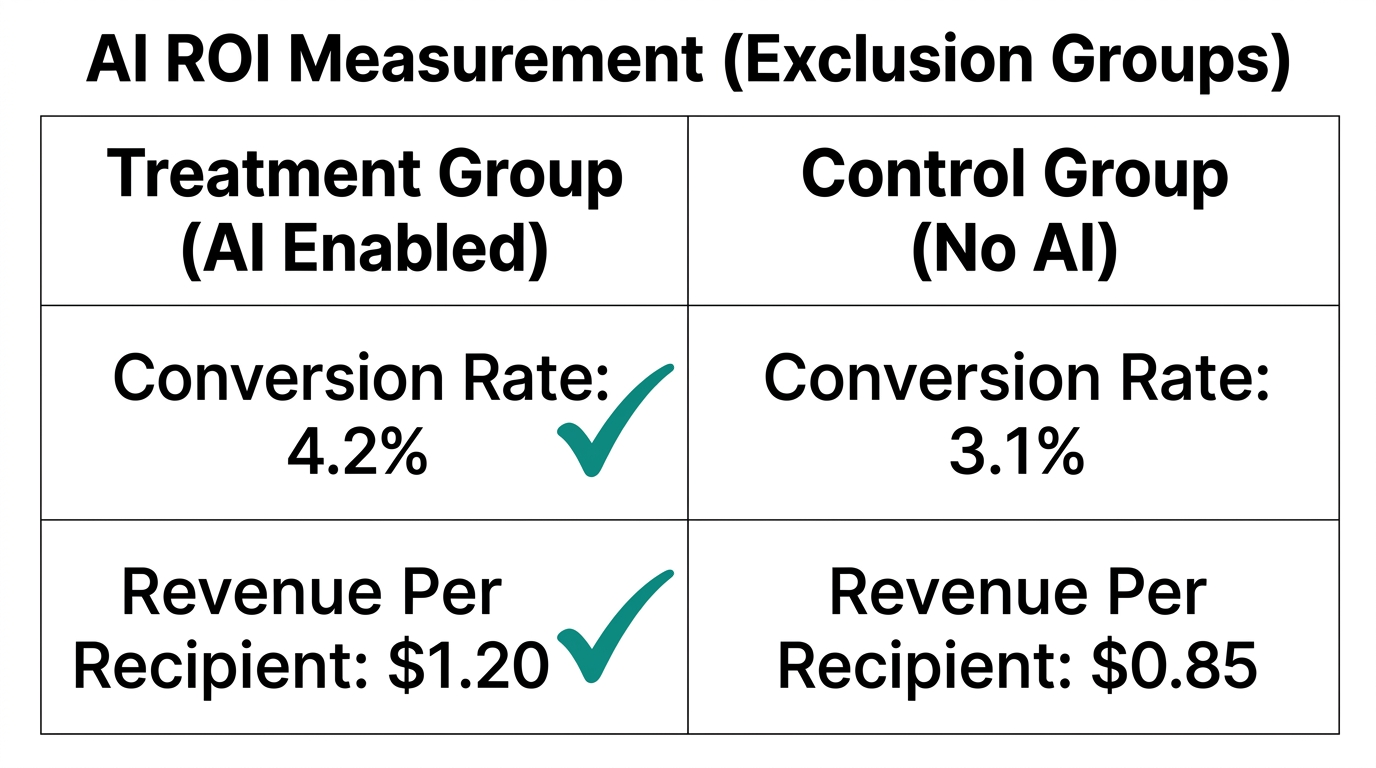
The fastest way to annoy a customer and trigger an unsubscribe is to send them a "20% off" coupon for an item they purchased at full price yesterday. Exclusion Group Logic is the AI-powered safeguard that prevents these "robotic" mistakes. By integrating your ecommerce data with support tools like Gorgias, you can ensure that AI-driven flows skip over customers who have open support tickets or have recently made a purchase.
In 2026, sophisticated brands like Culture Kings use these logics to synchronize their email and SMS strategies. If a customer is already engaging via SMS, the AI might choose to suppress the email version of a promotion to avoid over-saturation. This level of autonomous orchestration ensures a "surround sound" brand experience without being intrusive.
Conclusion: Your 2026 Automation Roadmap
The goal of ecommerce automation in 2026 is not to replace the human touch, but to automate the execution so you can focus on the strategy. By implementing Smart Send Time, AI-generated subject lines, and dynamic product feeds, you are building a system that treats every customer like your only customer. Brands like Force of Nature have seen 140% YoY growth in revenue from automated flows simply by moving toward more precise, AI-powered segmentation.
Start by identifying your highest-traffic flows—usually the Welcome Series or Abandoned Cart—and layer in one AI feature at a time. As your data grows, so will the AI's ability to drive conversions. To feed this machine with the right audience, consider using an AI-powered influencer discovery platform like Stormy AI to source creators who can drive the initial high-quality traffic that your Klaviyo automations will then convert into lifelong customers.