Auditing Google Ads Performance Max and AI Max: A 2026 Strategy for High-Growth Brands
Master your 2026 Google Ads Performance Max audit. Learn to optimize AI Max strategies, Asset Groups, and negative keywords to stop budget bleed in automated campaigns.
In 2026, the landscape of paid search has undergone a fundamental transformation. We have officially moved past the era where manual keyword bidding was the primary lever for success. Today, artificial intelligence isn't just a feature; it is the engine. However, as Google transitions from Performance Max (PMax) to the even more autonomous AI Max structures, many brands find themselves staring into a "black box" of automation. While these systems are powerful, they are not infallible. Recent data indicates that the average Google Ads account still wastes approximately 76% of its budget on underperforming keywords and poor placements, according to research by Metaflow AI. For high-growth brands, a rigorous Google Ads Performance Max audit is no longer optional—it is the difference between scaling and stagnating.
The Evolution: From Manual Keywords to AI-Driven Discovery
The headline for 2026 is the mainstream rollout of AI Max. Unlike traditional search campaigns that relied on specific keyword lists, the Pixis AI data shows that AI-driven PMax and AI Max campaigns now consistently hold 13–18% of total monthly spend. In this new Google Ads AI Max strategy, manual keyword lists have become secondary to audience discovery. The algorithm now looks at user intent, browsing behavior, and cross-platform signals to decide when to show an ad.
Expert Jyll Saskin Gales notes that as transparency and manual control decrease, survival depends on mastering automated targeting and optimizing your website so Large Language Models (LLMs) can properly interpret your offer. If your website structure is confusing, the AI will struggle to find your ideal customer.
"Tactical audits matter less than you think. In an AI-first world, a technically perfect campaign can fail if it is strategically misaligned with business goals."
As Sarah Stemen suggests, the modern audit must prioritize strategic alignment over button-pushing. This means ensuring your bidding strategy matches your actual business KPIs, rather than just chasing low-quality clicks.
Phase 1: The Signal Audit (Tracking Accuracy)
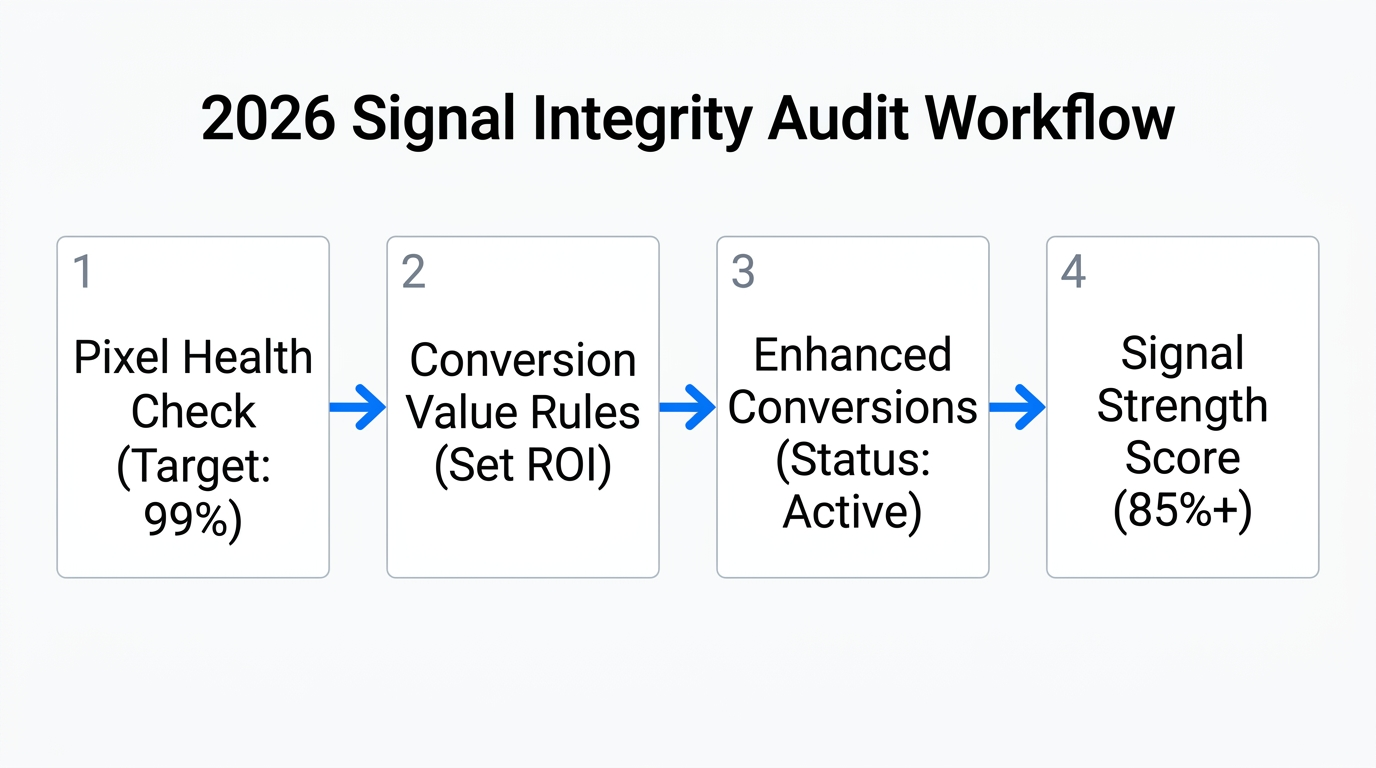
The most sophisticated AI in the world will fail if it's fed bad data. Shockingly, roughly 71% of accounts have inaccurate conversion tracking, according to North Country Consulting. This causes AI algorithms to optimize for the wrong signals, leading to massive budget waste. When conducting an automated targeting audit, your first step must be a deep dive into your conversion plumbing on platforms like Shopify or custom stacks.
- Verify Enhanced Conversions: Ensure you are sending hashed, first-party data back to Google. This bridges the gap caused by cookie deprecation and privacy regulations.
- Primary vs. Secondary Goals: A common mistake is setting "Add to Cart" as a primary goal alongside "Purchase." This confuses the AI. Only bottom-funnel actions (sales or high-intent leads) should be set as Primary.
- GA4 Data Flow: Confirm that GA4 is correctly linked and that "Enhanced Measurement" is capturing the right events.
| Audit Metric | Common Failure | 2026 Best Practice |
|---|---|---|
| Tracking Accuracy | 71% of accounts have errors | Enable Enhanced Conversions for all accounts |
| Conversion Goals | Multiple primary goals | Single Bottom-Funnel primary goal per campaign |
| Smart Bidding Lift | Ignoring AI bidding | 19% increase in conversions with Smart Bidding |
Phase 2: Asset Group Health and Creative Density
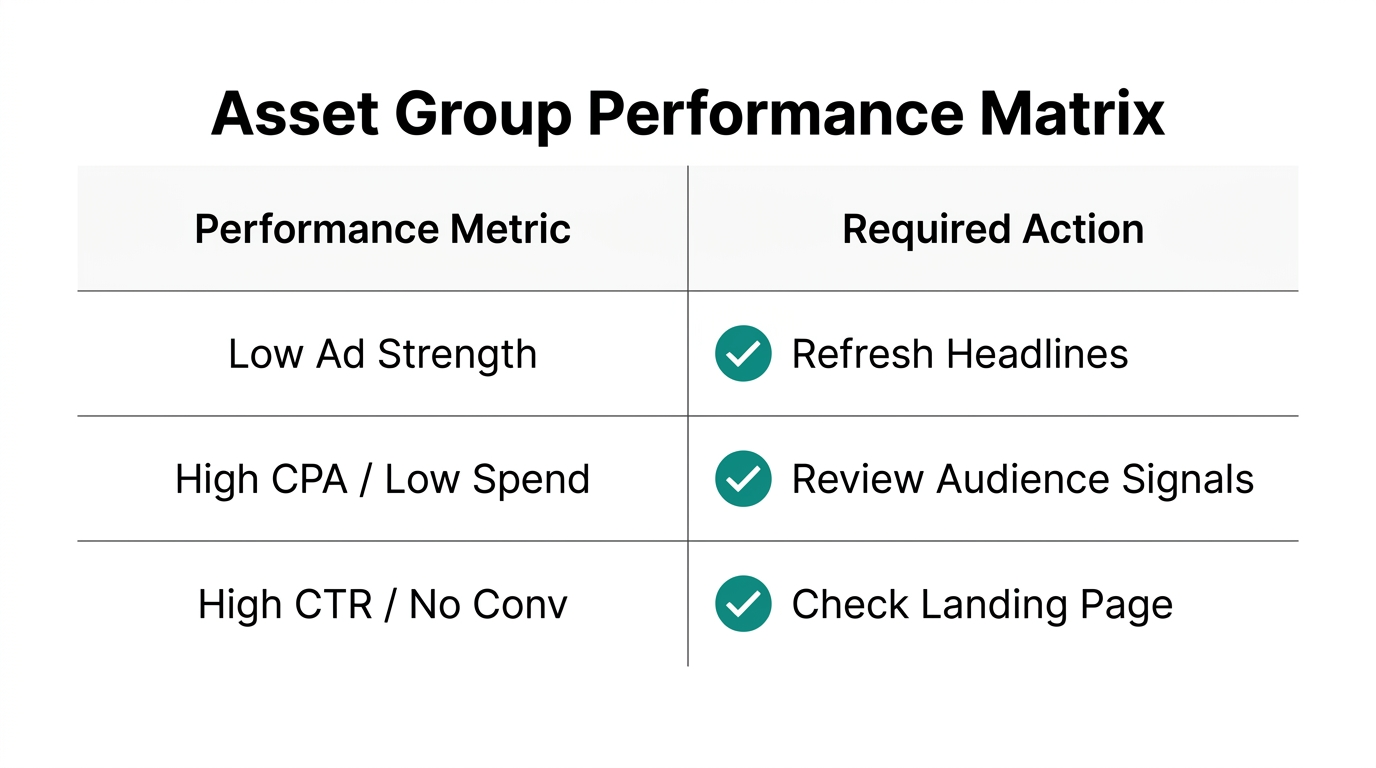
In Performance Max, your Asset Groups are your "ads." However, the AI cannot optimize "thin" groups. Running a PMax asset group optimization requires a commitment to creative volume. If you provide Google with only one image and one headline, you are effectively handicapping the machine learning process.
To avoid "thin asset" penalties, your 2026 audit should ensure every group contains:
- 15 High-Quality Images: Mix lifestyle, product-focused, and text-overlay graphics created in tools like Canva.
- 5 Diverse Videos: Include both 15-second "shorts" and longer brand stories.
- Full Headline/Description Slots: Use all 5 headlines and 4 descriptions to allow for maximum permutations.
Brands that struggle to produce this volume of content often leverage influencer-generated content. Platforms like Stormy AI allow marketers to discover and manage UGC creators who can quickly generate the 5+ videos needed to keep PMax asset groups fresh and high-performing.
Phase 3: Preventing Broad Match Budget Bleed
One of the biggest traps in the Google Ads AI Max strategy is the "set and forget" mentality regarding Broad Match. While AI is great at finding intent, it can still bleed budget on "near-meaning" queries that have zero intent to buy. A manufacturer recently discovered that AI-generated keyword recommendations had zero actual search volume, and a manual audit of those signals saved them $3,000 in monthly spend (Corey K Media).
The Negative Keyword Playbook
- Account-Level Negative Lists: Implement a robust list of "junk" terms (e.g., "free," "jobs," "login") to prevent PMax from bidding on them across all campaigns.
- Audit the Search Terms Report: Even in PMax, you can view search themes. Look for clusters of irrelevant terms and exclude them immediately.
- Intent Overlap: Ensure you aren't bidding against your own brand terms in a way that inflates your ROAS artificially without adding incremental value.
"Without a robust negative keyword strategy, Broad Match can still bleed budget on 'near-meaning' but 'zero-intent' queries." — Two Spouts
Navigating AI Overviews (AIO) in Search Results
In 2026, Google Ads AI Overviews (AIO) are a standard part of the search experience. Ads now appear directly inside these conversational summaries. As Andrew Percey of Prometheus PPC notes, while AIO may shrink organic CTR by 15–35%, it simultaneously increases the value of precision-targeted PPC ads.
When auditing your AIO performance, look for conversational queries. Users are asking longer, more specific questions. Your asset groups should include headlines that answer these questions directly to capture the high-intent traffic within the AIO box. This shift is why account consolidation is king: AI performs better with "meatier" campaigns and consolidated data sets rather than fragmented, small-budget efforts.
The 2026 AI Auditing Toolbox
You no longer need to spend dozens of hours in spreadsheets to find inefficiencies. A new generation of tools allows for real-time monitoring and natural language querying.
- AskGAAI.com: A natural-language tool that allows you to "ask" questions about your account performance without manual data exports.
- groas.ai: Exceptional for real-time AI optimization and intent analysis.
- Optmyzr.com: The industry standard for automated audits, scripts, and bulk account changes.
- PPCrush.ai: Specialized in identifying "low-hanging fruit" and negative keyword opportunities.
- TrueClicks.com: Provides "PPC Insurance" by auditing for errors and waste at scale.
By leveraging these tools, brands can move from a reactive "fix-it" mentality to a proactive growth posture. For example, using AI-driven "Retain Audiences" to inform algorithms helped a group of 15 dealerships see a 40% increase in CTR and a 15% lift in conversions (Strong Automotive).
The Path Forward: Strategic Auditing
The days of "set and forget" automation are over. To win in 2026, you must treat your Google Ads account as a living organism that requires high-quality fuel (data and creative assets) and regular check-ups. Smart Bidding alone can reduce your CPA by up to 30% (Marketing LTB), but only if the foundations are solid.
Start your audit today by verifying your tracking, expanding your creative assets with tools like Stormy AI, and using natural language tools to uncover hidden waste. Automation is your most powerful ally—as long as you remain the pilot.