2026 Google Ads Account Audit Playbook: How to Eliminate Budget Waste in an AI-First World
Learn how to conduct a 2026 Google Ads account audit to reduce waste and master AI PPC optimization. Use our checklist to audit signals, structure, and efficiency.
In 2026, managing a Google Ads account is no longer about who can manually tweak a keyword bid the fastest. It is about who can feed the most accurate data to the machine. As artificial intelligence has moved from a helpful assistant to the primary driver of PPC success, the stakes for your budget have never been higher. Recent data shows that the average Google Ads account wastes approximately 76% of its budget on underperforming keywords and poor placements, according to Metaflow AI. If you aren't auditing your account through an AI-first lens, you aren't just leaving money on the table; you’re actively funding the inefficiencies of the algorithm.
The Great Shift: From Tactical Tweaks to Strategic Signal Management
The days of granular, manual keyword adjustments are largely behind us. Experts like Sarah Stemen argue that tactical audits matter less than they used to; in 2026, even a technically "perfect" account will fail if it is strategically misaligned with business goals. Today, a successful Google Ads account audit 2026 focuses on Strategic Alignment—ensuring that the signals you send to Google’s AI are clean, high-intent, and reflective of actual profit.
"The key to 2026 PPC isn't controlling what the AI does, but controlling what the AI thinks. If you feed it bad data, it will find you bad customers with remarkable efficiency."
As Jyll Saskin Gales points out, transparency in the platform continues to decrease. To survive, marketers must master automated targeting and optimize their websites so Large Language Models (LLMs) like ChatGPT can properly interpret their offers. This shift is most evident in the rise of AI Max for Search, where manual keyword lists have become secondary to AI-driven audience discovery.
Phase 1: The "Signal" Audit (Tracking & Integrity)
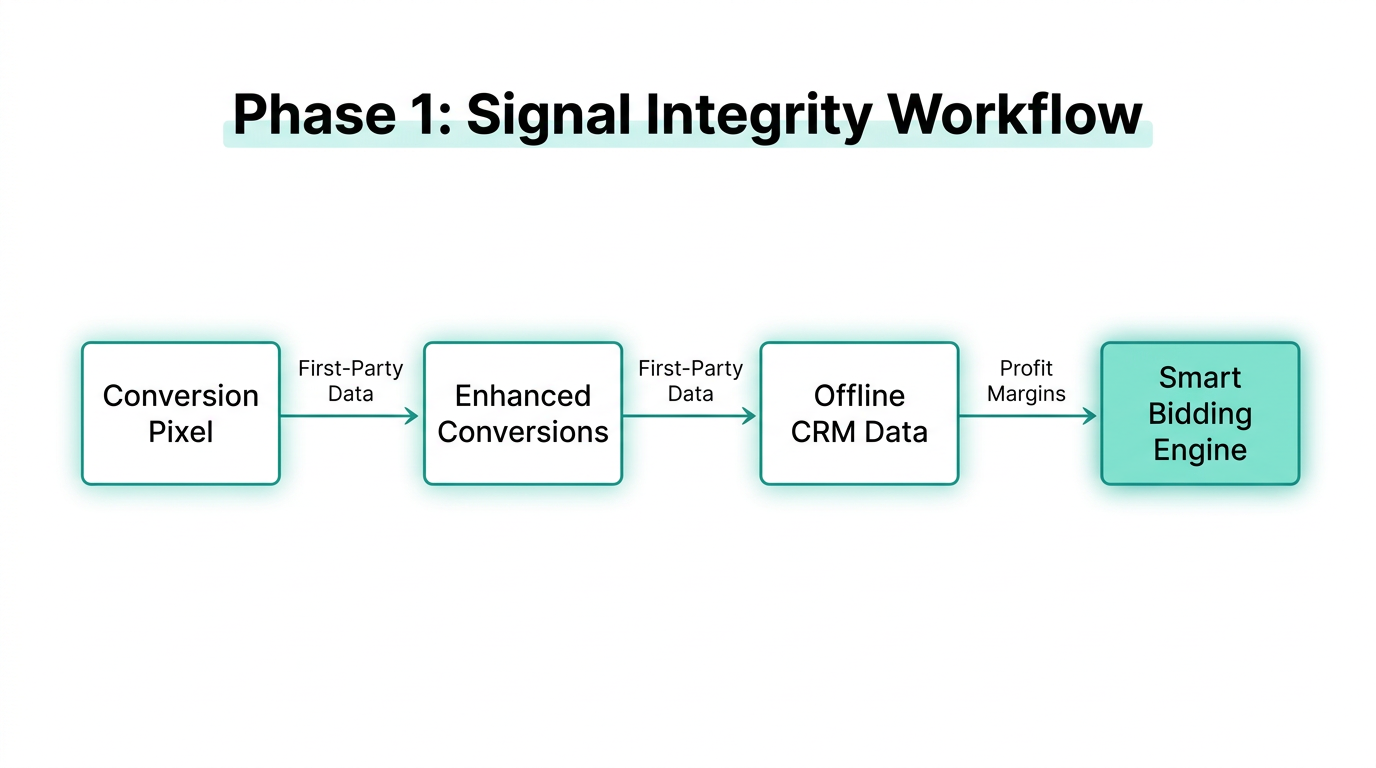
Your AI is only as smart as the data it consumes. Unfortunately, roughly 71% of accounts currently suffer from inaccurate conversion tracking, according to North Country Consulting. This causes Google’s algorithms to optimize for the wrong user actions, leading to a massive Smart Bidding performance audit failure.
Verifying Enhanced Conversions
In a world without third-party cookies, Enhanced Conversions are your lifeline. You must ensure that first-party data (emails, phone numbers) is being securely hashed and sent to Google. This bridges the gap in tracking and allows the AI to recognize when a user converts across different devices. Without this, your AI PPC optimization strategy is flying blind.
Primary vs. Secondary Goals
A common mistake in 2026 is "double-counting" or over-reporting. Ensure that only your "bottom-funnel" actions—like actual sales or qualified leads—are set as Primary conversion actions. If you set "Newsletter Signups" as a primary goal alongside "Purchases," the AI may prioritize the cheaper, lower-value signup, diluting your ROI. This is a critical step in any Google Ads audit checklist.
| Audit Component | Target State | Impact on AI |
|---|---|---|
| Conversion Tracking | Enhanced Conversions Enabled | Higher attribution accuracy |
| Goal Settings | Only "Bottom-Funnel" as Primary | Focuses spend on high-intent users |
| GA4 Integration | Enhanced Measurement ON | Provides deeper behavioral signals |
Phase 2: The "Framework" Audit (Structure & Consolidation)
Structure in 2026 is all about data density. AI performs significantly better with consolidated data sets rather than fragmented, small-budget campaigns. Last year, search campaigns dominated 56.2% of investment, but Pixis AI reports that Performance Max (PMax) consistently held 13–18% of monthly spend. To reduce Google Ads waste, you must build a structure that allows these automated campaign types to thrive.
The Power of Consolidation
If you have five campaigns targeting similar audiences with $20/day budgets, you are starving the AI. Consolidate them into one "meatier" campaign with a $100/day budget. This gives the Smart Bidding algorithms enough data to exit the "learning phase" quickly. Using AI-driven Smart Bidding has been shown to result in an 18% increase in unique search query categories with conversions, according to ALM Corp.
Performance Max Asset Health
PMax is a "black box," but you control the fuel. A common error is running PMax with only 1–2 images or headlines. To maximize efficiency, you must fill all 15 image slots, 5 video slots, and all headline options. High-quality creative is the new "targeting." While platforms like Stormy AI can help you discover and manage the TikTok and Instagram UGC creators needed to produce this high-volume content, your job within Google Ads is to ensure those assets are correctly mapped to your audience signals.
"In 2026, the creative asset is the only lever left that can truly differentiate your brand from the competition's automated bidding."
Phase 3: The "Efficiency" Audit (Cost Control & Waste)
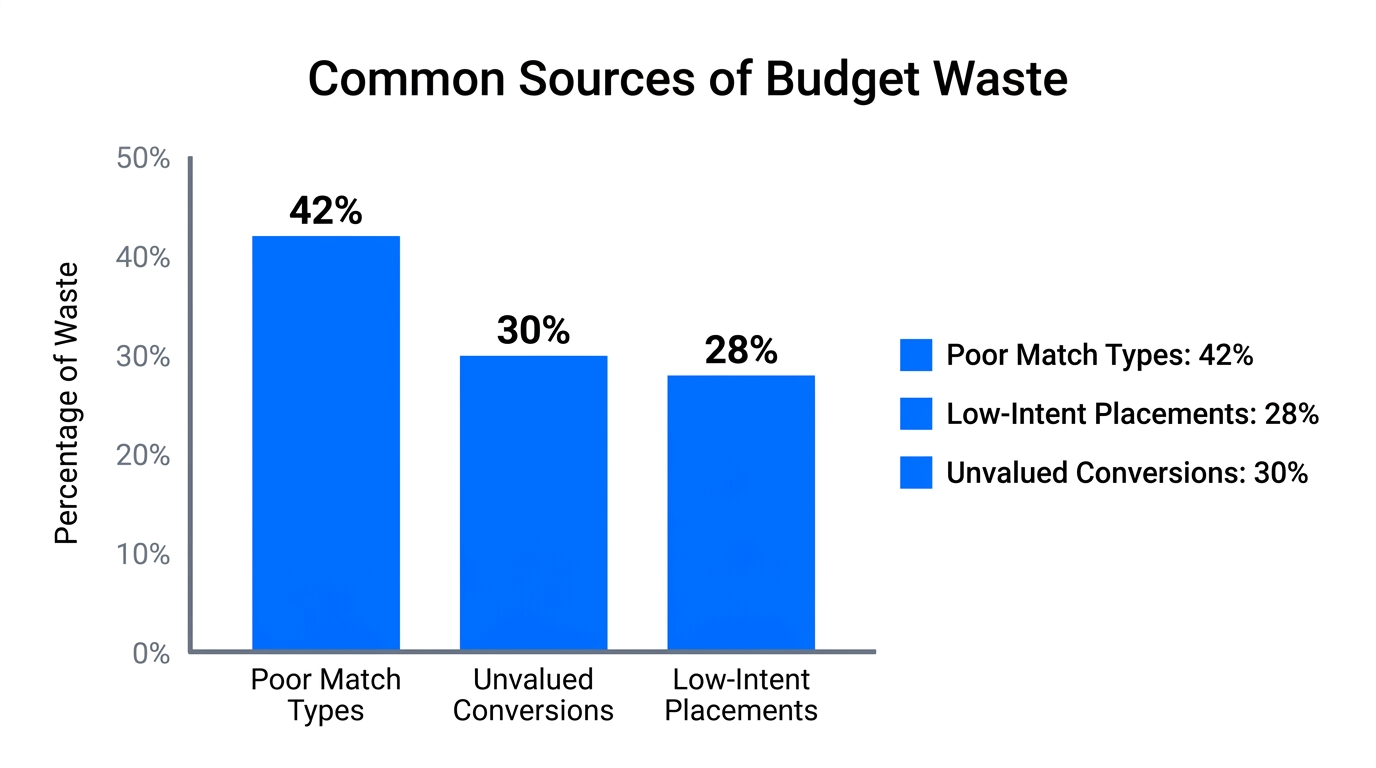
Even with advanced AI, waste is rampant. Broad Match, when combined with Smart Bidding, can be incredibly powerful—but it can also bleed budget on "near-meaning" queries that have zero purchase intent. According to Two Spouts, assuming the AI handles everything without a robust negative keyword strategy is a recipe for disaster.
Negative Keyword Lists & AI Tools
You should no longer manually hunt for every negative keyword. Use tools like PPCrush.ai to identify "low-hanging fruit" and junk queries automatically. This allows you to reduce Google Ads waste by cutting out clicks that don't convert. A manufacturer recently saved $3,000 in monthly spend by manually auditing AI-generated keyword recommendations that actually had zero real-world search volume, as noted by Corey K Media.
PPC Insurance and Monitoring
To prevent catastrophic errors, many agencies now use "PPC Insurance" tools. Tools like TrueClicks focus on auditing for errors and quality control at scale, while Opteo provides continuous monitoring and AI alerts for account health. For high-level strategy, Optmyzr remains the industry standard for automated audits and scripts.
| Tool Category | Recommended Tool | Primary Function |
|---|---|---|
| Automated Auditing | Optmyzr | Bulk changes, scripts, and comprehensive audits. |
| PPC Insurance | TrueClicks | Error detection and waste prevention. |
| Intent Analysis | groas.ai | Real-time optimization and intent auditing. |
| Natural Language Insights | AskGAAI.com | Ask questions about your data in plain English. |
The Role of AI Overviews (AIO) in 2026
Ads are now appearing directly inside Google’s AI Overviews. While some feared this would destroy PPC, Andrew Percey notes that while AIO might shrink organic CTR by 15–35%, it actually increases the value of precision-targeted PPC ads. Your audit must check how your ads interact with these conversational results. Are your headlines answering the "conversational" intent of a search query?
"AIO hasn't killed search; it has just made the top of the page more valuable for those who know how to appear in the answer."
Conclusion: Your 2026 Audit Action Plan
To win in 2026, you must stop acting like a media buyer and start acting like a data architect. A successful Google Ads account audit 2026 requires a ruthless examination of your tracking signals, a simplified campaign structure that favors data density, and a tech stack that provides automated insurance against waste.
Remember these three pillars:
- Audit the Signals: Verify Enhanced Conversions and ensure GA4 is passing clean data.
- Audit the Framework: Consolidate campaigns to give AI the volume it needs.
- Audit the Efficiency: Use AI tools to maintain robust negative keyword lists and prevent bid strategy misalignment.
By shifting from tactical tweaks to strategic signal management, you can transform your Google Ads account from a budget-burning engine into a high-precision growth machine. And if you're looking to scale your creative assets to keep those AI campaigns fueled, consider how Stormy AI can automate your influencer and UGC sourcing to keep your PMax assets fresh and high-performing.