The 2026 Guide to GEO: How to Rank in Perplexity and SearchGPT
Master Generative Engine Optimization (GEO) in 2026. Learn to rank in SearchGPT and Perplexity, increase citation share, and recover lost organic CTR with this playbook.
As we navigate through the first half of 2026, the marketing landscape has shifted from the foundation of the "Experimental Era" to one of "Foundational AI Infrastructure." The era of chasing the top blue link on Google is fading. Today, the most valuable real estate on the internet isn't a search result page—it's a citation within a generative answer. If your brand isn't being mentioned by OpenAI or Perplexity, you effectively do not exist for a massive segment of high-intent consumers.
Traditional search volume is predicted to decline by 25% by the end of 2026 as users shift to AI-driven answers. For marketers, this means transitioning from Search Engine Optimization (SEO) to Generative Engine Optimization (GEO). This guide provides the strategic blueprint for securing visibility in this new AI-first world, focusing on information density, citation share, and the technical architecture required to satisfy modern AI bots.
The 2026 Landscape: Why SEO as You Knew It Is Dead
In 2025, we saw the "Zero-Click Content" trend accelerate, but 2026 has brought the finality of that shift. According to recent data, organic Click-Through Rates (CTR) have dropped by 58-79% for informational queries because AI Overviews provide the answer immediately. When a user asks, "How do I integrate Model Context Protocol (MCP) into my CRM?", they no longer need to visit five different blogs. They get a synthesized answer with citations.
However, there is a silver lining. While total traffic from search engines is down, the quality of traffic coming from AI citations is unprecedented. Reports from Onely show that GEO-driven traffic converts at an average rate of 27%, compared to just 2.1% for traditional organic search. This is the "GEO Conversion Paradox": you get fewer visitors, but they are nearly 13 times more likely to become customers. To win, you must stop optimizing for keywords and start optimizing for trust.
"AI is the engine of speed, but humans are the brakes of trust. In 2026, marketing isn't about being seen, it's about being believed." — Nathan Yeung, Wesley Clover
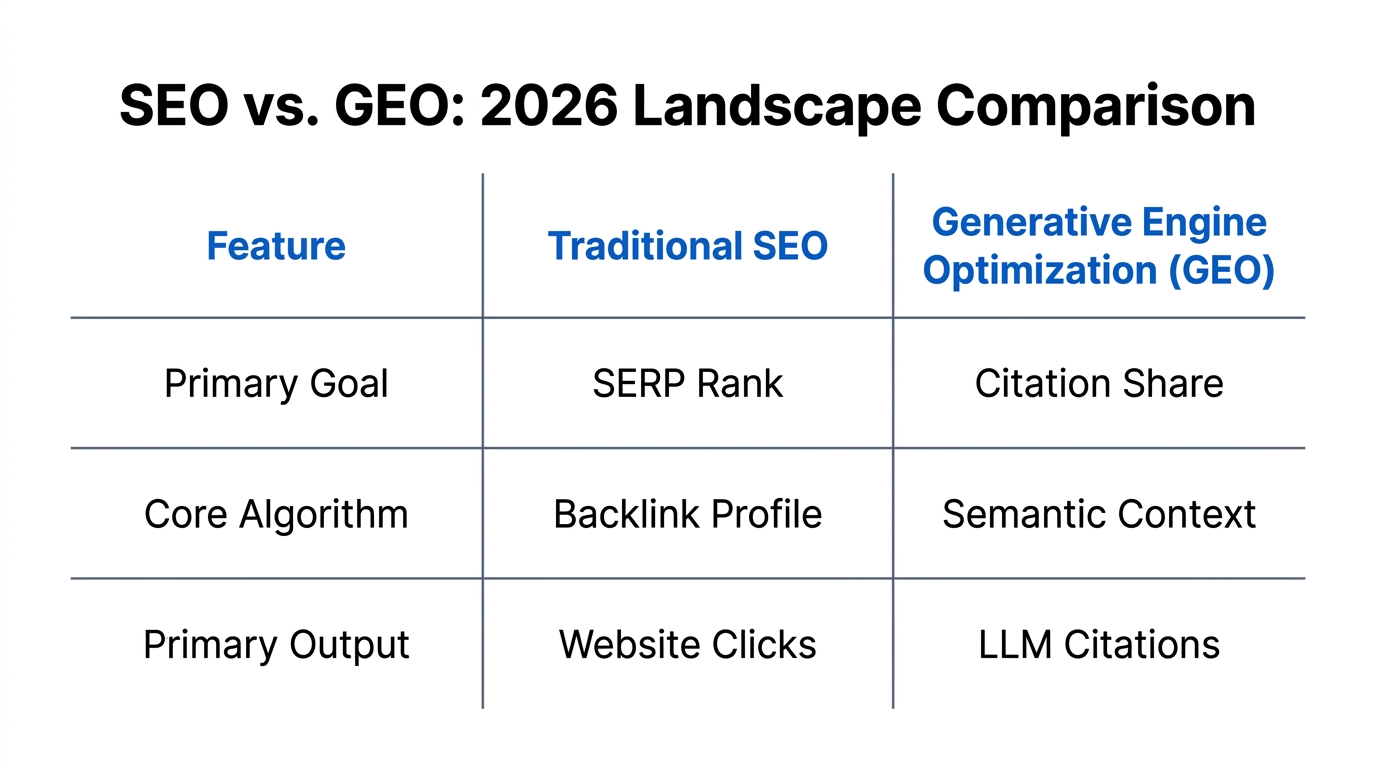
| Feature | Traditional SEO (Pre-2025) | Generative Engine Optimization (2026) |
|---|---|---|
| Target | Search Engine Algorithms (Blue links) | LLMs and Generative AI Agents |
| Success Metric | Click-Through Rate (CTR) | Citation Share / Recommended Mentions |
| Content Goal | Keyword matching & Backlinks | Information density, Accuracy, & Trust |
| User Journey | Search -> Click -> Browse | Query -> AI Answer (Zero-click) |
The 'Clean Block' Rule: Architecting Content for Bots
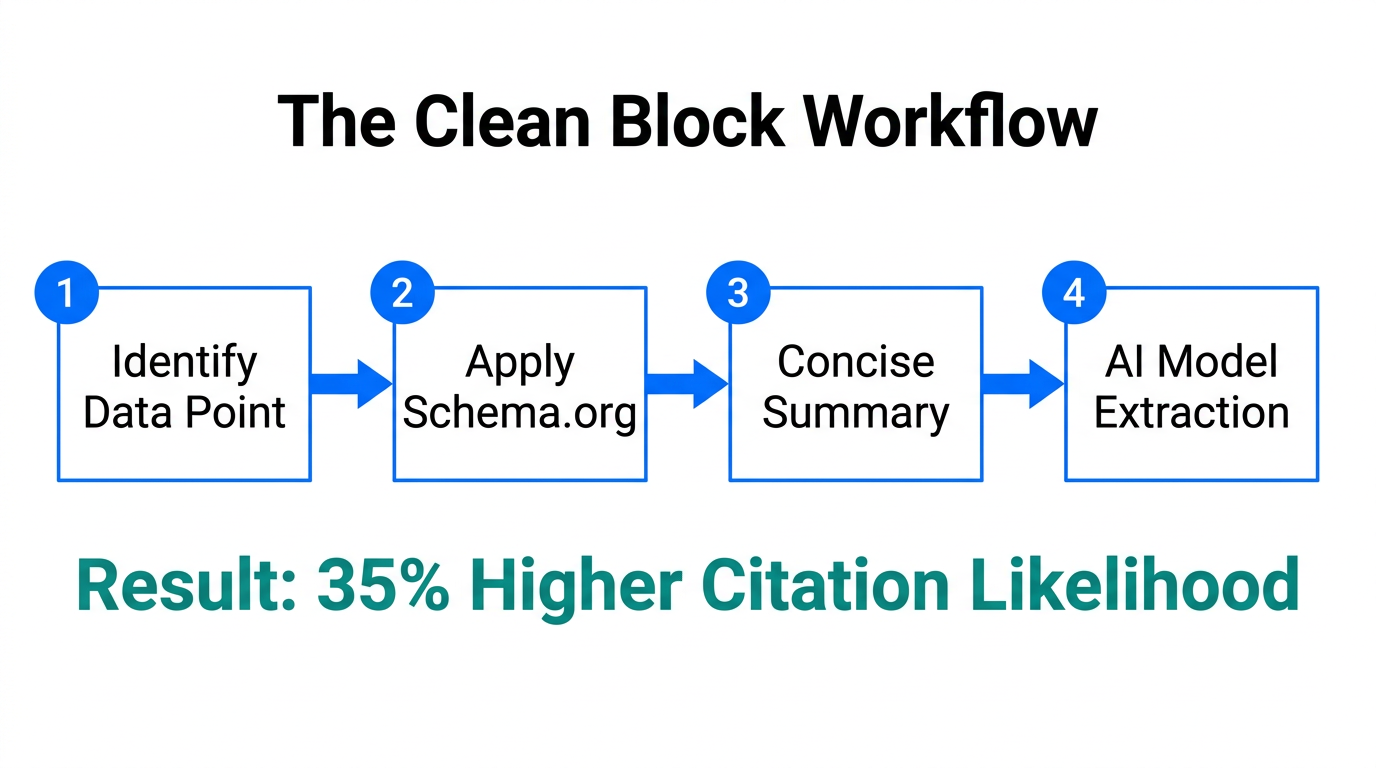
In the past, we wrote for humans first and bots second. In 2026, your content must be structured so that OAI-SearchBot and PerplexityBot can digest it without friction. This is known as the 'Clean Block' Rule. AI models do not "read" your page like a human; they extract semantic entities and facts from specific nodes of your content.
To implement the Clean Block Rule, your content must be modular. Use clear, descriptive H2 and H3 tags that mirror the questions users are asking in ChatGPT. Instead of a vague heading like "Our Thoughts on Marketing," use "What are the benefits of Agentic Workflows for SMBs?" This allows the LLM to easily attribute a specific fact to your URL, increasing your Citation Share. Leading agencies like Advisable suggest that content not structured in this modular fashion is effectively invisible to modern scrapers.
- Crawlability: Ensure you are not blocking
OAI-SearchBotorPerplexityBotin your robots.txt. Many brands accidentally block these, cutting themselves off from AI discovery. - Semantic Labeling: Use schema markup to define facts, expert names, and data points.
- Information Density: Avoid "filler" text. AI models prefer high-density blocks that provide the most value per token.
As Jasper’s State of AI 2026 report points out, high-maturity teams are seeing a 300% ROI on their content spend because they have moved away from "AI slop" and toward expert-led, structured data blocks that AI engines find irresistible.
Tactical Guide: Increasing Citation Share and Information Density
If "Rank 1" was the goal in 2024, "Citation Share" is the goal in 2026. This metric measures how often your brand is cited as a source in a generative response relative to your competitors. To increase this, you must focus on original research and data. LLMs are trained to prioritize RAG (Retrieval-Augmented Generation)—they look for the most accurate, grounded, and specific information to answer a prompt.
For example, a wellness brand that publishes original clinical trial data will be cited far more often than one that simply summarizes existing articles. This is because AI engines like Claude and Perplexity are increasingly savvy at identifying primary sources. Brands that invest in a "Humanity Moat"—using real expert faces and proprietary data—are seeing the highest gains in visibility.
"The winning model is 'Human + AI.' Think of AI as a junior copywriter who never sleeps, but still needs a senior editor to provide the truth." — Meghan Keaney Anderson, Jasper
When creating content, aim for a high Information-to-Word Ratio. Every paragraph should contain a fact, a statistic, or a unique insight. If an AI can summarize your entire article in one sentence without losing value, your information density is too low. Brands using platforms like Stormy AI to find creators who specialize in niche, data-heavy content are finding it easier to secure these precious citations in specialized AI search results.
Tracking the Invisible: Measuring GEO in Google Analytics
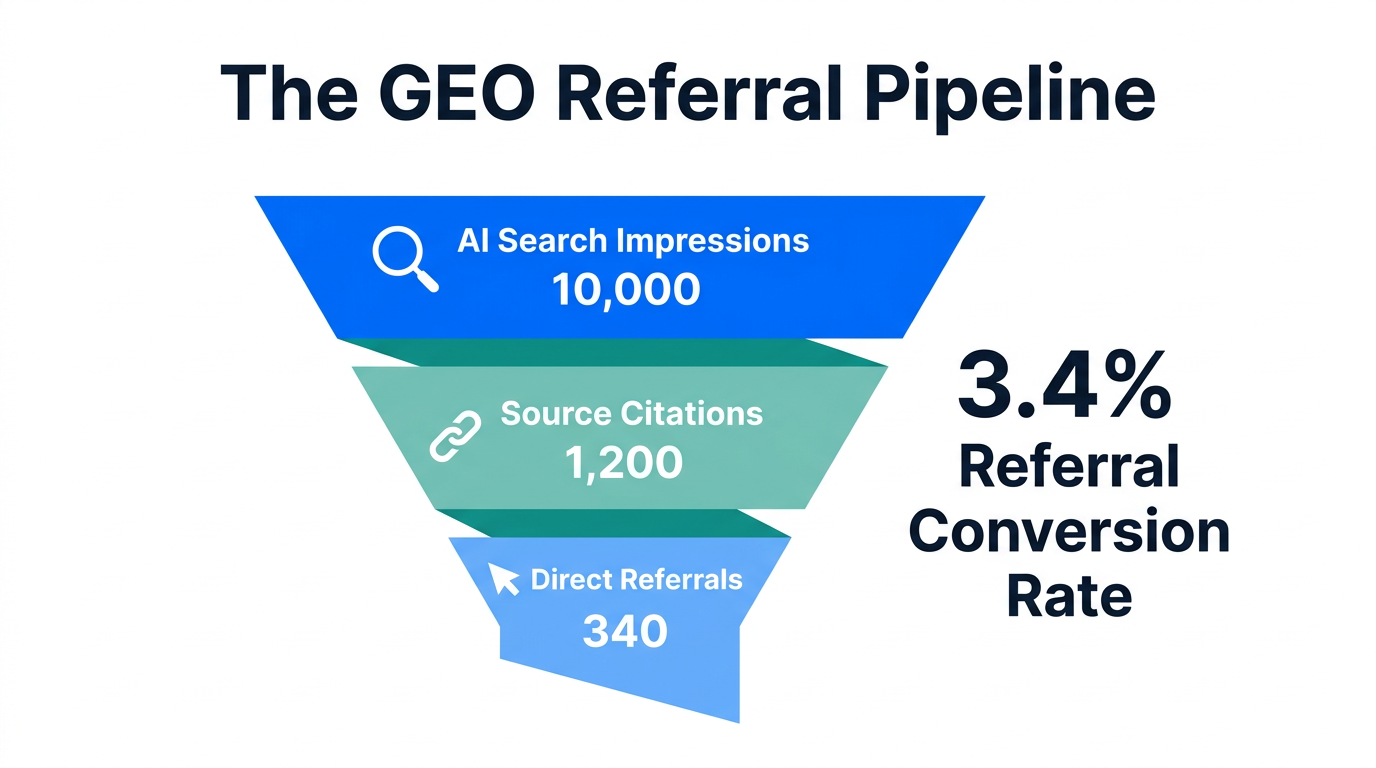
One of the biggest pain points in 2026 is "Dark AI Social"—traffic coming from AI interfaces that doesn't always show up as a standard referral. To accurately track your GEO performance, you must move beyond basic organic search tracking and implement specific UTM parameters for AI engines.
Step 1: Set Up Custom Channel Groupings
In Google Analytics 4, create a new channel grouping specifically for "Generative AI." This should include referrals from domains like chatgpt.com, perplexity.ai, and claude.ai. Since OpenAI has pivoted toward a high-scale advertising model, you also need to distinguish between organic citations and "Sponsored Citations."
Step 2: Use Strategic UTMs
When you share links in AI-accessible forums or through your own AI agents, use specific tags such as utm_source=chatgpt.com&utm_medium=citation. This allows you to see exactly which content blocks are being pulled by AI engines and which ones are converting. Tools like Gumloop can even automate the process of checking your citation frequency across different models.
Step 3: Monitor 'Recommended' Mentions
Success in 2026 isn't just about the click; it's about the recommendation. Use social listening and competitive intelligence tools to track how often your brand is the "preferred recommendation" in conversational queries. If a user asks Apple Search Ads or a Siri-integrated GPT for the "best CRM for a 10-person team," are you the first answer?
The 2026 GEO Marketing Playbook
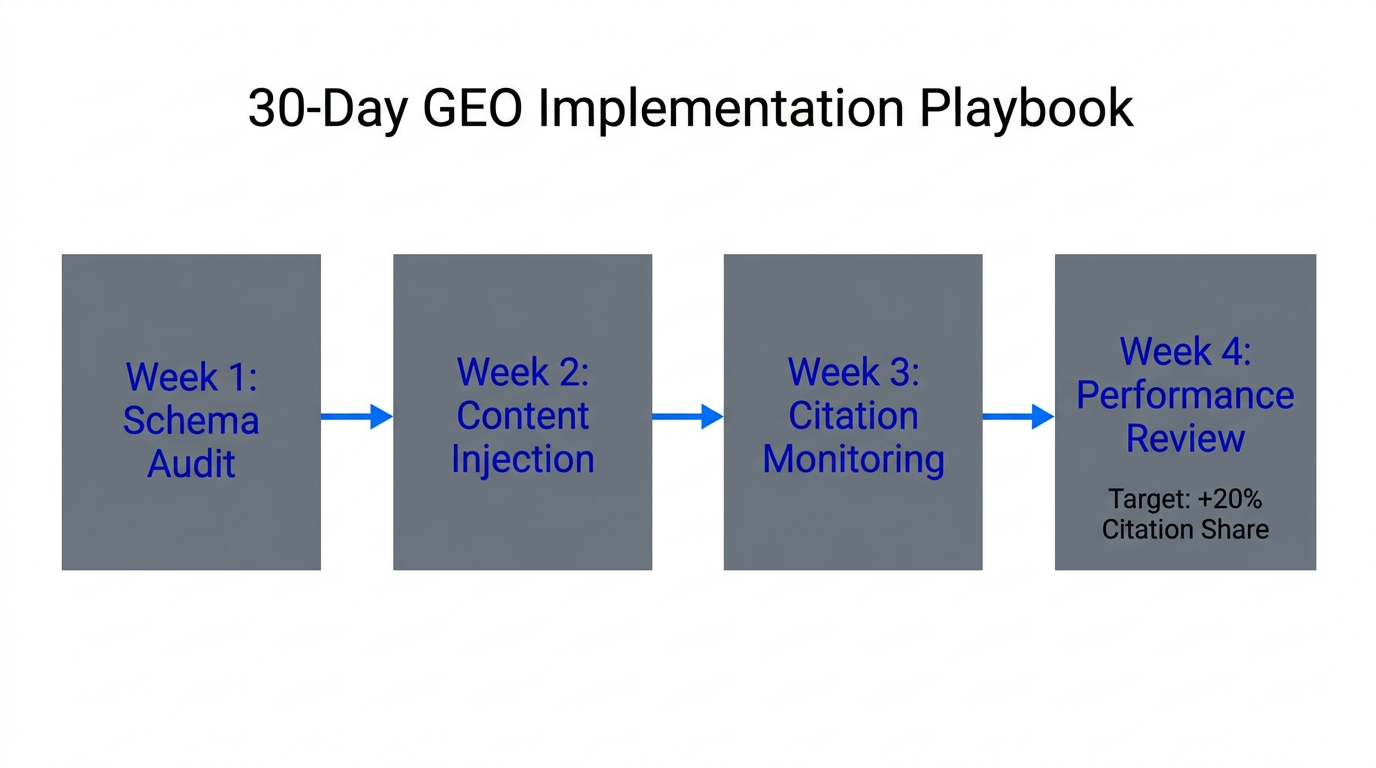
Ready to transition? Follow this step-by-step guide to move your team from old-school SEO to modern GEO dominance.
- The AI Audit (Month 1): Use tools like Fathom to record customer calls. Identify the exact questions they ask. These questions are your new "keywords."
- Build the RAG Layer (Months 2-3): Centralize your brand voice and proprietary data in a secure knowledge base or AI-powered workspace. Ensure your public-facing content is a reflection of this internal "truth" database.
- Deploy Agentic Workflows (Months 4-6): Move from simple prompting to Agentic Workflows. Use systems like Salesforce Agentforce to automate the research and drafting of citation-heavy content.
- Monitor and Pivot (Ongoing): Track your citation share weekly. If a competitor is being cited for a topic you own, analyze their content structure. Are they using the 'Clean Block' rule more effectively?
"The real winners in 2026 are those who connect data, not just collect it. AI search rewards the brands that provide the missing piece of the puzzle." — Bill Bruno, CEO of Celebrus
As you refine your strategy, remember that the "Sameness Problem" is real. AI-generated content often feels hollow. To stand out, you must inject your brand’s unique perspective. While platforms like Stormy AI can help you find the right influencers to amplify your message, the core of your GEO success will always be the unique expertise you provide that an AI cannot hallucinate.
The Bottom Line: Being Citation-Worthy
In 2026, the primary success metric for content teams is no longer keyword density; it is citation-worthiness. To survive the 25% decline in traditional search volume, brands must become the primary sources of truth that AI models rely on. By implementing the Clean Block rule, focusing on information density, and tracking GEO referrals with precision, you can turn the AI search revolution into a massive competitive advantage.
Stop writing for the algorithm of 2024 and start writing for the generative engines of 2026. Your conversion rates depend on it.