From SEO to GEO: Optimizing for AI Search Summaries and Answer Engines in 2026
Master Generative Engine Optimization (GEO) in 2026. Learn how to optimize machine-readable content and answer engine optimization to stay visible in AI search.
The era of the "Ten Blue Links" is officially over. As we navigate through 2026, the digital landscape has shifted from a destination-based web to an answer-based ecosystem. For over two decades, marketers lived and died by the Google SERP (Search Engine Results Page), but today, the primary gateway to information isn't a list of websites—it is the AI summary. Whether it is ChatGPT, Google Gemini, or Perplexity, users are no longer clicking through to your homepage; they are reading a synthesized response that cites you... if you are lucky. This evolution has birthed a new discipline: Generative Engine Optimization (GEO).
With the global marketing automation market reaching $8.14 billion in 2026, according to Fortune Business Insights, the pressure to maintain visibility is higher than ever. It is no longer enough to rank; you must be the data source that the AI agents trust. This guide explores how to pivot your strategy from traditional SEO to a robust AI search strategy that ensures your brand remains the primary citation for the next generation of consumers.
Understanding GEO vs SEO 2026: The Fundamental Shift
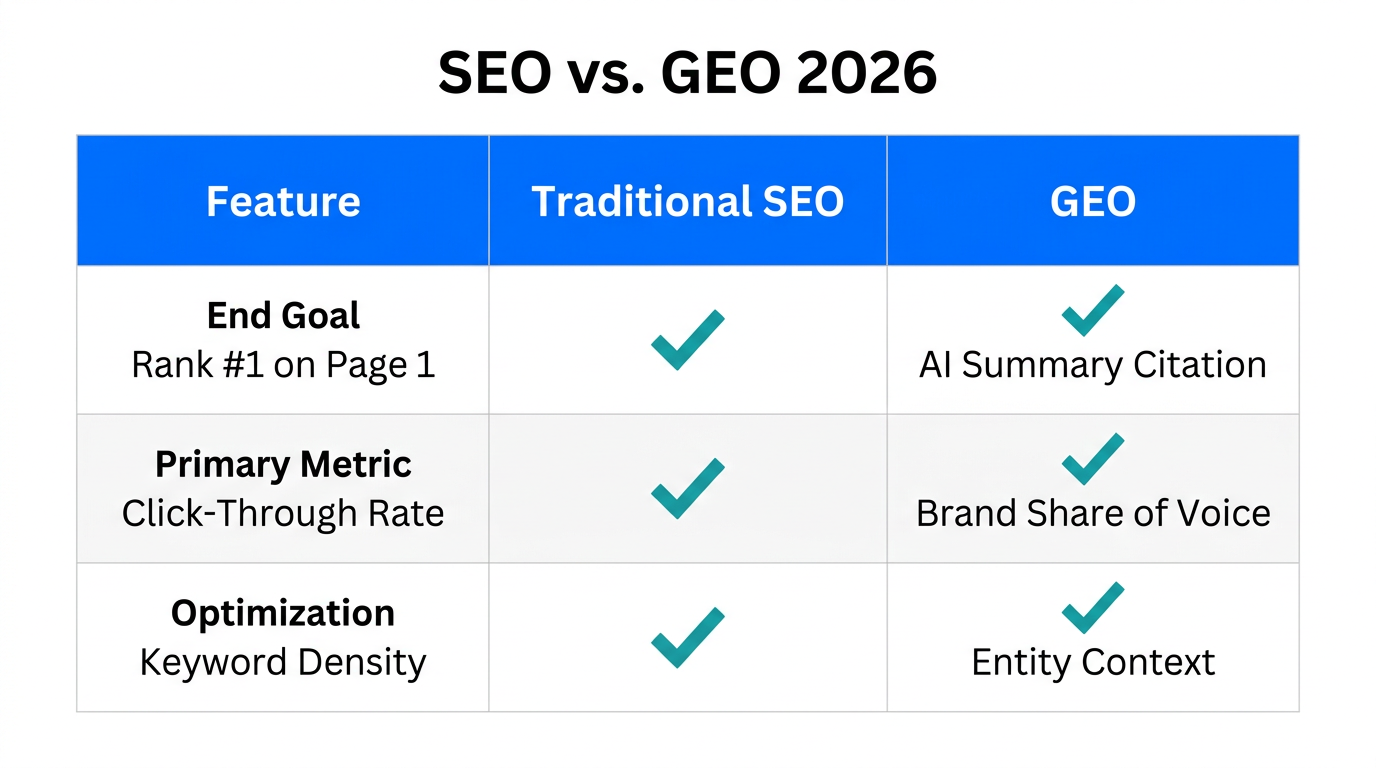
In 2026, the distinction between traditional SEO and Generative Engine Optimization is stark. While SEO focused on keyword density, backlink profiles, and site speed to please a crawler, GEO focuses on machine-readable content and semantic authority to satisfy an LLM (Large Language Model). The goal has shifted from being "on page one" to being the single source of truth within an AI-generated answer.
Research from DemandSage indicates that 96% of marketers have now adopted automation platforms, many of which are specifically designed to handle the "agentic" nature of modern discovery. In this environment, your content must be structured so that an AI can easily ingest, verify, and summarize it.
| Feature | Traditional SEO | GEO (2026) |
|---|---|---|
| Primary Goal | Drive clicks to a website | Become the cited authority in an AI summary |
| Target Audience | Human users scanning links | AI Agents and Answer Engines |
| Key Metric | Click-Through Rate (CTR) | Citation Frequency & Brand Mention Volume |
| Content Structure | Long-form articles with keywords | Modular, machine-readable fragments |
"If your brand lacks clarity and trust in 2026, you will simply disappear from AI-mediated discovery."
As Gartner analysts highlight in their latest search trend report, the brands that win are those that treat AI as a growth engine rather than a cost-saving layer.
The Rise of Answer Engine Optimization (AEO)
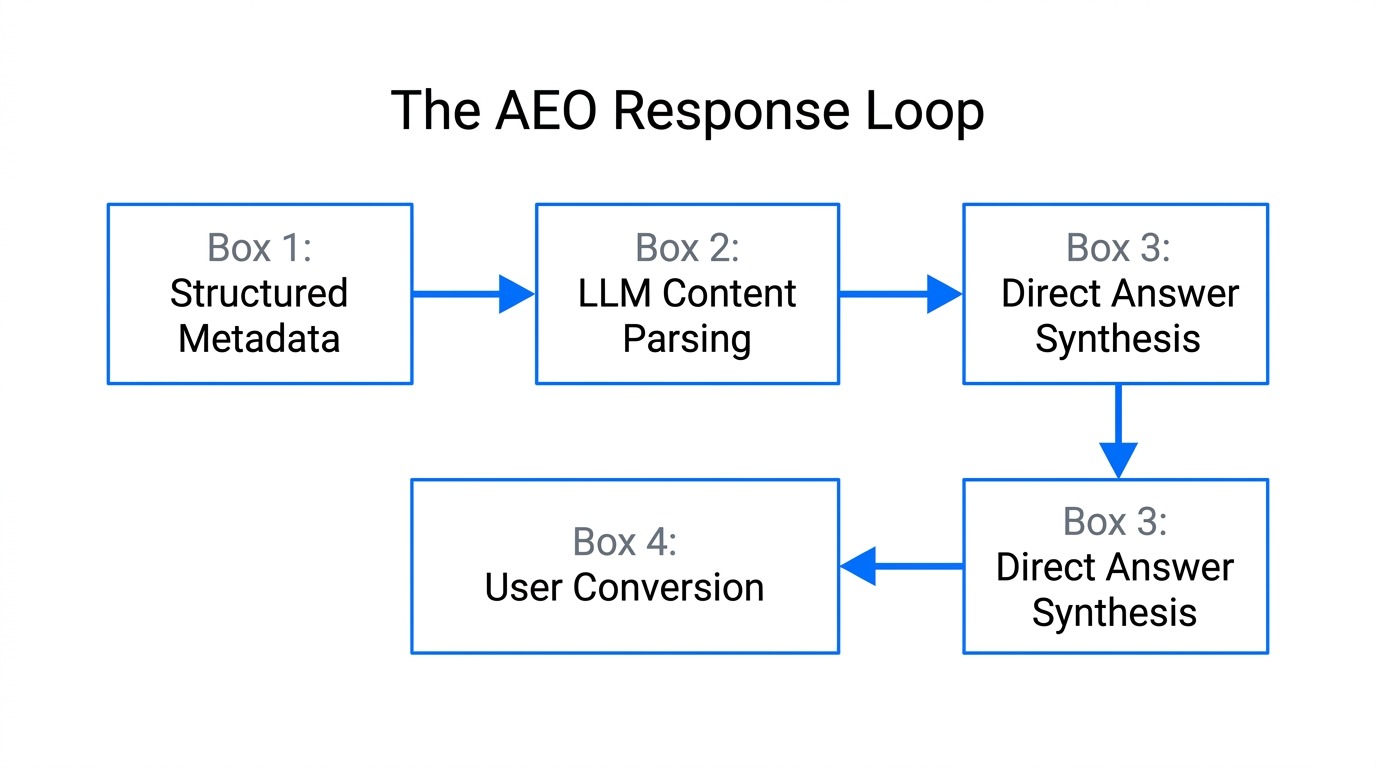
Answer Engine Optimization (AEO) is a subset of GEO that focuses specifically on high-intent, conversational queries. When a user asks Perplexity, "What is the best enterprise automation tool for a mid-market manufacturing firm?", the AI doesn't just look for keywords; it looks for verified data points, pricing transparency, and user sentiment. To win in AEO, brands are now leveraging newcomer platforms like Profound, which was recognized in the 2026 G2 Awards for helping companies control how they appear in these generated summaries.
To succeed in the AEO era, your content must move away from "fluff" and toward Machine-Readable Content. This involves:
- Advanced Schema Markup: Going beyond basic metadata to include detailed product specifications, nested entity relationships, and real-time availability data using Schema.org standards.
- Modular Content Blocks: Writing in a way that allows AI agents to extract specific facts without having to read a 2,000-word intro.
- Grounding API Integration: Ensuring your site is easily indexed by services like the Google Grounding API to provide verifiable evidence for AI claims.
UGC: The Ultimate Ranking Signal for AI Trust
One of the most significant shifts in 2026 is the "AI Slop" backlash. With the internet flooded by low-quality, AI-generated content, consumer distrust has skyrocketed to 72%, according to recent surveys by Edelman. In response, AI models like Gemini and ChatGPT are weighting User-Generated Content (UGC) as a primary trust signal.
AI models look for "social proof" across TikTok, Reddit, and YouTube to verify if a brand is actually delivering on its promises. This is where platforms like Stormy AI become essential. By allowing brands to discover, vet, and manage creator relationships at scale, Stormy AI helps generate the high-volume, authentic human content that AI engines use to validate their summaries.
"In 2026, a single viral Reddit thread or TikTok review carries more weight in an AI's citation logic than a hundred keyword-optimized blog posts."
By leveraging TikTok Ads Manager alongside UGC-sourced through AI-powered discovery, brands can create a feedback loop where human-led content fuels machine-led discovery.
Zero-Party Data: Fueling Hyper-Tailored Discovery
With the total collapse of third-party cookies, the 2026 marketing playbook centers on Zero-Party Data. This is data that users intentionally and proactively share with a brand. Modern marketing systems, like those from Klaviyo or Salesforce, have integrated "Preference Centers" to capture direct consumer preferences.
This data is critical for generative engine optimization because AI agents often act on behalf of the user. If an AI agent knows a user prefers eco-friendly products and organic materials, it will filter its search summaries accordingly. If you haven't signaled these attributes through structured data and zero-party preference centers, you will be filtered out before the user ever sees your brand.
The 2026 Playbook: Building Your AI Search Strategy
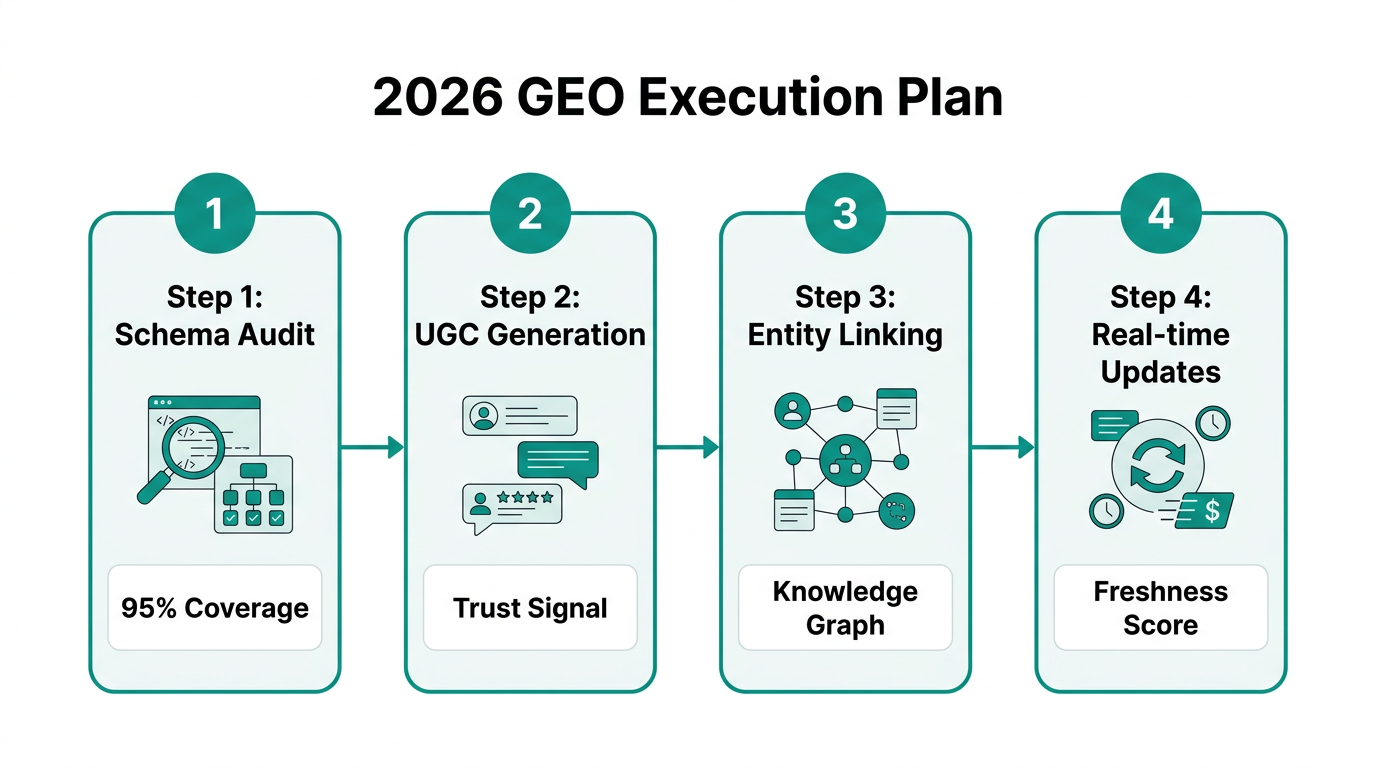
Transitioning from GEO vs SEO 2026 requires a methodical approach. Follow these steps to ensure your brand is ready for the era of answer engines.
Step 1: Implement Advanced Schema & Entity Grounding
Don't just use standard tags. Use Hightouch or similar composable CDPs to sync your product data directly with your site's schema. Ensure every claim on your page is backed by a "Source" tag that an AI agent can verify. Machine-readable content is the foundation of 2026 visibility.
Step 2: Optimize for Intent-First Clusters
Forget high-volume keywords. Focus on high-intent conversational clusters. For example, instead of targeting "marketing automation," target clusters like "AI automation consultant pricing for SaaS startups" or "how to integrate Claude with Salesforce CRM." These are the specific queries AI agents are tasked with answering.
Step 3: Leverage Agentic AI for Outcome-Based Content
In 2026, content creation is handled by Agentic AI—systems that don't just write copy but autonomously run A/B tests. Use tools like Zapier Central or Enrich Labs to build "meta-agents" that monitor AI search results and automatically update your site's content fragments to improve citation rates.
"Organizations using agentic AI reported a 41% average revenue increase and a 77% higher conversion rate compared to manual processes in 2026."
Step 4: Scale Human-Centric Trust Signals
Combat the "AI Slop" backlash by flooding the ecosystem with real human reviews and UGC. Use Stormy AI to find creators who can produce authentic content on TikTok and YouTube. These mentions act as third-party validation that AI engines crave.
Conclusion: The Future of Visibility
As we move deeper into 2026, the success of your brand depends on your ability to pivot from SEO to GEO. The goal is no longer to be the loudest voice in the room, but to be the most cited. By focusing on machine-readable content, advanced schema, and high-trust human signals like UGC, you can ensure your brand remains at the center of the AI-driven conversation.
The transition is not without its risks. As Gartner research suggests, by 2027, some brands may even differentiate themselves by being "AI-Free" to regain trust. However, for most businesses, the path forward is clear: embrace Answer Engine Optimization and build a technical foundation that allows AI agents to discover, verify, and recommend your products with confidence.