The 18-Minute Campaign: A Claude Code Playbook for Growth Teams in 2026
Master the Claude Code playbook for rapid campaign deployment. Learn how AI growth marketing strategies in 2026 achieve 10.3x ROI via automated A/B testing.
In 2026, the distance between a product concept and a multi-variant ad campaign has collapsed. The era of the "two-week sprint" for creative development is over, replaced by agentic workflows that operate in minutes. Growth marketing is no longer about who can write the best prompt, but who can orchestrate the best autonomous agents. This Claude Code playbook outlines how high-performance teams are using the 18-Minute AI Team framework to dominate their niches with unprecedented speed and precision.
The New Marketing Reality: From Prompting to Orchestration
The marketing landscape in 2026 has transitioned from simple chatbots to agentic orchestration. Companies now allocate an average of 18.4% of their total marketing budget directly to AI-native tools and infrastructure, according to recent data from Gartner's 2026 CMO Report. The focus has moved from "chatting" to "doing," where tools like Claude Code allow marketers to describe a workflow—such as analyzing a competitor and building a landing page for the identified gap—and have the AI execute the entire technical build.
"In 2026, the focus has moved from 'Chatting' to 'Doing.' Marketers who fail to adopt agentic orchestration will find themselves outcompeted by teams that can iterate 50 times faster."
Teams using these agentic tools report a 75% reduction in time spent on repetitive strategic analysis. This efficiency gain allows growth leads to shift toward high-level strategy and creative vision rather than manual execution. To compete, your stack must move beyond the browser and into the CLI (Command Line Interface) where autonomous agents can interact with your local files and live APIs in real-time.
The "Build-Test-Win" Stack for 2026
Success requires a specific ecosystem of tools that talk to each other. In 2026, the modern growth stack relies on agentic orchestration to connect disparate platforms like TikTok Ads Manager and specialized AI-powered CRMs. Below is the essential stack for rapid campaign deployment.
| Tool | Primary Use | 2026 Monthly Cost |
|---|---|---|
| Claude Code | Autonomous Campaign Building | $100 (Max Tier) |
| Gemini 3.1 Pro | Real-time Search & Google Ads Sync | $19.99 |
| Surfer SEO | GEO Content Optimization | $89 |
| Jasper AI | Enterprise Brand Voice Copy | $49 |
| Opus Clip | UGC & Video Re-purposing | $19 |
While legacy tools like Meta Ads Manager remain critical, they are now managed by sub-agents. For example, the Max Tier for Claude Code ($100/mo) is the professional sweet spot, allowing for near-unlimited concurrent sub-agents to handle everything from lead scoring to multi-variant headline testing.
The "18-Minute AI Team" Framework
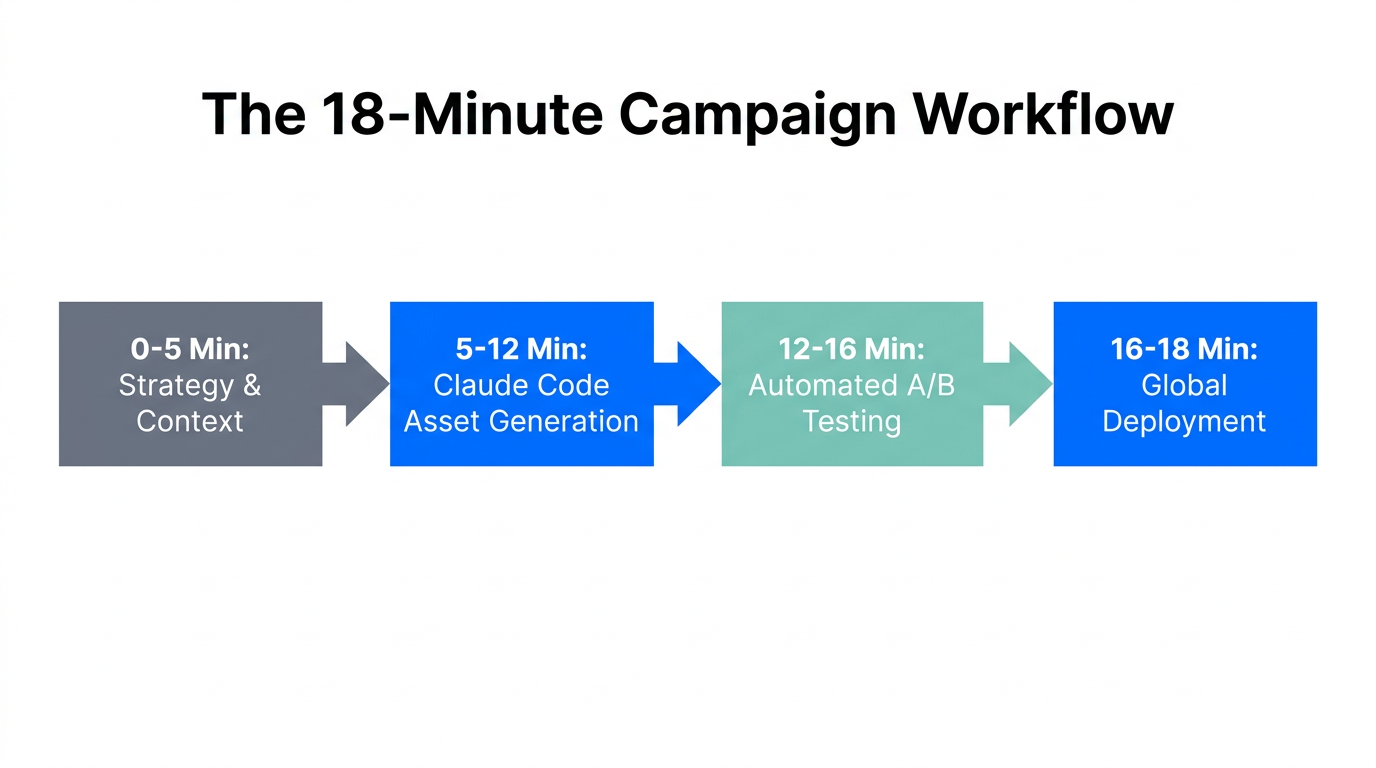
This playbook allows a single growth marketer to function as a full-scale agency. By using Model Context Protocol (MCP), which acts like a "USB-C for AI," you can connect Claude directly to your CMS and ad accounts without manual data exports.
Step 1: Initialize the Environment
Start by setting up your marketing workspace in the terminal. Run claude init to allow the agent to index your project files, including brand guidelines and past performance data. This ensures all generated assets stay within your specific brand-voice.
Step 2: Connect via MCP Servers
Link your tech stack using MCP. This allows Claude to "see" your live Google Ads data and your Shopify store. For instance, a WordPress MCP allows the AI to find content gaps and publish landing pages autonomously. Platforms like Stormy AI provide essential creator discovery data that can be fed into this workflow to source the high-quality UGC needed for the campaign's visual assets.
Step 3: Deploy Ad Agents
Use the command /copy [URL] to generate 50 unique ad variants based on a landing page. Claude will analyze the page, identify the core value propositions, and output a multi-variant testing grid for your ad accounts. This replaces hours of manual copywriting with seconds of strategic generation.
Step 4: Real-time Audit and Iteration
Run /audit [URL] for a complete Generative Engine Optimization (GEO) report. Unlike traditional SEO, GEO focuses on how AI engines like SearchGPT perceive your brand. The agent will suggest real-time adjustments to ensure your brand is mentioned as a top solution in AI-generated answers.
Automated A/B Testing: Adjusting Headlines Every 24 Hours
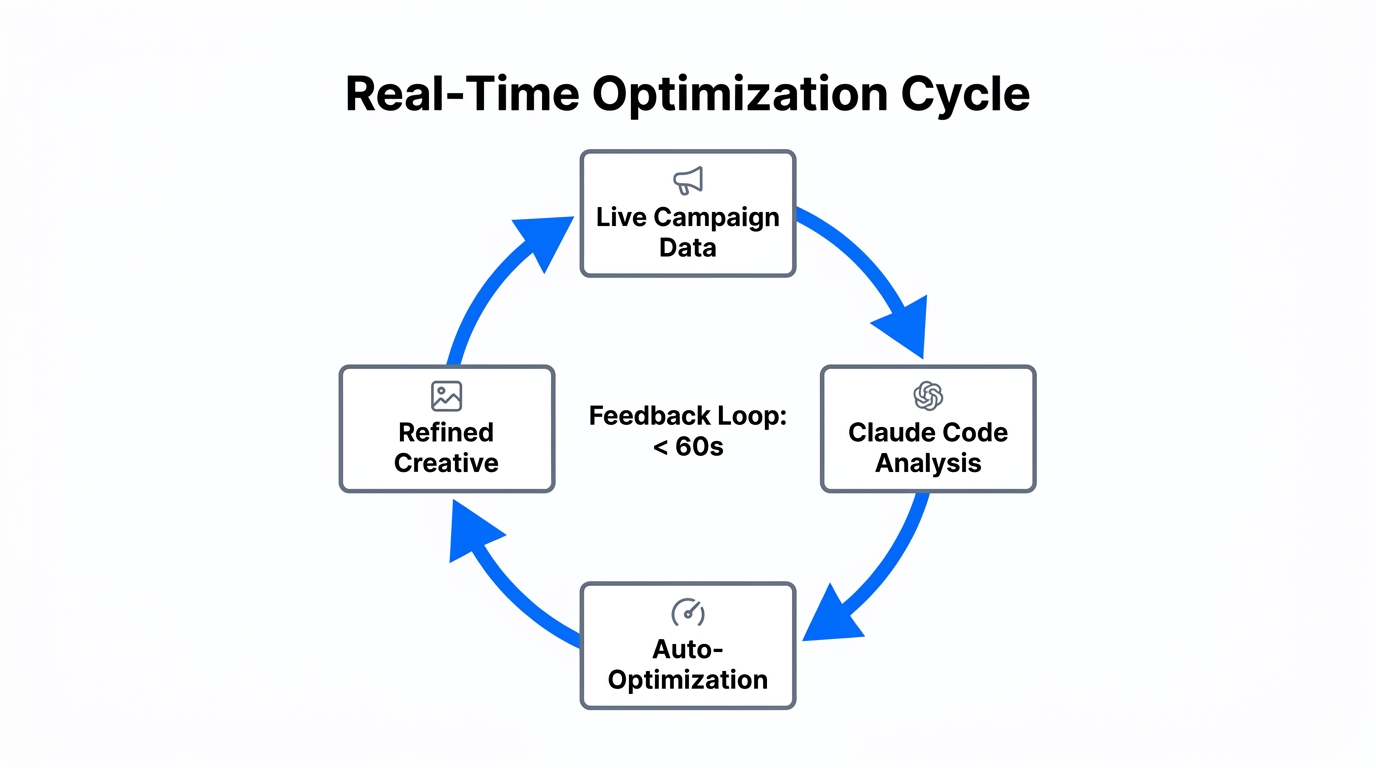
One of the biggest shifts in 2026 is the move from static A/B testing to dynamic optimization. Using Gemini 3.1 Pro integrated with Apple Search Ads or Google Ads, marketers can now adjust headlines every 24 hours based on real-time search trends. If a sudden trend emerges on TikTok, your AI agent detects the shift and rewrites your ad copy to match the new semantic intent.
This level of responsiveness was previously impossible for human teams. By leveraging agentic SEO workflows, content clusters are updated automatically to maintain dominance in AI Overviews. Research from agencies like Primal shows that AI-optimized creative variants are delivering a 23% reduction in Cost-Per-Acquisition (CPA) on Meta and a 15% lift in conversion rates on Google.
"AI makes 'average effortless,' leading to a flood of bland content. The winning teams in 2026 are those who use AI for speed but keep humans in the loop for soul."
Scale without the Slop: Bypassing the AI Backlash
The biggest risk in 2026 is "AI Slop." Following high-profile failures from global brands whose holiday campaigns were panned as "soulless" and "uncanny," consumers have become hyper-aware of purely AI-generated visuals. According to Forbes, only 38% of consumers view AI-generated marketing positively, creating a significant trust crisis.
To bypass this, growth teams must use a Human-in-the-Loop (HITL) model. This involves:
- UGC Hybridization: Use AI to script and optimize, but use human creators for the final video output.
- Brand-Voice Guardrails: Use Jasper AI or specialized Claude prompts to inject unique brand perspectives that a generic LLM cannot replicate.
- Interactive Value Exchanges: Replace static content with AI-gated tools (e.g., personalized skincare advisors) that provide immediate value in exchange for first-party data.
Case studies from global retailers like A.S. Watson show that deploying an AI skincare advisor resulted in a 396% conversion rate boost, proving that when AI provides genuine utility, consumer trust increases.
The Economics of Agentic Growth: Results-Based Models
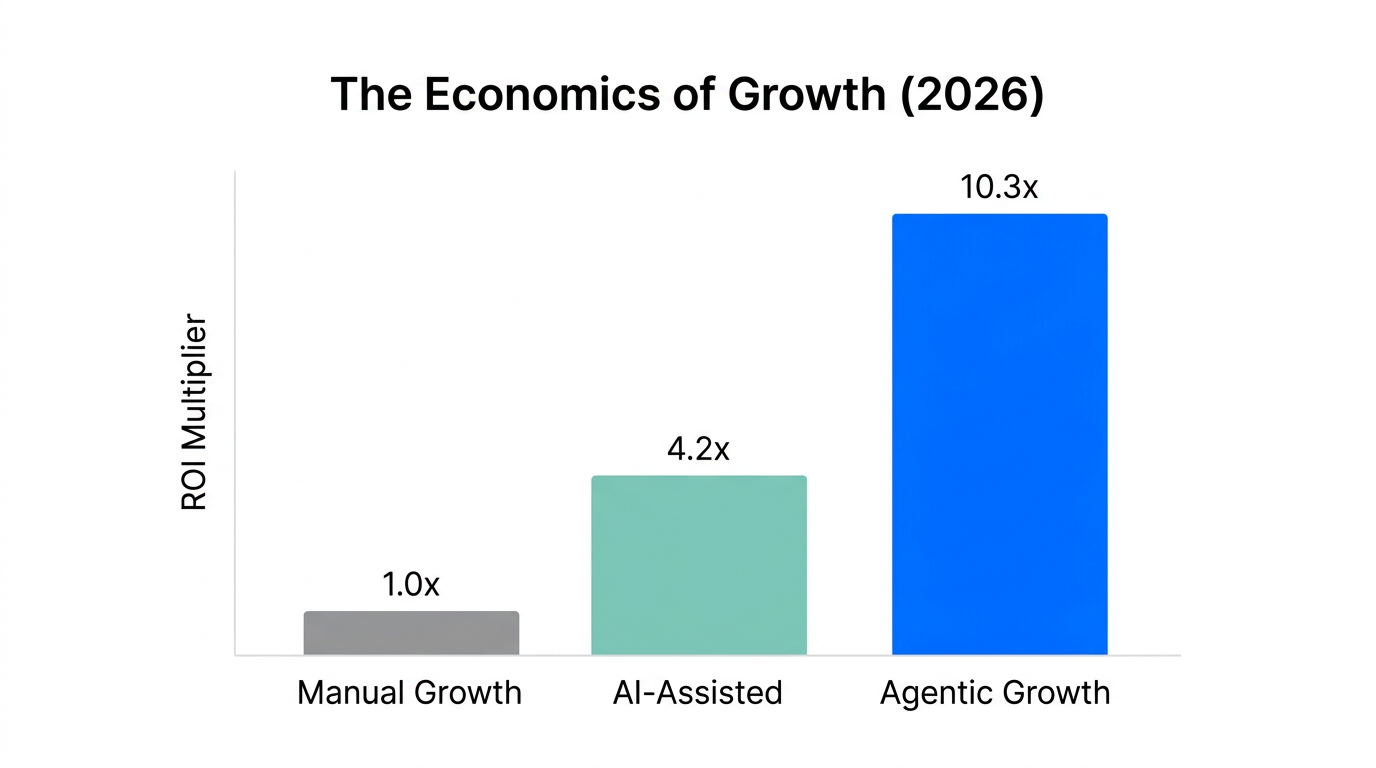
In early 2026, the industry saw the first major shift toward performance-guaranteed AI SaaS. Companies like ActiveCampaign now offer account credits if their autonomous agents do not reach specified performance goals. This has fundamentally changed how growth teams track success.
| Metric | Traditional Manual Result | Agent-Led Result (2026) |
|---|---|---|
| Sales Efficiency | Baseline | +20% Increase |
| Email Revenue | 2% of total | 37% of total |
| Campaign Turnaround | 14 Days | 18 Minutes |
| CTR (Triggered Email) | Baseline | 332% Higher |
This 10.3x ROI is only achievable when agents are given autonomy over lead scoring and personalized outreach. Data from Omnisend reveals that automated "agentic" flows now contribute significantly more to total revenue than manual blast campaigns ever did. Furthermore, B2B sales teams using AI for lead scoring report 40% higher conversion rates, according to Cubeo.
Conclusion: Deploying Your First 18-Minute Campaign
The Claude Code playbook is not just a technical guide; it is a fundamental shift in how growth teams operate. By moving from manual execution to agentic orchestration, you can deploy, test, and optimize campaigns at a scale previously reserved for the world's largest agencies. Start by initializing your environment, connecting your stack via MCP, and letting your sub-agents handle the high-volume tasks of variant generation and headline optimization.
As you scale, remember that the most successful campaigns in 2026 are those that balance AI speed with human insight. Use platforms like Stormy AI to find the authentic human creators that keep your creative from feeling like "AI slop." By following this AI growth marketing strategy, you ensure your brand remains competitive in an increasingly automated world where trust is the ultimate currency.