The Claude Code Marketing Playbook: Automating Growth with Agentic Workflows
Learn how to configure Claude Code for automated growth hacking in 2026. This tactical tutorial covers MCP servers, custom slash commands, and agentic workflows.
In 2026, the era of "Chat AI"—where we spent our days coaxing chatbots to write better email copy—is officially over. We have entered the age of Action AI. The modern growth engine is no longer a static stack of SaaS tools; it is a Marketing Automation Mesh where autonomous agents navigate APIs and databases to execute complex strategies without human hand-holding. At the center of this shift is Claude Code, the agentic CLI that reached $2.5 billion in annualized run-rate revenue by Q1 2026, serving over 300,000 business customers.
For the technical marketer, Claude Code is more than a terminal-based assistant; it is the orchestrator of your growth experiments. Whether you are running Agentic SEO audits or managing a fleet of TikTok campaigns, the ability to script agentic marketing workflows is the single most valuable skill this year. This guide provides a step-by-step Claude Code marketing tutorial to move you from manual tasks to a fully automated growth mesh.
The 2026 Marketing Mesh Landscape: From Stack to Canvas
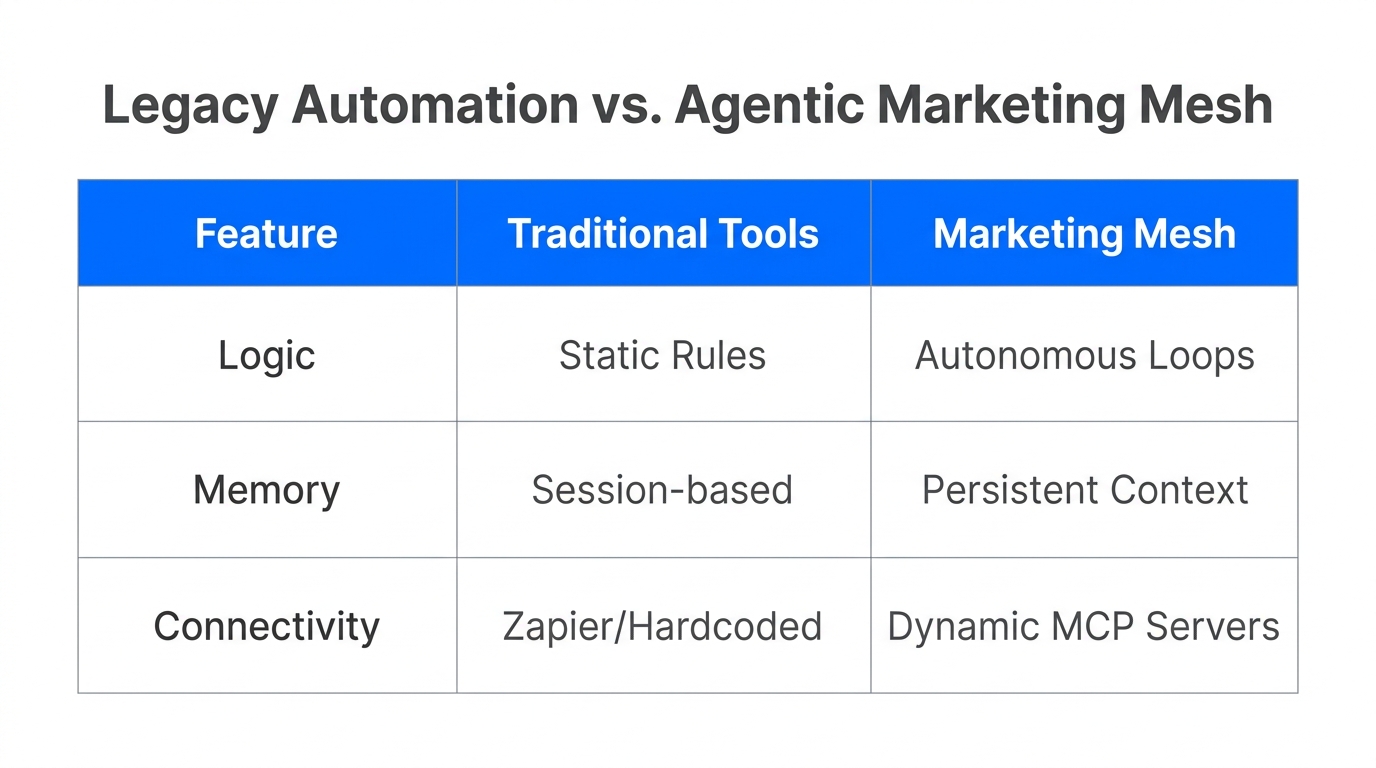
The transition from a "MarTech Stack" to a "Composable Canvas" is no longer a theoretical prediction. As Scott Brinker, VP at HubSpot, recently noted, the rigid martech stack is giving way to a unified data foundation where agents roam freely to find information. This mesh architecture allows for unparalleled efficiency; marketing teams using agentic tools like Stormy AI already report a 75% reduction in time spent on repetitive strategic analysis.
"The Technical Marketer 2.0 doesn't write code; they orchestrate agents to build and monitor the systems that do."
As of 2026, the AI Agent Market has reached $12.06 billion, with 79% of companies adopting AI agents in some capacity. This growth is driven by a shift toward Agentic Commerce, where AI agents act as the actual "customer," scanning catalogs via APIs to make purchasing decisions. Marketers must now optimize for these agents through Answer Engine Optimization (AEO) and machine-readable content feeds.
| Category | Tool/Platform | Role in the Mesh | 2026 Pricing |
|---|---|---|---|
| Orchestrator | Claude Code | Executing terminal commands and API calls | $20 - $200/mo |
| Mesh Foundation | RudderStack | Routing warehouse-native event data | Free to Enterprise |
| Workflow Mesh | n8n | Visualizing agentic workflow triggers | $20+/mo |
| Standard | MCP | The protocol connecting AI to your stack | Open Source |
Step 1: Initializing Permanent Marketing Memory with CLAUDE.md
The biggest mistake marketers make with Claude Code is treating every session as a blank slate. To build effective agentic marketing workflows, you must establish a permanent context. By creating a CLAUDE.md file in your project root, you provide Claude with "permanent memory" regarding your brand voice, Ideal Customer Profile (ICP), and historical campaign data.
Your CLAUDE.md should act as the "source of truth." Include sections for your brand style guide, high-performing keyword lists, and technical documentation for your marketing APIs. This ensures that every time you launch a command, Claude already knows your tone is "professional but accessible" and that you prioritize UGC-style content for TikTok Ads campaigns.
CLAUDE.md to store persistent brand data. This prevents "context drift" and ensures Claude remains aligned with your 2026 growth strategy without repeated prompting.Step 2: Connecting the Mesh with Marketing MCP Servers
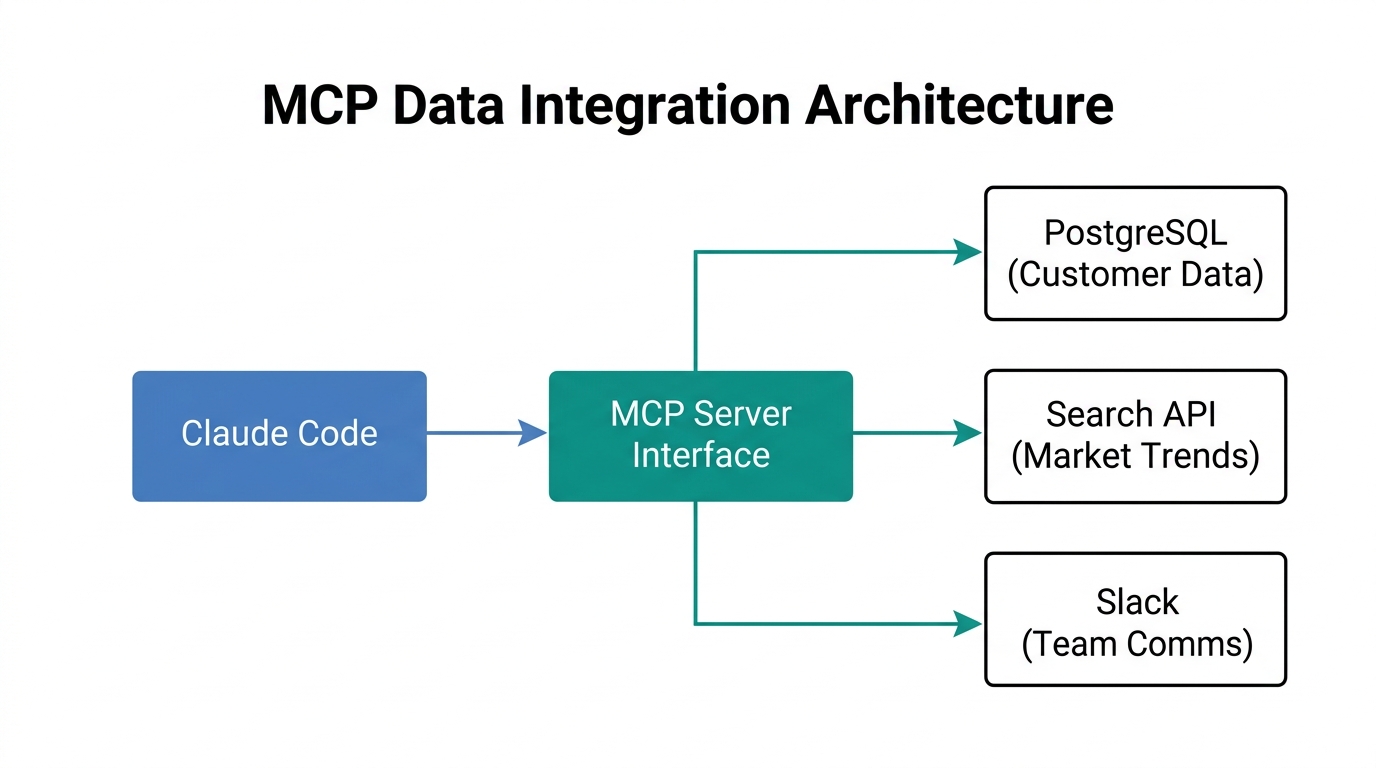
The Model Context Protocol (MCP) is the open standard that allows Claude Code to talk directly to your marketing tools. Instead of downloading CSVs and uploading them to a chat window, you can install marketing MCP servers to give Claude native access to your data.
To start building your automated growth hacking 2026 setup, install these critical connectors via the terminal:
claude mcp add google-drive: Gives Claude access to your content briefs and marketing assets.claude mcp add hubspot: Allows Claude to fetch real-time CRM data and deal stages directly from HubSpot.claude mcp add adloop: A powerful open-source server for managing Google Ads and GA4 performance via CLI.claude mcp add zapier: Connects Claude to over 6,000 legacy apps for complex automation chains via Zapier.
With these servers active, you can ask Claude questions like, "Analyze our Google Ads CPC trends from last month and cross-reference them with our high-value leads in HubSpot." This eliminates the "integration plumbing" that used to take days of manual work.
"The move from 'Chat AI' to 'Agentic Mesh' is delivering ROI benchmarks as high as 544% for companies that automate their data routing."
Step 3: Deploying Specialized Subagents in .claude/agents/
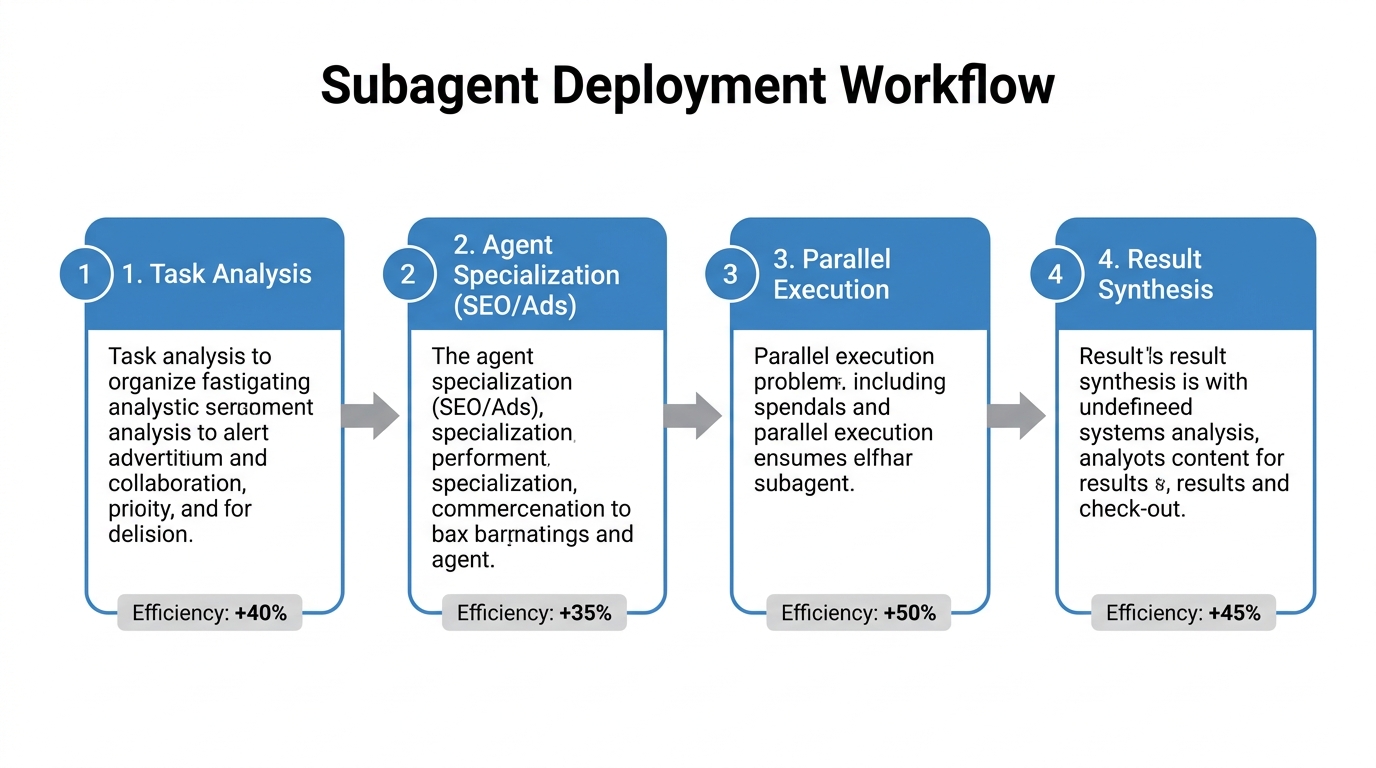
Complexity is the enemy of automation. Instead of asking one Claude instance to handle everything, the Claude Code marketing playbook suggests deploying specialized subagents. In your project directory, create a .claude/agents/ folder and define specific personas for different growth tasks.
By defining subagents, you can assign dedicated tasks such as UTM Generation, PPC Performance Monitoring, or Content Repurposing. For example, a specialized "SEO Agent" can be configured to focus solely on crawling your site and checking for GEO (Generative Engine Optimization) compatibility, while a "Social Agent" monitors engagement on TikTok and Instagram.
Example Subagent Workflow:
- The Researcher: Scans competitor pricing and ad copy via search APIs.
- The Strategist: Takes the research and drafts a new campaign brief in
CLAUDE.md. - The Executor: Uses the Canva MCP to generate creative assets based on the strategist's brief.
This multi-agent orchestration is now standard; Anthropic reports that 57% of organizations now use "Agent Teams" to handle research, coding, and QA in parallel.
Step 4: Building Custom Slash Commands for Growth
Efficiency in Claude Code comes down to your /commands. Rather than typing long prompts, technical marketers create custom slash commands that trigger entire agentic sequences. A common command in 2026 is /market-audit [URL], which triggers parallel scans of SEO, copy quality, and competitor positioning.
| Command | Action Triggered | Tools Used |
|---|---|---|
/market-audit | Parallel competitor and SEO scan | Frase MCP, Google Search |
/ppc-check | Scans ad accounts for budget anomalies | AdLoop MCP, Slack |
/utm-gen | Creates tracking links and updates sheets | Google Drive MCP, Bitly |
/ugc-brief | Generates a creator brief from product data | Notion MCP, Stormy AI |
These commands transform Claude from a chat interface into a powerful marketing operating system. You can even configure Auto Mode, a feature launched in March 2026, which allows Claude to skip permission prompts for low-risk actions like reading files or searching the web, further accelerating your workflow.
"Companies implementing mesh architectures report an average 10% revenue boost within the first 6–9 months of deployment."
Step 5: Managing Context Compaction and Usage Limits
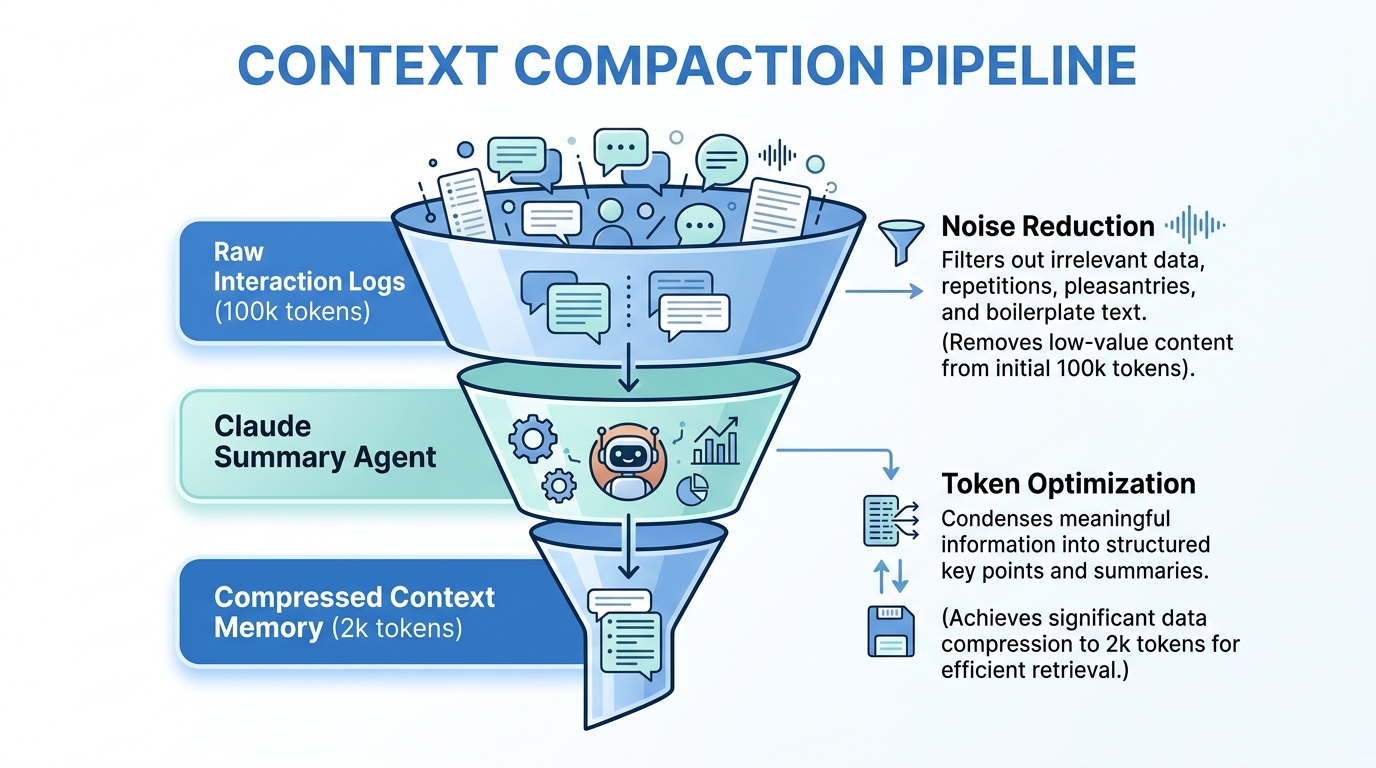
With great power comes high token usage. One of the biggest pain points for power users is the "Context Trap." A single complex command like "refactor this entire email automation script" can consume over 150,000 tokens, quickly hitting the limits of Claude Code Pro plans.
To maintain your automated growth hacking 2026 systems, you must master "Context Compaction." This involves regularly archiving old project data and summarizing long CLAUDE.md files into shorter, more efficient instructions. Additionally, Anthropic now offers Quota Happy Hour during off-peak hours (8 AM – 2 PM ET), where token budgets are doubled—perfect for running heavy data analysis or batch content generation.
Conclusion: The Future of the Technical Marketer 2.0
As we move deeper into 2026, the divide between "traditional" and "technical" marketers will only widen. Those who embrace Claude Code commands for marketers and build their own agentic marketing workflows will find themselves leading the industry. By configuring your CLAUDE.md, connecting your stack via marketing MCP servers, and deploying specialized subagents, you are not just automating tasks—you are building a self-improving growth machine.
The transition is not without risk—only 16% of RevOps professionals fully trust their data accuracy today—but the rewards are undeniable. From 836% ROI in omnichannel personalization to saving 14 hours a day on social automation, the "Mesh" is the ultimate competitive advantage. For those looking to source the best creators for these automated campaigns, platforms like Stormy AI provide the data foundation needed to fuel your agentic workflows with high-quality influencer talent. Start building your mesh today, or get left behind in the age of the agent.