The Ad Divide: Why Top Brands Use Claude Code for Creative Hooks and Brand-Led Growth in 2026
Discover how the 2026 'Ad Divide' uses Claude Code for creative hook mapping and brand growth. Learn to deploy agent swarms for performance marketing success.
In 2026, the marketing landscape has shifted from simply chatting with AI to running Operational AI environments. The era of generic chatbots is dead, replaced by autonomous agents that live in terminal windows and navigate entire brand ecosystems. At the heart of this shift is the 'Ad Divide'—a strategic split where high-growth teams utilize OpenAI for raw data logic and bid automation, but rely exclusively on Claude Code for creative hooks, emotional resonance, and brand-led growth. As Anthropic’s annualized revenue run-rate hit $14 billion in early 2026, according to DemandSage, the message from the market is clear: nuance is the new currency of performance marketing.
Defining the 'Ad Divide': Logic vs. Brand Resonance
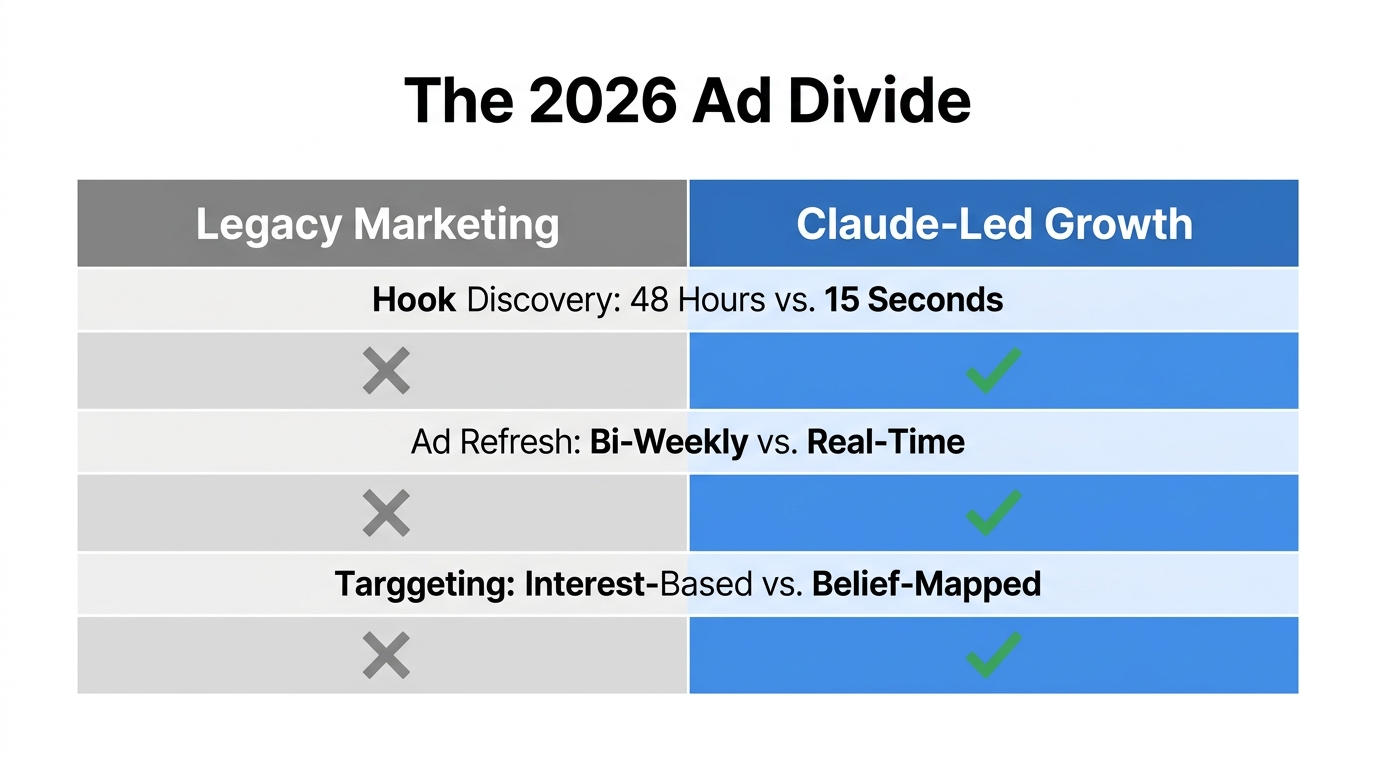
The 'Ad Divide' is the formal recognition that not all LLMs are created equal for GTM (Go-To-Market) tasks. While models like GPT-5.2 excel at complex Python scripts and math-heavy bidding caps, they often fall into a trap of 'robotic fluff' when tasked with brand creative. Conversely, Claude has surged to a 32% enterprise market share this year, as reported by Stormy AI, primarily because of its superior ability to maintain brand consistency and execute complex reasoning.
For a growth lead in 2026, the stack is specialized. You use OpenAI to calculate the LTV/CAC ratios and script your automated bidding rules, but you use Claude to write the scripts that stop the scroll. This trend is driven by Claude Code, a terminal-native agentic tool that allows marketers to organize files, write updates, and automate the busywork of GTM engineering directly from their command line. As Boris Cherny, creator of Claude Code, noted at GTMnow, people are using it as an 'apartment with AI in it,' managing entire pipelines without ever opening a browser UI.
| Feature | Claude (Opus 4.5/4.6) | OpenAI (GPT-5.2) | Google Gemini 3 Pro |
|---|---|---|---|
| Best For | Strategic reasoning, brand voice | Data analysis, complex math | Ecosystem integration |
| Philosophy | Operational/Agentic | Performance/Logic | Distribution/Multimodal |
| GTM Strength | Creative Hook Mapping | Bid Automation scripts | Bulk SEO generation |
"The 'Anthropic Voice' has become the gold standard for 2026 brand creative because it avoids the 'Corporate Memphis' feel of traditional AI outputs."
The 'Belief Friction' Detection Technique
One of the most powerful applications of Claude in 2026 is Belief Friction detection. In a world where every consumer is bombarded by AI-generated ads, the only way to convert is to identify exactly where a customer is hesitant and address it with surgical precision. Traditional marketing tools look at clicks; Claude looks at intent. By feeding Claude years of customer call transcripts and support tickets—a technique recommended by GTM Strategist Maja Voje—the AI can map out 'Belief Gaps.'
If your customer believes your software is 'too hard to implement,' Claude doesn't just write a 'How-To' guide. It generates a Creative Hook that centers on the emotional relief of a 1-click setup. This granular understanding of Claude Code brand voice allows brands to create counter-angles that resonate on a psychological level rather than just a feature-comparison level. Platforms like Stormy AI have seen this in action, where personalized outreach driven by deep emotional mapping yields a 4.8% meeting-booked rate, far outpacing the 0.6% industry average for templated automation.
Setting up 'Claude War Rooms' for Real-Time Competitive Response
The speed of business in 2026 requires more than monthly strategy meetings. Top brands now use Claude Projects as persistent, internal 'War Rooms.' These are shared environments where the AI has access to every piece of competitive intelligence, pricing change, and product launch in the market. When a competitor drops their price at 9:00 AM, a Claude War Room has already identified the threat, analyzed the impact on your current funnel, and prepared three counter-angles by 9:15 AM.
This is made possible by the Model Context Protocol (MCP), which allows Claude to read and write to databases like HubSpot or Salesforce without middle-ware. According to GTMnow, over 40 major GTM tools adopted MCP by late 2025, effectively turning Claude into a real-time central nervous system for revenue ops. Unlike 'Agent Washing'—where legacy tools claim to be agents but are just simple sequences—these War Rooms utilize the full reasoning capabilities of Sonnet 4.6 to execute complex, multi-step market responses.
"The goal is an AI team member, not a replacement. Success in 2026 requires aligning these agents within a strategic framework so they amplify your GTM efforts." — Paul Sullivan, Arise GTM.
Case Study: The 4.8% Meeting-Booked Success Story
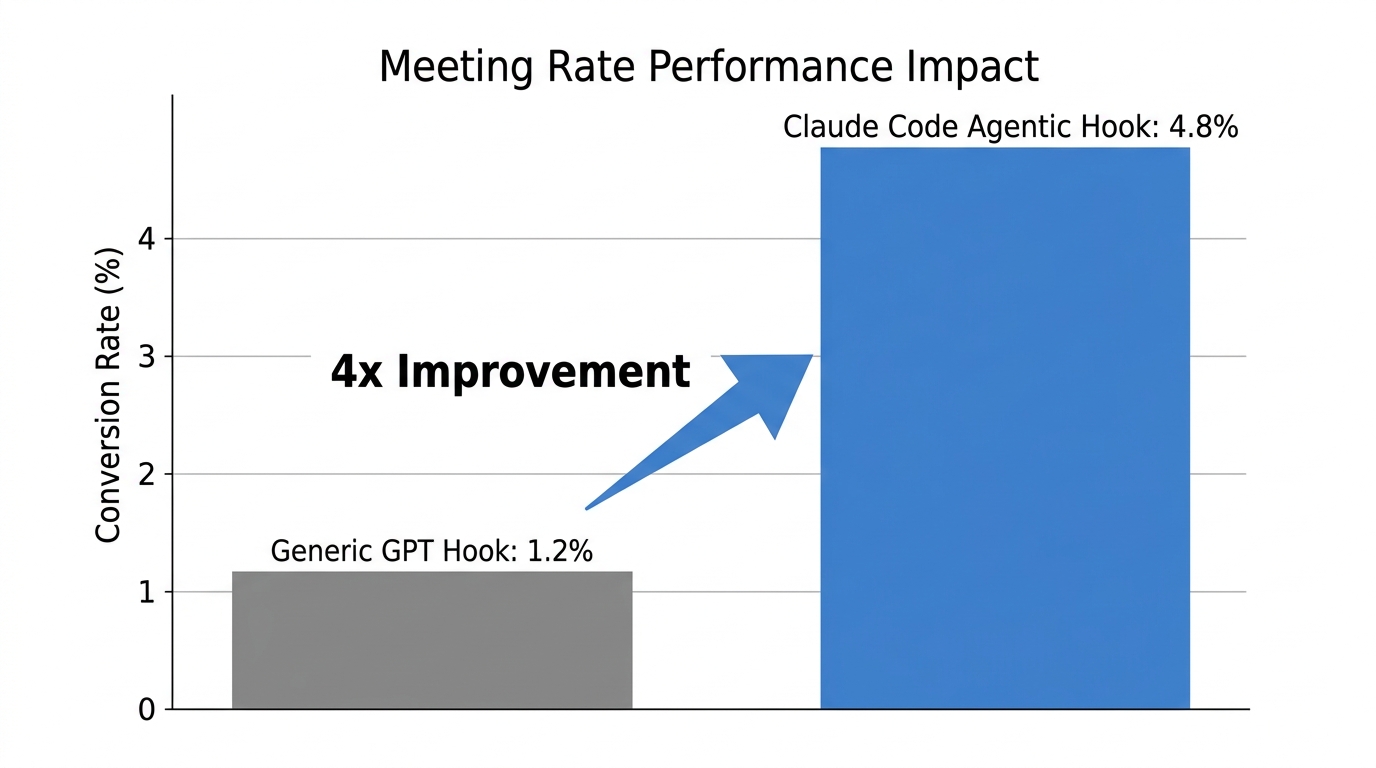
A mid-market B2B SaaS company recently overhaul their outbound strategy using Claude's Creative Hook mapping. Instead of the standard 'Hey, I saw your post' emails, they utilized a Claude Code agent to scrape the LinkedIn activity and quarterly reports of their top 500 target accounts. This wasn't just data scraping; it was Context Engineering.
The agent mapped specific challenges mentioned by CEOs to the 'Belief Friction' points of their own product. The result? A personalized outreach campaign that achieved a 4.8% meeting-booked rate. This performance is backed by data from Stormy AI, which indicates that agentic performance marketing—moving from manual ads to autonomous 'swarms'—is the most significant driver of CAC reduction in 2026. In fact, enterprises using HockeyStack's AI-native attribution report a 42% reduction in CAC when utilizing real-time CRM syncing via Claude MCP.
Playbook: Running Agent Swarms for Creative Automation
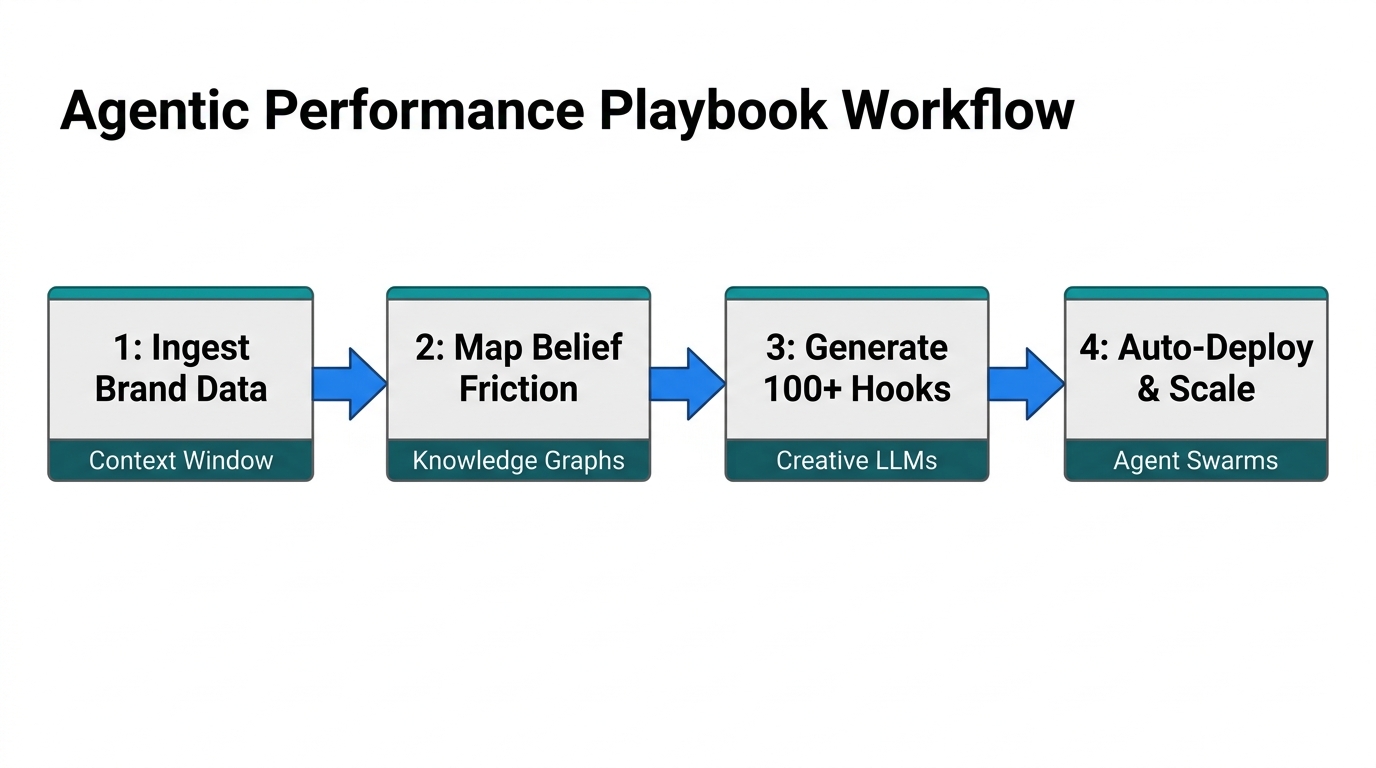
If you want to survive the 2026 ad landscape, you must move toward Agentic Performance Marketing. This involves setting up 'swarms'—multiple Claude instances working in parallel—to monitor platforms like Meta Ads Manager and TikTok Ads in real-time. Here is the 2026 playbook for deploying these swarms via the terminal.
Step 1: Install the Agentic Core
The foundation of 2026 GTM engineering is terminal-native. You don't need a browser to start. Install the toolset via npm: npm install -g @anthropic-ai/claude-code. Once installed, authenticate and connect your marketplace of agents from repositories like the GTM Agents Repo, which contains over 90 specialized agents for sales and marketing automation.
Step 2: Connect the Model Context Protocol (MCP)
To give your agents 'eyes' on your revenue, you must connect them to your data. Use the command claude mcp add hubspot-server --api-key=YOUR_KEY to bridge the gap. This allows Claude to see which creative hooks are actually leading to closed-won deals, not just clicks. This level of AI creative automation ensures your budget is never wasted on 'vanity metrics.'
Step 3: Deploy the Monitoring Swarm
Using a terminal script, set up a swarm to monitor LinkedIn/Facebook CPMs every 15 minutes. If a specific creative's CPM spikes by more than 20% without a corresponding lift in conversion, the agent automatically pauses the ad and triggers a Slack notification. This prevents the 'Ad Decay' that plagued growth teams in 2024 and 2025.
"2026 is the year we stop being 'Prompt Engineers' and start being 'Context Engineers.' It's about what you feed the machine, not just how you ask it."
The 'New GTM' Stack: Context over Conversational UX
As we move deeper into 2026, the 'Ad Divide' will only widen. Companies like TELUS have already saved over 500,000 hours of manual labor by deploying internal Claude-based tools for research and content auditing, according to Stormy AI. Even massive enterprises like Deloitte have deployed Claude to 470,000 employees, focusing on knowledge synthesis rather than simple text generation, as noted by Panto AI.
To compete, your growth stack must be API-first. Teams are abandoning traditional UIs for persistent agents hosted on platforms like Railway. For example, the 'Scaleport' model involves scraping every Slack message and Zoom transcript into a PostgreSQL database, allowing a custom Claude agent to manage meeting agendas and accountability with 94% client retention rates, according to Scaleport.
As you look to optimize your influencer marketing and creator discovery in this agentic era, leverage platforms like Stormy AI that integrate these autonomous capabilities directly into your workflow. Whether you're finding UGC creators for app install campaigns or mapping emotional triggers for a B2B launch, the tools are ready. The only question is: are you on the right side of the Ad Divide?