Automating Influencer Outreach in 2026: Using Stormy AI and OpenClaw for 62% Lower CAC
Learn how to use Stormy AI influencer discovery and OpenClaw's agentic commerce framework to automate seeding and reduce CAC by 62% in 2026.
In 2026, the traditional influencer marketing workflow—hours of manual scrolling, messy spreadsheets, and ghosted outreach emails—is officially obsolete. As social commerce matures into a projected $8.5 trillion industry by 2030, according to data from Statista and internal research by Stormy AI, the competitive edge has shifted from those who work hardest to those who deploy the smartest agents. For growth marketers, the goal this year isn't just to find influencers; it is to build an autonomous ecosystem that discovers, vets, negotiates, and ships product samples while the team focuses on high-level strategy. This is the era of Agentic Commerce.
By combining the advanced analytics of Stormy AI for discovery with the open-source execution power of OpenClaw, brands are achieving unprecedented efficiency. We are seeing a fundamental shift from Direct-to-Consumer (DTC) to Business-to-Agent (B2A) marketing, where AI agents act as the primary intermediaries for commerce. Those who have mastered this "agentic GTM" strategy report a 55% increase in operational efficiency and a staggering 62% reduction in Customer Acquisition Cost (CAC). This article provides the actionable playbook for setting up this 2026 tech stack.
"The agent economy reduces friction to near zero because the agent supports decisions that are already forming in the consumer’s mind." — Petralia, Ogilvy One
The Rise of OpenClaw and the Agentic Ecosystem

As of March 2026, OpenClaw has become the definitive framework for autonomous commerce. Originally known as Clawdbot, the project exploded in popularity, reaching over 274,000 GitHub stars as reported by Marketing Interactive and tracked on GitHub. In markets like China, the "Lobster Fever" has seen OpenClaw usage surpass even the U.S., with millions of monthly social engagements recorded by CARMA.
Unlike legacy automation tools like Zapier, which rely on rigid "If-This-Then-That" logic, OpenClaw agents—or Clawbots—possess reasoning capabilities. They can browse the web, interact with store data via the Shopify MCP Connector on Composio, and execute multi-step tasks across different platforms. When you pair this execution power with a discovery engine, you create a self-sustaining marketing machine.
Phase 1: Identifying High-ROI Micro-Influencers with Stormy AI
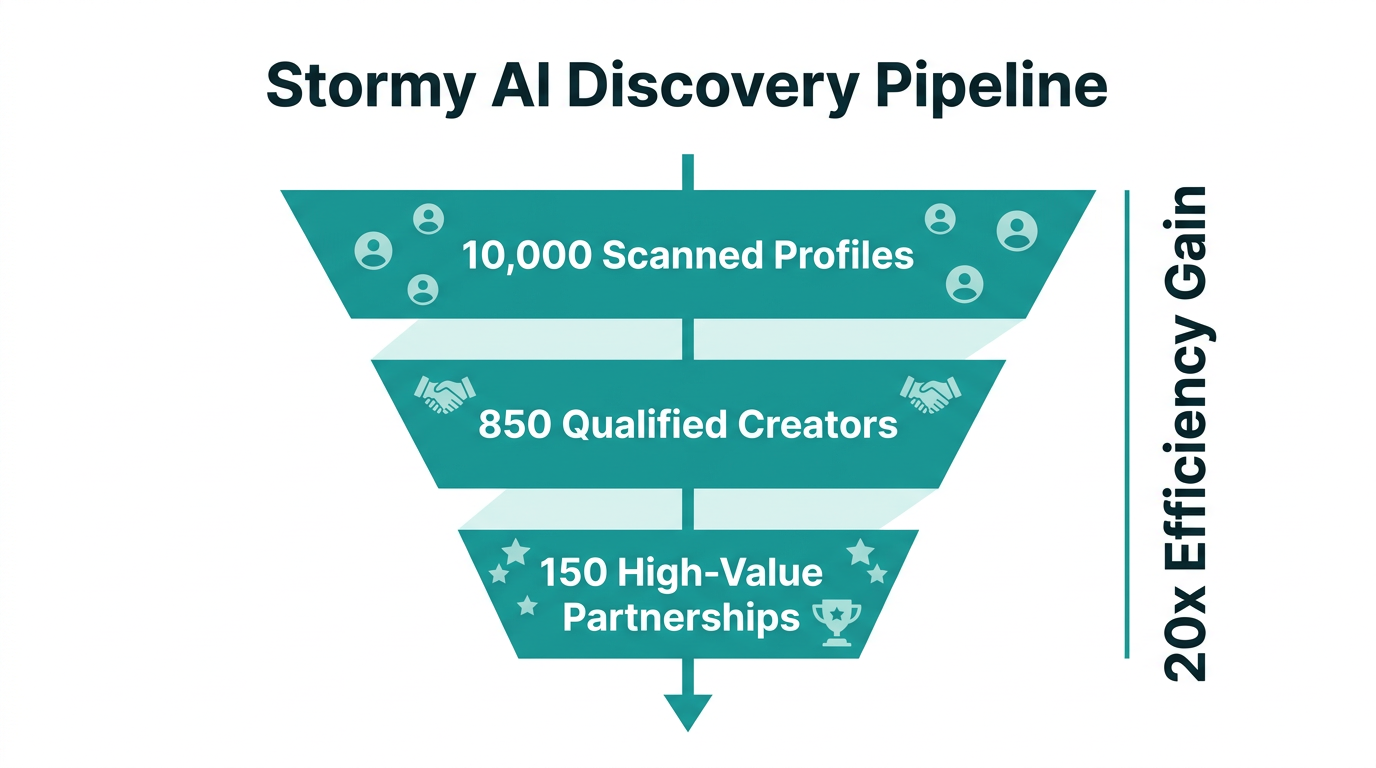
The first step in any automated pipeline is quality data. In 2026, the most successful brands avoid "celebrity" influencers in favor of hyper-targeted micro-influencers who command high trust. Stormy AI allows marketers to identify these creators using natural language prompts and deep performance analytics. Instead of manually checking engagement rates, you can task Stormy with finding creators who have a high probability of conversion based on historical audience sentiment and niche-specific quality scores.
Once you have identified a pool of creators, the platform's AI-powered vetting tools automatically detect fake followers and engagement fraud. This ensures that the "Clawbots" you deploy in the next phase are only reaching out to high-quality leads. According to Stormy AI research, brands using this AI-driven discovery process see a much higher intent-to-buy from the resulting traffic, as agents only initiate a session when the intent is 100%.
"Agents do not 'window shop.' Stores optimized for B2A see a 14.2% conversion rate for agent-initiated checkouts, compared to the human average of 2.1%."
Phase 2: Setting Up Multi-Channel 'Tentacles' for Outreach
Once your list of influencers is refined, the OpenClaw framework takes over the outreach. One of the most powerful features of the 2026 "Mantis" update is the ability to deploy Unified Multi-Channel Tentacles. A single OpenClaw brain can now manage conversations across WhatsApp, Discord, Telegram, and WeChat simultaneously using the same brand context.
Using Composio as the connectivity layer, your agent can access real-time inventory data to offer influencers specific products that are currently in stock. This isn't just a template email; the AI negotiates affiliate rates and answers questions about product specs in seconds. Case studies shared on Reddit highlight how one store owner replaced a $2,400/mo Virtual Assistant with a $50/mo OpenClaw agent that handled 93% of inquiries with an 87-second response time.
| Feature | OpenClaw (2026) | Legacy Automation (Zapier/Flow) |
|---|---|---|
| Logic Type | Reasoning: Understands context and exceptions. | Rules: Rigid If-This-Then-That logic. |
| Platform Access | System-level (Browser, Desktop, APIs). | API-level only. |
| Outreach Channels | Multi-channel "Tentacles" (WhatsApp, WeChat, etc.). | Limited to supported app integrations. |
| Cost Structure | Open Source + API Token fees. | Subscription-based per-task tiers. |
Phase 3: The Alchemy London Framework for Seeding
The most difficult part of influencer marketing has always been the logistics: shipping samples and tracking attribution. In early 2026, the agency Alchemy London pioneered an OpenClaw-driven "Influencer Order Tracking System." This framework, referenced in Stormy AI's latest reports, automates the entire seeding cycle via the Shopify Admin API.
When an influencer agrees to a collaboration during the automated outreach phase, the OpenClaw agent automatically creates a $0 draft order in Shopify, triggers the shipment from the warehouse, and sends the tracking number to the creator. To ensure global compliance, the framework uses the "London Protocol" to handle complex VAT and tax calculations across borders. This end-to-end automation is a primary driver behind the 4x revenue growth observed in brands adopting this protocol.
"OpenClaw isn't just a model; it's the hands and legs of your brand. We are moving from emotional marketing to mathematical optimization." — Jacky Chan, CTO, Votee AI
Measuring the ROI: 62% Lower CAC and Higher AOV
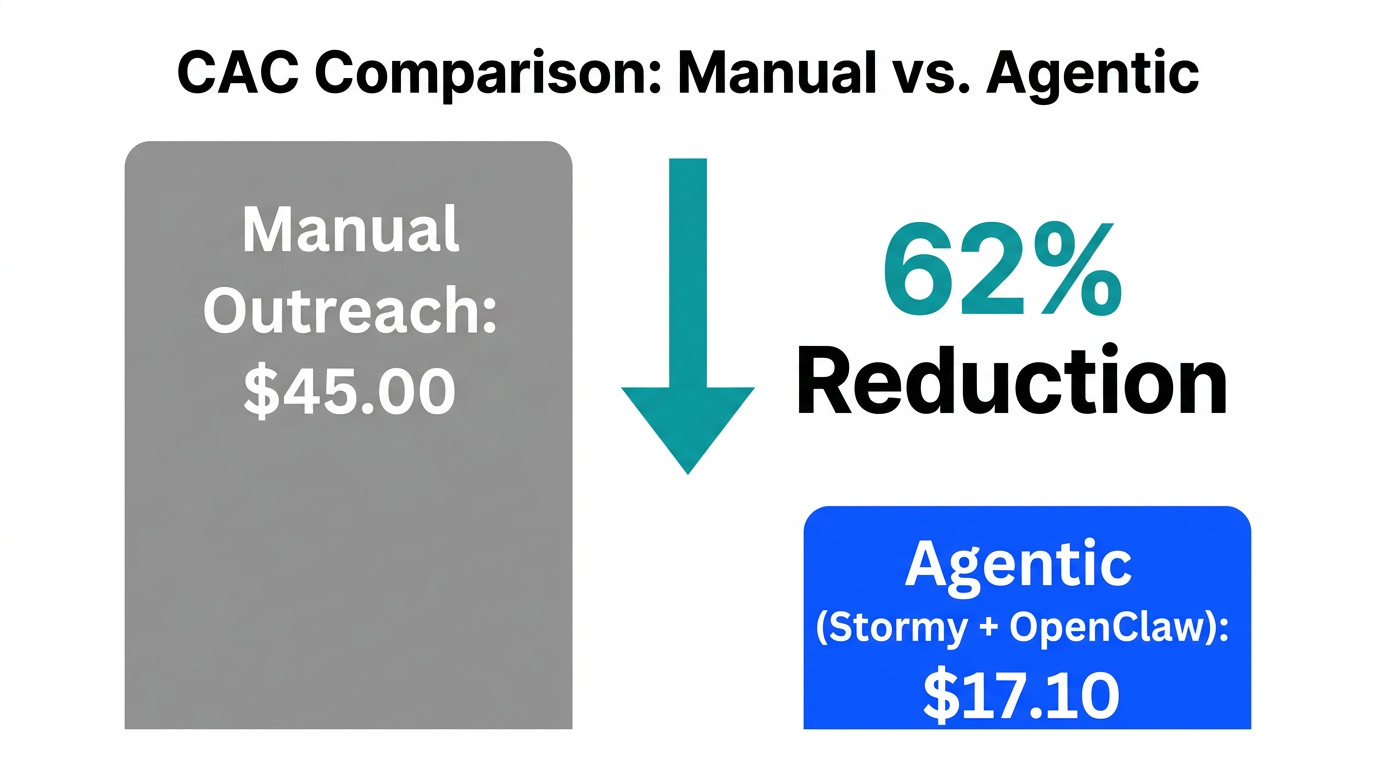
The data from the first quarter of 2026 is clear: agentic management is significantly more cost-effective. According to the Shopify Engineering Blog, the reduction in manual labor costs combined with the higher conversion rates of agent-verified traffic leads to a 62% drop in CAC. While the Average Order Value (AOV) is sometimes 11% lower—as agents are programmed to find the optimal price rather than falling for impulse add-ons—the sheer volume and efficiency more than compensate for the difference.
To monitor these metrics in real-time, many growth teams use Adzviser, an AI-native analytics platform that provides secure reports on agent-driven sales. This allows marketers to see exactly which influencers were sourced by Stormy AI and how many were successfully converted by the Clawbots. For apparel brands, these agents have even reduced return rates by 28% by cross-referencing influencer body data with garment specs before shipping samples, according to Retail Dive.
The 2026 Influencer Automation Playbook
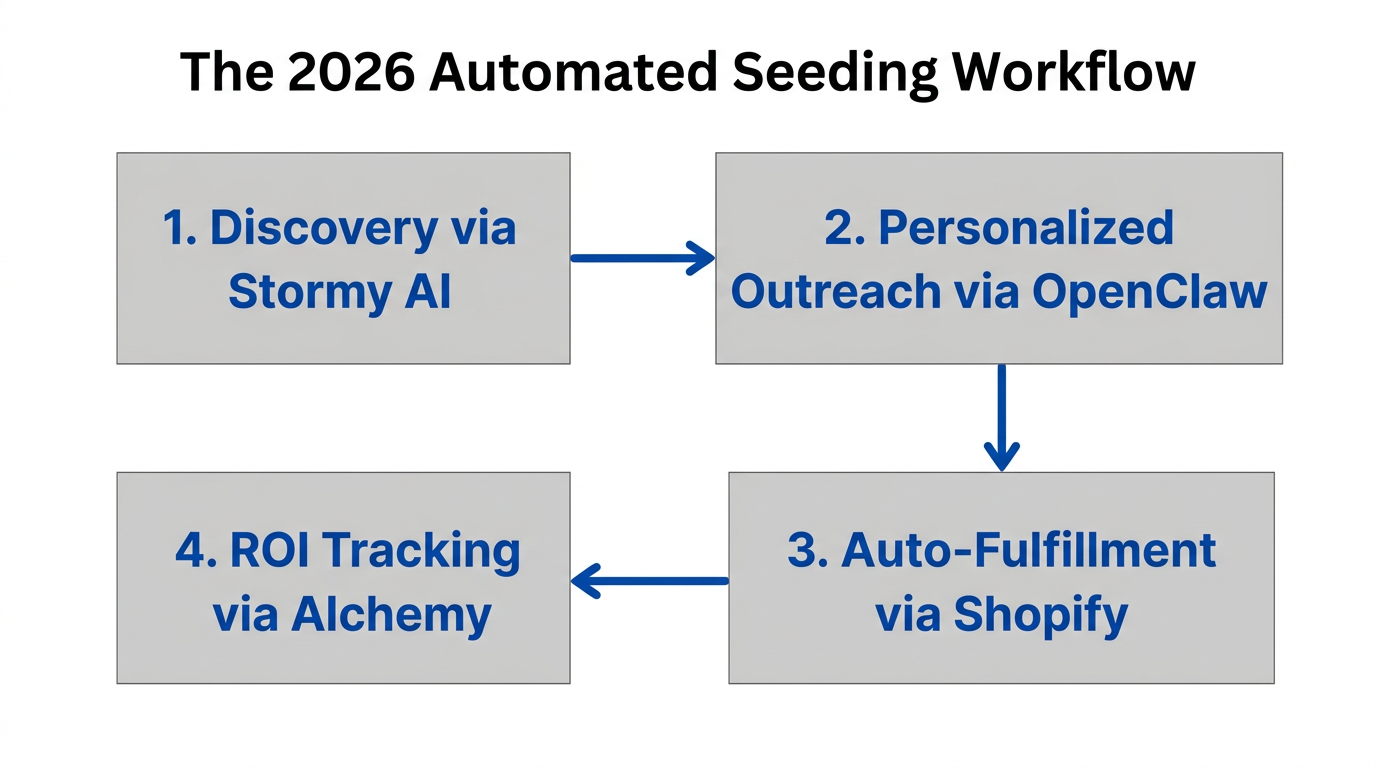
If you are ready to implement this system, follow these five steps to deploy your first agentic influencer campaign:
- Infrastructure Setup: Deploy OpenClaw via Docker on a 24/7 VPS such as Tencent Cloud Lighthouse or Hetzner. This ensures your agent is always awake to respond to influencers in different time zones.
- Connect Your Store: Link your Shopify Admin API through Composio. This uses the Model Context Protocol (MCP) to help the AI understand your product catalog and inventory levels.
- Discovery with Stormy AI: Use Stormy AI to generate a list of 50-100 micro-influencers. Export this data directly into your OpenClaw environment.
- Define Scoped Roles: Assign specific skills to your Clawbots. For example, use "Martin" for outreach and "Klara" for influencer support and tracking. Inject your brand's SOPs from Notion or Google Drive so the agents speak in your brand voice.
- Human-in-the-Loop (HITL): Set "Circuit Breakers" in your configuration. Use tools like Clawly to ensure an agent cannot approve a shipment or a payment over $100 without a manual push-notification approval on your phone.
Challenges: Navigating the 'Technical Wall'
While the rewards are high, the technical barrier remains significant. Over 65% of OpenClaw installations fail because merchants cannot properly manage Python environments or API security. There are also risks like the "Loop of Doom," where a misconfigured agent might accidentally purchase its own inventory or deplete a budget through recursive errors, as documented on Reddit's Shopify community.
Furthermore, as Semrush data indicates, the shift toward Agentic Search Optimization (ASO) means that if your data isn't structured correctly, agents simply won't find your brand. 2026 is the year where technical SEO becomes technical ASO.
Conclusion: Future-Proofing Your Influence
The combination of Stormy AI and OpenClaw represents the pinnacle of growth marketing in 2026. By automating the discovery and outreach lifecycle, you aren't just saving time—you are building a scalable commerce engine that operates with a precision no human team could match. The brands that survive this decade will be those that transition from being "content creators" to being "agent orchestrators."
Ready to start your journey into agentic commerce? Begin by finding your next 100 high-ROI creators on Stormy AI today and witness the power of AI-driven growth firsthand.