In the high-velocity landscape of 2026, where artificial intelligence permeates every corner of our digital existence, a counter-intuitive business model has emerged as a powerhouse of experiential branding. While most startups are racing to integrate more screens, more notifications, and more connectivity, Yondr has scaled to an estimated $300 million in annual revenue by doing the exact opposite: removing the phone from the equation entirely. By creating physical 'phone-free zones' through patented magnetic pouches, Yondr has tapped into a deep, visceral human craving for presence—a move that serves as a masterclass in anti-digital brand positioning.
The Pendulum Theory: Why Anti-Tech is a High-Growth Opportunity
 27:38
27:38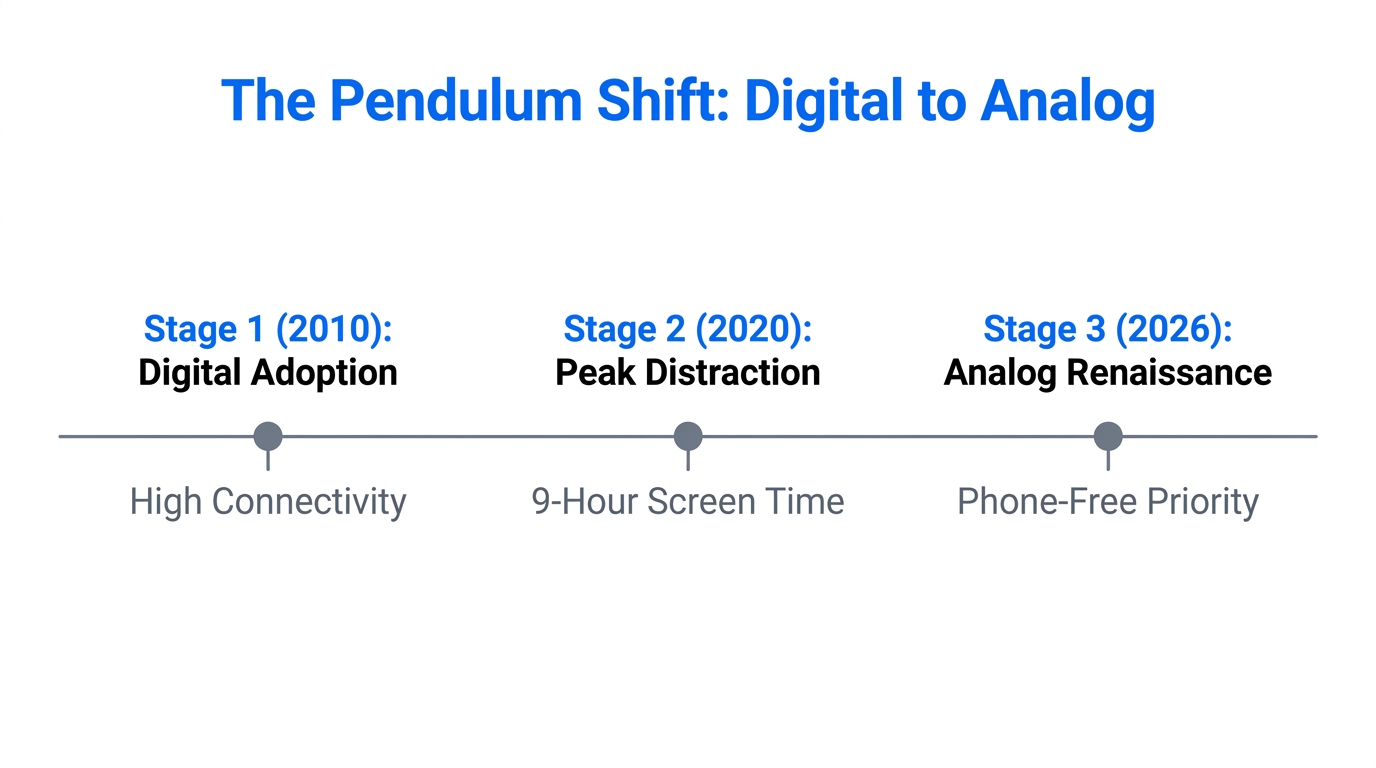
The success of Yondr is rooted in a psychological framework known as the 'Pendulum Theory.' In marketing, every major trend eventually creates an equal and opposite counter-trend. As consumer tech usage has accelerated to an average of six to eight hours of screen time per day, with many users opening their devices over 300 times daily, according to Pew Research studies on digital habits, the pendulum has swung into a state of 'digital exhaustion.' This exhaustion has birthed a massive consumer tech detox market that values friction over seamlessness.
When a trend moves too far in one direction, it creates a vacuum of demand for the opposite experience. In an era where TikTok and Meta Ads compete for every second of our attention, the most 'luxurious' thing a brand can offer is undistracted time. Brands that recognize this shift are pivoting away from constant 'input' and toward 'presence.' For example, high-end social clubs like Soho House and co-working spaces are increasingly marketing themselves not on their Wi-Fi speeds, but on their ability to facilitate real-world human connection.
"Every force has an equal and opposite reaction. As we become more addicted to our screens, the value of a phone-free hour sky-rockets, creating a new class of high-growth 'unplugged' businesses."
From Comedy Sets to $500k School District Contracts
31:38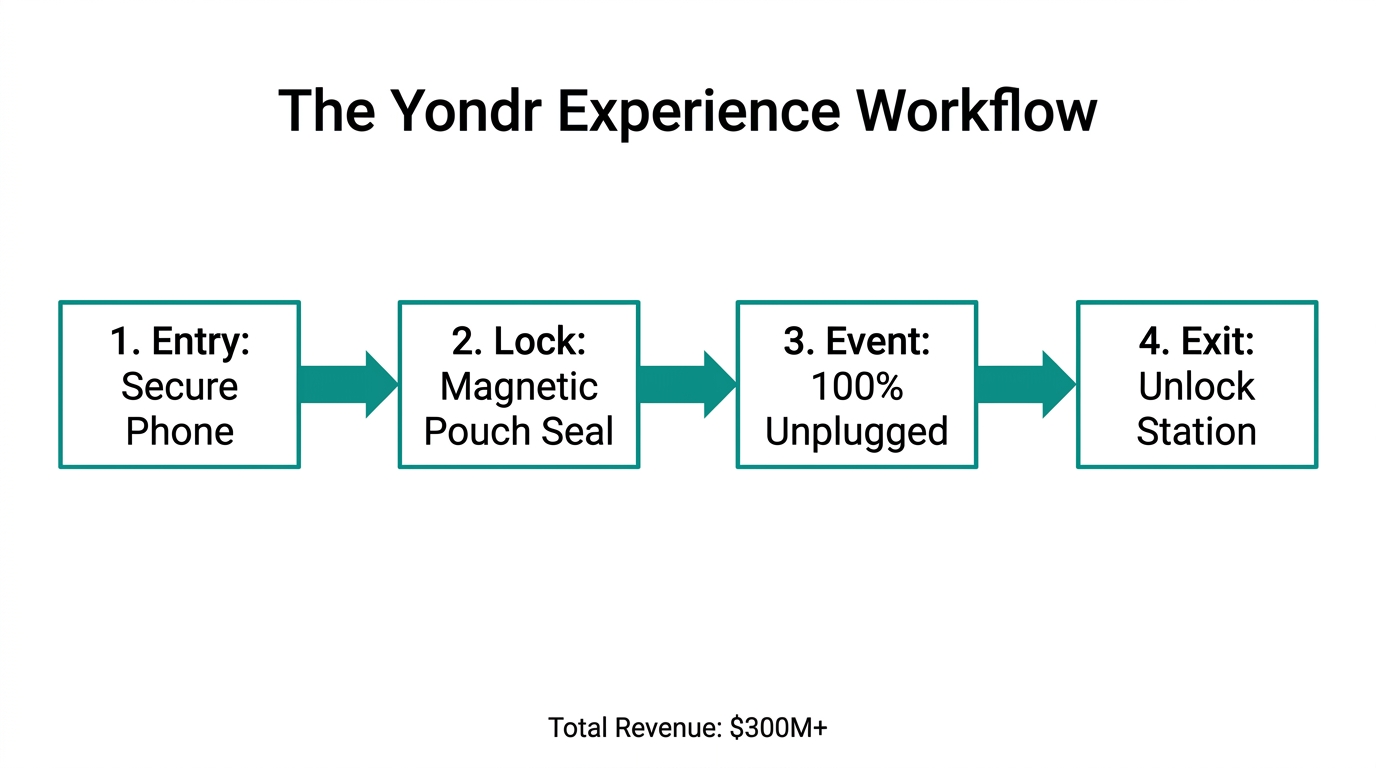
The Yondr business model is a fascinating evolution from a niche utility to a systemic infrastructure play. Originally founded in San Francisco by a former soccer player who witnessed a lack of consent in digital sharing at music festivals, the product is deceptively simple: a magnetic pouch that locks a user's phone but allows them to keep it in their possession. The pouch can only be opened at a specialized unlocking station, similar to the anti-theft tags used by retailers like Shopify merchants.
While the company gained initial notoriety in the world of stand-up comedy—most notably through a high-profile partnership with Dave Chappelle—its real growth engine has been institutional. Today, roughly 70% of Yondr's revenue is generated from school districts. In 2026, it is common for a single school district (such as those in New York or Minnesota) to sign contracts worth upwards of $500,000 to implement phone-free zones.
| Market Segment | Core Pain Point | Value Proposition |
|---|---|---|
| Live Entertainment | Content leaks & audience distraction | Protects IP; Increases performer/audience connection |
| Education | Cyberbullying & learning distractions | Improves grades; Increases student social interaction |
| Corporate / Retreats | 'Always-on' culture & lack of focus | Enables deep work; Improves team bonding |
This shift from entertainment to education transformed Yondr from a 'cool gadget' into a necessary piece of social infrastructure. By solving for experiential brand building in schools, Yondr has proven that anti-digital solutions can scale through B2B contracts just as effectively as traditional software-as-a-service (SaaS) models.
Marketing Through Friction: The Power of 'Remarkable' Events
In his seminal work, marketing legend Seth Godin describes the concept of the 'Purple Cow'—something that is 'remarkable' or literally worth remarking on. Yondr is the ultimate Purple Cow. When a consumer is told they must lock their phone in a bag to enter an event, the immediate reaction is often a mix of rage and anxiety. However, this friction is exactly what makes the event memorable.
Case in point: The Dave Chappelle 'No-Phone' policy. By forcing fans to unplug, Chappelle didn't just protect his jokes from leaking on YouTube; he created an environment where the audience was 100% present. This increased the perceived value of the ticket. Because the experience couldn't be captured on a phone, it became a 'you had to be there' moment. In the influencer era, where every meal is photographed for Instagram, a phone-free event feels like an exclusive, underground ritual.
For modern marketers, the lesson is clear: Don't be afraid to ask your customers for a sacrifice. Whether it's a 12-hour 'phone fast' or a 'Join or Die' community tagline, demanding commitment from your audience can actually foster deeper loyalty. This is especially relevant for UGC creator sourcing; brands can use platforms like Stormy AI to find creators who advocate for 'digital minimalism,' tapping into an audience that is primed for high-quality, real-world experiences.
"Greatness comes from a simple process of consistency. Whether it's writing 1,000 words a day or sitting in a room without a screen, the 'unplugged' path is where the best work happens."
The 2026 Tech Detox Market: A Marketing Playbook
24:58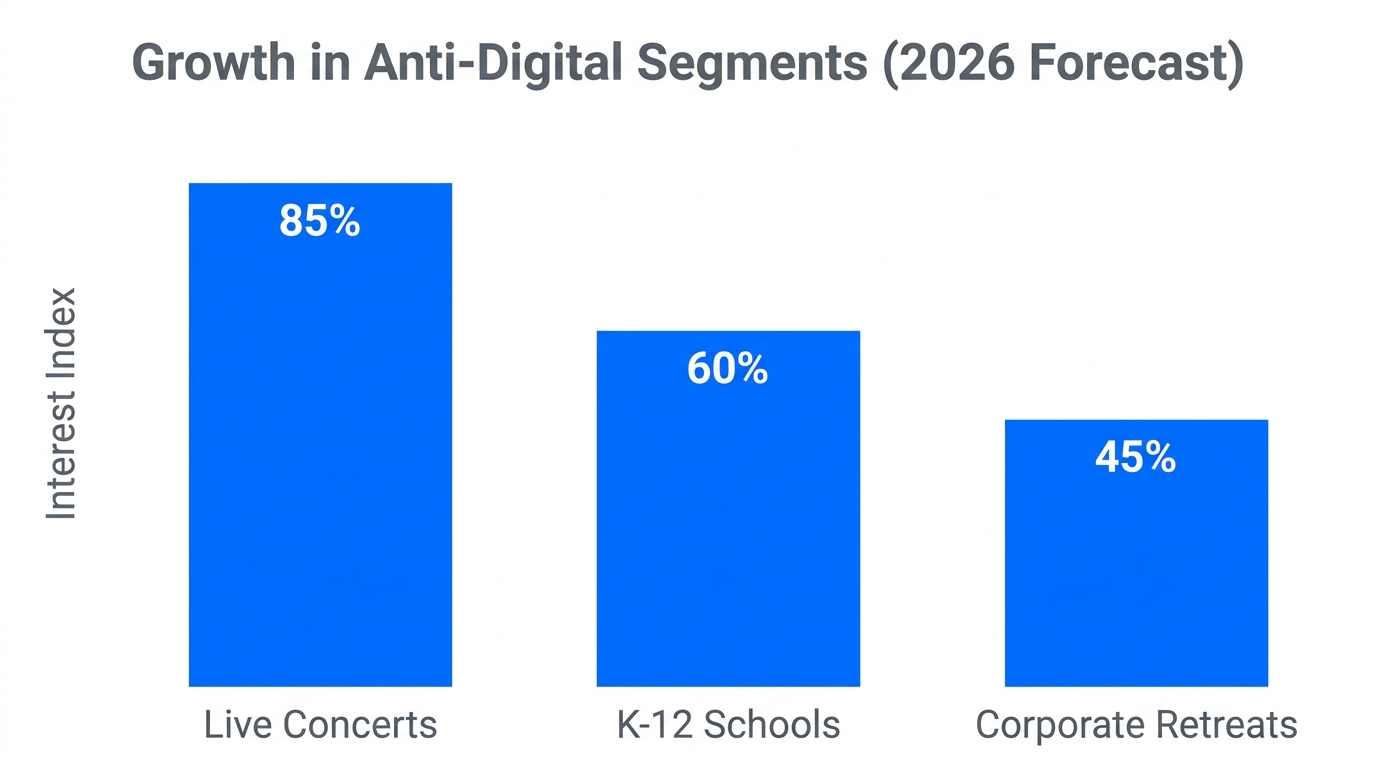
As we look deeper into 2026, the 'anti-digital' movement is expanding beyond pouches. We are seeing a resurgence of 'Gilded Age' social clubs—spaces like The Battery in San Francisco or Zero Bond in New York—that prioritize physical presence over digital networking. This is a direct response to the 'Bowling Alone' phenomenon, where traditional social structures have crumbled, leaving a void that premium, 'unplugged' spaces are now filling.
To integrate these elements into your own brand strategy, consider the following playbook:
Step 1: Identify the 'Input' Overload
Analyze where your customers are being bombarded with noise. If you are a fitness brand, perhaps your 'value add' isn't a new app, but a 'no-phone' run club. If you are a productivity tool like Notion or Linear, highlight how your features enable 'Deep Work' rather than just more notifications.
Step 2: Create a 'High-Friction' Ritual
Introduce a ritual that requires the user to put down the device. This could be a physical workbook designed in Canva or a limited-time 'silent' discount code that only appears at physical events. The goal is to make the customer feel that the 'analogue' moment is the reward.
Step 3: Leverage Community Scarcity
Use the 'Join or Die' mentality. Make your community feel like a necessary haven from the digital storm. When sourcing influencers for these campaigns, use data-driven tools to vet creators not just for their reach, but for their audience quality and 'real-world' engagement metrics. You want creators who can drive people to show up in person, not just double-tap on a screen.
Conclusion: The Future of Presence
Yondr’s $300M success story is a testament to the fact that humans are fundamentally social animals who are currently drowning in a digital sea. By positioning themselves as the 'lifeguard' of presence, Yondr has built a business that is essentially AI-proof. You cannot 'AI' a physical pouch or a real-world conversation.
As you build your brand this year, remember the Pascal's Wager of modern marketing: If you bet on connectivity, you are competing with everyone. If you bet on presence, you are competing with no one. Use tools like Stormy AI to discover the creators and communities that are leading this charge, and don't be afraid to lead your audience back to the 'analogue' world. In the end, the most remarkable thing you can do for your customers in 2026 is to help them turn their phones off.