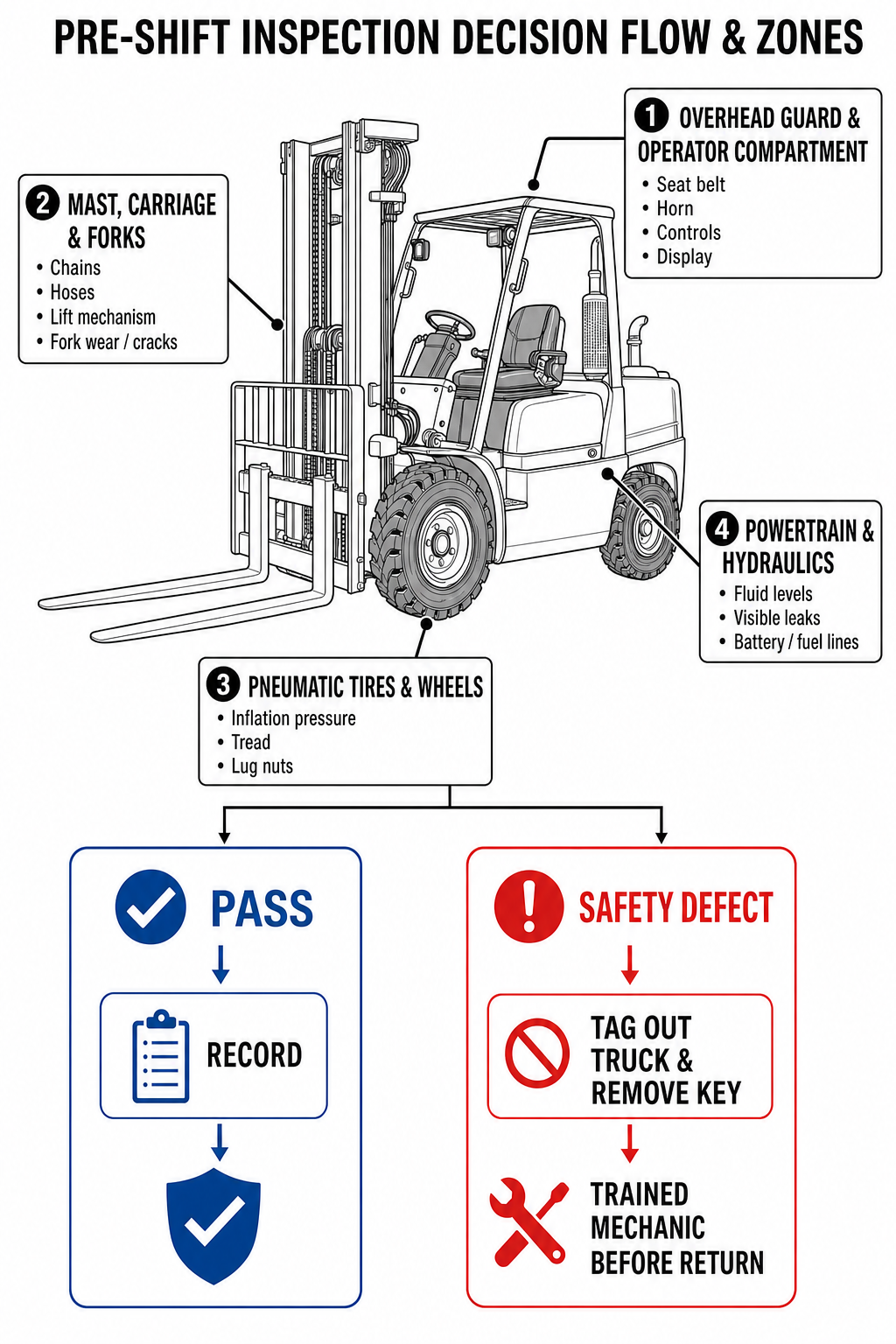
Yale GP40-70N Pre-Shift Defect: Tag It Out Before Service
When a pre-shift inspection on a Yale GP40-70N Series N reveals any condition affecting safe operation, the truck must be removed from service immediately, tagged out with the key removed, and repaired by a trained mechanic.
Yale Guide 8000 YRM 2689, PDF page 26 / printed page 18 and PDF page 30 / printed page 22
Manual ID
8000 YRM 2689 (Part No. 504295733)
During a daily pre-shift inspection on a Yale GP40-70N Series N pneumatic tire counterbalance forklift, finding any condition that adversely affects safe operation requires immediate mandatory removal from operation: the truck must be stopped immediately, tagged out, the key removed, and the defect repaired by a trained mechanic before the unit is returned to service.
1
Step 1: Conduct Systematic Pre-Shift Inspection
Inspect operator protection equipment, fork condition and wear, tire condition and pressure, fluid levels, fuel levels, battery condition and electrolyte level, steering, controls and instruments, cracks, damage or leaks, brake operation, and lift mechanism operation prior to the beginning of each shift.
2
Step 2: Halt Operation Immediately if Safe Use is Affected
If any condition that can adversely affect safe operation is located, immediately stop the lift truck. The unit must not be operated until all such conditions are corrected prior to use.
3
Step 3: Tag Out the Lift Truck and Remove Key
Take the truck out of operation immediately by applying the parking brake, fully lowering forks to the ground, shutting off power, removing the key to prevent unauthorized use, and tagging the truck out.
4
Step 4: Require Repair by Trained Mechanic Before Service Return
Report the condition to supervision and transfer the unit to a trained mechanic. All faults must be repaired by a trained mechanic, and the mechanic must be a trained operator to test drive the repaired truck before returning it to service.
Pre-Shift Inspection Protocol and Requirements (Yale 8000 YRM 2689)
Inspection Stage
Required Pre-Shift Action
Source Authority & Responsibility
Pre-Shift Evaluation
Perform inspection of truck and attachment prior to each work shift to locate adverse conditions
Operator or mechanic (Yale 8000 YRM 2689, p. 18 / PDF p. 26)
Safety Defect Identified
Stop truck immediately, take out of operation, tag truck out, and remove key
Operator mandatory requirement (Yale 8000 YRM 2689, p. 22 / PDF p. 30)
Corrective Repair & Testing
Repair fault completely; test drive conducted only by mechanic who is a trained operator
Trained mechanic only (Yale 8000 YRM 2689, p. 18 & 22 / PDF p. 26 & 30)
Mandatory Pre-Shift Inspection Scope
A pre-shift inspection of the truck and attachment is required by OSHA and Yale standards prior to the beginning of each work shift. The express purpose of this inspection is to locate conditions that can adversely affect the lift truck's safe operation, and records of pre-shift inspections should be maintained.
Items that must be checked on the lift truck prior to operation include operator protection equipment, fork condition and wear, tire condition and inflation pressure, fluid levels, fuel levels, battery condition and electrolyte level, steering operation, controls and instruments, overall check for cracks, damage or leaks, brake operation, and correct operation of the lift mechanism.
Steering, controls, instruments, and brake operation
Lift mechanism correct operation and structural integrity
Immediate Removal from Operation and Tag-Out Protocol
Lift truck operators must be trained on and understand that if anything affecting the safe use of the truck is found during the pre-shift inspection or during operation, the truck must be taken out of operation immediately.
The isolation protocol requires that the truck is tagged out and the key removed to prevent unauthorized operation. Whenever leaving the truck, the forks or attachment must be fully lowered and tilted forward with fork tips touching the ground, controls placed in neutral, parking brake set, and power shut off.
Trained Mechanic Repair and Test Drive Boundaries
All conditions affecting safe use must be corrected prior to the use of the lift truck. Permitting untrained or improperly equipped personnel to work on lift trucks subjects them and others to an unnecessary and unreasonable risk of serious injury or death.
Repairs must be performed exclusively by mechanics trained in safe maintenance and repair practices. Furthermore, in order for the mechanic to test drive a repaired lift truck, the mechanic must also be a trained operator pursuant to safety standards.
Applies to Yale GP40N, GP50N, GP60N, and GP70N Series N pneumatic tire counterbalance forklifts. Covers pre-shift inspection, removal from operation, tag-out, key removal, and trained mechanic service boundaries.