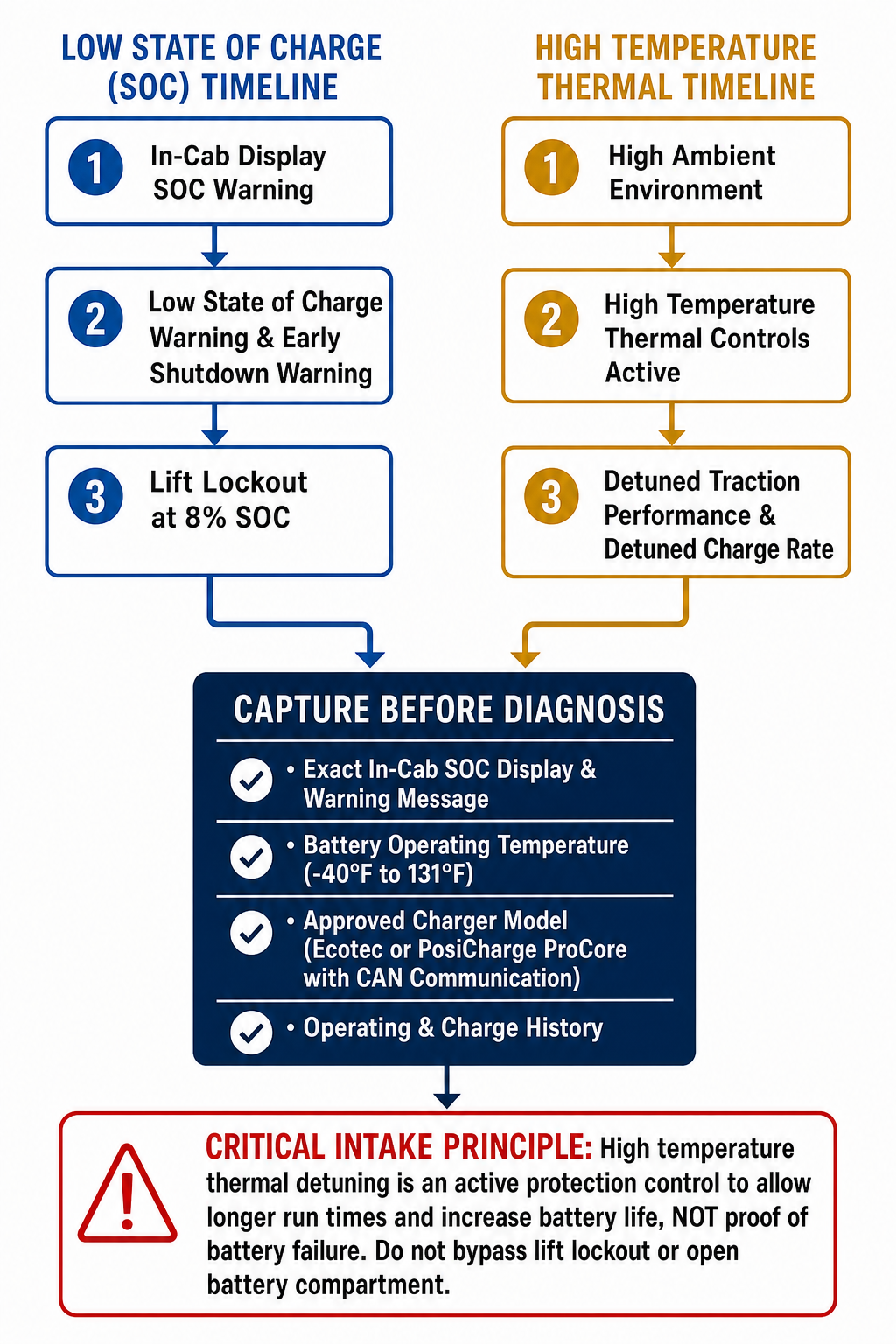
Yale ERC/ERP Integrated Lithium: Separate Low-Charge Warnings From Thermal Detuning
On Yale ERC050-060VGL and ERP050-060VLL forklifts, low state of charge warnings and high-temperature thermal detuning both modify operational performance. Capturing exact SOC percentages, warning alerts, ambient conditions, and charger communication data is required before field diagnosis.
STORMY Editorial · · 8 min read
Diagnostic separation between low state of charge warnings and battery high-temperature thermal detuning on Yale ERC-VGL and ERP-VLL series trucks.
Integrated Lithium-Ion Technology Yale ERC050-060VGL and ERP050-060VLL Frequently Asked Questions
Locator
Yale Integrated Lithium-Ion FAQ, dated 2021-05, PDF pages 1-2
Manual ID
ERC-VGL / ERP-VLL FAQ (2021-05)
Yale ERC050-060VGL cushion and ERP050-060VLL pneumatic integrated lithium-ion forklifts incorporate advanced truck-to-battery CAN communication that automatically modulates traction performance and charge rates. When operators encounter reduced travel speed or modified charging behavior, field teams frequently confuse standard low State of Charge (SOC) warning protections with high-temperature thermal detuning controls. Because thermal detuning is an active design feature engineered to extend battery life and run times in elevated ambient temperatures—not an indicator of battery defect—technicians must collect complete operating and diagnostic parameters prior to escalating service.
1
1. Record In-Cab Display SOC and Warning Notifications
Inspect the operator display to verify real-time battery state of charge (SOC), low SOC warnings, and early shutdown alerts. Note whether the truck is operating near the 8% lift-lockout threshold or if a performance drop is occurring at higher charge levels.
2
2. Assess Ambient Temperature and Thermal Operating Conditions
Check facility ambient temperature against the battery operating range of -40°F to 131°F (-40°C to 55°C). Determine if elevated ambient conditions have triggered the battery high-temperature thermal control to detune traction performance and charge rates.
Ensure the truck is connected to a validated charger (Ecotec or PosiCharge ProCore) utilizing battery-to-charger CAN communication. Confirm the CAN link is active, allowing the battery to control charging rates from 0-80% before tapering to protect against overcharging.
4
4. Assemble Comprehensive Field Service Dispatch Packet
Log model number (ERC050/060VGL or ERP050/060VLL), battery capacity (33kWh for ERC-VGL, 30kWh for ERP-VLL), exact display readouts, charger model, operating temperatures, and full symptom context before dispatching technical escalation.
Operational Comparison: Low State of Charge (SOC) vs. High-Temperature Thermal Detuning
Operational Attribute
Low SOC Warning & Lockout
High-Temperature Thermal Detuning
Trigger Mechanism
Battery state of charge depletion during normal operation
High ambient operating environment
Performance Impact
Low SOC warnings, early shutdown warnings, and lift lockout at 8% SOC
Automatic detuning of traction performance and reduction of charging rates
System Objective
Protects basic truck operational reserve and signals need to recharge
Allows longer run times and increases overall battery service life in high ambient environments
Standard Operating Range
Operational until 8% lift-lockout threshold is reached
Functional within broader -40°F to 131°F (-40°C to 55°C) operating envelope
Intake Data to Record
Exact display SOC % and presence of low SOC / early shutdown warnings
Ambient temperature, battery temperature context, and active detuning state
CAN-Bus Charging Architecture and Infrastructure Requirements
Yale ERC050-060VGL (33kWh) and ERP050-060VLL (30kWh) integrated lithium-ion trucks advance powertrain integration by establishing direct Battery-to-Charger CAN communication. This digital link allows the battery to control the charging rate directly.
Under CAN control, the battery accepts faster charging from 0% to 80% SOC before charging slows to protect the battery from overcharging. The fastest charging rate requires an electrical infrastructure providing 480V on a 50A breaker, connected to validated chargers such as Ecotec or PosiCharge ProCore.
Validated and approved charger brands: Ecotec and PosiCharge ProCore.
Fastest charging rate infrastructure requirement: 480V on a 50A breaker.
Standard factory battery warranty: 7 years or 12,000 hours with 60% capacity retention.
Distinguishing Operational Thermal Controls from Battery Defects
When an integrated lithium forklift exhibits reduced traction speed or lower charging rates in elevated ambient environments, field teams must separate intentional thermal control from hardware failure.
Official Yale documentation states that high-temperature thermal controls give the battery the ability to detune truck traction performance and charge rate to allow longer run times and increase battery life in high ambient environments. Experiencing thermal detune is an active protective control and does not indicate battery defect or failure.
Cold Storage Protection and Mechanical Service Boundaries
For cold temperature operations, all ERC050-060VGL and ERP050-060VLL trucks come equipped with factory-installed battery heaters for cold storage conditions. When connected to the charger, heaters engage to keep battery temperature above 32°F (0°C), and are capable of maintaining battery temperature above freezing when stored in -20°F (-30°C).
The integrated lithium-ion battery is maintenance free, and accessing or removing the battery is not part of the normal service schedule. If removal is ever necessary, the battery is removed vertically from the floor by authorized personnel.
Applies strictly to Yale ERC050VGL, ERC060VGL, ERP050VLL, and ERP060VLL 4-wheel electric counterbalanced forklifts with factory-integrated lithium-ion battery technology. Does not apply to third-party drop-in lithium conversions, lead-acid models, or non-integrated Yale electric series.