In the high-velocity landscape of 2026, growth teams are undergoing a fundamental shift in how they manage customer data. The era of paying a "SaaS tax" of $40 to $150 per user for bloated legacy platforms is rapidly coming to an end. Instead, a new movement—the "unclouding" of the enterprise—is taking hold, led by the meteoric rise of OpenClaw. This open-source agentic ecosystem has redefined AI CRM for startups in 2026, moving away from static databases toward autonomous systems that don't just store lead data, but actively research and engage with it, similar to how modern brands are exiting the cloud [source] to regain architectural control.
Analyzing the 'Unclouding' Trend: Why Private VPS is the 2026 Standard
By early 2026, the sentiment toward third-party cloud providers shifted from convenience to concern. Growth-stage startups realized that their most valuable asset—proprietary lead data—was being used to train the very models their competitors were buying. This has led to the "unclouding" trend, where businesses move their self-hosted customer relationship management systems back to private environments.
Today's growth teams are increasingly deploying their tech stacks on specialized infrastructure. Platforms like Tencent Cloud Lighthouse now offer dedicated instances optimized for running OpenClaw bots 24/7. By hosting OpenClaw CRM on a private VPS, teams regain full control over their data architecture while drastically reducing latency in agentic workflows.
"The move to local-first and self-hosted agents isn't just about saving money; it's about data sovereignty in an age where AI models are hungry for your proprietary lead lists."
Using Docker-first deployment strategies, these teams isolate their CRM environment from the public web, providing a security layer that traditional SaaS simply cannot match. This agentic infrastructure allows a company to run its entire sales operation on a private server for the cost of a few pizzas, rather than a luxury car lease, often managed via DigitalOcean Droplets or similar scalable VPS solutions.
Cost-Benefit Breakdown: Legacy CRMs vs. OpenClaw CRM
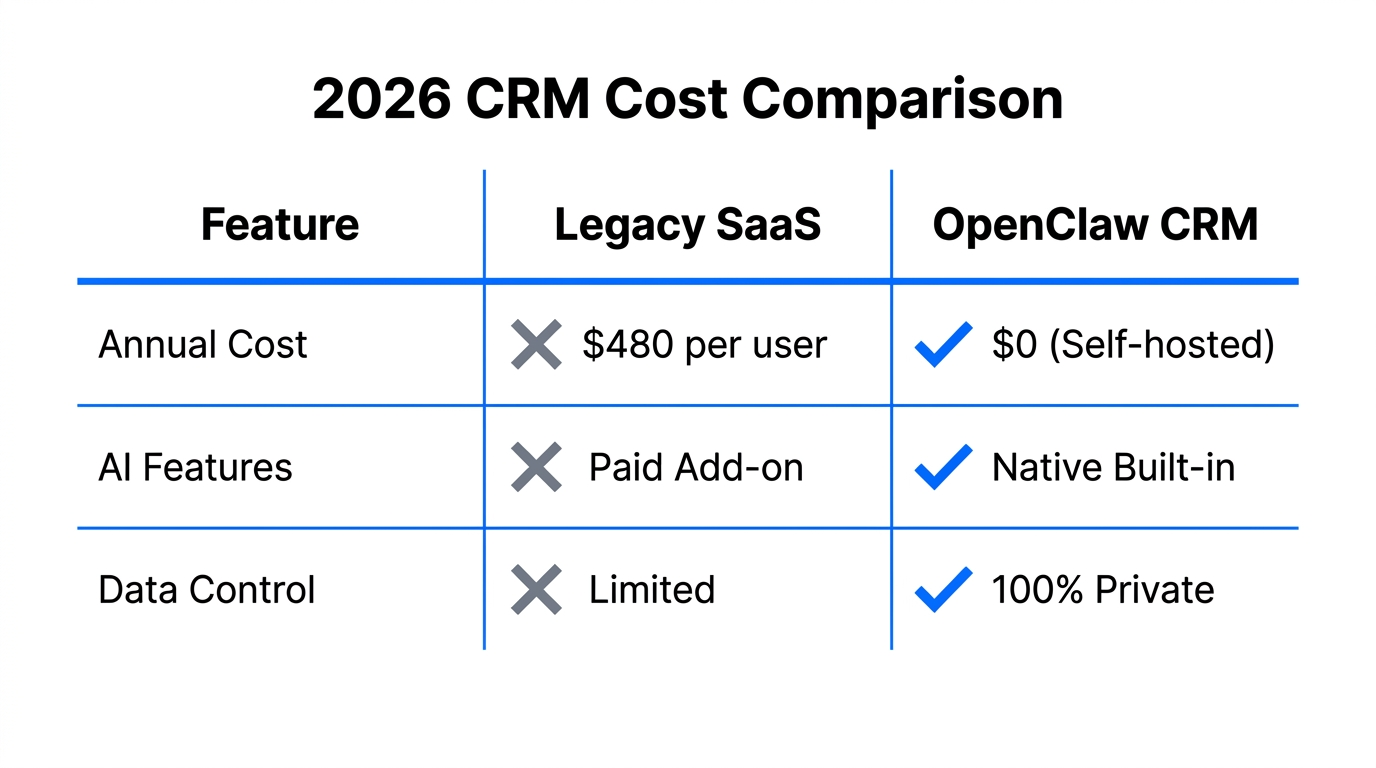
The financial argument for switching to an open source Salesforce alternative is staggering. In 2026, legacy enterprise platforms continue to hike prices, often charging for contact tiers, seat counts, and "AI add-ons" that were once standard features. In contrast, OpenClaw's growth has been fueled by its radical affordability.
| Metric | Legacy Enterprise CRMs | OpenClaw CRM (Self-Hosted) |
|---|---|---|
| Monthly Cost (10 Users) | $400 - $1,200+ | $10 - $20 (VPS Cost) |
| Data Ownership | Vendor-controlled cloud | Private & Local-first |
| AI Capabilities | Paid add-ons ($$$) | Agentic-native (Token-based) |
| Customization | Limited by API/Plan | Unlimited (Open Source) |
While proprietary sales tools can cost between $20 and $40 per user, an entire team can run OpenClaw CRM on a VPS from DigitalOcean or Hostinger for roughly $10–$20 per month total. The only variable cost is AI token usage. Savvy teams optimize this further by using tiered model routing: sending simple data entry tasks to Claude Haiku or GPT-4o-mini, while reserving high-tier models like Claude Opus for complex deal negotiation.
The 3.5x Efficiency Gain: Agentic CRMs vs. Human-Led Systems
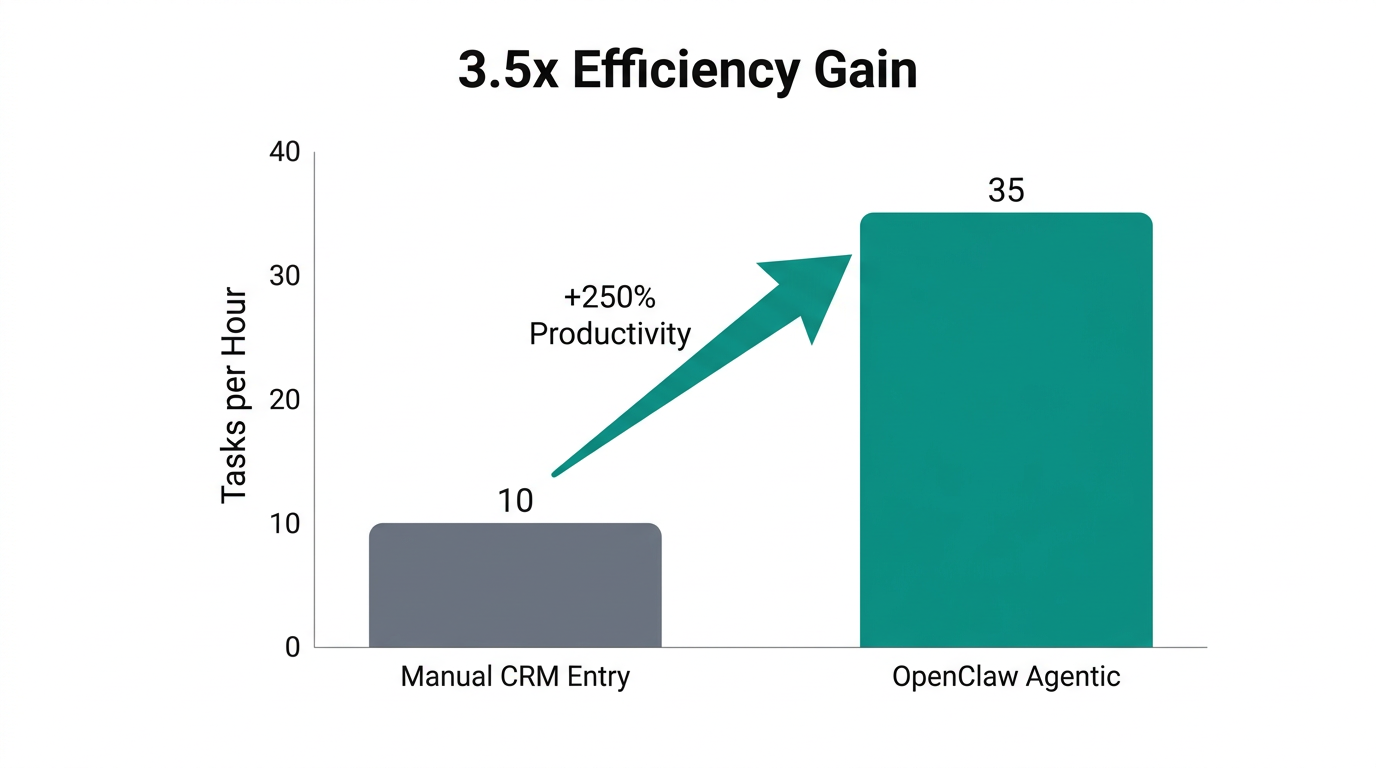
The primary reason OpenClaw is winning isn't just price—it's performance. According to the Stanford AI Index (2025/26), agentic systems like OpenClaw complete multi-step research and CRM tasks 3.5x faster than even the most skilled human researchers.
Traditional CRMs are passive; they wait for a human to input data. An agentic CRM is proactive. It can monitor Gmail, qualify leads based on SOPs stored in Notion, and automatically update deal stages. For example, growth teams often use Stormy AI to discover high-performing creators, then use an OpenClaw agent to automatically pull those profiles into their self-hosted CRM for outreach.
"OpenClaw is the AI that actually does things. It doesn't just generate a report; it logs into your system, finds the contact, and executes the workflow." — Peter Steinberger, Founder.
This shift to B2A (Business-to-Agent) marketing means that instead of humans spending hours on manual data entry, they are now managers of a fleet of autonomous agents. These agents handle the heavy administrative back-office tasks that traditionally sink productivity. In industries like real estate, tools like Homie are already packaging OpenClaw to integrate with Follow Up Boss, showing that even legacy-heavy sectors are pivoting toward agentic automation via Zapier-style workflows.
Data Ownership as a Competitive Advantage
In 2026, your lead list is your moat. Legacy SaaS vendors have a long history of data mining user behavior to improve their own products. By moving to Supabase or other local-first data storage solutions within an OpenClaw environment, growth teams ensure their competitive intelligence stays private.
This level of control allows for hyper-personalized outreach without exposing sensitive customer interactions to a third-party cloud. Cybersecurity researchers from firms like CrowdStrike have noted that while OpenClaw's system-level access is powerful, it must be properly sandboxed. By running a self-hosted customer relationship management system, you can implement custom security protocols—such as using ClawRouter for cost and permission management—that SaaS platforms won't allow.
The Migration Roadmap: Moving from Legacy to Agent-First
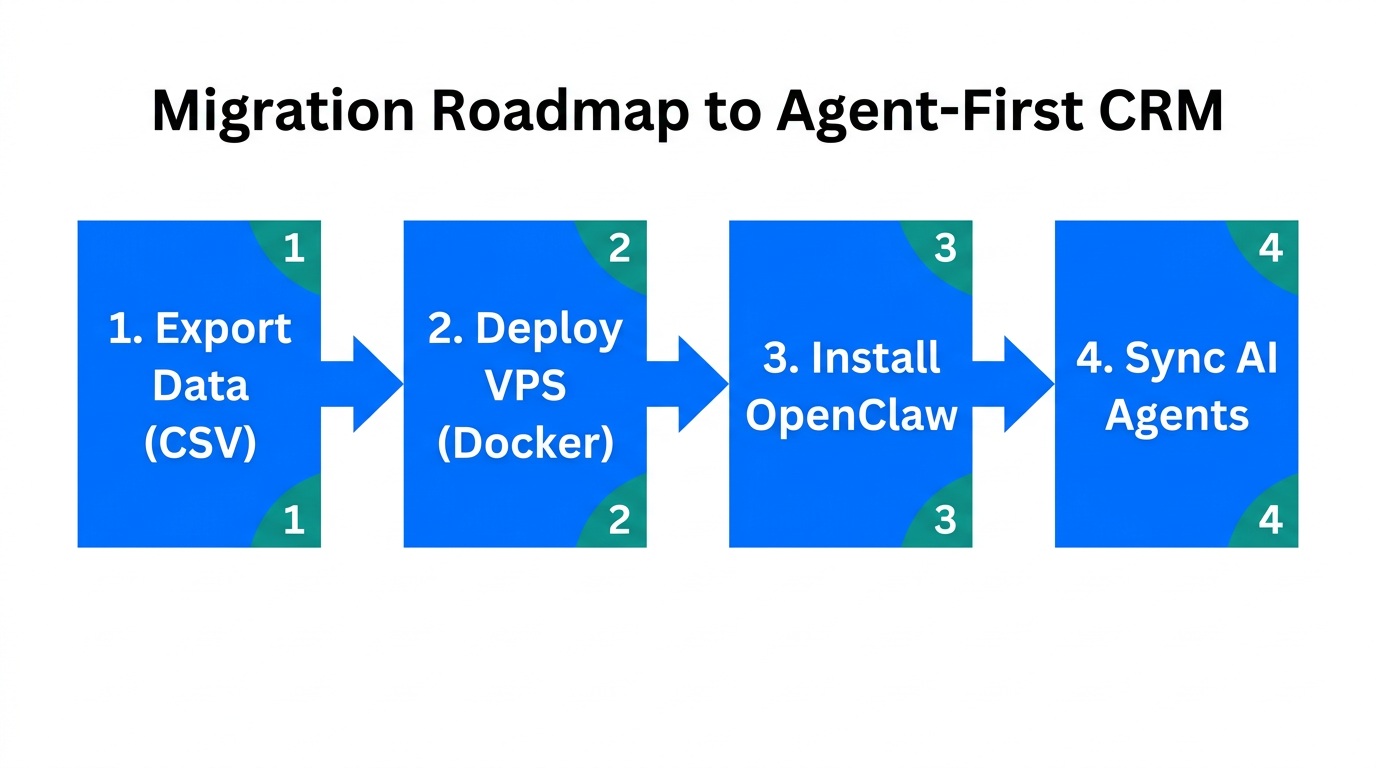
Transitioning from a platform like HubSpot to an AI CRM for startups in 2026 doesn't have to happen overnight. Most successful teams follow a tiered migration playbook:
Step 1: The Middleware Layer
Start by using OpenClaw as a middleware intelligence layer. Let it monitor your messaging channels like WhatsApp or Telegram and push data into your existing CRM. This allows you to test the 3.5x efficiency gain without breaking your existing workflows.
Step 2: Generate the "Skill File"
To give your agent "hands," you need to generate an OpenAPI spec for your current data structure and drop it into OpenClaw’s config.yml. This allows the agent to read and write to your database autonomously.
Step 3: Gradual Data Unclouding
Begin moving your most sensitive lead lists to a local-first environment using OpenClaw CRM. Use the agent to sync data between the legacy system and your new private server until you are ready for a full cutover.
Common Mistakes to Avoid in the Agentic Transition
While the benefits of the OpenClaw CRM cost comparison are clear, there are pitfalls that can destroy your ROI if you aren't careful:
- Session Bloat: Failing to use the
/newcommand to start fresh sessions can cause your agent to send massive conversation histories with every API call, leading to exponentially high token costs. - Defaulting to Opus: Never use high-tier models for basic tasks like "check my calendar." This can turn a $10/month operation into a $200/month mistake. Use tiered model routing.
- Over-Automation: Never allow an AI agent to send customer-facing emails without a Human-in-the-Loop (HITL) check. As experts warn, "AI doesn't have a reputation; you do."
- Plain-Text Secrets: Never store API keys in plain-text config files. Always use environment variables or secret managers to protect your access to tools like Meta Ads Manager or TikTok Ads Manager.
"OpenClaw reached 270,000+ GitHub stars in record time because it shifted the focus from 'chatbots' to 'agents that do work.' The growth is explosive because the value is immediate."
Conclusion: The Future of Growth is Agentic
The transition from high-cost SaaS to OpenClaw CRM represents more than just a cost-saving measure; it is a fundamental shift in how 2026 growth teams operate. By embracing the unclouding trend and leveraging agentic efficiency, startups can move 3.5x faster than their competitors while maintaining absolute control over their data.
Whether you are sourcing creators via Stormy AI or managing complex B2B deal flows, the agentic ecosystem offers a level of scalability that legacy systems cannot match. The AI CRM for startups in 2026 is not a platform you subscribe to—it’s an ecosystem you own.