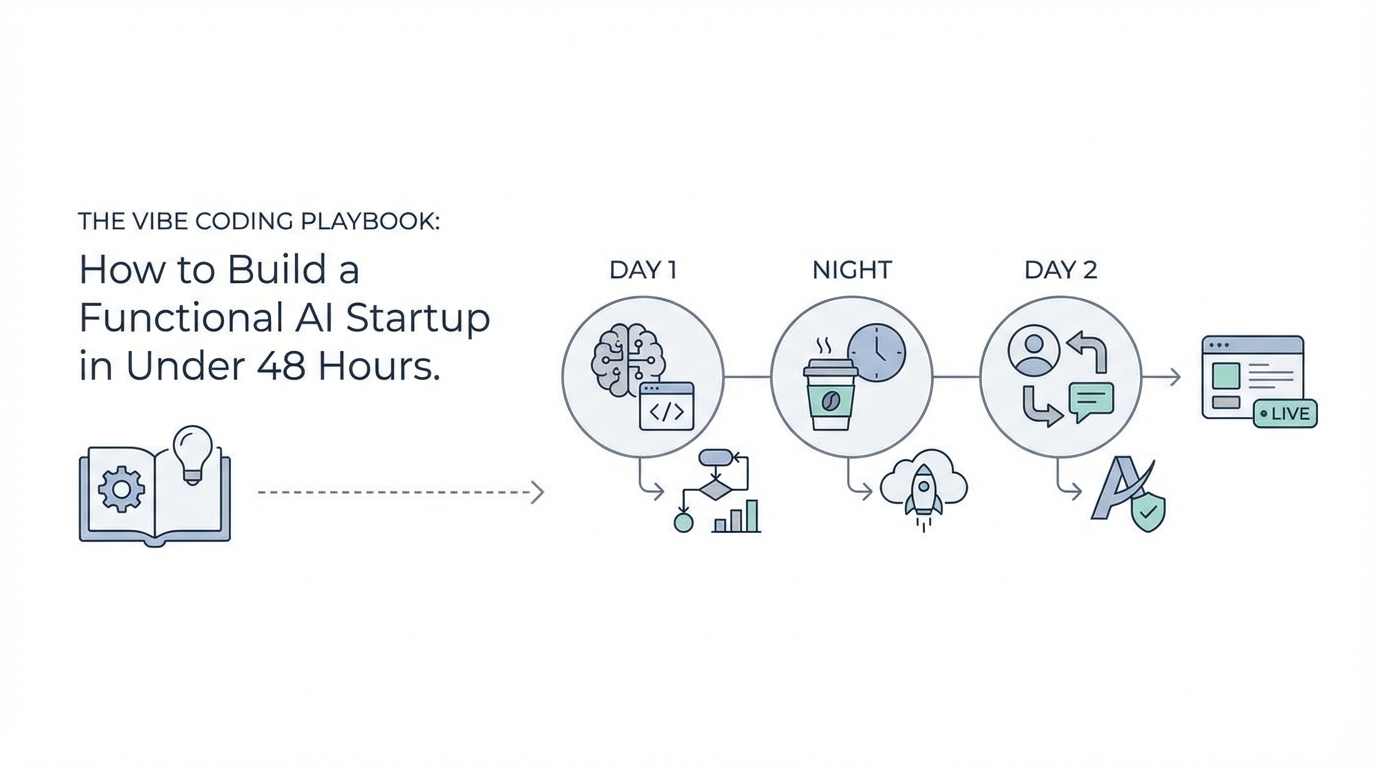
Imagine taking a raw idea from the internet, building a functional software product around it, and selling it for $15,000 in just eight days. This isn't a hypothetical scenario from a silicon valley fever dream; it is the new reality of vibe coding. By leveraging Large Language Models (LLMs), rapid prototyping software, and a "ship first, polish later" mentality, the barrier to entry for software entrepreneurship has effectively collapsed. The shift is moving away from the manual labor of writing syntax toward the high-level strategy of creative direction and code review.
In this playbook, we are breaking down the exact process used by seasoned builders like Josh Pigford to move from zero to one with lightning speed. Whether you are a non-engineer looking to launch your first app or a veteran developer wanting to cut your development time by 90%, these strategies for ai software development will redefine how you think about shipping code.
What is Vibe Coding?

Vibe coding is the act of using AI tools like Claude and Cursor to generate, iterate, and deploy software without the developer needing to manually write the majority of the codebase. Instead of getting bogged down in the minutiae of semicolons and indentation, the builder focuses on the "vibe"—the user experience, the logic flow, and the overarching architecture. As the research suggests, the goal is to get the reps in. If you look at successful builders, many have over 70 projects under their belt, ranging from failed experiments to multi-million dollar exits like Baremetrics.
The fundamental shift here is that the new bottleneck is no longer doing the work; it is reviewing the work. As tools become more capable of generating functional backends in minutes, the developer's role evolves into that of an Art Director or Product Manager. You are no longer the one swinging the hammer; you are the one ensuring the house is built to the right specifications. To master this, you must understand how to provide context to your AI agents and how to timebox your efforts to avoid the trap of over-engineering.
Step 1: Naming and Domain Discovery with MCP
Before you even open a code editor, you need a name. For many, this is where projects go to die. We spend weeks agonizing over a .com that isn't parked for $10,000. Vibe coding solves this through automation. Using Claude and the Model Context Protocol (MCP), you can turn domain hunting into a 30-minute automated task. MCP allows Claude to connect to external tools—in this case, a Whois MCP that checks domain availability in real-time within the chat interface.
Instead of manually checking sites, you can prompt Claude: "I need a name for an app that helps people find expired domains. Use keywords like 'snag,' 'snipe,' or 'acquire.' Run these through the Whois MCP and show me only available .com or .ai domains." The AI will iterate through hundreds of variations, check their status, and summarize the best picks for you. This is how projects like Name Snag are born—by finding a catchy, available domain that sets a professional floor for the brand's value from day one.
If you find a premium domain you love on a marketplace like Atom.com, don't be afraid of the price tag. Many platforms now offer lease-to-own payment plans, allowing you to secure a high-value asset for a few hundred dollars a month while you test the "vibe" of your startup. This lowers your upfront risk while maximizing your brand's perceived authority.
Step 2: The Vibe Coding Toolstack
To build an AI startup in under 48 hours, you cannot rely on traditional development environments. You need a stack that favors speed and AI integration. The current gold standard for rapid prototyping includes:
- Claude (Anthropic): Widely considered the best model for code generation and architectural reasoning. Its Artifacts feature allows you to see front-end changes in real-time.
- Cursor: An AI-native code editor that indexes your entire codebase. It allows you to use "Composer" mode to generate multiple files and complex logic branches by simply describing what you want.
- AI-Driven Backends: Tools like Supabase or Convex handle database management and authentication with minimal configuration, allowing you to focus on the unique value proposition of your app.
- Social Distribution (X/Twitter): Using platforms like X to build in public is a core component of the vibe coding stack. It provides the feedback loop necessary for rapid iteration.
When you are in the thick of building, your primary job is iterative destruction. If a feature isn't working or the code is getting too messy, don't spend hours debugging. Instead, provide the AI with the updated context and ask it to rewrite the module from scratch. In the world of vibe coding, rebuilding is often faster than repairing.
Step 3: The 48-Hour Playbook
Shipping a functional product in two days requires a strict schedule. Here is the 48-hour breakdown for building and launching your AI startup:
Hour 0-4: The Discovery Phase
Find an idea with high "viral potential" or clear utility. Use sites like IdeaBrowser.com to identify gaps in the market. Once you have a concept, use the Claude MCP workflow mentioned above to secure your domain and handle basic branding. Don't overthink the logo—use tools like Adobe Illustrator or even AI image generators to create a "first pass" that looks professional enough to ship.
Hour 5-16: Core Logic and MVP
Build the "happy path" of your application. This is the single most important sequence of actions a user takes to get value. For Name Snag, this was the ability to search for and identify expired domains. Use Cursor to generate the backend logic. Do not worry about edge cases or complex user settings. If the core functionality works, you have a product.
Hour 17-32: Public Iteration
This is where most founders fail. They wait until the product is "perfect" before showing it to anyone. Instead, start posting screenshots and polls on social media immediately. If a tweet about your project starts gaining traction—perhaps by siphoning views from a viral thread—you are building a pre-launch waitlist in real-time. This interactivity is essentially a free community-driven QA session.
Hour 33-48: The V2 Reset and Launch
By the second day, you will likely have realized that your initial code structure is flawed. This is normal. Many successful vibe coders scrap their entire V1 codebase on day two and rebuild V2 from scratch using the lessons learned. Because the AI does the heavy lifting, a total rewrite only takes a few hours but results in a significantly more stable product. Once V2 is live, hook up a payment processor like Stripe and open the doors.
Marketing and Growth for Your AI Startup

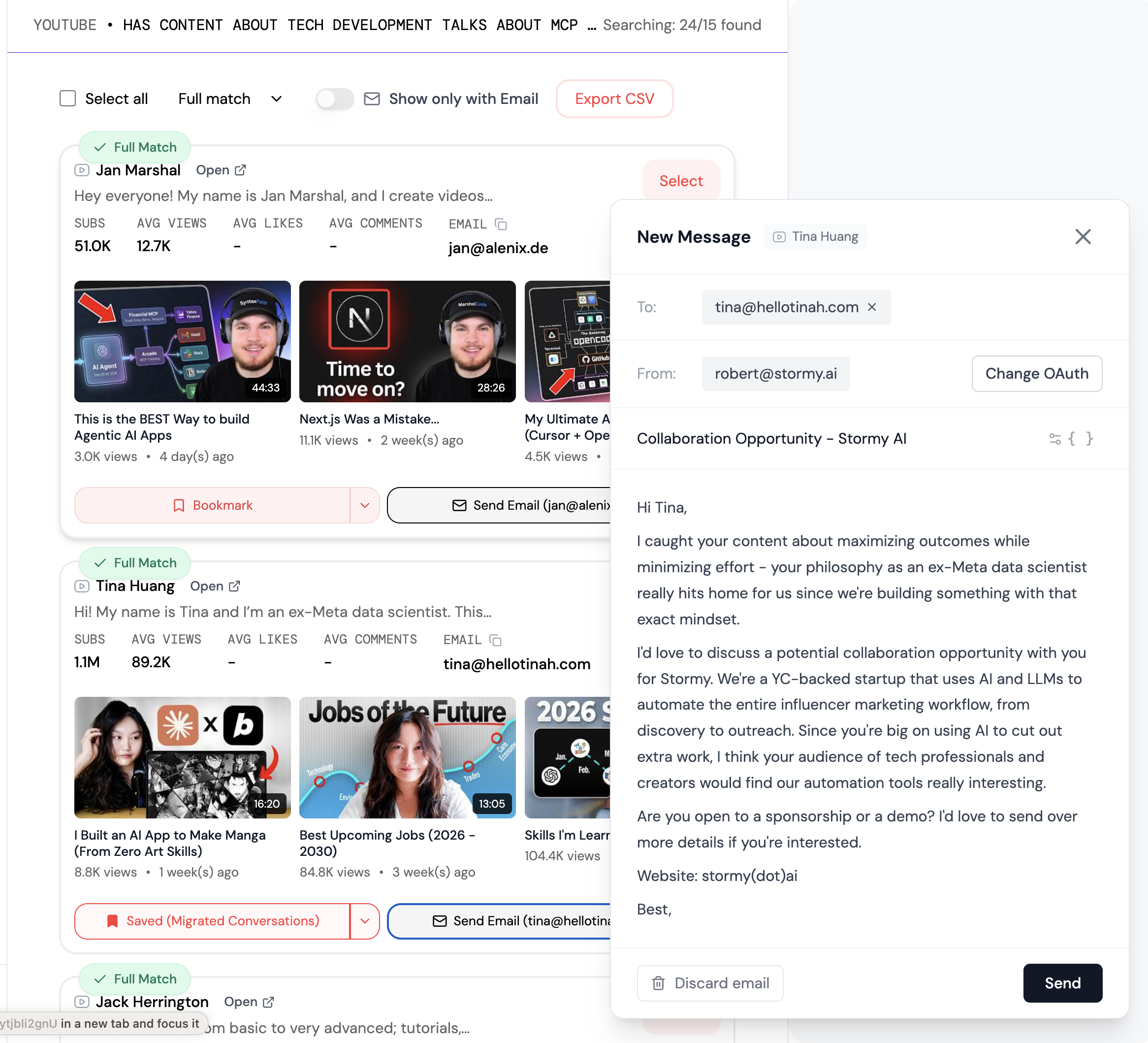
Once your functional prototype is live, the focus shifts to distribution. AI startups thrive on User Generated Content (UGC) and social proof. You don't need a massive ad budget if you can get creators to showcase your tool in action. To scale this process, modern AI platforms like Stormy AI can help source and manage UGC creators at scale, allowing you to find influencers who specialize in tech or productivity niches and automate the outreach process.
By using an AI-powered creator discovery platform, you can find micro-influencers who will build tutorials or "day in the life" videos featuring your software. This creates a compounding effect: your "vibe-coded" product gains credibility through third-party validation, leading to more organic shares and lower customer acquisition costs. Remember, the goal of a 48-hour build is to prove market demand, not to build a finished masterpiece.
Scaling, Pivoting, or Selling
What happens after the 48 hours are up? You have three choices: scale the business into a long-term venture, pivot based on user feedback, or sell the asset. There is a growing market for "startups in a box." Platforms like Acquire.com allow you to list functional, revenue-generating apps for five or six figures. If your obsession is the zero-to-one phase, you can make a lucrative career out of building, launching, and flipping AI tools every few weeks.
As Josh Pigford noted in his journey with Name Snag, the motivation is often learning. Every project you vibe code teaches you more about API integrations, semantic search, or database architecture. Even if a project doesn't result in a $15,000 exit, the "reps" you get in shipping functional software are invaluable. You are attending "shipping school," and the tuition is simply your time and a few API credits.
Conclusion: The Era of the Solopreneur
The rise of vibe coding marks the end of the era where technical barriers prevented great ideas from reaching the market. By combining Claude's reasoning capabilities, Cursor's development speed, and social media's distribution power, a single individual can now do the work that previously required a full engineering team.
The blueprint is simple: find an idea, timebox your development to 48 hours, use AI to handle the heavy lifting, and bring the community along for the journey. Stop over-engineering and start shipping. The world doesn't need more perfect code; it needs more functional solutions. Whether you end up building a $1.2 million ARR powerhouse or a quick $15,000 flip, the only way to win is to get started. Grab a domain, fire up Claude, and start building your first AI startup today.