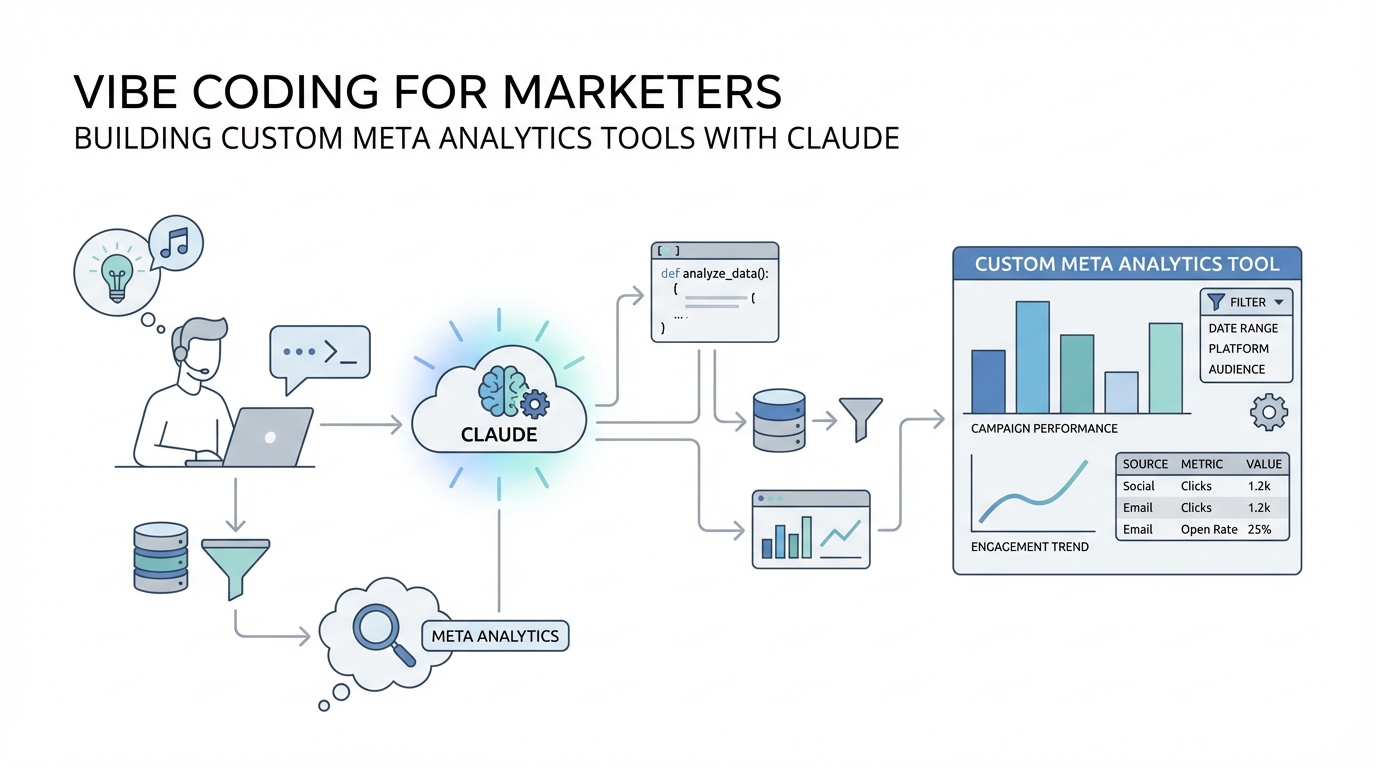
In early 2026, the barrier between a growth marketer and a software engineer has all but dissolved. We have entered the era of the "Vibe Coder," a term popularized by tech visionaries like Andrej Karpathy, where the ability to articulate a strategy in natural language is more valuable than the ability to write clean Python syntax. For agencies and brand owners, this isn't just a technical curiosity; it is a competitive necessity. By leveraging agentic tools like Claude Code, marketers are no longer waiting for IT departments to build dashboards. Instead, they are "vibing" their own bespoke infrastructure into existence, resulting in AI driven marketing ROI that was previously unreachable.
Defining 'Vibe Coding' in 2026: The New Growth Stack

Vibe coding is the process of using high-reasoning LLMs to build functional software without the user needing to master the underlying codebase. Unlike the "no-code" movement of the early 2020s—which relied on rigid drag-and-drop interfaces—vibe coding is fluid. You describe the "vibe" of the tool you need, and the AI handles the architecture, API integrations, and debugging. For those focusing on marketing automation for agencies, this shift is massive. According to research from Digital Applied, agencies using Claude Code for automation report a 75% time saving, effectively turning an 8-hour strategy session into a 2-hour automated execution.
Why is this happening now? The introduction of the Model Context Protocol (MCP) by Anthropic has changed the game. MCP allows Claude to sync with live data in real-time, eliminating the friction of manual CSV exports. Marketers are now building tools that talk directly to their Meta Ads Manager, Shopify stores, and CRM systems. We are moving toward what experts call agentic commerce, where AI isn't just suggesting ads but acting as a trusted advisor that researches and completes tasks autonomously.
"The era of the 'writing assistant' is over. We are now in the age of strategic infrastructure, where the marketer's primary role is to architect the AI's environment."Building a Custom Meta Ads Creative Analytics Tool

The standard Meta Ads Manager is excellent for raw data, but it often fails to explain why a piece of content is working. This is where Meta Ads creative analytics becomes a superpower. By using Claude Code, you can build a terminal-based dashboard that doesn't just look at Click-Through Rate (CTR) but analyzes the visual and psychological elements of your winning hooks.
For instance, media buyers like Mike Futia have used Claude to build custom tools that sync ad data and perform deep-dive qualitative analysis. These tools can identify if a specific "POV style" video is outperforming a "Studio style" video, even if they share the same budget. This level of granularity is essential when you consider that over 4 million advertisers are now using generative AI tools on Meta platforms, according to Marketing Dive. To stand out, you need better data than the default dashboard provides.
The Technical Playbook for Custom Tooling
- Setup the Terminal: Install the Claude Code CLI via your terminal using the command
npm install -g @anthropic-ai/claude-code. This gives you a direct line to the most powerful reasoning engine available. - Connect the APIs: Use meta-ads-mcp to allow Claude to "see" your live campaign performance. This is the bridge between the AI and your actual ad spend.
- Define the Logic: Instruct Claude to create a "Reviewer Skill." You can feed it a CLAUDE.md file containing your brand voice and historical winning hooks.
- Automate the Audit: Set up a script that triggers every morning to analyze creative fatigue. As noted by DTC Daily, detecting CTR decay early is the difference between a profitable week and a wasted budget.
By building this yourself, you avoid the generic "AI-speak" common in third-party platforms. You are creating a tool that understands your specific brand nuance and your specific customer avatars.
The $1,500 Autonomy Test: Lessons in AI Management

One of the most radical examples of vibe coding for marketers comes from Giorgio Liapakis, who conducted an autonomy test by giving Claude Code full access to a Meta Ads account and a $1,500 budget. As reported on Medium, the AI managed everything from ICP (Ideal Customer Profile) research to creative strategy and ad publishing. The human role was reduced to a single daily command: /let-it-rip.
The results were enlightening. The AI-driven tools were able to pivot targeting faster than a human media buyer could, resulting in a system that optimized for performance in real-time. This aligns with broader industry data from Meta Newsroom, which shows that advertisers using AI-driven tools saw a 22% improvement in ROAS, yielding an average return of $4.52 for every dollar spent.
"The goal isn't to replace the marketer, but to replace the manual labor that prevents the marketer from thinking bigger."However, this autonomy comes with risks. Letting an AI manage your budget requires Frequency Caps and strict guardrails. Without them, the AI might over-optimize for a tiny segment, leading to rapid ad fatigue. Marketing automation for agencies should always include a "Human-in-the-Loop" for the final 20% of creative nuance and legal compliance, a principle echoed by experts at Shared Physics.
Avoiding Pitfalls: Budget Spiraling and Garbage Traffic
As you build your custom tools, it is easy to get caught up in the "vibe" and lose sight of the unit economics. One of the most common mistakes is setting the wrong objective. If you tell your custom-coded agent to optimize for "Traffic," it will do exactly that: find the cheapest, lowest-quality clickers who never convert. Search Engine Land warns that this often leads to "garbage traffic" goals that look good on a spreadsheet but kill AI driven marketing ROI.
Another issue is audience saturation. Because Meta's AI is designed to find the path of least resistance, it may keep showing ads to the same people who have already engaged. Expert analysis from Infinity Nation suggests that manual frequency caps are still necessary to prevent performance from tanking. When vibe coding your dashboard, make sure to include a high-visibility alert for frequency spikes.
Finally, avoid vague prompts. Simply telling Claude to "write an ad" is a recipe for "AI slop." Winning ads require specific constraints—like the 125-character primary text limit or the 4:5 visual format for Reels. Use resources like ADEN's Lab to refine your prompt engineering to ensure your custom tools produce high-quality output.
Integrating Influencer Analytics for a Unified Growth View
While custom Meta dashboards are powerful, they often exist in a vacuum, ignoring the massive impact of User-Generated Content (UGC) and influencer partnerships. To truly master the growth stack, marketers should integrate their custom-coded tools with platforms like Stormy AI.
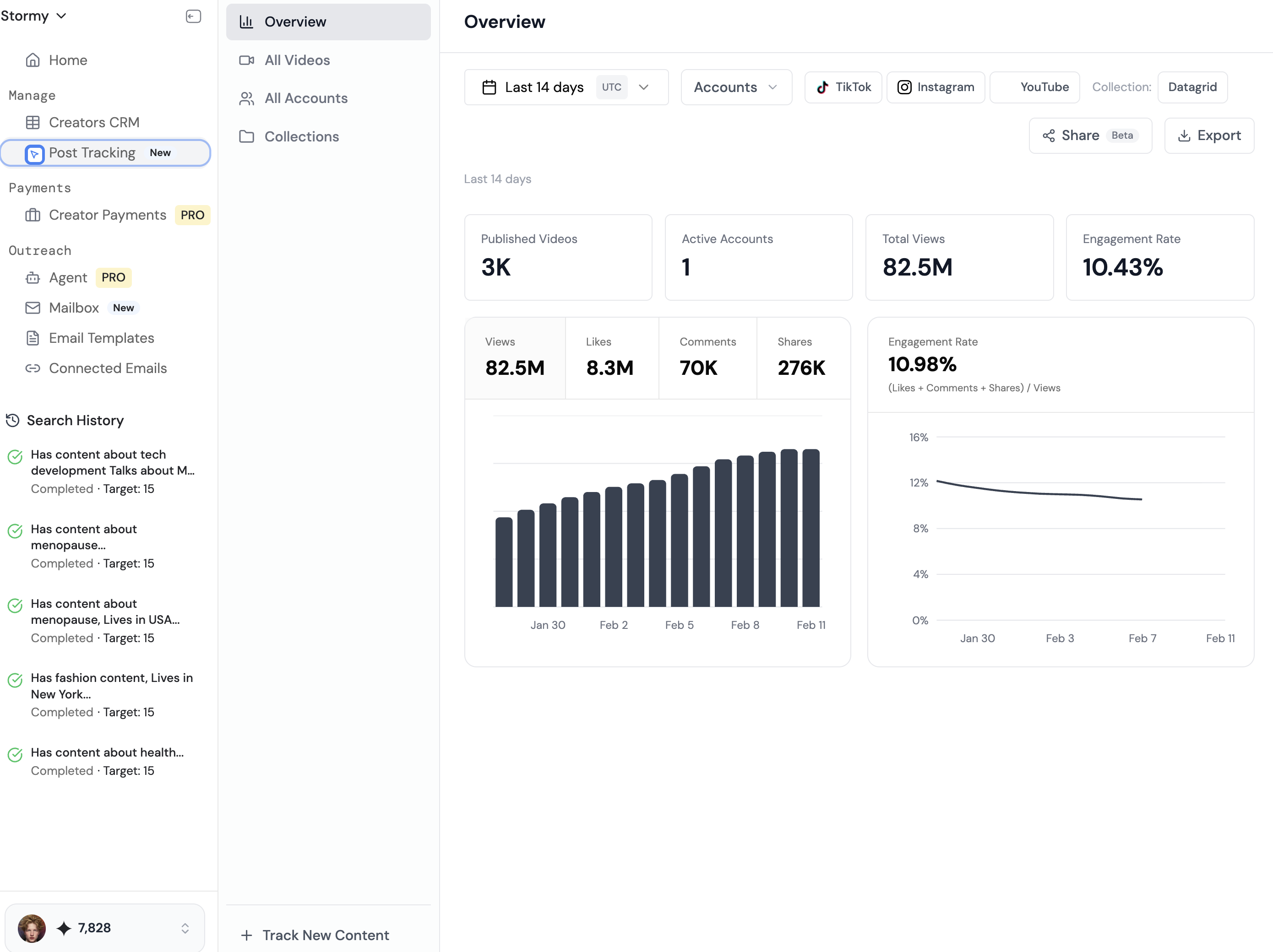
By using the post tracking and analytics features of Stormy AI, you can pull performance data from your influencer campaigns directly into your custom Claude-built dashboard. This allows you to see how a specific creator's video performs as an organic post versus how it performs as a Spark Ad on Meta. Tools like Stormy AI help bridge the gap by providing automated influencer vetting and fake follower detection, ensuring that the "top of funnel" content you are feeding into your Meta machine is actually high-quality.
When you combine the discovery power of an AI-powered influencer platform with a custom-coded analytics tool, you create a closed-loop system:
- Step 1: Use Stormy to find and outreach to high-performing UGC creators.
- Step 2: Track their content's organic engagement via Stormy's post tracking.
- Step 3: Feed the winning content into your Meta Ads machine.
- Step 4: Use your custom Claude dashboard to analyze the ROAS and creative nuances.
Conclusion: The Rise of the Full-Stack Marketer
The transition to vibe coding represents a fundamental shift in how we approach growth. It is no longer enough to be a "creative" or a "quant." The modern marketer must be a generalist who can architect systems. By building custom marketing tools with Claude, you are reclaiming your time and your data.
As Meta's AI continues to drive nearly $550 billion in economic activity (as cited by fb.com), those who can build their own analytics and optimization tools will be the ones who capture the lion's share of that value. Start small: install Claude Code, connect it to your Meta API, and ask it to analyze your last 30 days of creative performance. The vibe is the limit.