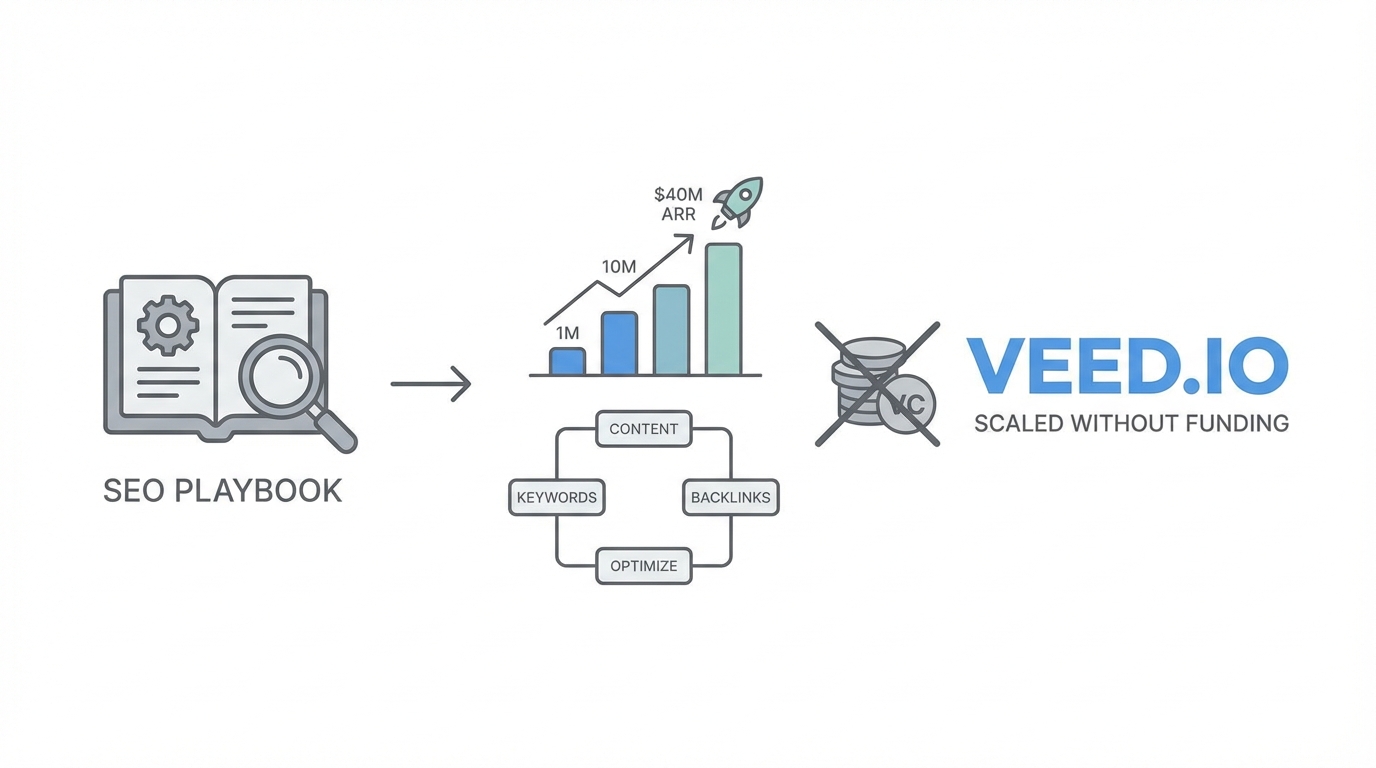
In the world of high-growth technology, the story of Veed.io stands as a radical outlier. Most founders believe that hitting $40 million in annual recurring revenue (ARR) requires a massive venture capital injection, a polished PR firm, and an expensive marketing team. But for Saba Cannajad and his co-founder Tim, the reality was much grittier. Their journey started in a shared co-working space where they had to nickel and dime every purchase to survive, even getting kicked out of their office and watching their interns quit on the same day.
Veed.io didn't become a household name for video editors through super-bowl ads or viral stunts. Instead, they leveraged a relentless, data-driven approach known as "Brute Force SEO." By identifying thousands of high-intent long-tail keywords and building dedicated entry points for every single one, they created a SaaS SEO strategy that acted as a perpetual motion machine for user acquisition. This article deconstructs the exact playbook they used to scale from zero to millions of users without a dollar of initial funding, providing a blueprint for any founder looking at content marketing for startups as their primary growth lever.
The Zero-Budget Origin Story: From Rejection to Revenue
Before the millions in revenue, there was total insolvency. Saba grew up in "the middle of nowhere" and taught himself design using a cracked version of Photoshop. After meeting his co-founder Tim at a global hackathon, they spent two years building projects that failed. When they finally landed on the idea for Veed.io, they were met with silence. They applied to Y Combinator and were rejected—not once, but multiple times. At one point, they were so broke they couldn't afford a $100 monthly subscription for Crisp Chat and had to beg for a discount just to keep talking to their 30,000 monthly users.
The turning point came when they realized that if they couldn't buy traffic, they had to earn it. Saba, despite being "very dyslexic," decided to take over the marketing department himself. His strategy was simple: find exactly what people were searching for and build the best possible answer for it. This product led growth model was born out of necessity. They didn't have the budget for a sales team, so the product had to sell itself through the search bar. This is a classic example of how to scale a SaaS when your bank account is empty: you trade your time for search engine real estate. For modern teams, managing these early user relationships and potential creator partnerships is made easier with Stormy AI, which provides a built-in CRM and automated outreach tools to handle the heavy lifting that Saba did manually.
Identifying High-Intent Long-Tail Keywords

The core of Veed's SaaS SEO strategy was the realization that people don't search for "video editing software" when they have a quick problem to solve. They search for specific actions. Saba identified over 500 unique search terms that represented immediate user needs. These weren't broad, competitive terms; they were "high-intent long-tail keywords" like:
- Trim video
- Crop video
- Add text to video
- Add subtitles to video
- Convert MOV to MP4
Each of these terms represents a user with a "burning hair" problem. They need a solution right now. By focusing on these specific queries, Veed was able to bypass the high competition of the broad "video editor" category and dominate the niche markets that their competitors were ignoring. For modern startups, this discovery phase can be significantly accelerated. While Saba had to manually hunt for these terms, today's founders can use Stormy's AI search to identify trending niches and creator-led search patterns across platforms like TikTok and YouTube in seconds.

Programmatic SEO Examples: The 500-Page Workflow
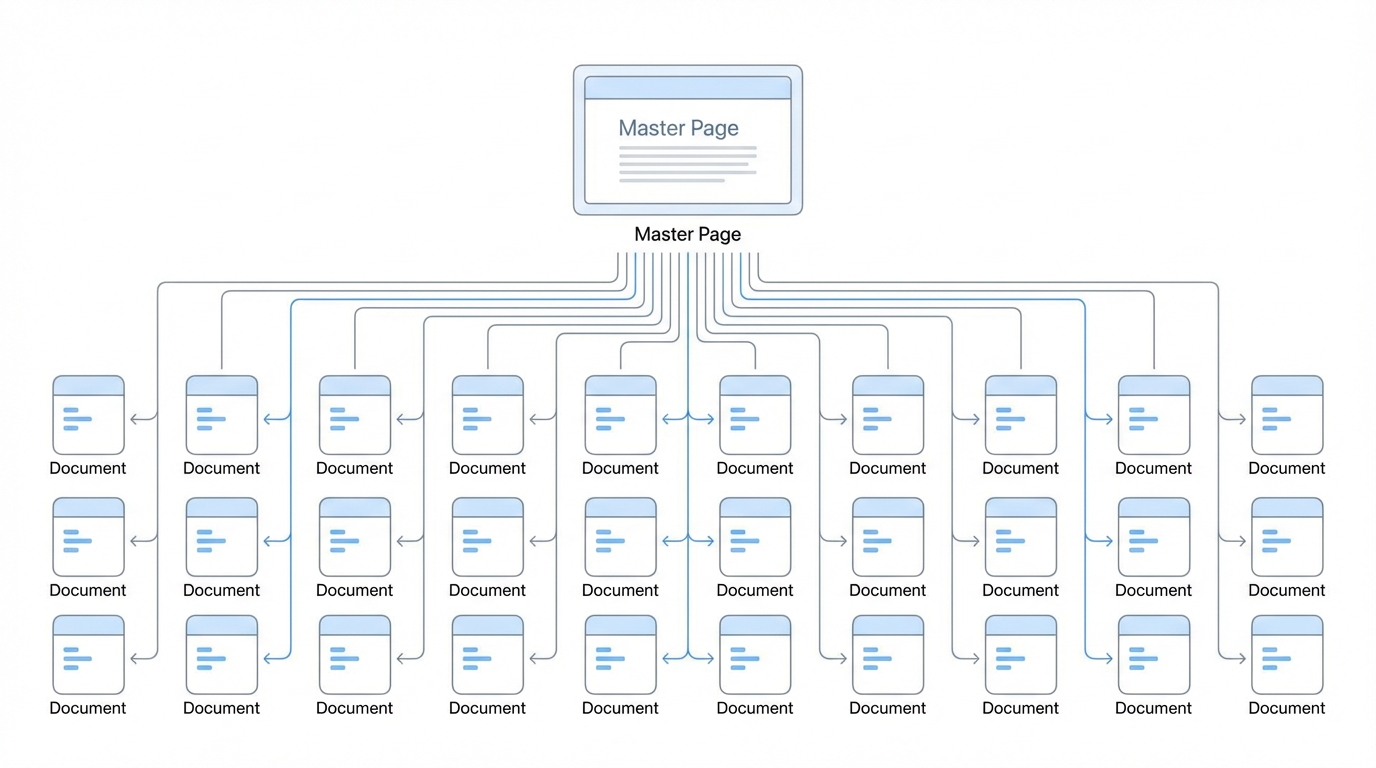
Identifying the keywords was only half the battle. The "brute force" element came in the execution. Saba built a dedicated landing page for every single one of those 500+ search terms. This is one of the most successful programmatic SEO examples in the SaaS world. But it wasn't just about volume; it was about relevance. Each page was designed to lead the user directly into the tool to perform that specific task.
The workflow for scaling this content production was intense. Saba wrote the copy for these pages himself, often working from 7 AM until late at night in a co-working space they were technically sharing with one entry card to save money. This content marketing for startups approach ensured that no matter how niche a user's request was, Veed had a custom-tailored front door waiting for them. They used PostHog to track how these users interacted with the site, allowing them to refine the conversion funnel for each specific landing page. If you are looking to replicate this, the key is to automate the template but personalize the utility.
The Anatomy of a Veed Landing Page
- H1 Matching the Query: If the user searched "crop video," the headline was "Crop Video Online."
- Immediate Call to Action: A large "Upload Video" button that put the user directly into the editor.
- Educational Content: A short guide on how to perform the task, which helped with SEO rankings and user trust.
- Cross-Linking: Links to other related tools (e.g., "Now that you've cropped your video, want to add subtitles?") to keep the user in the ecosystem.
Leveraging YouTube as an SEO Engine
Saba didn't stop at text-based Google search. He recognized that YouTube is the second-largest search engine in the world. For every one of those 500 landing pages, he recorded a dedicated YouTube video. This created a double-whammy SEO effect. When a user searched for "how to trim a video," they would see Veed's website in the traditional search results and Veed's video in the video carousel.
This multi-channel approach is crucial for any product led growth strategy. It builds authority and captures users in different mindsets—those who want to read and those who want to watch. This level of content saturation is exactly what Stormy's post tracking is designed to monitor. By analyzing which types of video content are gaining traction for competitors or in specific niches, founders can decide which "brute force" efforts will yield the highest ROI before they even hit record.
Scaling Content Production with Zero Budget
The most impressive part of Veed's story is that they achieved $40M ARR while remaining extremely lean. Even after they started making revenue, they took half of their salaries to hire two more engineers rather than spending it on expensive ads. They proved that how to scale a SaaS isn't about the size of your budget, but the consistency of your output. They focused on compounding interest—each SEO page they built was an asset that would continue to bring in users for years without further investment.
Today, the landscape has changed. While Saba had to manually write and record everything, AI-powered influencer discovery and outreach tools have made it possible to scale these efforts through partnerships. Instead of building 500 pages yourself, you can use Stormy's AI outreach to find 500 micro-influencers who already have the attention of your target audience. This allows you to achieve the same "brute force" saturation but with the added benefit of social proof and third-party validation.

The Results: From Zero to One to Forty Million
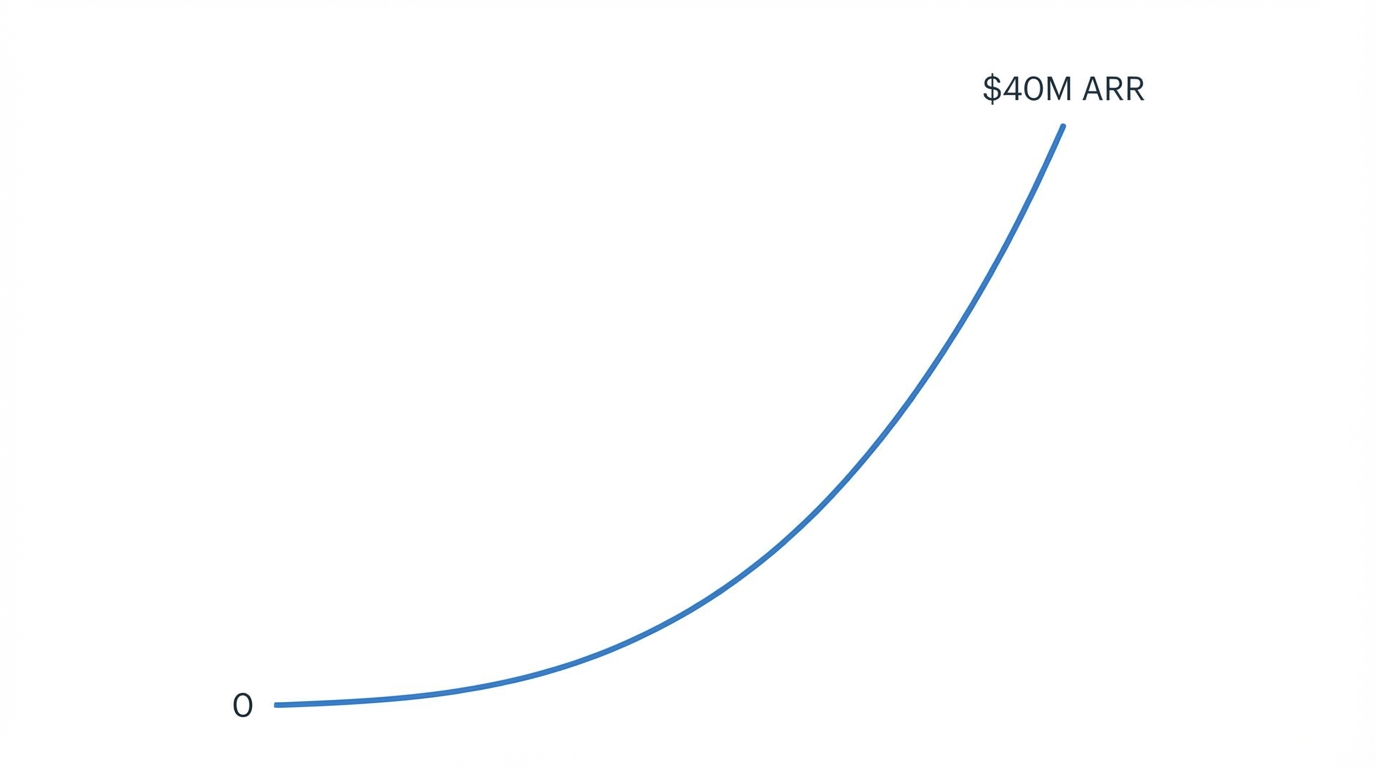
The growth trajectory of Veed.io is a testament to the power of persistence. After two years of zero progress, the SaaS SEO strategy finally caught fire. They went from zero to $1 million in revenue in their first year of focusing on growth. Four months later, they hit $2 million. Two months after that, $3 million. Within six months, they had doubled to $6 million. This exponential curve is the hallmark of successful content marketing for startups.
By the time they reached $40 million in revenue, Saba described the feeling as a "middle finger" to everyone who rejected them, including the VCs and Starter Story features that highlight his journey. But the lesson isn't just about revenge; it's about the endurance sport of business. Scaling a SaaS requires you to be in "day-to-day combat," constantly drumming the beat of the company and keeping growth up even when you feel vulnerable.
Conclusion: Your Brute Force Blueprint
Veed.io's success proves that a SaaS SEO strategy built on brute force can outcompete even the most well-funded startups. To replicate their success, you must be willing to do the unglamorous work of identifying long-tail needs and creating high-quality entry points for every single one. Whether you are building landing pages or leveraging UGC creators to dominate social search, the principle remains the same: saturation equals success.
If you're ready to start your own growth journey, don't wait for a VC to validate your idea. Use modern tools to speed up the process. You can vet creators with Stormy's analysis to find your first marketing partners, or use AI to automate the outreach that Saba and Tim had to do by hand. The tools have evolved, but the requirement for persistence and brute force hasn't changed. Start building your search real estate today, and you might just be the next $40M success story.