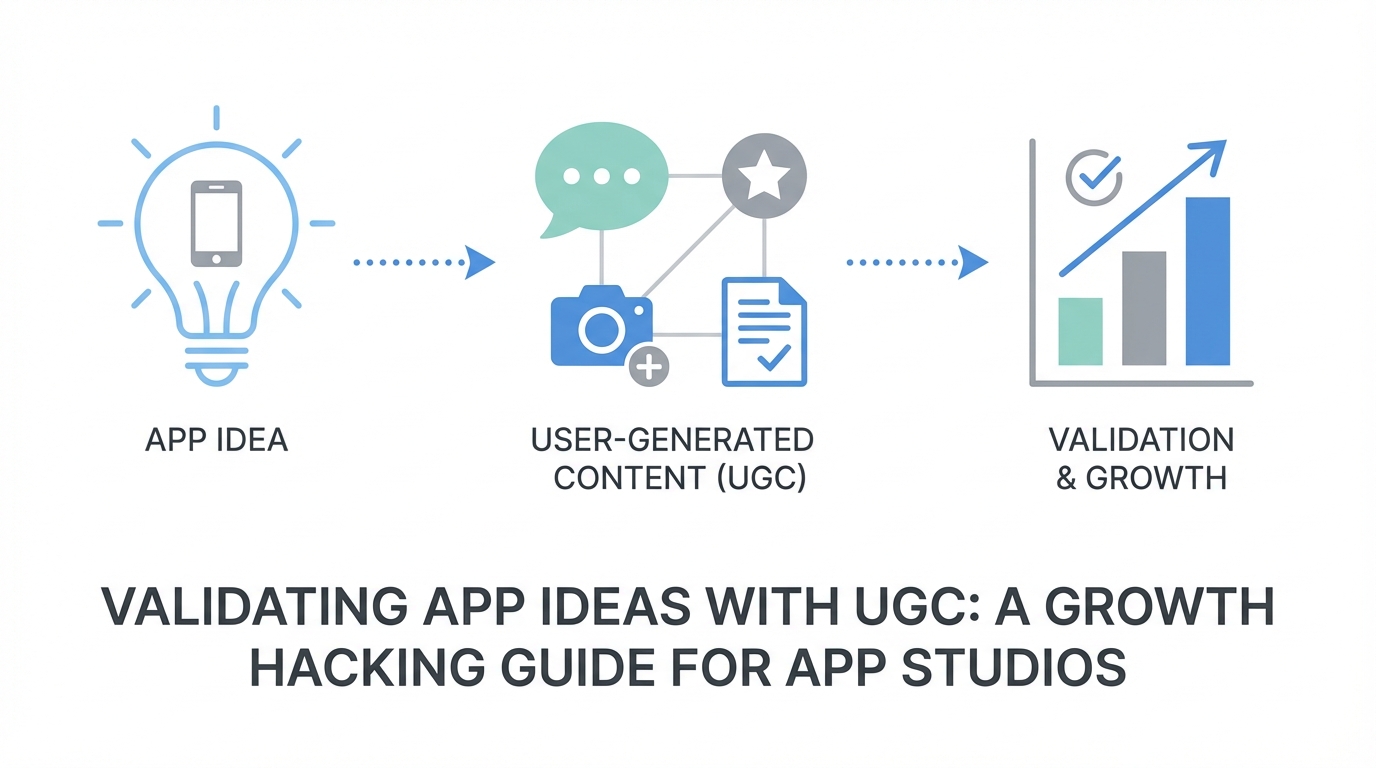
In the current mobile landscape, the traditional "build it and they will come" philosophy is a recipe for a quiet failure. For solo founders and emerging app studios, the primary challenge isn't just engineering; it's distribution. With rising costs in traditional performance marketing, a new mobile app growth hacking strategy has emerged: using high-volume, organic User-Generated Content (UGC) to validate app ideas before committing to massive development cycles. By leveraging small budgets and short-form video, savvy developers are now testing product-market fit in under 30 days, often seeing their app store conversion rate optimization skyrocket in the process.
The Unit Economics of Validation: The $1,000 MVP Marketing Plan


Many founders believe that a significant launch requires a five-figure marketing budget. However, recent data from high-growth app studios suggests that you can validate app ideas for as little as $500 to $1,000. This lean mvp marketing plan involves hiring a handful of creators—often college students—to produce a high volume of content over a 30-day window. Unlike traditional campaigns on platforms like Meta Ads Manager, which require constant financial fueling to maintain visibility, organic UGC builds a library of assets that can go viral at any time.
Consider the case of Sideshift, a platform that scaled from 10,000 to 150,000 users in just four months. By spending approximately $10,000 across their entire campaign, they generated 20 million views in 30 days from just 300 posts. This resulted in a customer acquisition cost (CAC) that was measured in pennies. Using platforms like Stormy AI, an AI-powered search engine that finds creators via natural-language prompts, allows studios to run dozens of these experiments simultaneously without breaking the bank.
The 'Photogenic' Case Study: From 5% to 50% Conversion
One of the most compelling arguments for an organic-first strategy is its impact on app store conversion rate optimization. A solo founder developing 'Photogenic'—an AI-powered photo album app—experienced this shift firsthand. Initially, the app was converting App Store visitors at a mediocre 5% to 10%. This is common for new apps that lack social proof or recognizable branding. By using Stormy AI to vet creators for audience quality and engagement fraud, you can ensure your traffic comes from high-quality sources. After launching an organic UGC campaign that amassed 35 million views across 46 posts, the conversion rate jumped to over 50%.
Why the massive jump? When a user discovers an app through an organic video, the psychological barrier to entry is lower. By the time they reach the App Store, they aren't just "browsing"; they are actively seeking the solution they just saw in action. This high-intent traffic is far more valuable than the passive clicks generated by Google Ads. For the founder of Photogenic, this influx didn't just provide downloads; it provided the data needed to refine app retention and features by observing how users interacted with the AI when it "messed up"—a viral hook that the creator discovered independently.
Why Organic Search Traffic Outperforms Paid Ad Clicks
There is a fundamental difference in user behavior between clicking an ad and performing an organic search. Ads on TikTok or Instagram are explicitly labeled, which triggers a natural skepticism in users. Conversely, when a user watches a UGC video, closes TikTok, opens the App Store, and types in the name of your app, they have already completed a multi-step commitment. This behavior is what drives the mobile app growth hacking success seen by top studios today.
While tools like Apple Search Ads are excellent for capturing existing demand, organic UGC creates the demand. To ensure your creators are hitting the right notes, you can use research tools like SpyTalk to find winning formats within your specific niche. By identifying what is already trending, you can give your creators a head start, rather than asking them to reinvent the wheel. Stormy AI further simplifies this by using its AI search engine to identify creators who already have a track record in these specific high-converting niches.
The Minimum Viable Test (MVT) Playbook

To effectively validate app ideas, you need a repeatable framework. Here is the step-by-step playbook used by successful app studios to test new concepts without over-investing.
Step 1: The Short and Sweet Brief
Don't overwhelm creators with a 50-page manual. Focus on the core value proposition and the "viral moment" of your app. Include a personalized Loom video explaining the product and provide clear personas for the target audience. If you have competitors with viral videos, link to them as inspiration. The goal is to give them a foundation while allowing for creative freedom.
Step 2: The Three-Day Warm-Up
For organic campaigns, the "warm-up" process is critical to avoid being flagged by anti-bot algorithms. Instruct your creators to act like humans. They should spend three to five days engaging with content in your app's niche—liking, commenting, and scrolling naturally—before posting their first video. This signals to the platform that the account is authentic, increasing the chances of hitting the For You Page (FYP).
Step 3: The Hybrid Deal Structure
A successful app studio distribution strategy relies on aligned incentives. We recommend a hybrid payment model: a base retainer of $15–$20 per video plus generous performance bonuses based on views or downloads. This attracts quality creators while incentivizing them to engage with comments and drive real conversions. You can manage this process at scale by utilizing the built-in creator CRM in Stormy AI to manage relationships and collaboration history.
Closing the Feedback Loop: Retention and Revenue

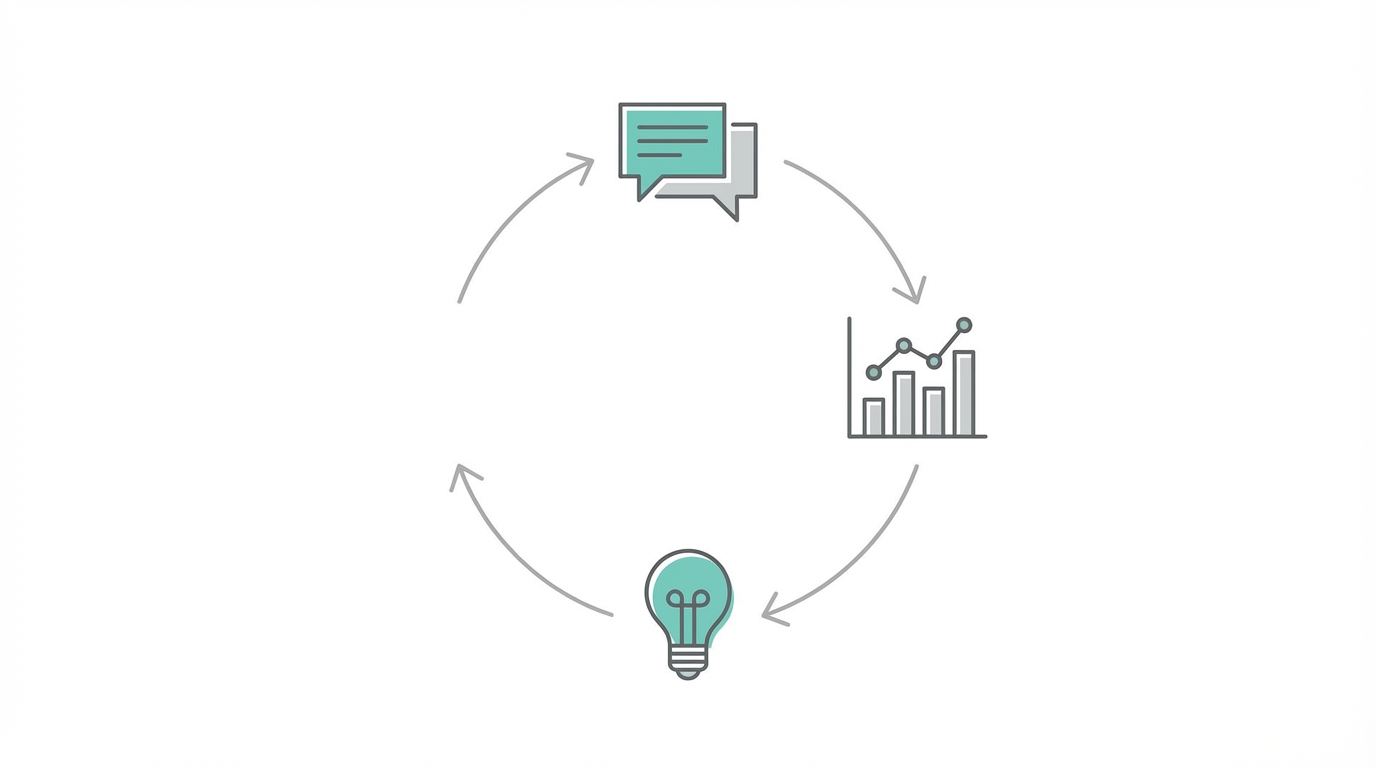
Validation isn't just about getting downloads; it's about seeing if users stay. High-volume organic traffic provides a massive sample size to test your app store conversion rate optimization and internal paywalls. Studios like Vert Ventures use this influx of users to test different monetization strategies in real-time. By integrating tools like Superwall, developers can swap out paywalls instantly to see which price points or features resonate most with the new audience.
If you launch 50 videos and see 100,000 views but zero increase in retention, you have validated that the current thesis or product hook isn't working. This allows you to pivot your development resources elsewhere before you've spent months building a product nobody wants. This "fail fast" approach is the cornerstone of modern mobile app growth hacking.
Scaling Your Distribution Strategy
Once you have found a winning format through organic testing, you can "spark" that content into paid channels. Take the videos that performed best organically and put them into Meta Ads or TikTok Ads. This combined approach ensures that you are not just gambling on creative, but scaling assets that have already proven their value in the wild. You can also set up an AI agent in Stormy AI that automatically discovers and outreaches to new creators every day while you sleep.
As the market for influencers and micro-influencers continues to converge, the cost of high-quality UGC remains relatively low. For app studios, the opportunity lies in building long-term relationships with hungry, smart creators—particularly college students—who are eager to gain growth marketing experience. These creators can eventually transition into strategist roles, helping you manage the distribution of dozens of apps across your portfolio.
Conclusion: The Founder's Advantage
In the race to validate app ideas, speed and cost-efficiency are your greatest allies. By adopting a UGC-first mvp marketing plan, you remove the guesswork from app development. You no longer need to wonder if people care about your astrology app or AI headshot tool; the data from 300 organic posts will tell you the truth. Start small, iterate quickly, and use mobile app growth hacking techniques to turn casual viewers into loyal power users. The tools are available, the creators are hungry, and the App Store is waiting—your only job is to start putting shots on goal.