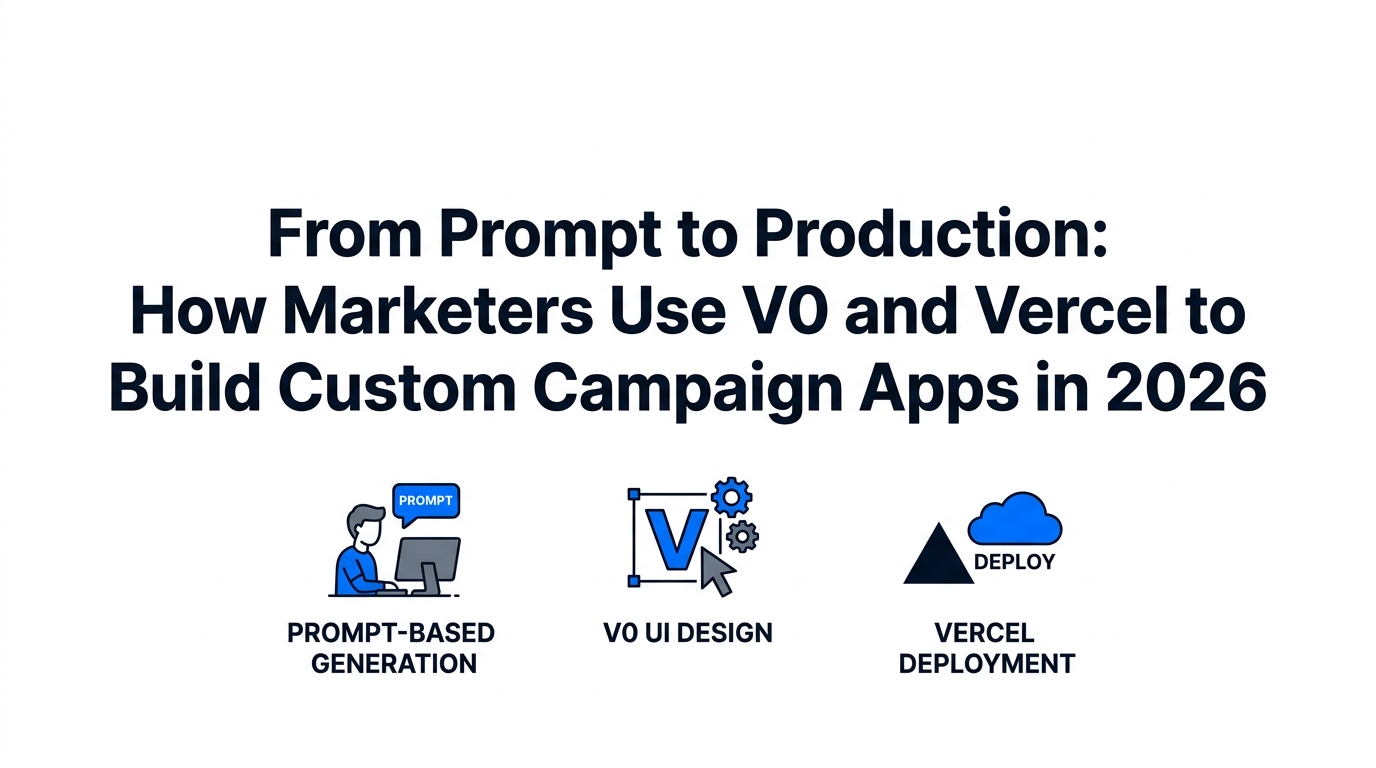
In 2026, the barrier between a marketing idea and a live, production-grade application has effectively vanished. Gone are the days of waiting six weeks for a development sprint to clear just to launch a simple seasonal campaign tool. Today, growth teams are operating with unprecedented iteration velocity, moving from a natural language prompt to a global URL in a matter of minutes. This shift is driven by the synergy between V0, an AI-driven interface generator, and Vercel, the deployment platform that has redefined web performance.
Democratizing the Web: The Rise of Software 2.0
Discover how Vercel removes friction to turn creative ideas into live production websites.
For decades, marketing teams were at the mercy of Software 1.0—a world where every button, form, and layout had to be explicitly coded, tested, and pushed through a rigid pipeline. In 2026, we have fully embraced Software 2.0, a paradigm where we use probabilistic models to "discover" the user interface we need through English prompts. This isn't just a toy for prototyping; it is how production software is built.
"I no longer write code. I only prompt. If you're truly brilliant, you find that you have to delete, delete, delete until you find the essentials of the idea."
Using V0 marketing tools, non-technical growth hackers can now generate complex React components simply by describing them. Whether it's a "bespoke retirement calculator for Gen Z" or a "gamified onboarding quiz for a Fintech app," the AI understands the intent and outputs clean, Next.js-compatible code. This democratization means that the "pit crew" (the engineers) can focus on core product architecture, while marketers handle the "lap speed" (the campaign execution).
Why Vercel Out-Converts Traditional CMS Platforms
See how Software 2.0 and Vercel represent a massive shift from traditional coding methods.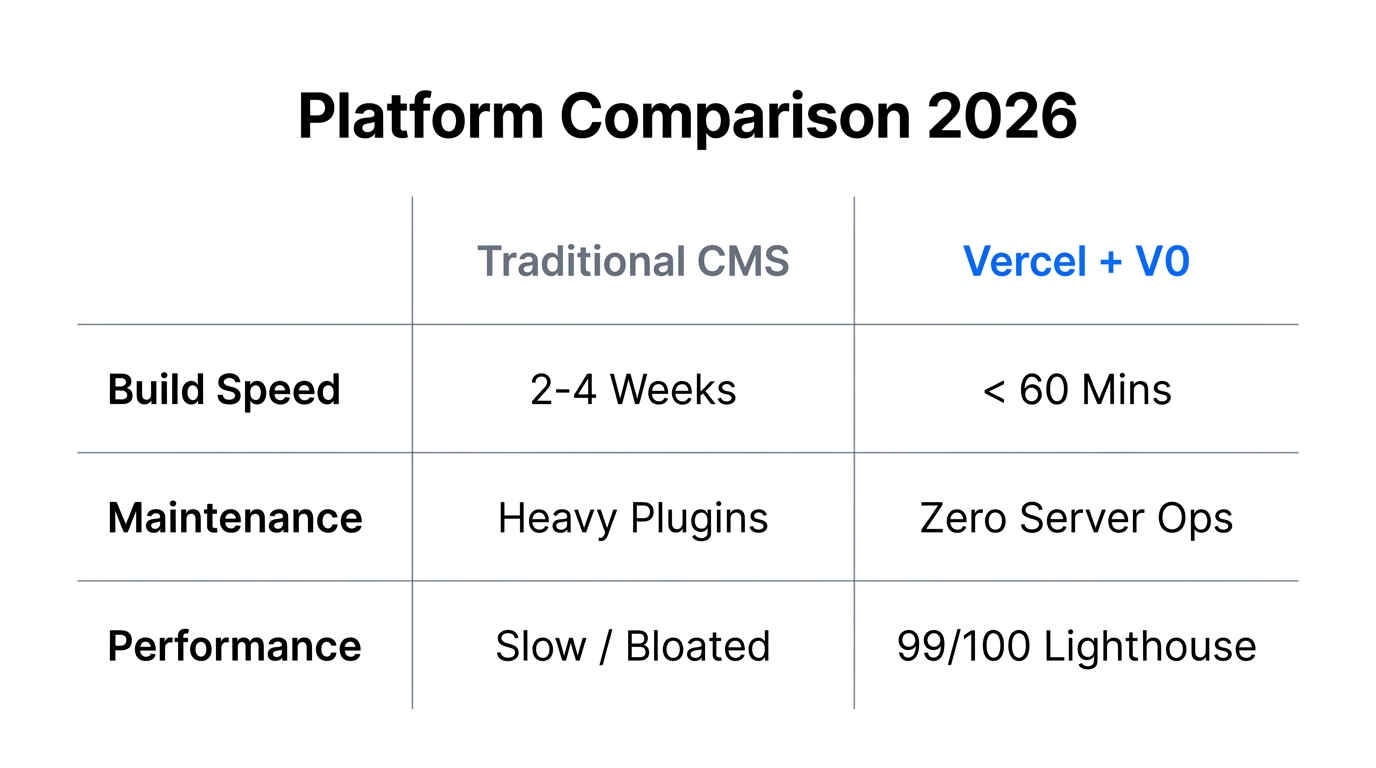
Many marketers are still tethered to legacy CMS platforms that prioritize ease of editing over end-user performance. However, in the high-stakes world of 2026 ad bidding, every millisecond counts. Research has shown that when enterprise e-commerce sites move from traditional stacks to Vercel, they see conversion rate improvements of 30% to 90% simply because the site is faster [source].
| Metric | Traditional CMS (WordPress/Wix) | Vercel + V0 (Next.js) |
|---|---|---|
| Load Speed | 1.5s - 3.0s | 0.2s - 0.5s |
| Deployment Time | Hours/Days | Seconds |
| Scalability | Server-dependent | Global Edge Network |
| Conversion Uplift | Baseline | +30% to 90% |
The secret lies in hydration. When you visit a Vercel-hosted site, you receive a pre-rendered, static HTML artifact immediately. Then, JavaScript "hydrates" the page, making it interactive and alive. It’s the difference between a static newspaper and the magical moving pictures in Harry Potter. This speed is why brands like Ramp and Brex use Vercel to maintain brand consistency while scaling hundreds of personalized landing pages.
The 60-Minute Playbook: Launching an AI-Powered Lead Magnet
Learn why custom apps are replacing basic email capture forms for modern marketing teams.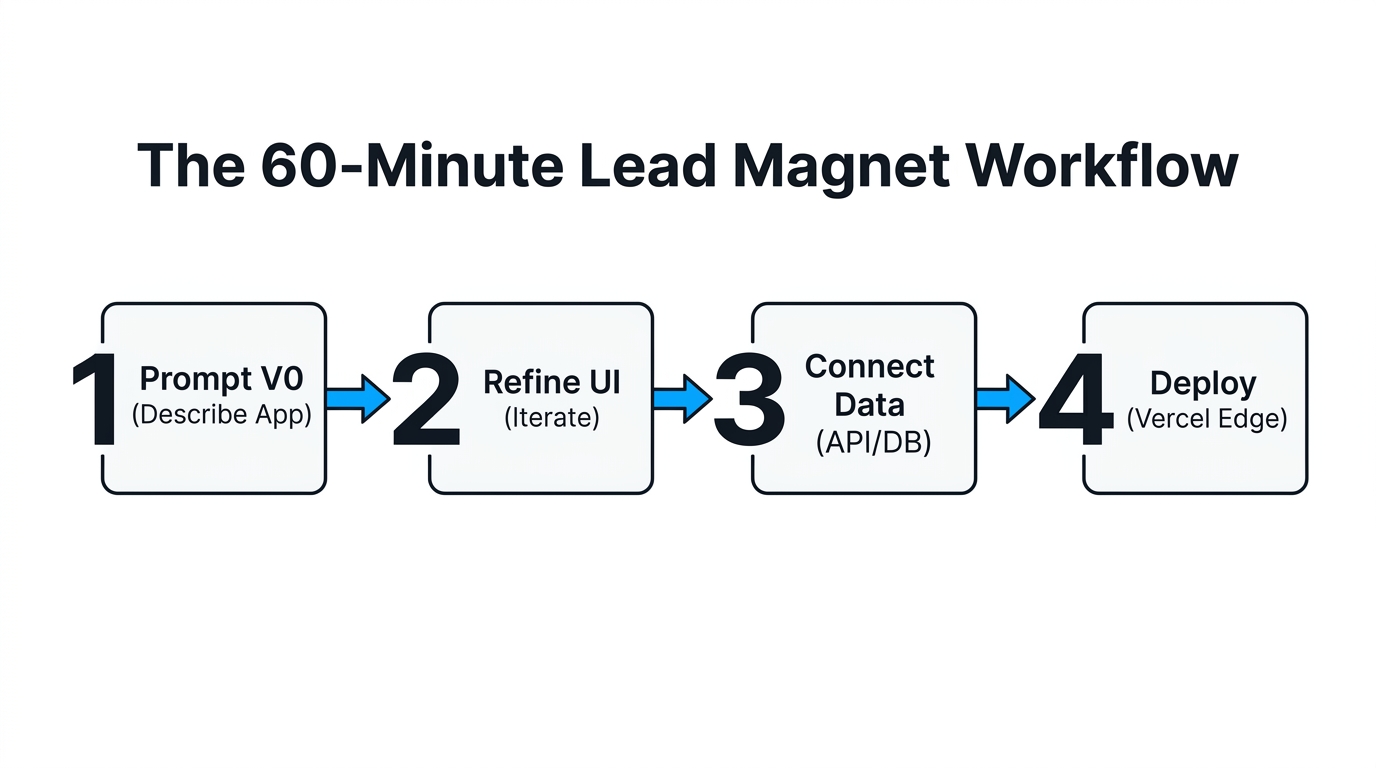
Building a custom lead magnet app used to require a $20k agency budget. Now, you can build landing pages with V0 and launch them before lunch. Here is the 2026 playbook for a high-performance campaign app:
- Step 1: The Prompt. Open V0 and describe your tool. Example: "Build a React-based ROI calculator for a SaaS company. It should have three sliders, a dynamic chart using Shadcn UI, and a lead capture form that one-clicks to a PDF report."
- Step 2: Refining the UI. Use V0’s iterative chat to tweak the design. Ask it to "make it look like Supreme.com" or "add a dark mode toggle." The AI handles the CSS and component logic instantly.
- Step 3: Connect the Data. For lead storage, use a "wrapper" approach. Connect your V0 code to a serverless database like Supabase or Neon with 1.0 deterministic logic.
- Step 4: Deploy to Vercel. With one click, push your code to Vercel. You now have a production URL protected by a global CDN.
- Step 5: Content Integration. To truly drive conversions, integrate social proof. Platforms like Stormy AI allow you to discover and manage UGC creators who can provide the video testimonials that populate your new high-speed landing page.
"If drag-and-drop is involved as a primary interaction mechanism, it is probably ripe for disruption. No one wants to drag; they just want to say 'build it'."
Modular Frameworks: How Ramp and Brex Scale
One of the biggest risks for marketers using AI app generation in 2026 is fragmentation. If every landing page is a "one-off" AI generation, your brand voice can get lost. The winners in the space—like Ramp—solve this by using modular frameworks. They create a core set of "brand-approved" components in Next.js and then use V0 to re-arrange and augment those pieces for specific campaigns.
This "Platform of Platforms" approach ensures that even as you ship 100 times a day, every pixel remains on-brand. When you combine this with ElevenLabs for AI-generated audio guides or ChatGPT for dynamic copy, the result is an app that feels like it was built by a 20-person engineering team over six months, despite being prompted into existence over a long weekend.
The Future: Beyond Simple Forms
Explore why the next generation of web interfaces will focus on completing specific tasks.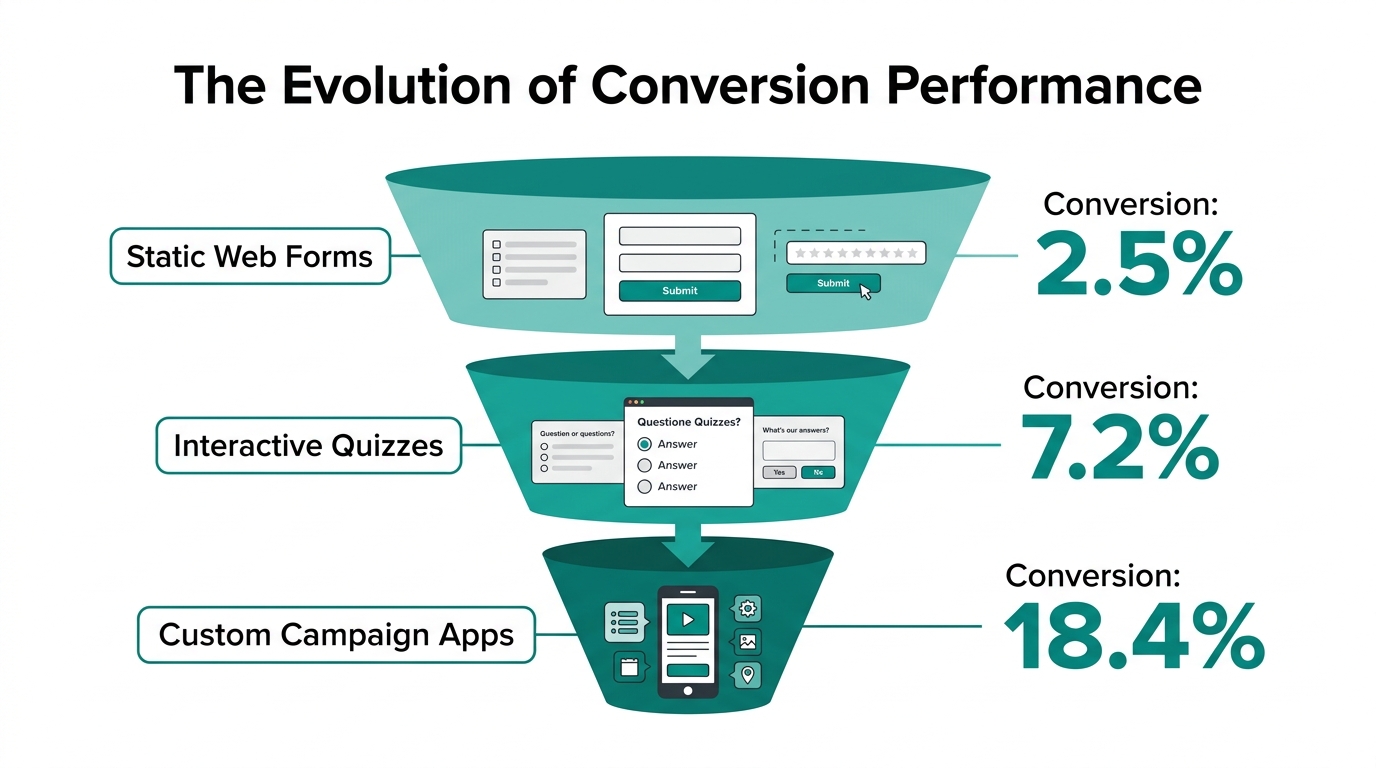
The evolution of Vercel for marketers is moving toward "Generative UI." Imagine a landing page that doesn't just display a form, but morphs based on the user's intent. If a user from Argentina visits your site, the AI-driven interface knows to offer them different payment terms or local social proof instantly, without you having to pre-code every edge case.
As we move further into 2026, the marketing "campaign" is becoming an interactive, living software product. Whether you are using TikTok Ads to drive traffic to a V0-generated app or managing influencer workflows on Stormy AI to populate that app with content, the toolkit has never been more powerful. The only question left is: How fast can you prompt?
Conclusion: From Idea to URL
The "energy dollar" of 2026 marketing is intelligence transmuted into execution. By leveraging V0 and Vercel, you are no longer limited by your technical constraints, but only by the clarity of your intent. Start small: take one existing static landing page, prompt it into a dynamic V0 app, and watch your conversion rates transform. The era of the non-technical founder and the high-output marketer is here. It’s time to go pro.