In the high-velocity world of 2026 marketing, your brand name is not just a label—it is your highest-frequency leverage point. As founders and marketers, we often treat naming as a secondary task, something to be checked off a list during a frantic Friday afternoon session. However, the difference between a 'safe' name and the 'right' name can be the difference between a few hundred million dollars in revenue and a $5 billion category-defining titan. In an era where attention is the scarcest currency, using Claude for brand names is no longer a luxury; it is a tactical necessity to escape the 'sea of sameness.'
The High-Frequency Leverage of Brand Naming
 2:07
2:07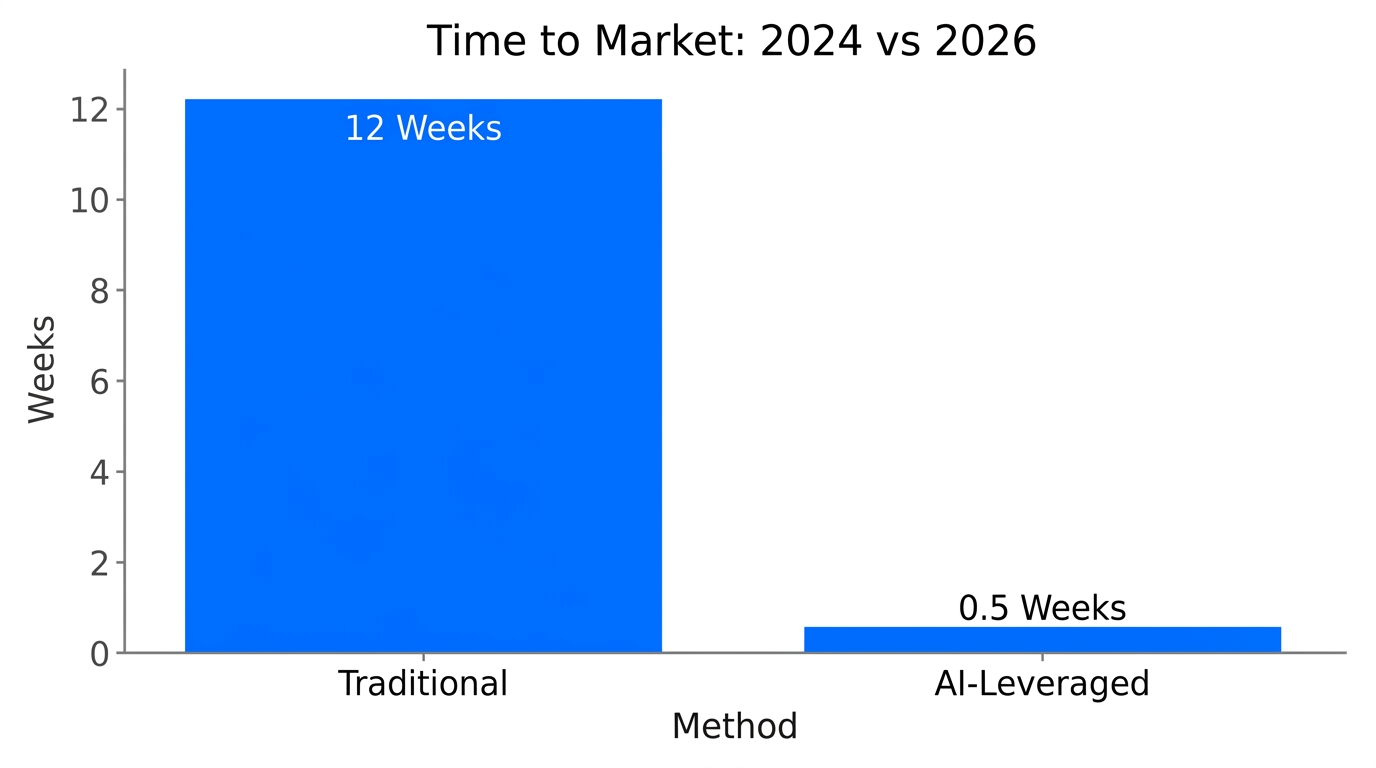
Nothing in your brand will be used more often or for longer than your name. It compounds over time. While most entrepreneurs settle for names like 'ProMop' (functional, boring, invisible), the greats reach for 'Swiffer'—a name developed by Lexicon Branding that implies speed, magic, and efficiency without ever using the word 'clean.' By leveraging AI branding tools 2026, you can move past descriptive labels and create what naming experts call processing fluency: names that are surprisingly familiar yet completely original.
"The right name creates an asymmetric advantage. It doesn’t just describe what you do; it launches the brand into a new psychological category for the consumer."
Rule #1: Quantity Leads to Quality
24:01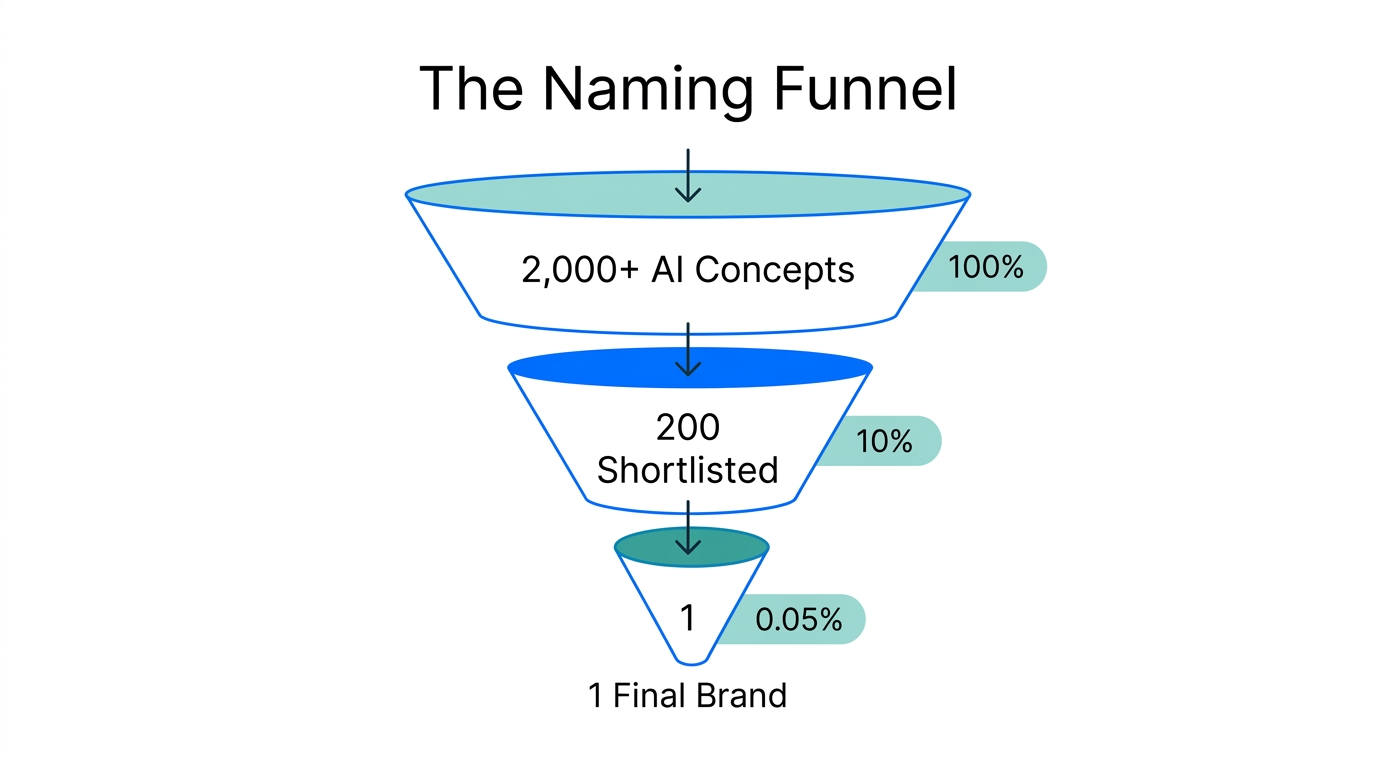
The biggest mistake founders make when using AI for naming is stopping too early. If you generate 50 names, you are still in the 'Comfort Trap.' To find the 'Ship of Gold' in the deep blue sea of possibilities, you need to generate at least 2,000 name concepts. In 2026, tools like Claude allow us to iterate across unrelated categories in seconds.
When you use Claude, don't just ask for 'names for a fiber company.' Instead, create distinct 'treasure hunt' teams within your prompts. One team should focus on the product benefits, the second on unrelated ingredients (like energy or minerals), and the third on a completely separate world, such as athletic performance or aviation. This divergent thinking ensures your outputs aren't just synonyms for your product, but strategic identifiers that stand out on a shelf or a digital storefront.
Avoiding the 'Comfort Trap'
Human beings crave comfort, but comfort is the enemy of branding. Names that 'do well in research' are often the worst choices because they are familiar and safe. If everyone on your team immediately likes a name, it’s probably invisible. You want a name that is polarizing. Polarization indicates energy. When you are building a presence on platforms like TikTok Ads Manager, you need a name that stops the scroll, not one that blends into the background.
| Naming Zone | Consumer Reaction | Market Outcome |
|---|---|---|
| The Invisible Zone | "That makes sense." | High consensus, zero distinction. |
| The Safe Zone | "I've heard that before." | Moderate growth, high friction. |
| The Tension Zone | "Wait, what is that?" | Asymmetric advantage, high energy. |
Prompting for Synchronicity: Beyond the Dictionary
53:43To get billion-dollar results from Claude, you must prompt for synchronicity—the connection of seemingly irrelevant things. This is how the Pentium processor got its name (from the Greek 'penta' for five) or how BlackBerry overcame the 'safe' urge to call their device the 'PocketLink.'
Step-by-Step Synchronicity Prompts:
- The Periodic Table: Ask Claude to map your product's core value (e.g., 'lightness') to elements, noble gases, or chemical reactions.
- Greek & Latin Roots: Don't just look for translations; look for morphemes on Etymonline that imply reliability (like 'B' sounds) or innovation (like 'X').
- Aviation & Physics: If your product makes people feel 'lighter,' look at terms for aerodynamics, lift, and anti-gravity.
By using Notion to catalog these cross-category inspirations, you can build a database that Claude uses to 'craft' names rather than just 'finding' them. This is how you find names like Azure for Microsoft—a word that implies the vastness of the sky, perfect for the cloud, but unexpected from a legacy software giant.
"The 'X' in Lexus or SpaceX isn't just a letter; it’s a universal symbol for innovation and the future. Some letters carry more market weight than others."
The 5-Day Billion-Dollar Naming Playbook
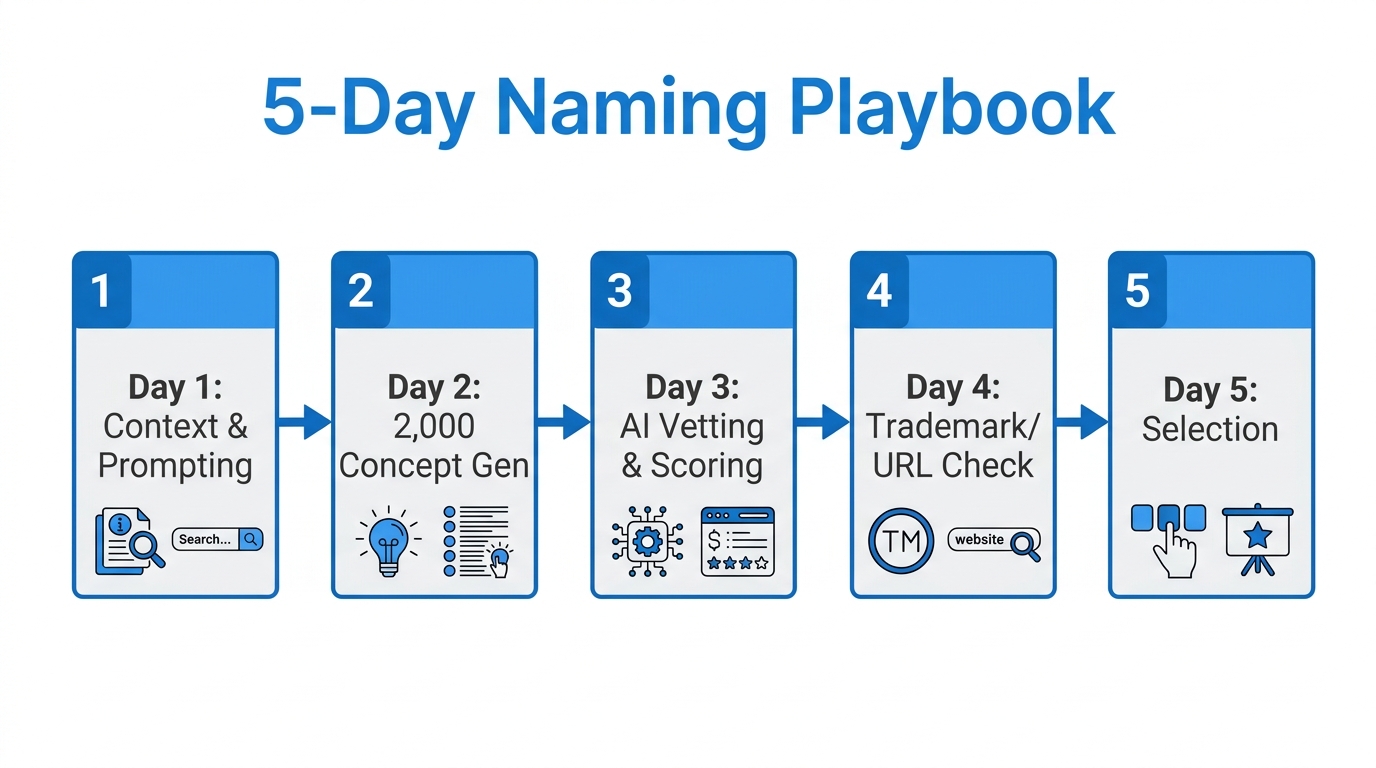
For self-taught marketers and entrepreneurs, the creator economy brand building process requires a structured workflow to avoid creative burnout. Here is how to use Claude to find your 'approximate' ideas in one work week.
Day 1: Mapping the Ocean
Research the 'sea of sameness.' Look at every competitor on Shopify and categorize their names. If they all use 'Fiber-this' or 'Bio-that,' create a 'No-Go' list. Use Claude to summarize the linguistic patterns of the top 50 brands in your niche.
Day 2: The Dreaming Room
This is the divergent phase. Feed Claude your research and ask for 1,000 names across 10 unrelated categories. Do not judge yet. Use Canva to quickly mock up how these names look in a Wall Street Journal headline. If it's believable, keep it.
Day 3: Synchronicity Injection
Take your top 50 'dream' names and ask Claude to find 'approximate' cousins. These are ideas that live between 'bizarre' and 'safe.' If you like 'Feather,' Claude might suggest 'Aero' or 'Volo.' This is where you find the linguistic gold.
Day 4: The Sound Symbolism Audit
In 2026, we know certain sounds trigger specific emotions. 'K,' 'P,' and 'B' are fast and reliable. Ask Claude to rank your list based on processing fluency and sound symbolism. This ensures your name isn't just a word, but a psychological trigger.
Day 5: The Judging Room
Now, bring in the 'Judge.' Switch Claude’s persona to a cynical trademark attorney. Run your top 10 names through legal availability checks and linguistic 'red flag' audits for global markets. Narrow it down to the final three.
Managing the 'Dreaming Room' vs. 'Judging Room'
The biggest killer of creativity is evaluation. When you are managing a team—or even just managing your own AI workflow—you must separate the generation of ideas from the judging of ideas. As Walt Disney famously did with the Disney Creative Strategy, keep these processes in separate 'rooms.'
When an AI or a team member brings you a 'bizarre' idea, don't say, 'That’s too expensive' or 'That’s illegal.' Instead, say, "I wish we could make that work," or "How could we modify that to make it legal?" This encourages approximate thinking, which is where the billion-dollar names like 'Impossible Burger' live. It’s an absurd claim that became a household name because the founders had the courage to stick with a polarizing choice.
"You don't need a popular name. You need the right name. Popular names are for people who want to fit in; right names are for people who want to win."
Conclusion: Scaling Your Brand in 2026
A name is only the beginning. Once you have a high-leverage name like 'Swiffer' or 'BlackBerry,' the next step is outreach and amplification. In the creator economy, your name needs to roll off the tongue of influencers and look iconic in a 15-second video.
By using AI-driven marketing workflows and platforms like Stormy AI, you can bridge the gap between a great name and a great market presence. Use Claude to find the name that creates the 'spark,' and use Stormy’s AI agents to find the creators who will turn that spark into a multi-billion dollar blaze. Remember: don't settle for comfortable. Aim for surprising, aim for polarizing, and aim for the name that makes your competitors look like they’re still using 'ProMops' in a 'Swiffer' world.