In 2026, the consumer landscape has shifted fundamentally. We no longer live in an era where a flashy logo and a vague promise of 'sustainability' are enough to win market share. Today’s buyers are hyper-aware, skeptical, and equipped with AI-powered tools that can sniff out greenwashing in milliseconds. According to the Edelman Trust Barometer, transparency is now the primary driver of brand loyalty. To survive, brands must adopt a strategy of radical transparency—a framework pioneered by Tony's Chocolonely. By turning supply chain failures into marketing assets and utilizing high-agency PR stunts, Tony’s hasn’t just built a chocolate company; they’ve built a $200M+ revenue engine that forces the entire industry to look in the mirror. This is the definitive playbook for mission-driven marketing in 2026.
The 'Arrested Founder' Stunt: High-Agency PR for Ethical Causes
 23:16
23:16Most founders avoid the police; Teun van de Keuken (the 'Tony' in Tony’s) practically begged for handcuffs. In 2005, the Dutch journalist was investigating the cocoa industry and discovered a horrific reality: despite signing treaties to end child labor, global giants like Mars, Nestle, and Hershey's were still sourcing from West African farms rife with child slavery and illegal labor practices, a crisis documented extensively in investigative reports by the Washington Post. A typical journalist would have simply published a report on a digital platform or written an op-ed. Tony took the path of high agency.
He filmed himself eating several bars of chocolate, then called the police to report a crime. His logic? Knowing that the chocolate was produced via slave labor, he argued that he was a knowingly complicit consumer of stolen goods. He demanded to be arrested. While the prosecutors eventually dismissed the case, the stunt generated global viral PR that no traditional ad budget could buy. This wasn't just a marketing tactic; it was a moral declaration that birthed a brand. In the first 48 hours of launching his own bar, Tony sold 20,000 units. The lesson for 2026 is clear: mission-driven marketing requires more than a mission statement—it requires a demonstration of conviction that disrupts the status quo, often involving B Corp certification standards and beyond.
"If you aren't willing to go to jail for your brand's mission, do you even have a mission at all? High-agency stunts are the only way to break through the noise in 2026."
Market Positioning: Building the 'Lonely' Brand in a Corrupt Industry
The name Tony's Chocolonely wasn't an accident. It was a strategic positioning play. van de Keuken felt 'lonely' in his crusade for a 100% slave-free supply chain. By naming the company after his isolation, he immediately cast the rest of the multi-billion dollar chocolate industry as the 'corrupt' establishment. This created a binary choice for the consumer: you are either with the 'lonely' crusader or you are funding the status quo.
In 2026, ethical brand building is about creating these stark contrasts. Tony's didn't just compete on taste; they competed on the unevenness of their bars. If you've ever opened a Tony's bar, you’ll notice the pieces are not uniform. This is a physical reminder that the profits in the chocolate industry are not distributed fairly. Every time a consumer breaks a piece of chocolate, they are engaging with the brand's Tony's Chocolonely brand strategy. It is a masterclass in using product design as a narrative device. By the time they expanded internationally, they had already captured 20% of the market share in the Netherlands, proving that purpose-led growth is a viable path to dominance in a market increasingly focused on ending child labor in supply chains.
Radical Transparency: Why Reporting Your Failures Builds Trust
29:03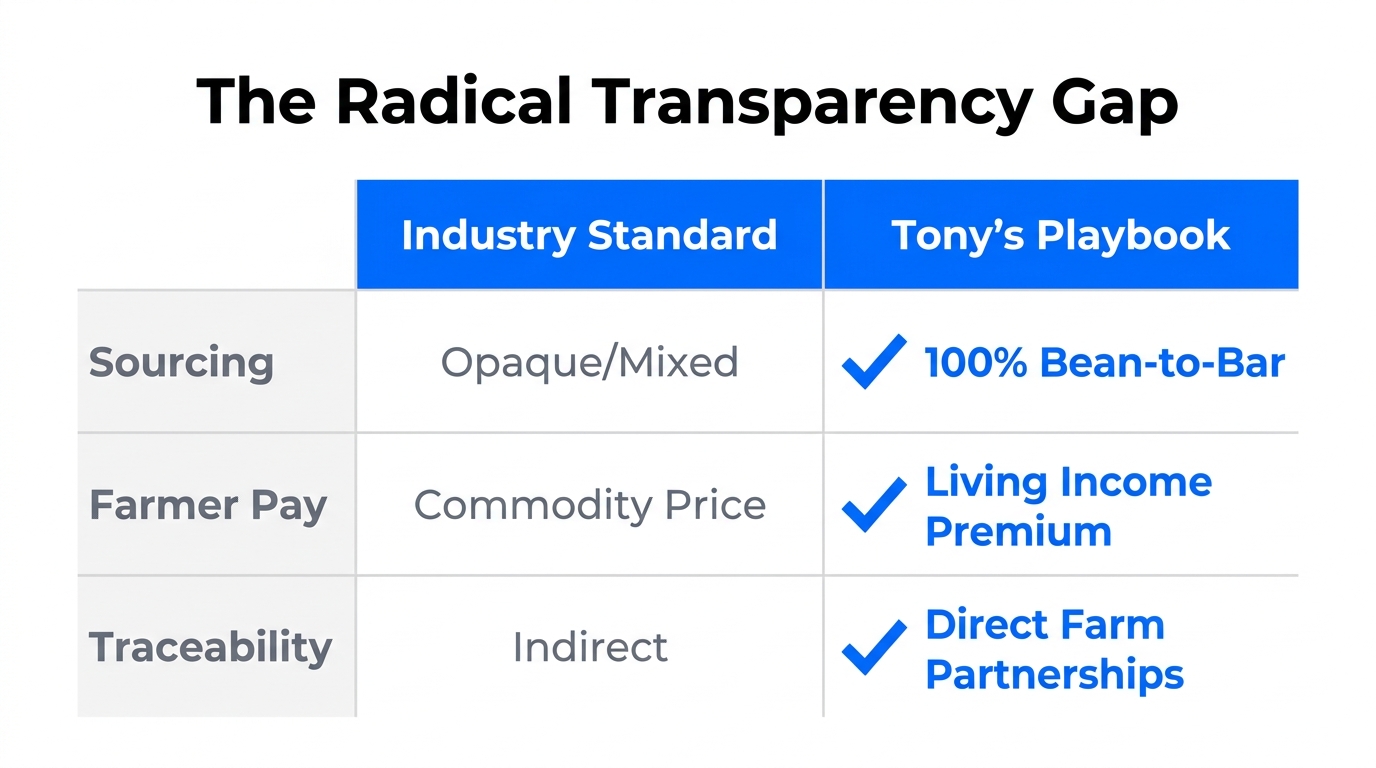
One of the most counter-intuitive aspects of the Tony’s playbook is their approach to bad news. In their Annual Fair Report, the company disclosed that they had discovered 11 issues of child labor within their own supply chain. Most corporate PR teams would bury this data deep in an appendix. Tony’s put it front and center. Why? Because in 2026, transparency is the only currency that matters.
By reporting their own failures, Tony’s proved they weren't 'greenwashing.' They acknowledged that cleaning up a global supply chain is messy and difficult. This honesty built more trust than a 'perfect' report ever could. Modern consumers know that perfection is a lie. When you admit to a failure and provide a clear plan to fix it, you move from being a 'brand' to being a trusted partner—a transition that tools like Stormy AI help brands manage by monitoring real-time sentiment and creator feedback. This approach is now being mirrored by brands like Feastables, where founder Jimmy Donaldson (MrBeast) has openly consulted with Tony's to ensure his own supply chains meet these rigorous 2026 standards.
Strategic Partnerships: The Tony's and Ben & Jerry's Blueprint
Growth in 2026 isn't just about individual performance; it's about ecosystem alignment. The collaboration between Tony’s Chocolonely and Ben & Jerry's provides a perfect blueprint for co-branded ethical growth. Both brands share a DNA of social activism—Ben & Jerry’s with their famous Greyston Bakery partnership (which employs ex-cons to reduce recidivism) and Tony’s with their cocoa mission.
| Feature | Traditional Partnership | Tony's x Ben & Jerry's Model |
|---|---|---|
| Primary Goal | Short-term sales spike | Long-term mission alignment |
| Supply Chain | Separate and siloed | Shared ethical sourcing standards |
| Marketing Message | "Try this new flavor" | "Join the movement for fair pay" |
| Success Metric | ROI on ad spend | Total lives impacted in supply chain |
By launching co-branded products like the "Chocolatey Love-A-Fair" bar, they didn't just cross-pollinate their audiences; they multiplied their moral authority. When two mission-driven giants stand together, it becomes much harder for critics to dismiss their efforts as a fluke. For startups looking to scale in 2026, finding a partner who shares your 'hill to die on' is more valuable than any influencer shoutout on TikTok.
The 2026 Purpose-Led Growth Playbook
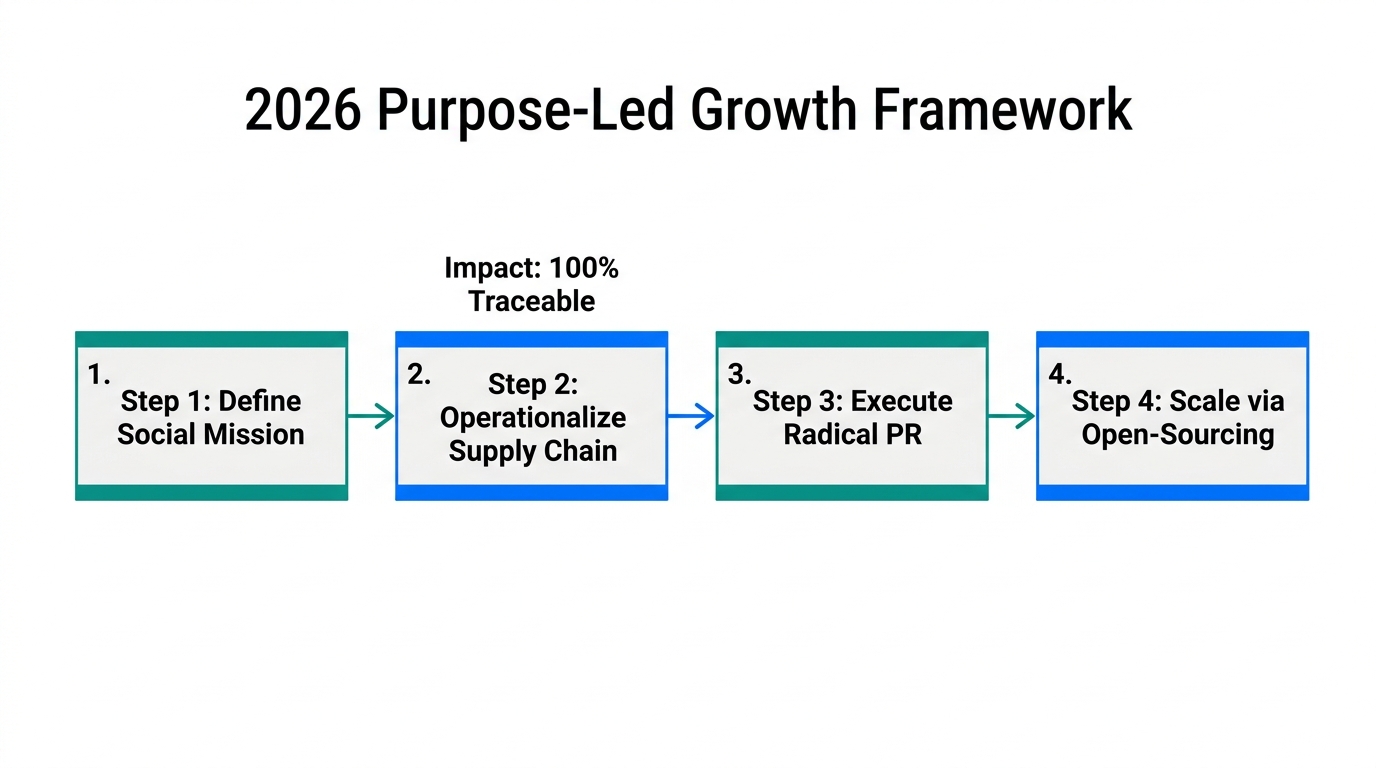
To turn a social cause into a $200M+ revenue engine, brands must follow a disciplined framework. It is no longer enough to just 'do good.' You must do good and dominate your category. Here is the purpose-led growth playbook for the current year:
- Identify the 'Original Sin' of Your Industry: Every major industry has a dark secret—whether it’s carbon emissions, data privacy, or labor exploitation. Your mission must address this core issue directly.
- Execute a High-Agency Entry Stunt: Use a PR stunt that demonstrates the absurdity of the status quo. Think like a journalist, not a marketer. Focus on earned media over paid media.
- Make the Mission the UX: Tony’s used uneven chocolate bars. Your mission should be baked into the user experience. If you are a software company, perhaps your 'mission' is reflected in your data transparency dashboard.
- Leverage AI for Mission Sourcing: To find the right advocates, you need data. Platforms like Stormy AI allow brands to source influencers who specifically align with ethical and social missions, ensuring your message isn't being carried by someone with a conflicting history.
- Report the 'Bad' with the 'Good': Publish a radical transparency report. Use tools like Notion or public dashboards to show your progress and, more importantly, your setbacks.
"Transparency is the new marketing. In 2026, your supply chain is your best advertisement."
The 'Lipstick Effect': Why Ethical Chocolate Wins in 2026
10:52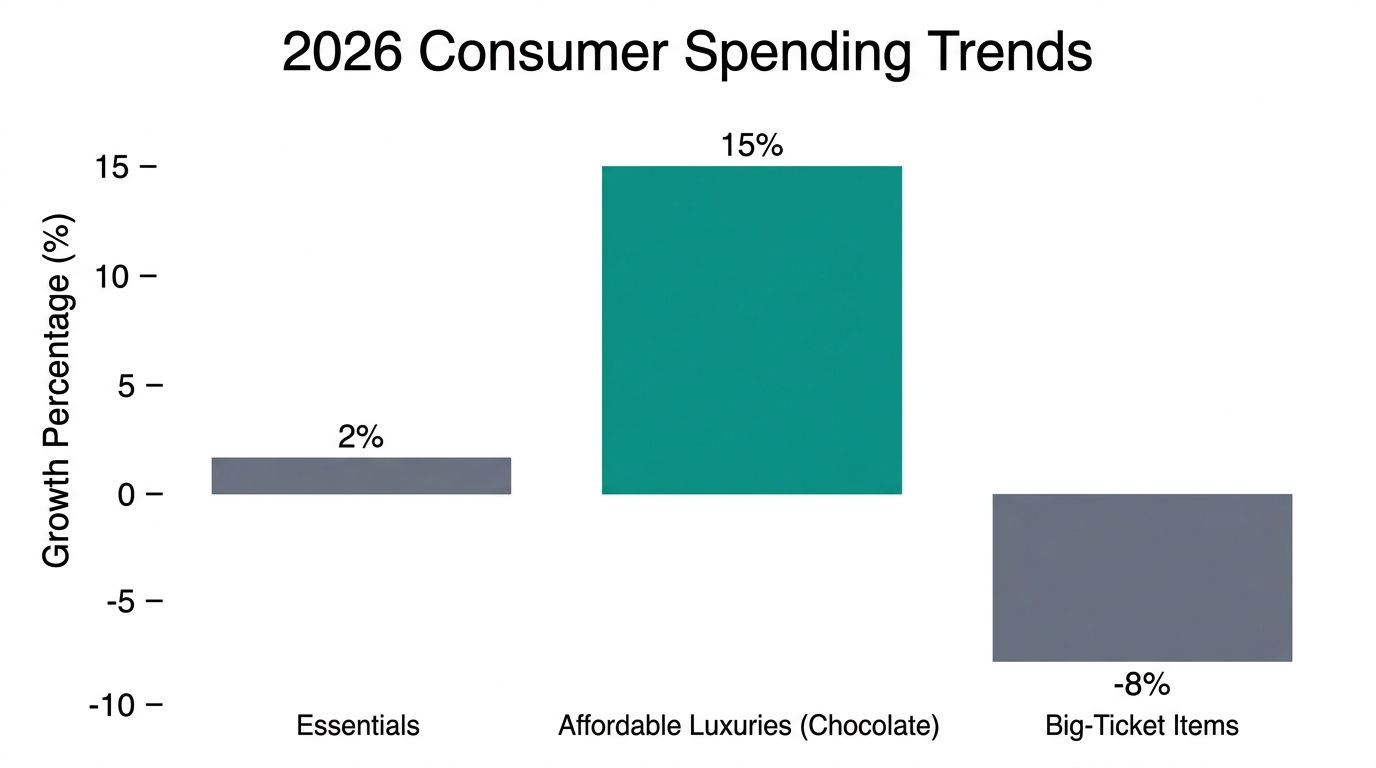
Even in a choppy 2026 economy, Tony's continues to thrive due to the Lipstick Effect. When consumers feel financial pressure, they shift away from massive luxury purchases (like cars or designer bags) and toward 'small luxuries' that make them feel good about themselves. A $6 bar of ethically sourced chocolate is the ultimate guilt-free indulgence. It provides emotional relief and a sense of moral contribution for the price of a coffee.
This economic theory suggests that mission-driven marketing 2026 is particularly resilient during downturns. People may stop buying electric vehicles, but they won't stop buying the 'best' version of their daily treats. By positioning yourself as the only ethical alternative, you capture the 'moral spend' of a consumer who is tightening their belt but still wants to do the right thing. This is how brands like The Last Mile (focusing on prison education) and Tony's build lasting legacies—by connecting commerce with conscience.
Conclusion: Transparency is the Only Strategy Left
The success of Tony's Chocolonely proves that you don't need to be a 'normal suit' to run a massive company. You can be a journalist with a grudge, a founder with a conscience, or a brand with a mission. As we navigate the complexities of 2026, the brands that win will be those that embrace radical transparency and high-agency PR. Don't hide your supply chain; show it. Don't apologize for being 'lonely' in your mission; lean into it. The future belongs to the brands that are brave enough to tell the whole truth, even when it’s ugly. Mission-driven branding is no longer a niche—it is the baseline.