Mastering the Tim Ferriss Content Strategy: How to Build an Up-Market Creator Brand in 2026
Learn the Tim Ferriss personal branding strategy to build a high-value creator brand in 2026. Discover the 'Email to Two Friends' method and the 1,000 True Fans model.
In 2026, the creator economy has reached a tipping point. The digital landscape is no longer just crowded; it is saturated with AI-generated filler that prioritizes volume over value. For founders and high-level creators, the race to the bottom—characterized by 'lowest common denominator' content—has become a losing game. To stand out, the most successful individuals are looking backward to move forward, adopting a personal branding strategy rooted in precision, intentionality, and depth. This is the Tim Ferriss model: a strategy that favors a luxury content approach over mass-market noise.
Tim Ferriss, the author of the 4-Hour Work Week and a pioneer of the modern podcasting format, has spent nearly two decades refining how to build an 'up-market' brand. By focusing on curiosity-driven experimentation rather than algorithmic trends, Ferriss has cultivated one of the most loyal and high-net-worth audiences in the world. As we navigate the complexities of 2026, his methods offer a masterclass in content marketing for founders who want to build influence that lasts.
The 'Email to Two Friends' Technique: Why Personal Writing Creates Universal Resonance
Tim discusses the breakthrough strategy of writing specifically for a small group of friends.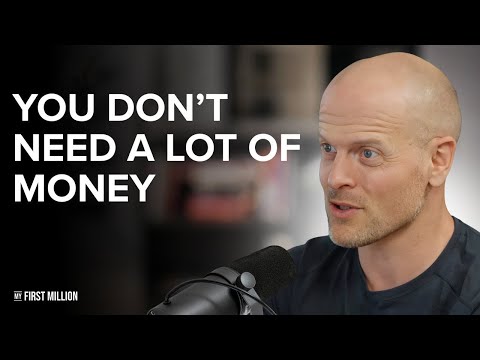
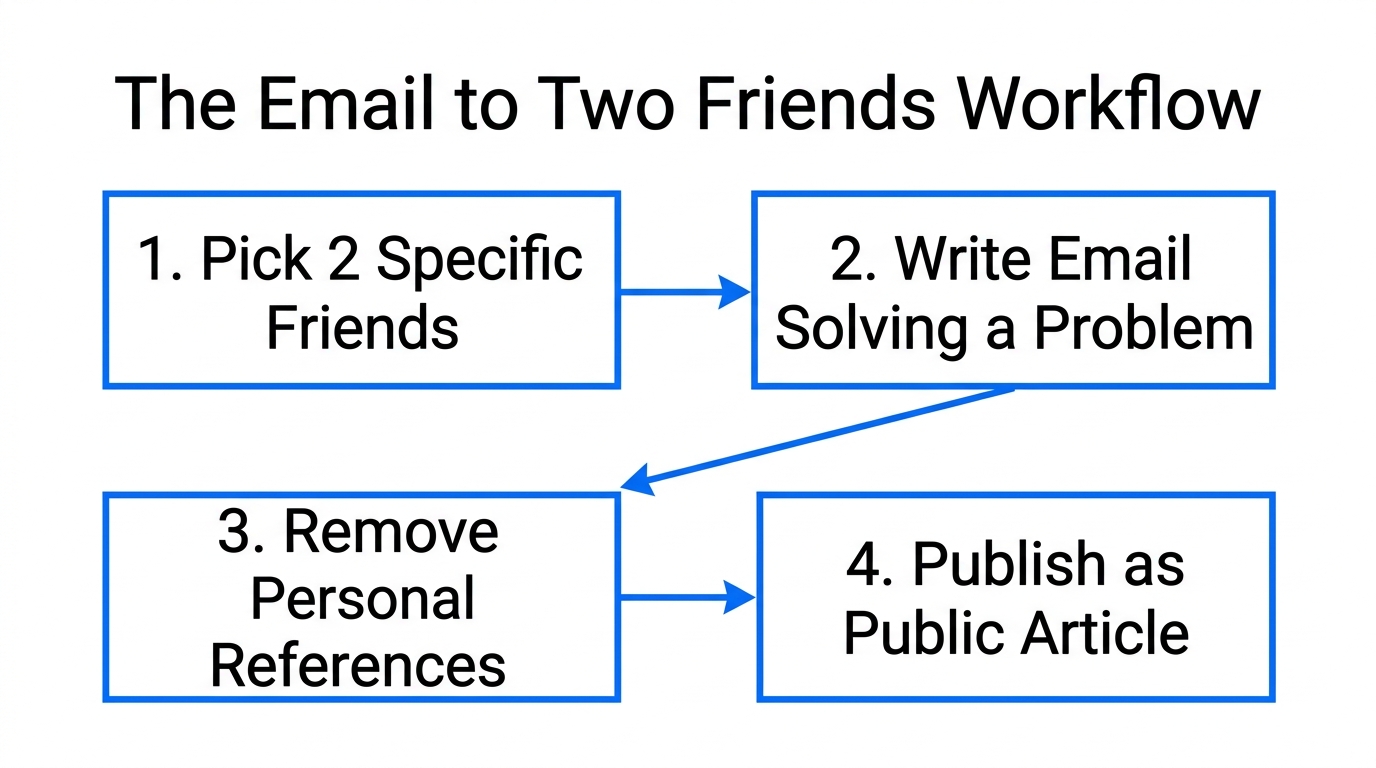
One of the biggest hurdles in modern content creation is the 'performance' trap—the tendency to write for an anonymous crowd or to sound 'smart' for the sake of authority. In his early days, Ferriss struggled with this while writing his first book. His solution was a radical shift in perspective: he stopped writing for a public audience and started writing as if he were sending a hyper-personalized email to two specific friends.
One friend was a corporate worker with 'golden handcuffs,' and the other was an overwhelmed entrepreneur. By narrowing his focus to these two individuals, Ferriss was able to include the 'warts, worries, and petty concerns' that make content feel human. This authenticity is what ultimately allowed his work to resonate with millions. In 2026, where AI can mimic professional prose perfectly, human weirdness is the only remaining moat. When you use tools like Notion to draft your thoughts, try to visualize a specific person you are helping. The personal is the most universal.
"If you try to sound smart, you're almost certainly dead on arrival. Embracing your weird self is how you build a brand that resonates with the humans you actually want to reach."
Luxury Content vs. Mass Appeal: Attracting the Right Audience
Learn why avoiding the lowest common denominator approach creates a more valuable brand.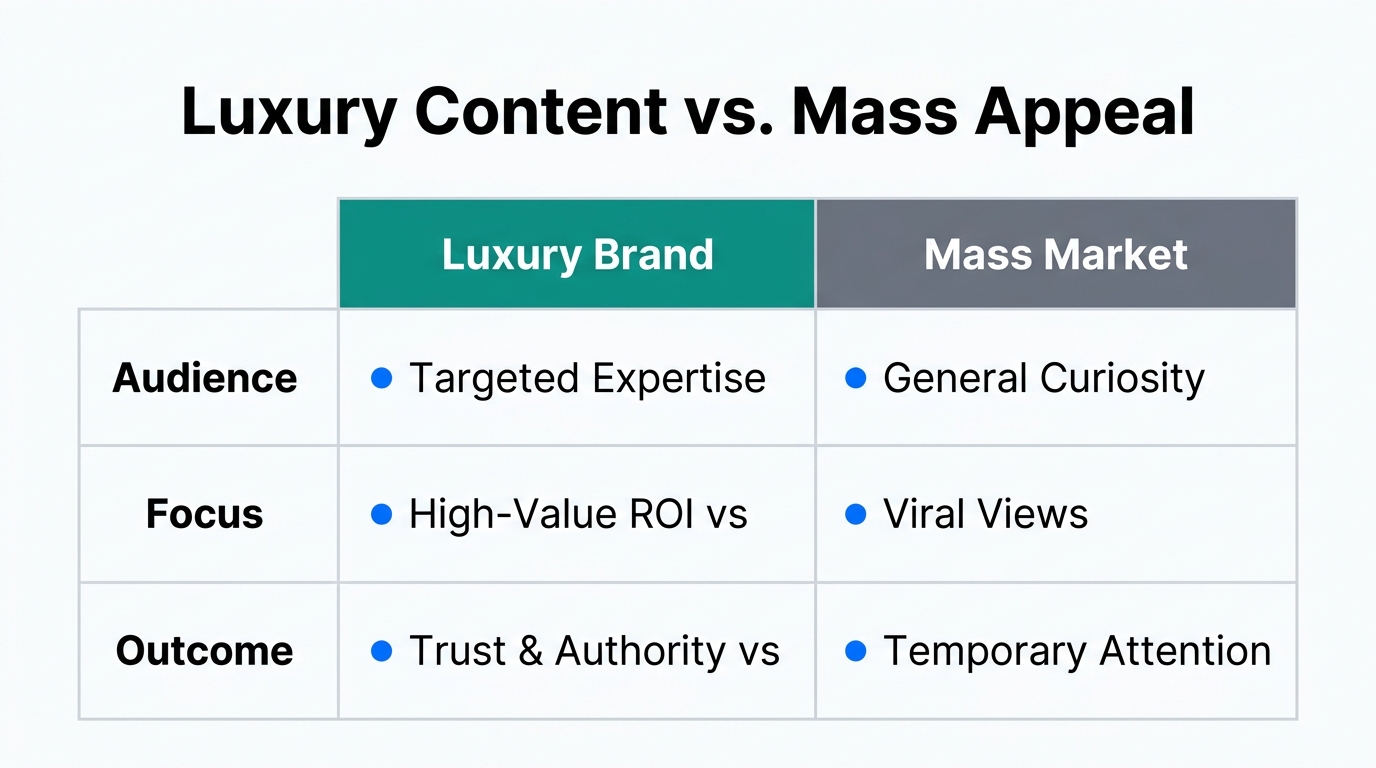
There is a dangerous temptation in the creator economy to optimize for total view counts. However, in 2026, content marketing for founders must prioritize audience quality over audience quantity. Ferriss refers to this as avoiding the 'magnet for the broke.' If your thumbnails and titles are designed to attract people who are merely looking for quick fixes or freebies, you will build an audience that cannot support a high-value business model.
Instead, the Ferriss approach utilizes 'Up-Market' or 'Luxury Content.' This means choosing topics that are inherently dense, intellectual, or niche. Whether it's a deep dive into PubMed research on metabolic psychiatry or an exploration of 17th-century philosophy, these topics act as a filter. They repel the casual scroller and attract high-level thinkers, investors, and decision-makers. While mass-appeal creators might use TikTok Ads Manager to blast broad messages, the up-market creator uses precision to find their tribe.
| Feature | Mass-Appeal Content | Up-Market (Ferriss) Content |
|---|---|---|
| Goal | Maximum Reach / Virality | High-Value Trust / Depth |
| Audience | Lowest Common Denominator | High-Net-Worth / Decision Makers |
| Format | Short, Clickbaity, Trends | Long-form, Experimental, Evergreen |
| Monetization | Ad Revenue / Mass Products | Equity, High-Ticket, 'True Fans' |
The Precision Moat: The Role of 'Anal-Retentiveness' in Brand Authority
Authority isn't just about what you say; it's about the rigor behind it. Ferriss credits much of his success to his 'unusual endurance' for precision. Drawing from a college writing class taught by the legendary John McPhee, Ferriss learned the value of the 'red ink.' McPhee would often cut 50% of a student's work without losing any meaning, forcing a density of information that is rare in today's digital world.
This 'anal-retentiveness'—spotting a mirror that is an eighth of an inch off-center—is a superpower when applied to content. It signals to the audience that you have done the work. In 2026, when identifying partners or collaborators, brands look for this level of detail. Platforms like Stormy AI can help founders find high-quality creators who already possess this level of audience vetting and content quality, ensuring that brand collaborations maintain that 'up-market' feel.
"The biggest weaknesses or curses are typically sitting right next to your superpowers. Precision is a sharp knife; if you squeeze it too tightly, you'll hurt yourself, but it's the best tool for the job."
Applying Kevin Kelly’s '1,000 True Fans' in the 2026 Creator Economy
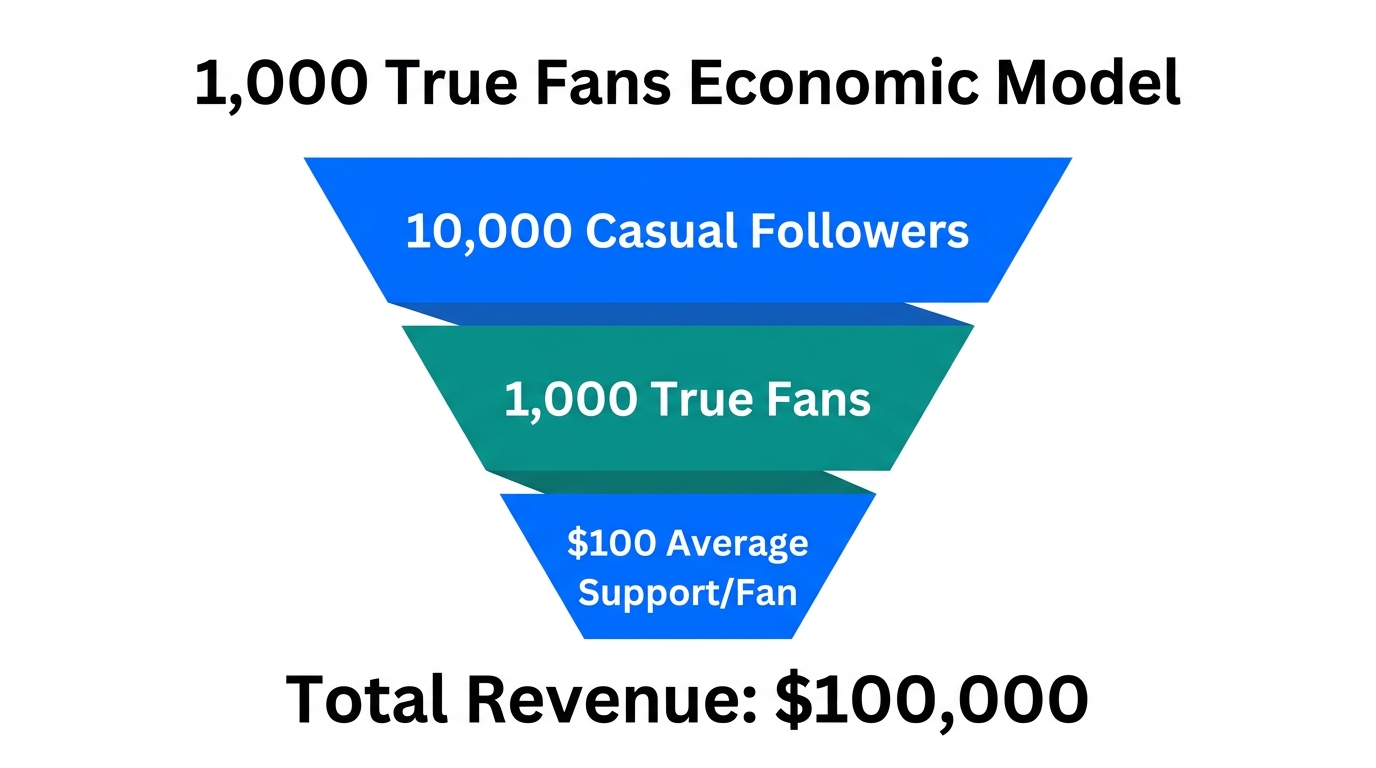
In his seminal essay, Kevin Kelly argued that a creator only needs 1,000 'true fans' to make a living. In 2026, this 1000 true fans 2026 model has evolved. With the rise of AI, the value of a 'fan' isn't just their subscription; it is their attention and trust. Ferriss has mastered this by aiming for 10% of his audience to love an episode rather than 100% of his audience to merely like it.
This strategy relies on identity diversification. Ferriss isn't just 'the 4-hour guy'; he is a board game designer, a student of archery, and a funder of psychedelic science. By being his 'weird self,' he creates multiple touchpoints for 'true fans' to connect with him. This prevents the creator from being pigeonholed and builds a resilient brand that can survive shifts in platform algorithms, whether you are building your list on Beehiiv or running campaigns on Meta Ads Manager.
The 2026 Trend: Long-Analog and Social Connection
Why intentional offline gatherings and analog hobbies are becoming essential for modern creators.A surprising pillar of the 2026 creator economy trends is the shift away from the purely digital. Ferriss is 'long-analog.' He advocates for physical games, in-person social interaction, and 'off-script' days. As society faces an epidemic of loneliness and digital fatigue, creators who facilitate real-world connection—or even just evoke it through their content—are winning.
This manifests in several ways for modern brands:
- Community over Following: Moving fans from social media to dedicated circles.
- Analog Hobbies: Sharing 'useless' pursuits (like piano or archery) that humanize the brand.
- Experiential Marketing: Using Eventbrite or private retreats to build deep relationships.
Conclusion: Trading Great Hours for Useful Dollars
The Tim Ferriss content strategy isn't about working less; it's about working on the right things. As Ferriss notes, many people trade 'great hours for useless dollars' because they lack the imagination to define what they actually want. For founders in 2026, the goal of a personal branding strategy should be to achieve 'post-economic' status—where decisions are driven by curiosity and fun rather than financial desperation.
By adopting the 'Email to Two Friends' method, maintaining a precision-based brand moat, and focusing on the 1,000 True Fans model, you can build a brand that is both up-market and deeply human. If you're ready to start finding the right creators to help amplify this high-value message, discover creators on Stormy to streamline your outreach and build lasting authority.