In the last twelve months, a small group of app founders has quietly disrupted the traditional mobile marketing landscape, generating over 2.5 billion views on TikTok. This wasn't the result of a single viral stroke of luck or a multi-million dollar Super Bowl ad. Instead, it was the product of a scientific, high-volume distribution model that treats virality not as an art form, but as a repeatable engineering problem. At the heart of this success is a strategic framework we call the Two-Pronged Playbook: a system that pairs high-effort, broad-appeal User Generated Content (UGC) with low-effort, high-frequency slideshows. By understanding how to balance these two layers, brands can dominate category rankings without the astronomical costs of traditional Meta or Google Ads.
The Science of Virality: Beyond Creativity
Most marketers approach TikTok with a "quality over quantity" mindset, hiring a handful of high-tier influencers and hoping for a hit. However, the data from over 2.5 billion views suggests a different reality. Success on TikTok is less about being super creative and more about being creative within the confines of what is already working. It is about identifying existing viral formats and seamlessly slotting your product into those narratives.
The masters of this craft don't guess what will work; they use a "shots on goal" effect. Instead of having five people post twice a day, they build systems that allow 50,000 people to post content simultaneously. This massive scale provides a feedback loop that no small-scale testing can match. When you put 100,000 pieces of content into the feed, the algorithm quickly tells you exactly what resonates. A difference of just a few words in a text hook—changing "Everybody needs a side hustle" to "Don't get a second job"—can be the difference between a video that flops at 1,000 views and one that explodes to 10 million.
The Awareness Layer: High-Effort UGC and Soft CTAs

The first prong of the playbook is the Awareness Layer. These are high-effort UGC videos designed for massive, top-of-funnel reach. The goal here isn't an immediate sale, but to spark curiosity and "seat" the brand in the user's mind. These videos often leverage what is known as the "Eggs Theory."
The Eggs Theory and Relatability
The Eggs Theory originated from a discovery that content featuring simple, relatable images—like hard-boiled or scrambled eggs—consistently outperformed more polished, high-production visuals. Why? Because eggs are universally understood, healthy, and, most importantly, cheap. They represent an achievable lifestyle. This visual language signals relatability to the viewer, encouraging them to stay for the next slide or the next second of the video.
"We noticed that the ones that were doing higher views always had some form of eggs on them. It's relatable... it seems achievable because it's cheap. That visual relatability just instantly sends them to the next slide. And that's huge signals to TikTok to push it into crazy viral view ranges."In the Awareness Layer, the call to action (CTA) must be soft. You might barely mention the app name or only include it in the description. For example, a video of someone crying while trying to pronounce words on a translation app (the "Lingo Pingo" format) feels like organic entertainment. The focus is on the human emotion or the humor of the situation. When the content is high-quality and relatable, the comments section becomes your primary conversion tool. Users will naturally ask, "What's the app?" This organic inquiry is far more powerful than a hard-sell pitch.
The Retargeting Layer: Low-Effort Programmatic Slideshows

While the Awareness Layer captures the attention, the Retargeting Layer captures the conversion. This is the second prong: thousands of simple, low-effort slideshows that act as a programmatic "shotgun" approach. These are not meant to go viral on their own; instead, they function as a follow-up for anyone who has already interacted with the brand's viral hits.
The Power of the Shotgun Approach
Unlike high-effort videos that require faces and acting, slideshows can be generated and distributed at scale using simple templates. By flooding the feed with subtle variations of the same message—changing the hook image, the background text, or the order of the slides—you increase the surface area for the algorithm to find your target audience. Even a video with only 500 views is valuable in this layer.
- Relevancy: TikTok’s algorithm is highly efficient at showing relevant content. If a user watched a viral video about your app, they are far more likely to see your retargeting slideshows.
- Frequency: Mass distribution ensures that the brand remains top-of-mind. Seeing a hard CTA after a soft-interest hook is the classic marketing funnel applied to short-form media.
- Cost-Efficiency: Because these are low-effort, you aren't paying high creator retainers. You are paying for distribution and views, often achieving installs at a fraction of the cost of Meta ads.
Hard vs. Soft CTAs: Strategic Timing

The success of the two-pronged approach hinges on knowing when to mention the product name. A common mistake among app founders is forcing a hard CTA into every piece of content. This often kills the virality of the post. People on TikTok can smell an ad from a mile away and will swipe past it immediately.
When to use a Soft CTA
Soft CTAs should be used when you are riding a trend or using a highly relatable format. The goal is to maximize watch time and engagement. If you are showing a "roast me" AI format or a relatable daily struggle, the product should be a side character, not the lead. The conversion happens in the comments or through the user's curiosity to check the profile.
When to use a Hard CTA
Hard CTAs are reserved for the "ground game"—the slideshows and specific conversion-focused posts. Phrases like "Instead, download the Noise app" or "I make $20 every night using this" are explicit. These videos may get fewer views because the algorithm recognizes them as promotional, but the views they do get are high-intent. These function as the final nudge to get a user to the App Store.
The Daily Views Budget: Why 500 Views Matter
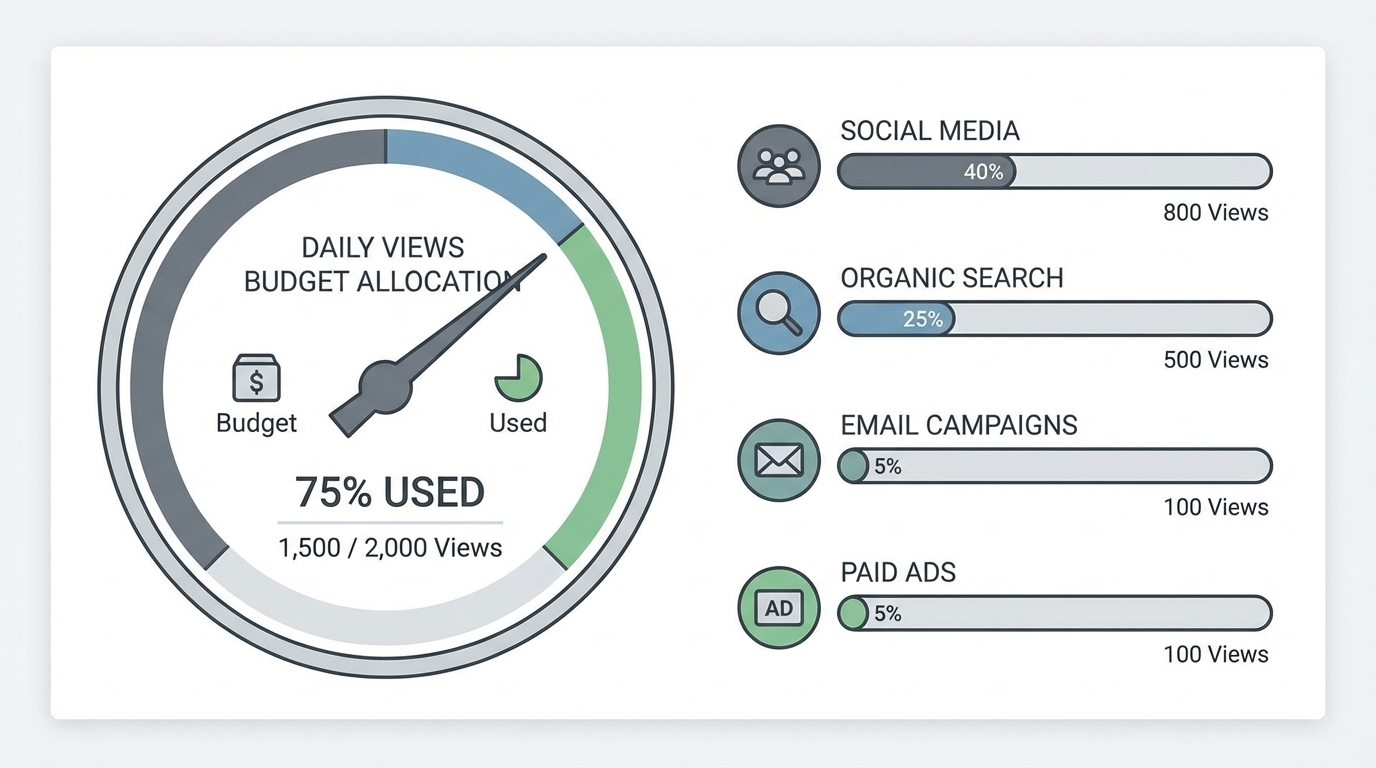
A common misconception in social media marketing is that a video with a few hundred views is a failure. In reality, TikTok likely operates with a "daily views budget" for specific niches. There is only a certain amount of attention that users will give to any particular trend or category (like "fitness apps" or "side hustles") on a given day.
By spreading your content across thousands of posts that each get 500 to 2,000 views, you are capturing a massive aggregate share of that daily attention. While one viral video might give you a spike, the "massive ground game" of hundreds of thousands of smaller posts provides the consistent, predictable baseline of traffic that leads to a Top 10 category ranking.
Dominating the Category: Managing the Distribution Machine
To truly dominate a category, founders must manage these two layers simultaneously. This requires a shift from being a "creative director" to being a "distribution manager." You must oversee multiple campaigns, testing different playbooks to see which formats are currently "ripping."
Using Data as Your Creative Compass
The most successful founders in this space don't rely on their gut feeling. They look at the analytics of their massive distribution. If a specific hook like "My job has a mandatory secret Santa" is driving massive engagement and comment seeding, they double down on that format across both UGC and slideshows. Conversely, if a campaign with 400 posts fails to gain traction, they pause it and pivot immediately. This level of agility is only possible when you have a distribution system that handles the manual labor of posting and variation.
Conclusion: Building a Growth Science
The era of "hoping for virality" is over. The 2.5 billion views generated by top app founders prove that growth is a science of scale, relatability, and strategic distribution. By implementing a Two-Pronged Playbook—leveraging high-effort UGC for awareness and programmatic slideshows for retargeting—you create an unfair advantage. Stop trying to invent the next big thing from scratch. Instead, find the "eggs" in your niche, copy the formats that are already winning, and put enough shots on goal to ensure your brand reaches the top of the charts.