In the high-stakes landscape of 2026, the difference between a market leader and a struggling startup often comes down to a single philosophy: the Order of Magnitude Rule. While most marketing teams are content with a 5% increase in conversion rates, the most successful brands are adopting the radical goal-setting methods used by Elon Musk at Tesla. Instead of asking how to improve by a fraction, they are asking how to 20X their digital sales. This isn't just about working harder; it is about reinventing the entire mechanical structure of the sales funnel to remove every ounce of friction.
Traditional Google Ads strategies or standard social media campaigns often fail not because the traffic is bad, but because the funnel is broken. By studying the Tesla sales funnel optimization, we can uncover a blueprint for E-commerce friction reduction that works across any industry. Whether you are selling a $120,000 electric vehicle or a $12 subscription, the principles of drastic simplification and customer-centric benchmarking remain the same.
The Order of Magnitude Rule: Why 10% Goals Limit Your Future
 33:37
33:37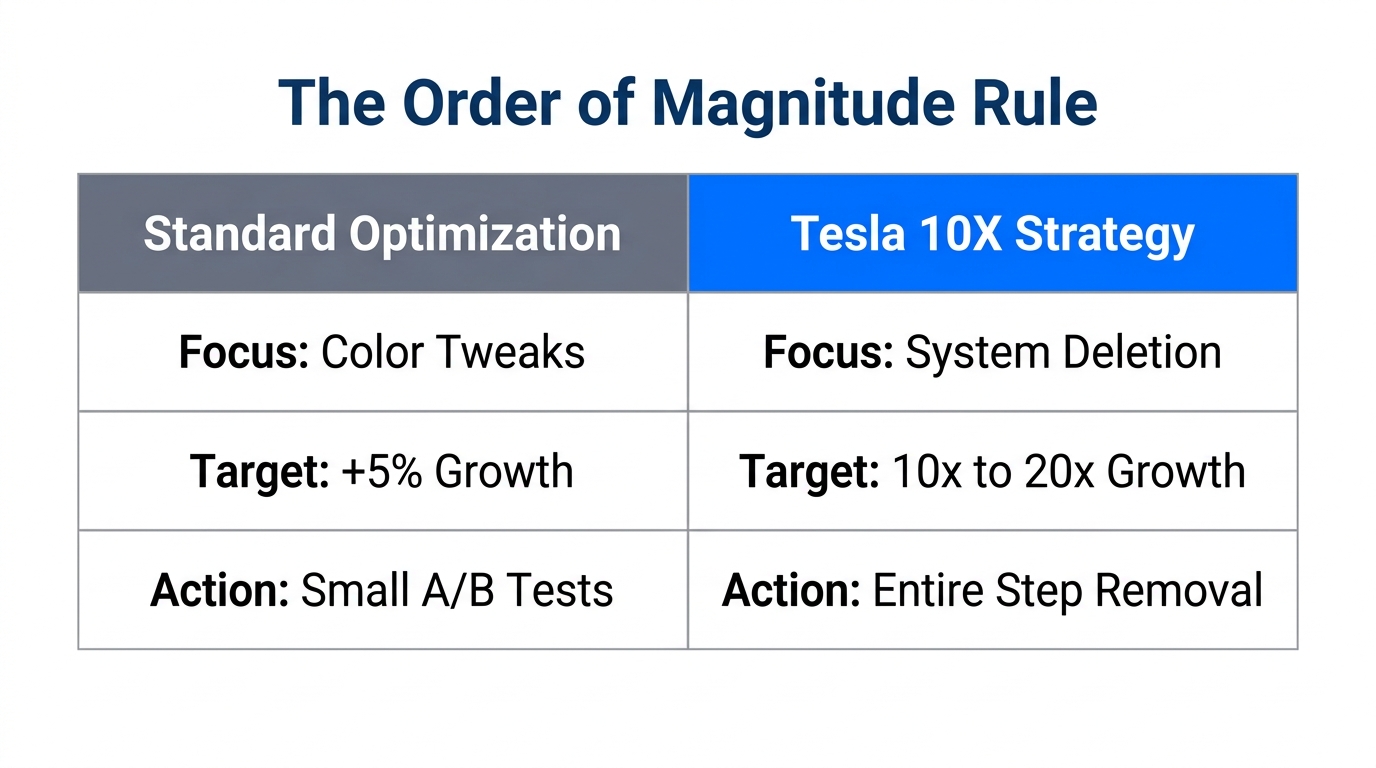
Most corporate environments reward incrementalism. If you hit a 10% growth target, you get a bonus. However, this mindset is a trap. When you aim for a 10% improvement, you tend to tweak existing systems—changing a button color on Shopify or adjusting a headline. But when you are tasked with a 20X improvement, you are forced to throw out the manual and think from first principles.
"If you set a goal for 5 to 7% improvement, you're probably going to get three to five. If you set a goal for an order of magnitude improvement, you have to think way differently about the problem." [Source: Inc. Magazine]
At Tesla, Musk famously demanded that digital sales grow by 20 times. This target made it impossible to simply "optimize" the existing website. It required a complete audit of how humans interact with technology when making high-ticket purchases. In 2026, the digital sales growth strategy must focus on these radical leaps. If your current conversion rate is 1%, don't aim for 1.1%. Aim for 20%. This level of ambition forces you to identify the fundamental blockers that are invisible to those seeking minor gains.
The Domino's Benchmarking Strategy: Cross-Industry Friction Analysis
34:40One of the most effective ways to optimize a funnel is to look outside your own industry. When Tesla was trying to revolutionize car buying, they didn't look at Ford or BMW. Instead, they looked at Domino's Pizza. Why? Because Domino's had mastered the art of the low-friction mobile transaction.
At the time, buying a Tesla required 64 clicks. Buying a pizza on the Domino's app took only 10. Musk’s challenge was simple: "We are 64, Domino's is 10. Let's go to 10." This cross-industry benchmarking is a powerful tool for any digital business. If you are an enterprise SaaS company, don't just compare yourself to other SaaS players. Compare your checkout or signup process to the fastest consumer apps like TikTok or Instagram.
| Metric | Old-School Funnel | The 2026 Tesla-Style Funnel |
|---|---|---|
| Click Depth | 60+ Touchpoints | Less than 10 |
| Product Choice | Infinite Customization | 2-3 Curated Configurations |
| Lead Follow-up | Manual / Delayed | Automated / Instantaneous |
| Decision Type | Complex / Fatigue-Inducing | Principal-Based / Simple |
In 2026, users expect a "one-click" experience. If your E-commerce friction reduction efforts aren't bringing you closer to the speed of a pizza order, you are losing sales to competitors who have simplified their path to purchase. Every extra click is an opportunity for the customer to leave. You can use tools like Hotjar or FullStory to watch users struggle, just as Tesla executives watched customers navigate their site.
Drastic Simplification: Killing Decision Fatigue
36:13Tesla’s biggest breakthrough in digital sales didn't come from a better ad; it came from deleting 359,998 product configurations. Originally, Tesla offered 360,000 different combinations for their vehicles, believing that "customization" was what the customer wanted. However, the data told a different story. Customers weren't actually buying 360,000 versions; they were essentially buying two: Standard or Performance.
By reducing choices, Tesla solved two major problems at once: decision fatigue for the customer and manufacturing complexity for the factory. In the world of digital sales growth, more choice often equals less conversion. When presented with too many options, the human brain tends to freeze—a phenomenon known as the Paradox of Choice. By curating the best versions of your product, you guide the customer to a decision rather than forcing them to do the work of an engineer.
"Decision fatigue is the silent killer of the digital funnel. If you make the customer do the work of choosing, they will choose to leave."
For brands leveraging platforms like Stormy AI to find creators for UGC, this principle applies to your creator briefs and landing pages. Don't offer ten different packages. Offer two. Make the choice so simple that it can be made in seconds. This level of drastic simplification is what allows a company to scale from 4,000 to 40,000 employees without losing its core efficiency.
The Click Audit Protocol: A Step-by-Step Playbook
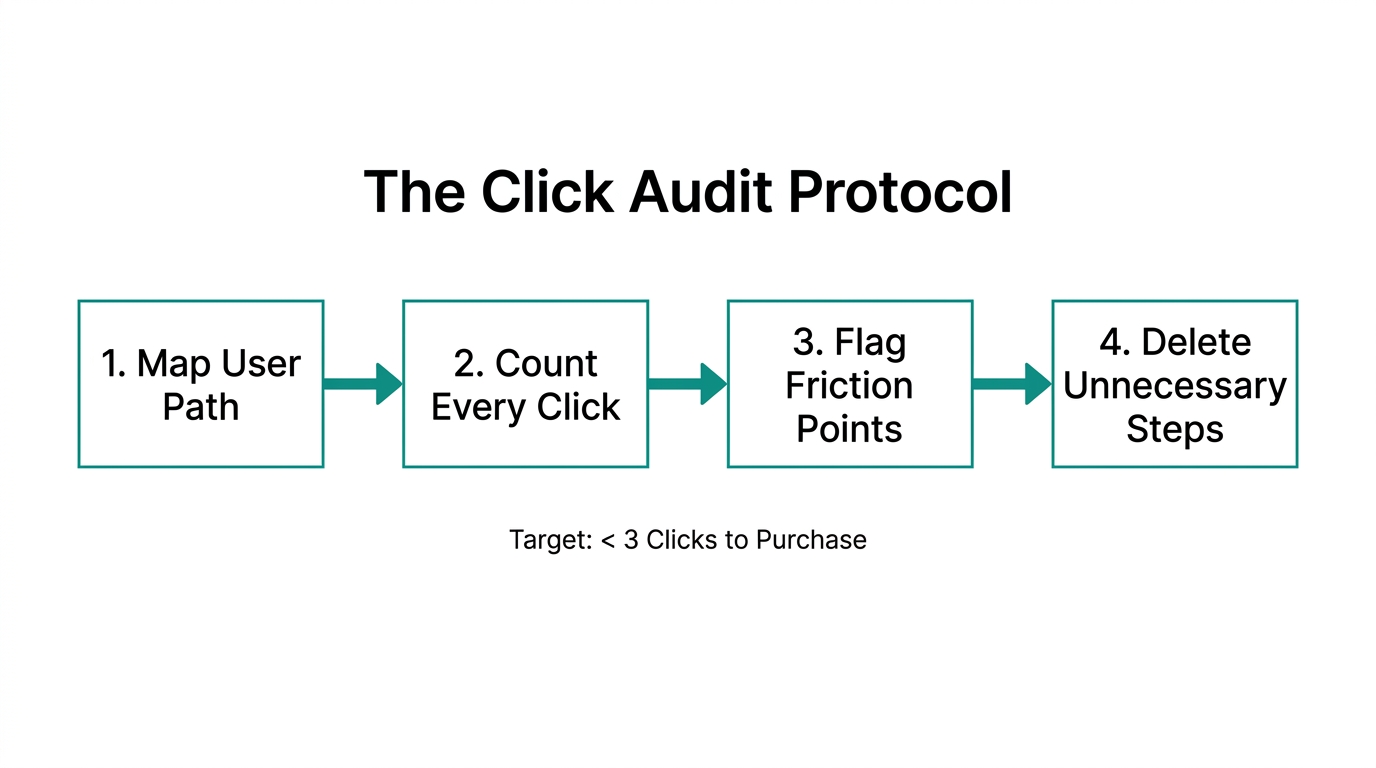
If you want to achieve 20X growth, you must perform a Click Audit. This is a rigorous, objective analysis of every touchpoint between a "stranger" and a "customer." Most teams find that they are over-complicating their own sales process through legacy systems and "religious" beliefs about their business model.
Step 1: The Mystery Shop
Go to your website as a total stranger. Use a personal email address and attempt to buy your most popular product. Do not use your developer credentials or "quick-checkout" tools. Record every single click, form field, and loading screen. This is the "ground floor truth" that often eludes CEOs who never use their own apps.
Step 2: Map the Domino's Gap
How many clicks did your mystery shop take? If it's more than 10, you have a friction problem. Compare your process to the most efficient transaction you’ve ever experienced—whether that's ordering a Lyft or buying a book on Amazon. Your goal is to close the gap between your current count and 10.
Step 3: Delete, Don't Tweak
Look at every form field. Do you really need their phone number? Do you need their middle name? At Tesla, they questioned the very "religion" of build-to-order manufacturing. In your business, you must question the religion of your data collection. If it doesn't directly lead to a sale, delete it. Reducing 60 touchpoints to 10 requires deletion, not optimization.
Identifying and Fixing 'Silent' Funnel Killers
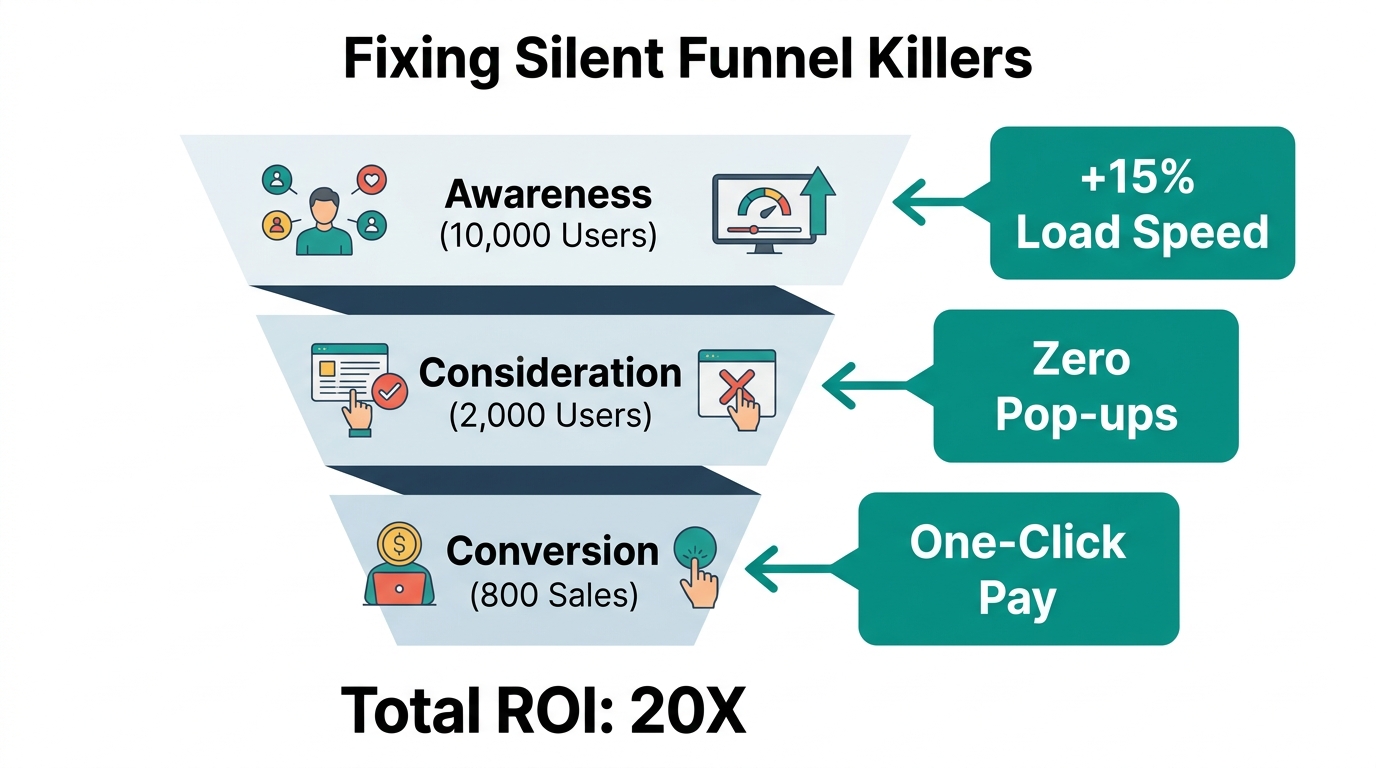
Sometimes, the bottleneck isn't on the website—it's in the follow-up. In the Tesla case study, the company was struggling to hit sales targets despite high demand. When a "mystery shopper" audited the process, they found 9,000 leads who had taken a test drive but had never received a callback. The sales team was so focused on new leads that they were ignoring the high-intent customers already in the funnel.
This is a silent killer. You might be spending thousands on TikTok Ads or Apple Search Ads to drive traffic, only to have those leads die in a CRM bottleneck. To fix this, you must stack-rank your constraints. Is your problem top-of-funnel traffic, or is it bottom-of-funnel execution?
"The most powerful analytics you have as a leader are your two eyes and two ears. Use them to see where the inventory of leads is stacking up."
In 2026, many brands are using AI Agents to solve this. For example, Stormy AI allows companies to set up an autonomous agent that discovers, outreaches, and follows up with thousands of creators daily. This eliminates the "callback bottleneck" by ensuring that no lead is ever left hanging while the human team sleeps. By automating the repetitive "middle" of the funnel, you can ensure that your conversion rate remains consistent regardless of lead volume.
Conclusion: The 2026 Sales Imperative
The Tesla sales funnel optimization playbook is not a secret; it is a discipline. It requires the courage to set 20X goals, the humility to learn from the pizza industry, and the ruthlessness to delete choice. As we move through 2026, the brands that win will be those that prioritize speed and simplicity over everything else.
Start your journey by performing a Click Audit today. Use your eyes and ears to find the "stacked up doors" in your manufacturing process—whether those are physical products or digital leads. When you find the bottleneck, don't just fix it; eliminate the process that created it. That is the only way to achieve true order-of-magnitude growth according to Gartner's 2026 marketing research.