In the high-stakes gold rush of the mid-2020s, most founders are obsessed with building the next great LLM or consumer-facing AI agent. Yet, while the giants battle for dominance, a quiet titan has emerged from the shadows. Surge AI, led by the enigmatic Edwin Chen, has effectively cornered the market on the most valuable resource in the 2026 economy: high quality training data for AI. By prioritizing elite human intelligence over low-cost automation, Surge AI has reportedly reached $1 billion in revenue with only 100 employees and zero outside funding.
This isn't just a success story; it is a blueprint for the next generation of B2B growth strategies. As we navigate 2026, the "human-in-the-loop" model is proving that in an world flooded with synthetic content, human expertise is the ultimate premium. This article deconstructs the Surge AI business model and provides an actionable playbook for identifying the niche utility gaps that the AI giants simply cannot automate.
The Premium Talent Moat: Quality Over Quantity
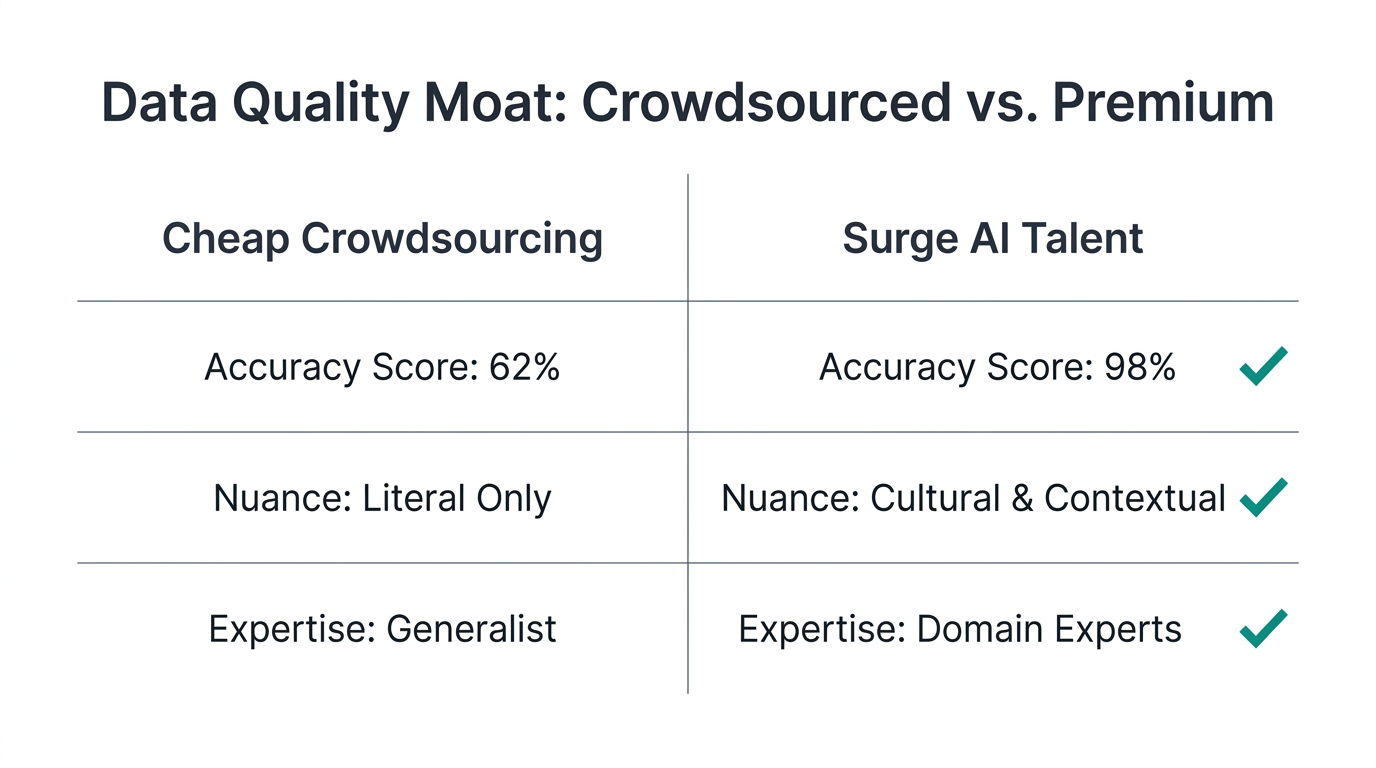
For years, the industry standard for data labeling was a race to the bottom. Companies like Scale AI built massive empires by leveraging huge volumes of offshore talent to perform repetitive tasks. However, as AI models became more sophisticated, the nature of the work shifted. In 2026, models no longer just need to know if a picture contains a stop sign; they need to know if a philosophical argument is logically sound or if a creative poem has "wit."
Surge AI realized early on that AI data labeling strategy is actually a talent acquisition game. Instead of hiring for the lowest possible cost, they built a marketplace of 100,000 specialists—including philosophers, engineers, and Ivy League graduates. They don't just label data; they provide Reinforcement Learning from Human Feedback (RLHF) that is "curious, witty, and imaginative."
This focus on quality over scale is a classic high-agency move. While others were trying to automate the human element, Edwin Chen leaned into it. By providing elite talent, Surge AI created a moat that is nearly impossible to disrupt with mere software. Even as infrastructure tools like Cloudflare protect their digital assets, the real security comes from the uniquely human insights their workforce provides.
"Data does for AI what life does for humans. It elevates neural networks that know nothing about the world into intelligence capable of sending rocket ships to Mars."
The Picks and Shovels Marketing Masterclass
 34:32
34:32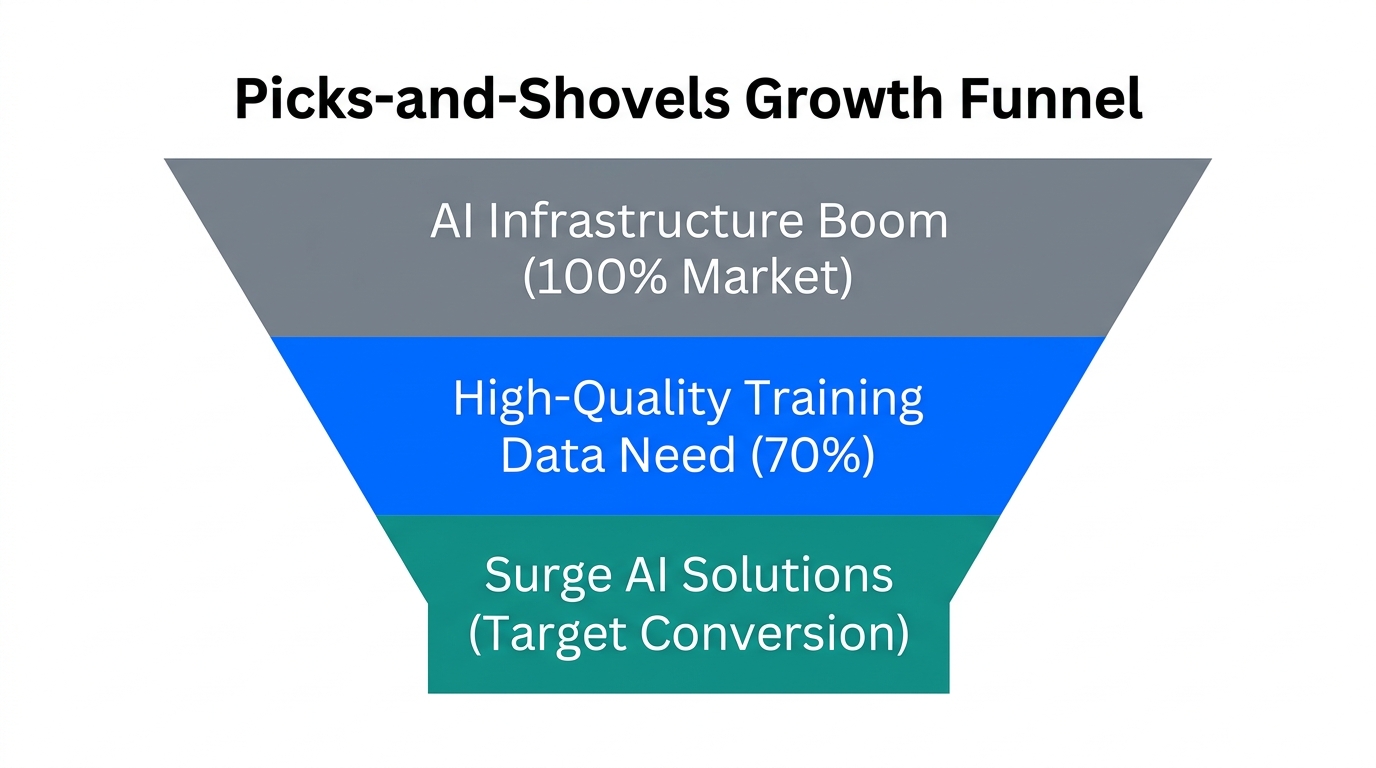
In every gold rush, the people selling the picks and shovels are the ones who get rich consistently. Picks and shovels marketing is about identifying a universal pain point in a booming industry and becoming the go-to infrastructure for it. Surge AI doesn't care which AI model wins the war; they provide the essential high quality training data for AI that every single one of them requires.
Consider the competitive landscape in 2026. Companies are pouring billions into Google Ads and TikTok Ads to promote their AI tools. Meanwhile, Surge AI stays silent. They don't need a massive marketing budget because they are embedded in the supply chain of their customers. When Handshake recently pivoted to data annotation, they were essentially trying to catch the lightning that Surge AI had already bottled.
| Feature | Surge AI | Scale AI | Handshake (New Pivot) |
|---|---|---|---|
| Talent Pool | Elite (Engineers/Philosophers) | Global/Generalist | Fresh College Grads |
| Pricing Model | Premium/High-Margin | Volume-Based | Marketplace/Job Board |
| Funding Status | 100% Bootstrapped | VC-Backed (Multi-billion) | VC-Backed |
| Market Focus | Niche Quality & RLHF | Enterprise Automation | Entry-Level Talent |
This strategy is highly applicable to other sectors. For instance, in the world of content, platforms like Stormy AI have adopted a similar picks-and-shovels approach by providing the AI-powered search and discovery infrastructure that brands need to find high-performing UGC creators across TikTok and Instagram. By solving the "sourcing" problem, they become an essential layer of the marketing stack without having to compete as a creative agency.
Bootstrapping a Billion-Dollar Ghost Ship
32:28Perhaps the most shocking aspect of the Surge AI story is the capital efficiency. In 2026, we are used to seeing startups burn through hundreds of millions in venture capital before seeing a dime of profit. Edwin Chen took the opposite route. He owns 100% of a company worth an estimated $30 billion, based on recent valuations of competitors like Scale AI (which recently saw half its ownership moved to Meta).
Surge AI operates like a "ghost ship." They have no public-facing blog, no active Twitter presence, and very few public photos of their leadership. This under-the-radar B2B growth strategy allows them to focus entirely on product and customer retention rather than the distractions of status and fame. In an era where "personal branding" is often overvalued, Surge AI proves that silence is a competitive advantage.
"Being a billionaire you've never heard of is the ultimate flex in 2026. Surge AI didn't build a brand; they built a utility."
The lessons in B2B growth strategies 2026 are clear: focus on high-intent workflows that require deep expertise. By keeping the team small (around 100 employees) and avoiding the "rat race" of Silicon Valley status, Surge AI has maintained a level of agility that much larger, more "famous" companies envy. They use tools like Linear and Notion to stay lean, proving that you don't need a massive headcount to generate massive revenue.
The 2026 Playbook: Identifying AI Utility Gaps
How can you apply the Surge AI business model to your own venture this year? The key is to look for "generative" opportunities—areas where you can take a single input and bloom it into an entire framework or service that solves a complex problem. Here is the step-by-step playbook for identifying these gaps:
Step 1: Look for "Human-In-The-Loop" Requirements
Identify tasks that AI models almost get right but fail at when it comes to nuance, ethics, or high-level creativity. This is where the money is. Just as radiologists now use AI as a co-pilot to avoid medical malpractice, businesses need human-verified outputs to avoid corporate malpractice. Whether you are building a service for legal review or highly-personalized outreach, the human stamp is your value add.
Step 2: Solve the Data Bottleneck
Every major technological shift creates a bottleneck. In 2026, the bottleneck is clean, verified data. If you can create a process that turns messy real-world information into structured data, you have a business. This is why tools like Stormy AI are so effective—they take the chaotic world of social media and turn it into a searchable, vetted database of influencers, effectively solving the data bottleneck for marketing teams.
Step 3: Charge a Premium for Agency
In a world of cheap automation, high agency is the new luxury. Do not compete on price. Surge AI charges 3x the market rate because they promise a level of thought and "generativity" that cheaper alternatives cannot match. When you provide a service that is "infinitely patient" and "better at communicating" than a standard tool, you have pricing power.
"The future of software isn't just code; it's the combination of AI efficiency and human discernment. That's the billion-dollar gap."
The Future: Will the Human-In-The-Loop Model Last?
34:02There is a valid debate about the longevity of this model. Some believe that within 7 to 10 years, AI will be able to label its own data through reinforcement learning without human feedback. However, history suggests otherwise. Look at Pandora, which started labeling music attributes over 20 years ago. Even today, the nuance of human taste remains a core part of how we train our most successful algorithms.
As self-driving technology from Waymo and Tesla continues to evolve, we see a similar pattern. While the "brain" of the car is digital, it was trained on millions of hours of human driving decisions. The economy of 2026 is one where the physical and digital are blurring, and the companies that facilitate that transition—the ones that provide the high quality training data for AI—will remain the most stable investments.
Whether you are managing creator relationships in a Creator CRM or building the next great data annotation firm, the lesson of Surge AI is simple: Find the boring, essential task that everyone else is ignoring, and do it with a level of human excellence that machines can't touch.