In 2025, influencer marketing has matured into a $30B+ global powerhouse, according to data from the Influencer Marketing Hub. For growth leads and marketing directors, the primary challenge is no longer just about finding creators, but about operationalizing them at scale. As brands move away from vanity metrics toward performance-driven results, the infrastructure they choose determines their success. This brings us to a critical influencer marketing platform comparison: the battle between the "System of Record" and the "Engine of Execution."
On one side, we have CreatorIQ, the enterprise giant trusted by Fortune 500 companies for manual governance and deep compliance. On the other, Stormy AI represents the new wave of Agentic AI—autonomous systems designed to handle the heavy lifting of discovery, outreach, and negotiation on autopilot. Choosing between them isn't just about features; it's about whether you want a database for your team to manage or an AI agent to do the work for you.
The Paradigm Shift: From Databases to Agentic AI
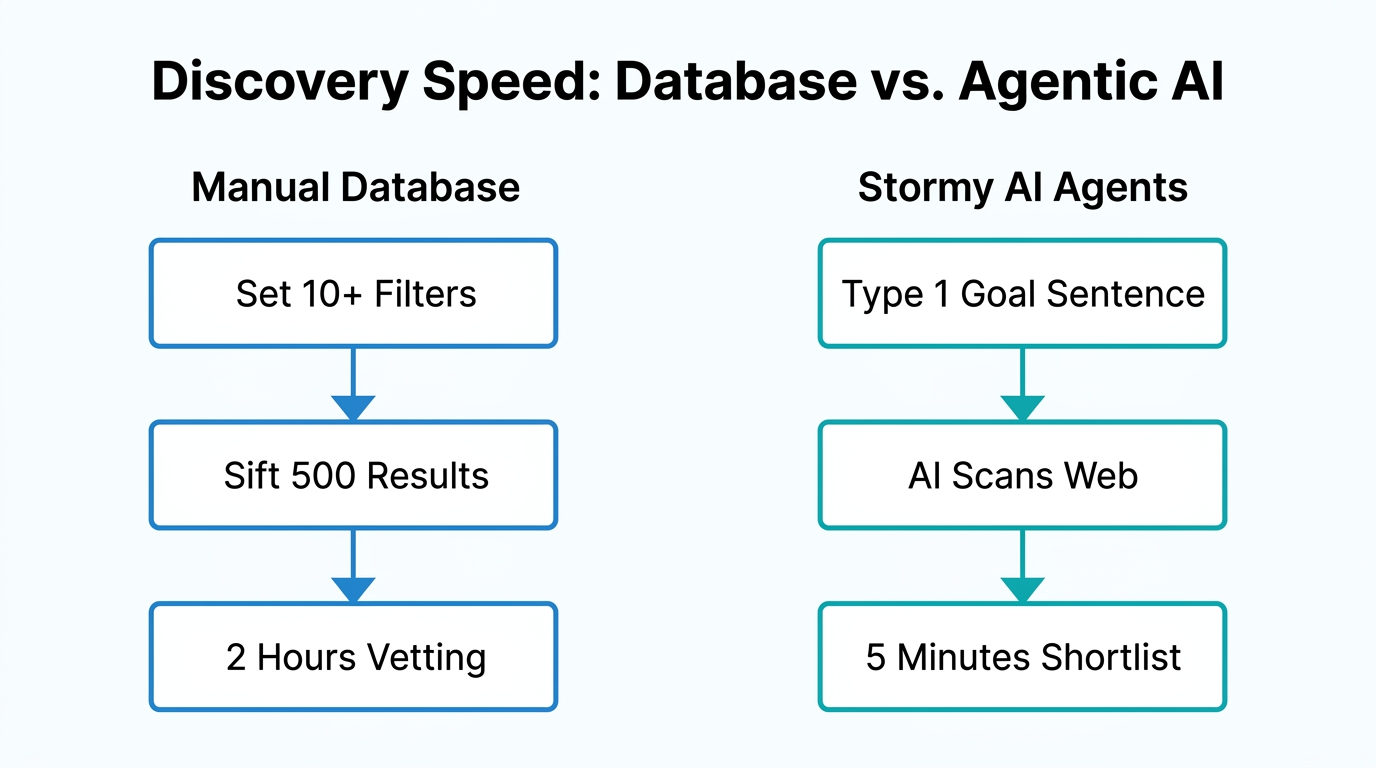
For the last decade, influencer marketing software was essentially a CRM with a search bar. Tools like CreatorIQ built massive repositories of creator data, allowing teams to filter through millions of profiles. However, the industry is shifting from "Data Tools" to "Agents." According to Moburst, 59% of marketers now use AI for creator discovery, signaling a move toward automation.
"The era of the 'database' is ending; the era of the 'execution engine' has begun. Marketers don't want more lists; they want more deals."
While CreatorIQ provides a robust infrastructure for human teams to navigate, Stormy AI functions as a "Creator SDR." It doesn't just show you who a creator is; it initiates the conversation, handles the follow-up, and negotiates the deal while you sleep. This is the core difference between enterprise influencer software built for oversight and AI-native platforms built for growth.
Stormy AI: The AI-Native Disruptor for Performance Teams
Born from the Y Combinator ecosystem, Stormy AI was built specifically for SaaS companies, high-growth startups, and agencies that need to scale micro-influencer campaigns without hiring a massive team. It leverages advanced Large Language Models (LLMs) to understand context in a way that traditional filters cannot.
Natural Language Discovery
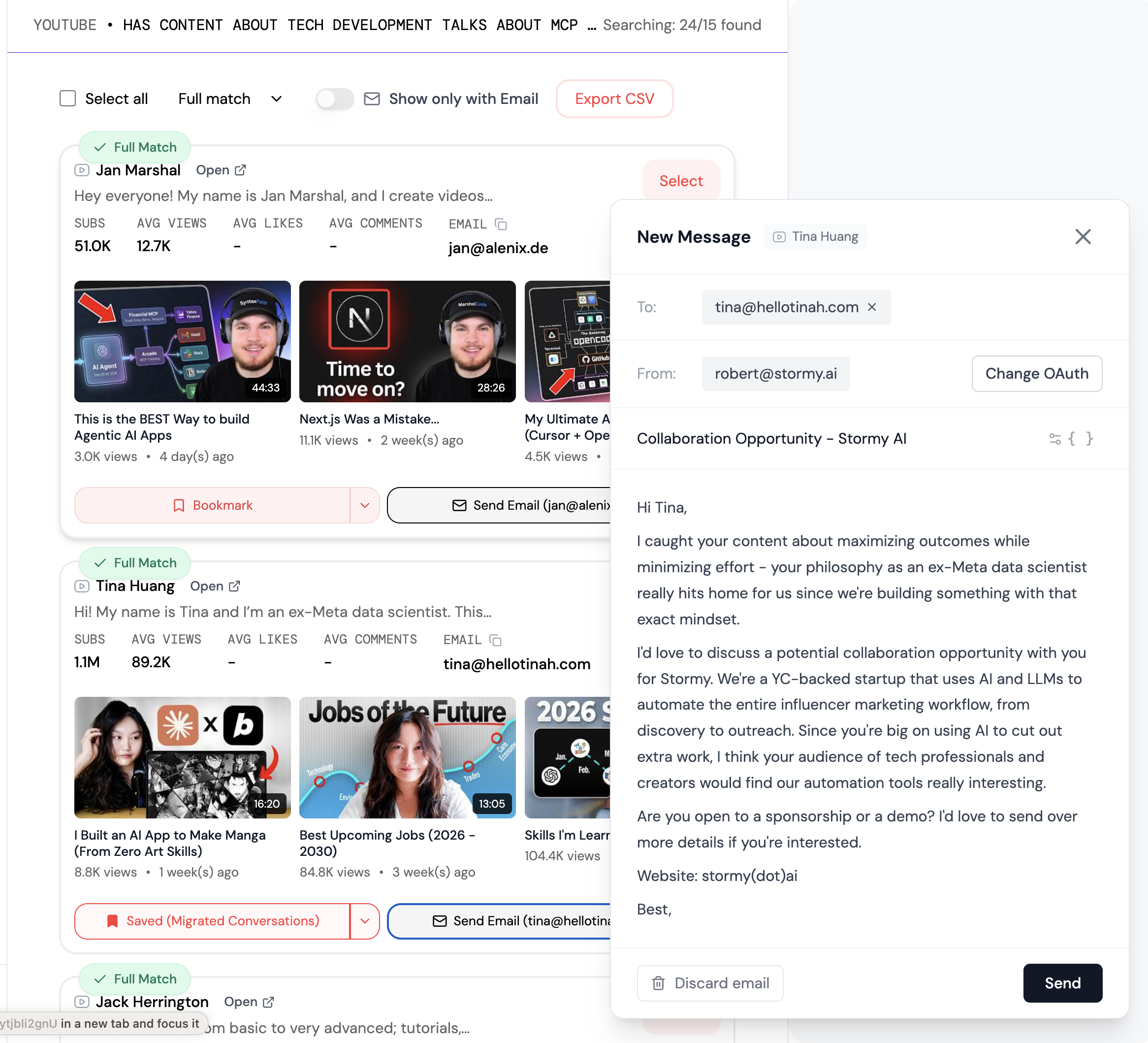
Instead of clicking through checkboxes for "Category" or "Location," users type natural-language prompts. For example, you can search for "US-based AI YouTubers with 10k-50k subs talking about agents" and get an instant, vetted list. This AI influencer discovery approach cuts hours of manual vetting from the workflow.

Autonomous Outreach & Negotiation
The standout feature in most Stormy AI reviews is its autonomous agent. Once you find creators, Stormy acts as an automated SDR. It finds verified email addresses, sends hyper-personalized outreach, and even handles autonomous negotiation. Using "Price Strike Protection," the AI automatically counters influencer offers to ensure your ROI stays within budget guardrails. This is a level of automation that traditional platforms simply don't offer.
CreatorIQ: The Enterprise Giant for Global Governance
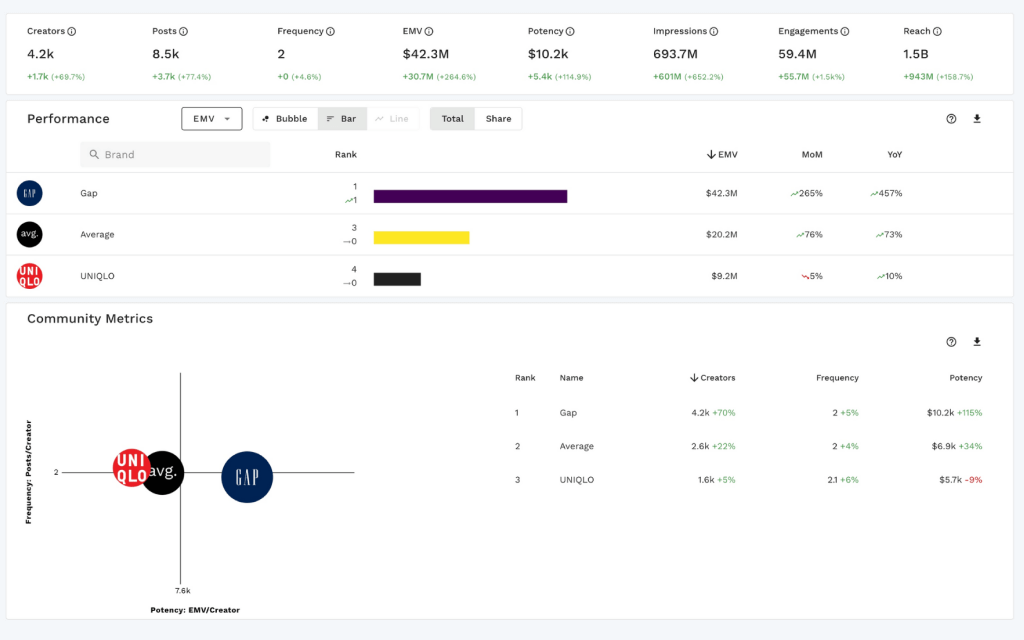
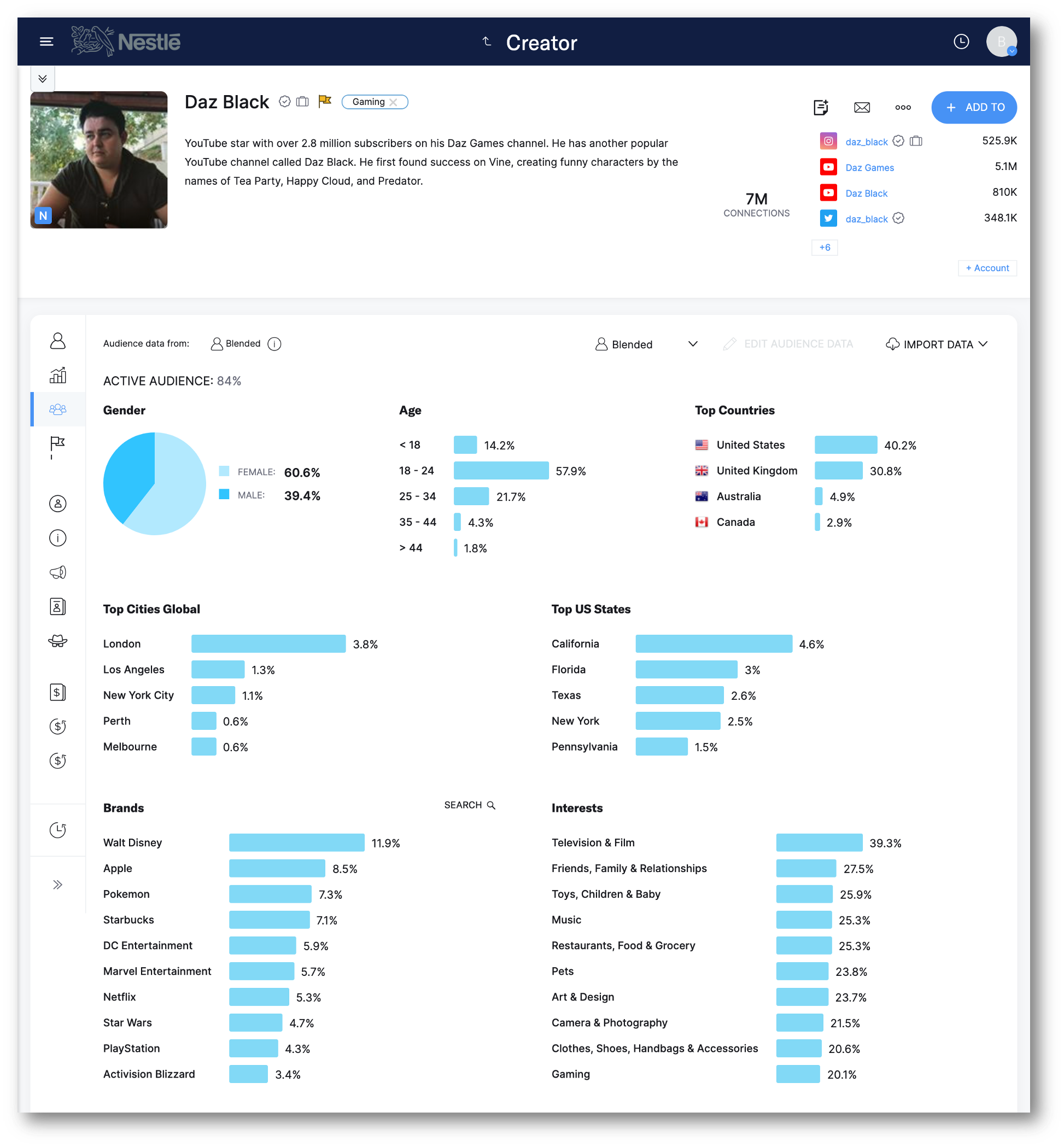
CreatorIQ is a premium platform designed for the complex needs of brands like Nestlé, Disney, and Unilever. It excels in environments where compliance, global multi-market campaigns, and high-level security are the top priorities. If you are managing a global brand's "System of Record," CreatorIQ is often the default choice.
Massive Database & Integrity
With access to over 20 million profiles, CreatorIQ offers one of the most comprehensive datasets in the industry. Their "Integrity Quotient" is a gold standard for detecting fake followers and engagement fraud, an essential feature considering brands lose $1.3B annually to fraud ([Source: Talkwalker]).
Intelligence Cloud & Compliance
CreatorIQ's Intelligence Cloud provides predictive analytics to forecast campaign impact based on historical performance. For a global enterprise, the ability to pay creators in 120+ currencies and ensure 100% FTC compliance across multiple regions is a massive advantage. However, this power comes with a steep learning curve and a significant CreatorIQ pricing commitment.
"CreatorIQ is built for the brand manager who needs to say 'no' to risks; Stormy AI is built for the growth lead who needs to say 'yes' to volume."
Direct Feature-by-Feature Comparison
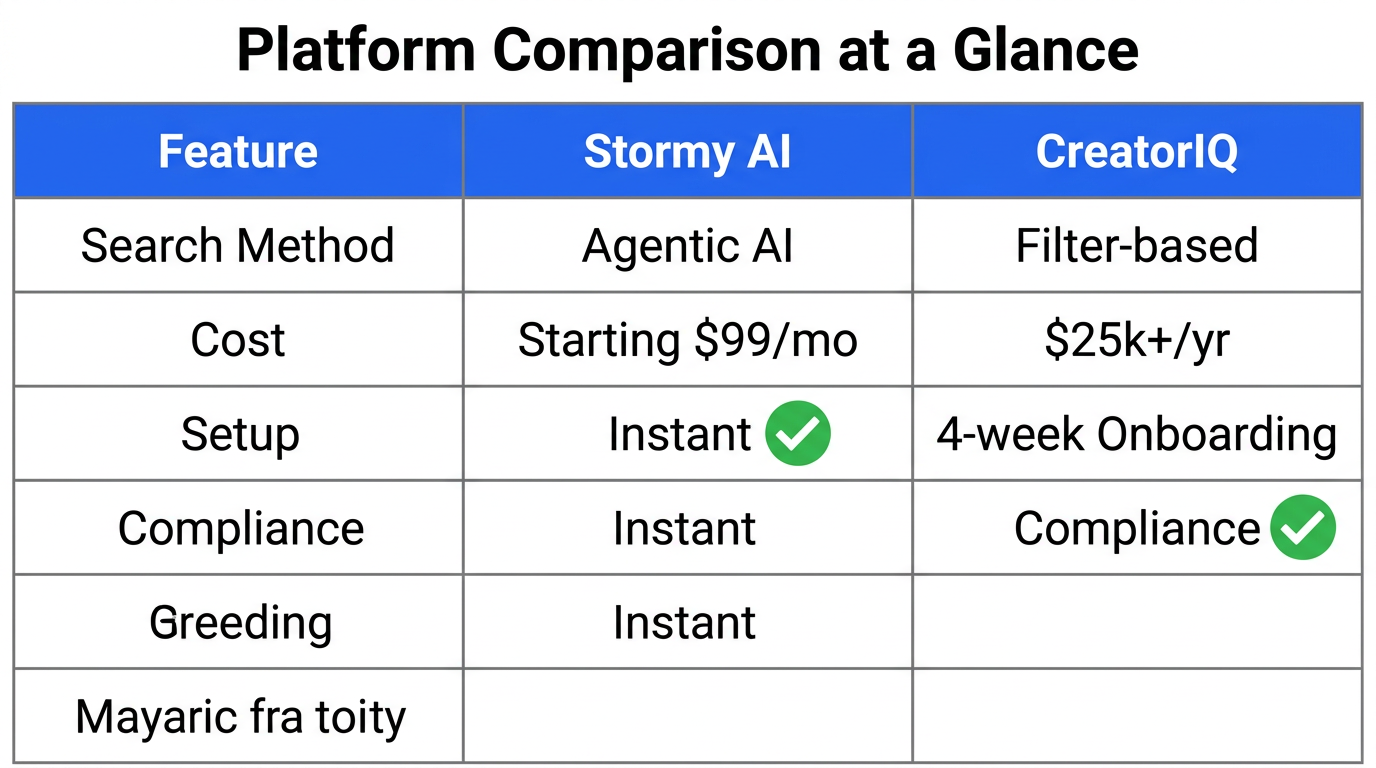
To help you decide, let's look at how these two platforms stack up across the key pillars of influencer management.
| Feature | Stormy AI | CreatorIQ |
|---|---|---|
| Core Philosophy | Agentic: AI acts as your team. | Infrastructure: Software empowers your team. |
| Discovery | Natural language AI search. | Traditional filters + Semantic search. |
| Outreach | 100% Automated (AI SDR). | Manual/Template-based bulk outreach. |
| Negotiation | Autonomous AI agents. | Human-led with platform assistance. |
| Pricing | Cost-effective; Startup-friendly. | $30k–$36k/year minimum. |
| Implementation | < 1 Day (Plug & Play). | 6–8 Weeks (Enterprise Onboarding). |
Pricing and Implementation Timelines
One of the biggest hurdles for startups is CreatorIQ pricing, which typically starts at $30,000 to $36,000 per year and requires a lengthy sales cycle. Implementation can take 6 to 8 weeks as you onboard global teams and sync APIs. In contrast, Stormy AI offers a cost-effective, plug-and-play solution that teams can start using in less than 24 hours. For companies prioritizing speed and ROI, the choice is often clear.
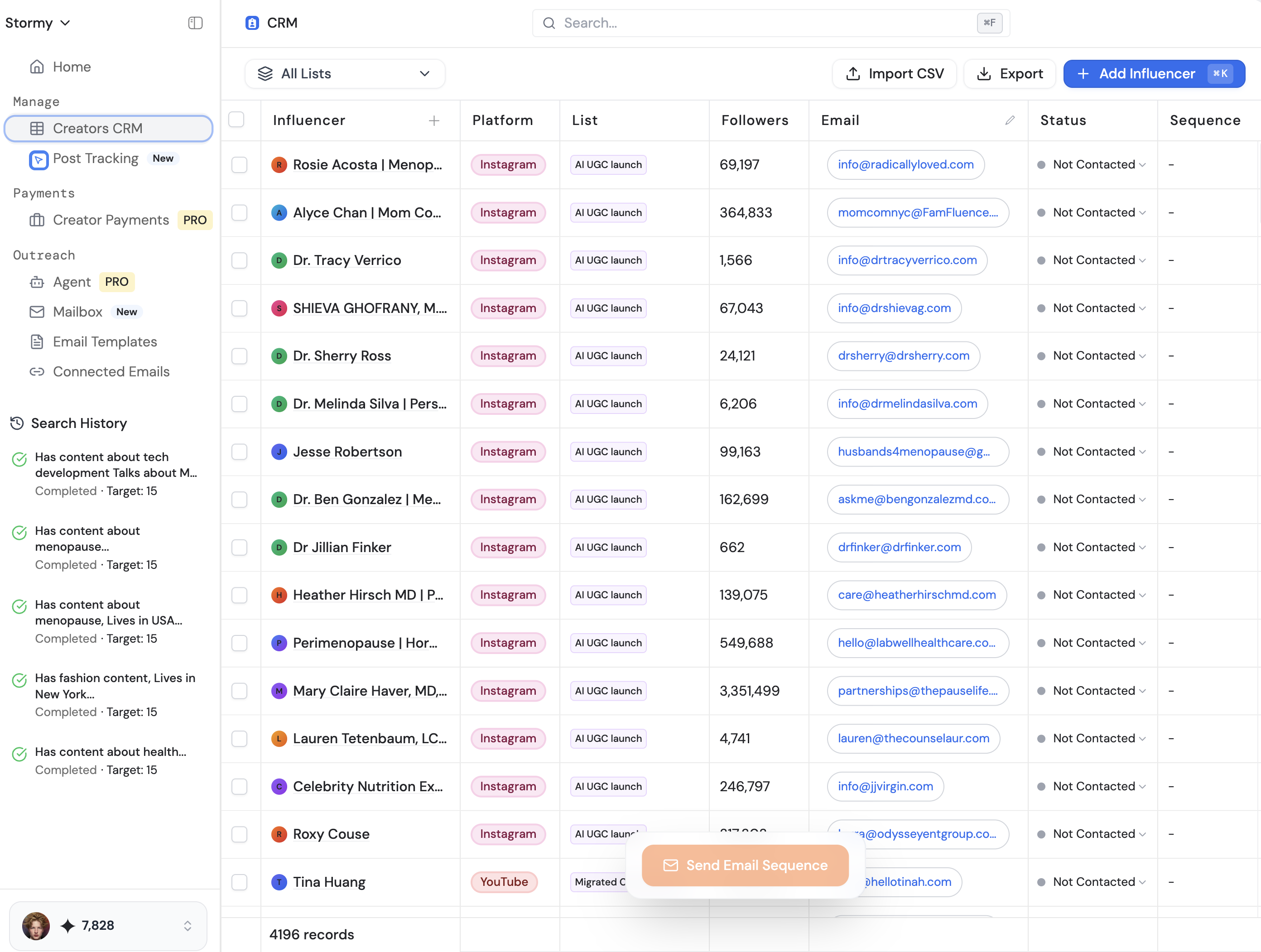
Performance Trends: Why Volume Matters
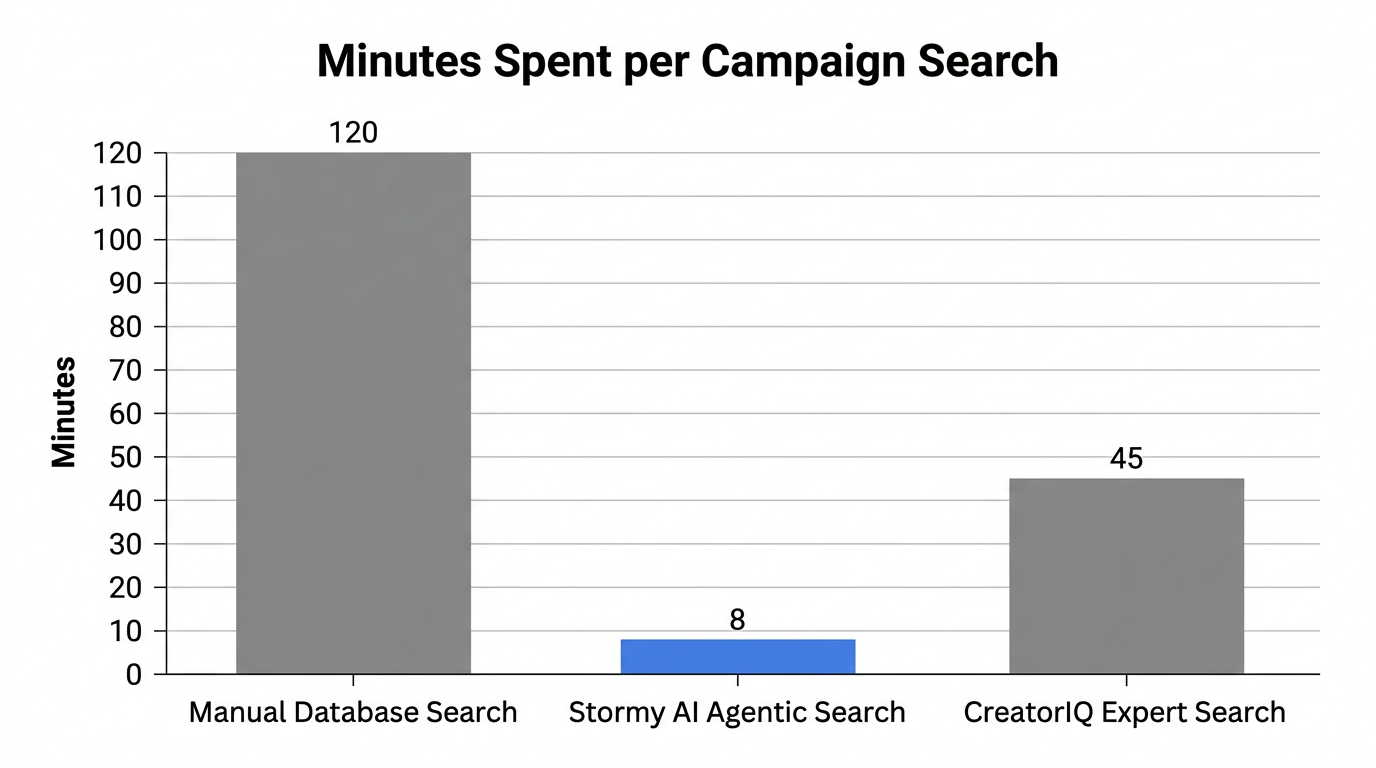
In 2025-2026, 74% of brands are reallocating budgets toward "Performance Creator Marketing," according to Impact.com. This shift focuses on Customer Acquisition Cost (CAC) and Average Order Value (AOV) rather than just likes. This is where nano-influencer dominance comes into play.
- Nano-creators (1k–10k followers) achieve a 2.71% engagement rate, significantly higher than celebrities.
- Managing 500 nano-influencers manually is impossible for a small team.
- Attempting to scale via Google Sheets leads to a 30% drop in efficiency ([Source: Medium/Sigmoid]).
This is why Stormy AI is becoming the gold standard for high-growth teams. Startups like ElevenLabs have used Stormy to automate the discovery and outreach for niche tech creators, cutting manual SDR work by up to 80% ([Source: Product Hunt]).
Decision Matrix: Which Platform Should You Choose?
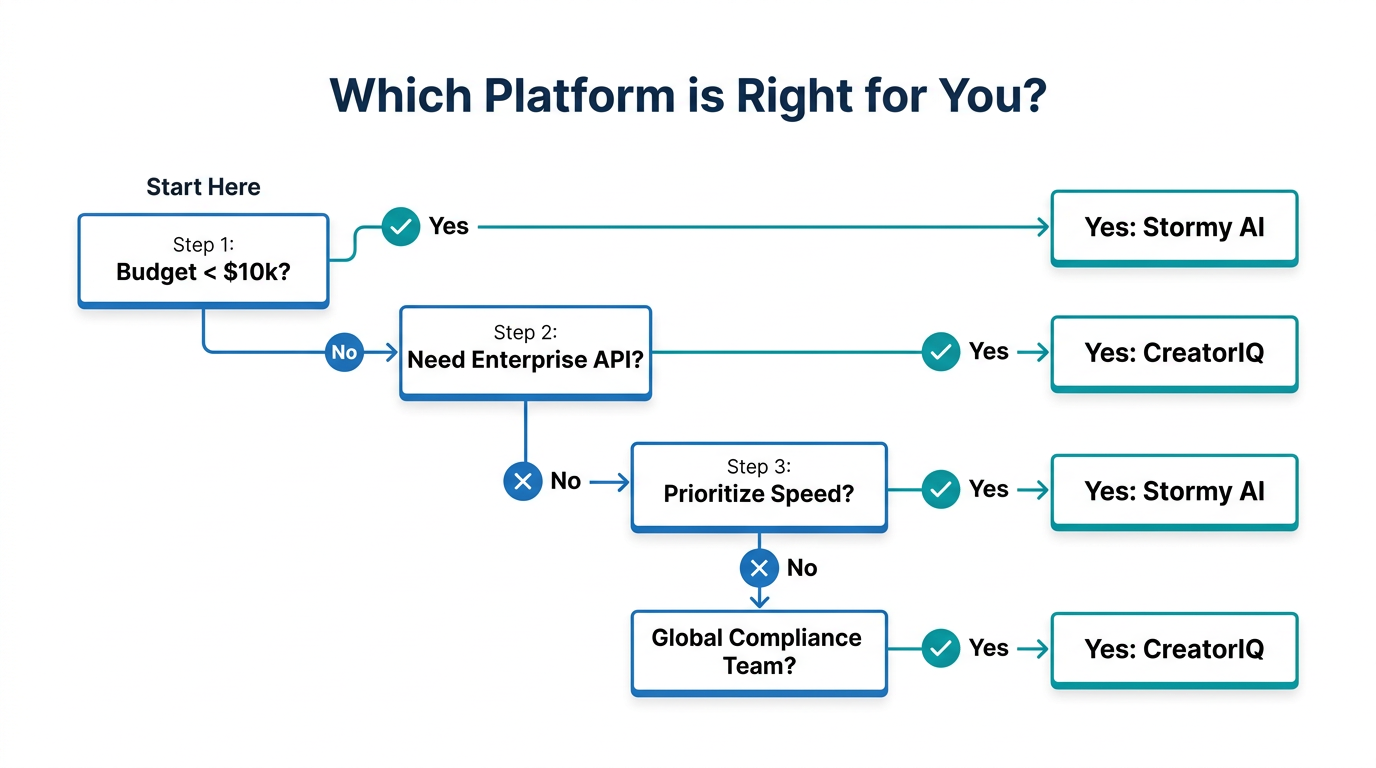
Choosing the right enterprise influencer software depends on your team's structure and goals. Use this guide to determine your path.
Choose Stormy AI if:
- Your primary goal is high-volume growth and product seeding.
- You have a small marketing team that needs to act like a large one.
- You want to automate the "long tail" of 100+ micro-influencers every month.
- You need to launch campaigns tomorrow, not in two months.
Choose CreatorIQ if:
- You are a global brand manager needing to sync teams across 10+ countries.
- You require deep, bespoke API integrations with legacy CRM systems.
- You prioritize manual, high-touch governance for a small group of "Celebrity" ambassadors.
- You have a dedicated team of 5+ people just for influencer management.
Conclusion: The Future is Agentic
While CreatorIQ remains a powerful tool for the Fortune 500 to maintain their status as a system of record, the future of creator marketing belongs to those who can execute at speed. For growth-minded companies, Stormy AI offers a level of efficiency that traditional influencer marketing platform comparisons often overlook: the ability to stop managing and start scaling.
By leveraging autonomous AI agents for discovery, outreach, and negotiation, you free your team to focus on high-level strategy and creative direction. If you're ready to move beyond the limitations of manual databases and embrace the efficiency of agentic AI, it's time to discover creators on Stormy today.