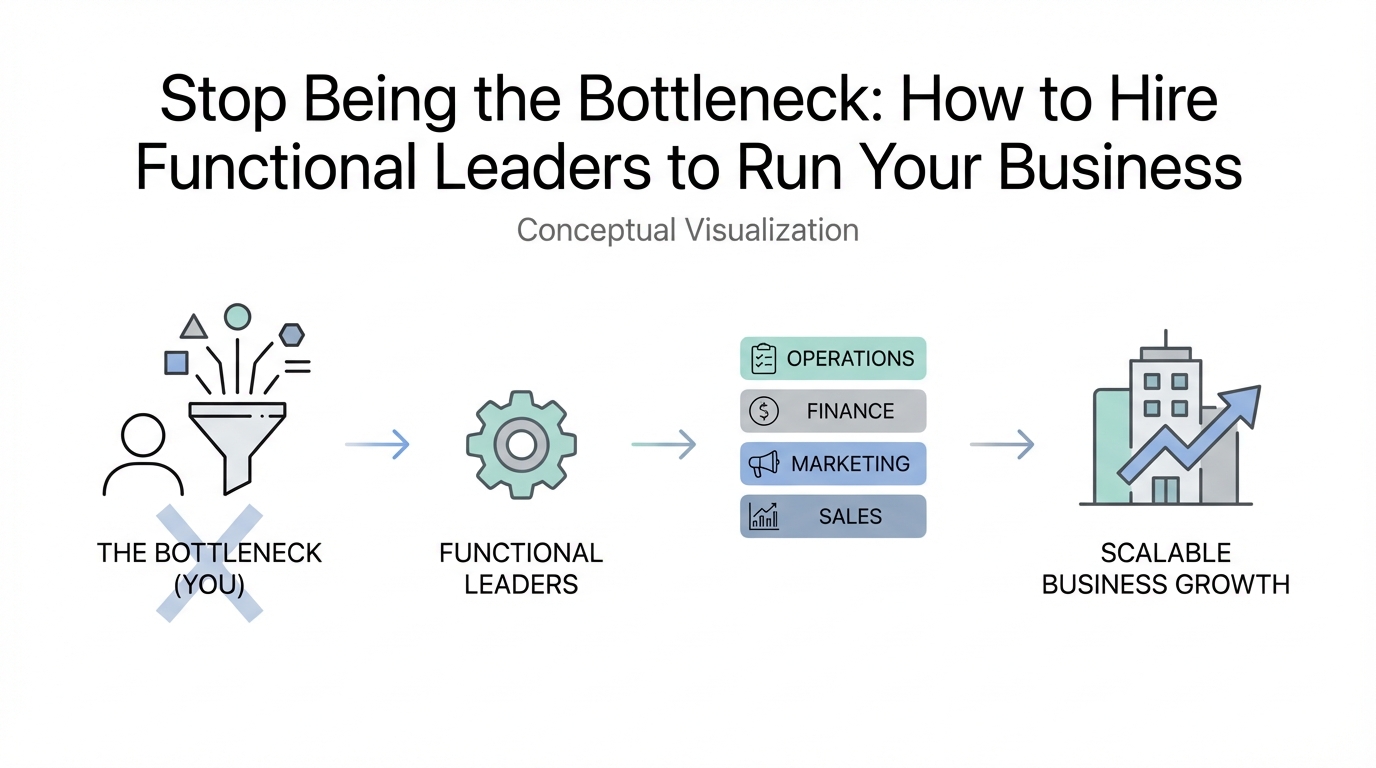
You have built a business from zero to seven figures through grit, late nights, and being the smartest person in every room. But suddenly, around the $4M to $10M revenue mark, the very qualities that got you here—your attention to detail, your constant stream of ideas, and your need for control—have become your greatest liabilities. You have entered the "swamp of scale," a dangerous territory where growth stalls because everything must pass through you. To break through to scaling a business to 8 figures, you must stop being the most valuable player on the court and start acting like the person in the owner’s box. This transition requires a fundamental shift in entrepreneurial leadership: moving away from hiring "helpers" and toward recruiting functional leaders who can drive the business without your constant supervision.
The Paradox of Founder Value: Why Your Success is Your Ceiling
There is a hard truth in the world of high-growth companies: the more valuable you are to your company, the less valuable your company is to a potential buyer. If your fingerprints are on every sales script, every product update, and every marketing campaign, you don't own a business; you own a very high-paying, high-stress job. To achieve a true exit or even just a month-long vacation, you have to systematically remove yourself from the day-to-day operations. This often triggers an ego crisis for founders who pride themselves on being the "visionary." However, as Ryan Deiss famously notes, choosing to be the MVP means you will never truly own the team. To scale further, you must leverage platforms like Meta Ads Manager and other automation tools to build systems that don't rely on your physical presence.
The founder bottleneck is not just a time management issue; it is an impulse control issue. Most entrepreneurs are trained to identify problems and immediately jump in to fix them. But at $5M+ in revenue, you can no longer fix every problem yourself. You must transition from "idea generation" to "constraint identification." Instead of asking, "What is my next big idea?" you should be asking, "What is the single biggest constraint holding us back?" This involves applying the Theory of Constraints to your operations. Often, that constraint is solved by better hiring functional leaders who specialize in one area—like sales, marketing, or fulfillment—rather than a founder who tries to do everything at 70% efficiency. Utilizing data from Google Ads can help you identify where these constraints lie in your customer acquisition funnel.
The Myth of the "Visionary Snowflake" and the Integrator

A popular piece of advice in the startup world is that every "visionary" needs an "integrator"—a magical number-two who handles all the details the founder hates. While this sounds great in theory, it rarely works in practice for a business in the swamp of scale. Hiring a single "mini-me" or a generalist COO often just creates another layer of communication without solving the underlying founder bottleneck. You don't need a single person to manage your chaos; you need specialized leaders to manage specific functions of the business. You aren't a "visionary snowflake" who is too creative for systems; you are likely just an operator who hasn't yet learned how to delegate authority to real experts. When you stop looking for a savior and start looking for functional experts, your entrepreneurial leadership style matures, and the business begins to breathe.
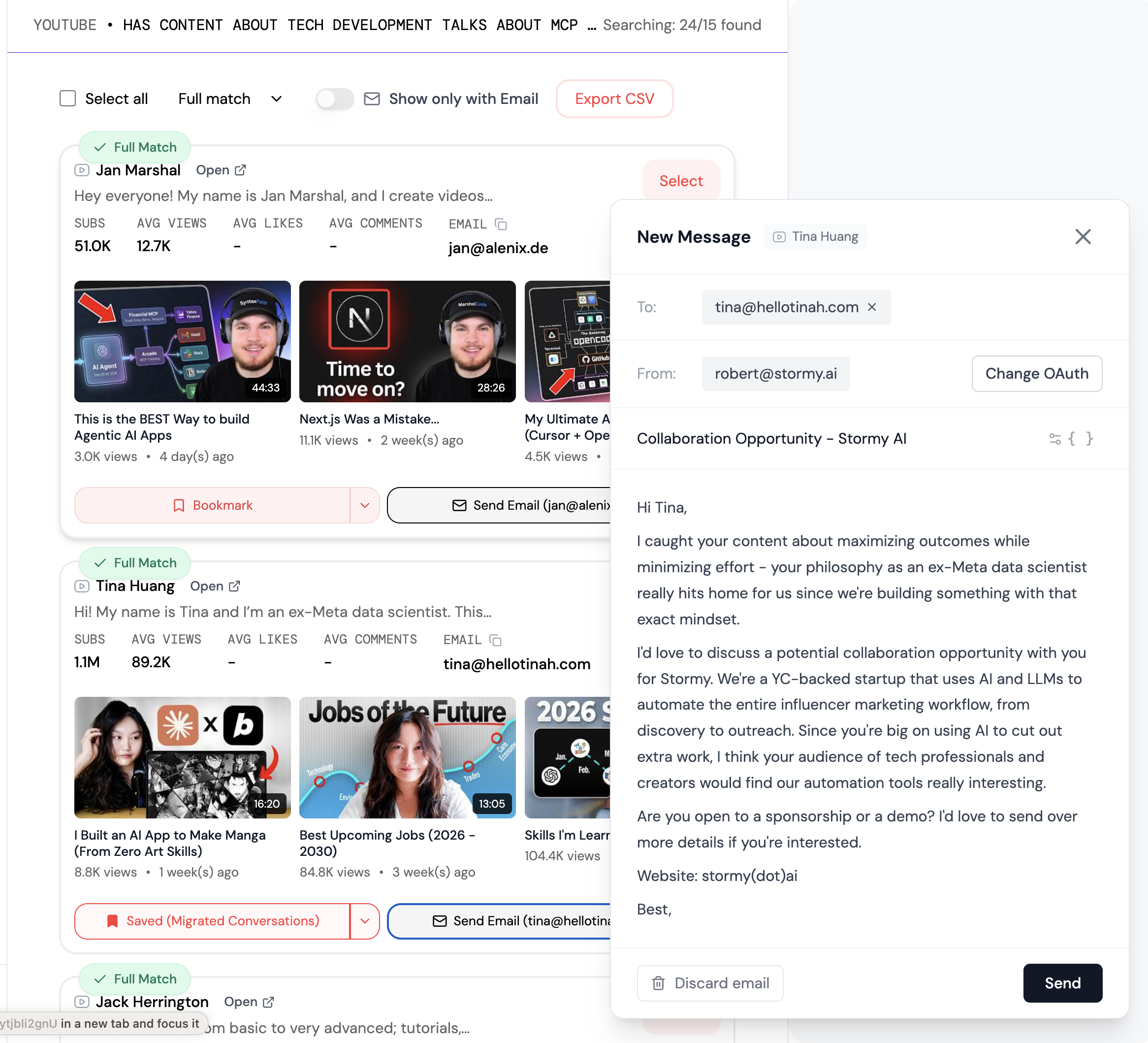
The mistake of the "integrator" hire is that it assumes the founder should remain the sole source of ideas. In reality, a healthy 8-figure company has a marketing leader who brings their own ideas, a sales leader who optimizes their own scripts, and a product head who understands the roadmap better than the founder does. For instance, in modern growth strategies, finding the right creators for your brand shouldn't be your job. Stormy AI is an AI-powered platform for creator discovery across TikTok, Instagram, and YouTube that allows your marketing lead to find UGC creators and manage influencer campaigns autonomously using natural language search, removing you from the creative approval loop entirely. By empowering a team to use specialized tools like Apple Search Ads, you move the company toward a state where it can optimize without you.
Helpers vs. Drivers: Why Your Hiring is Adding to Your Workload
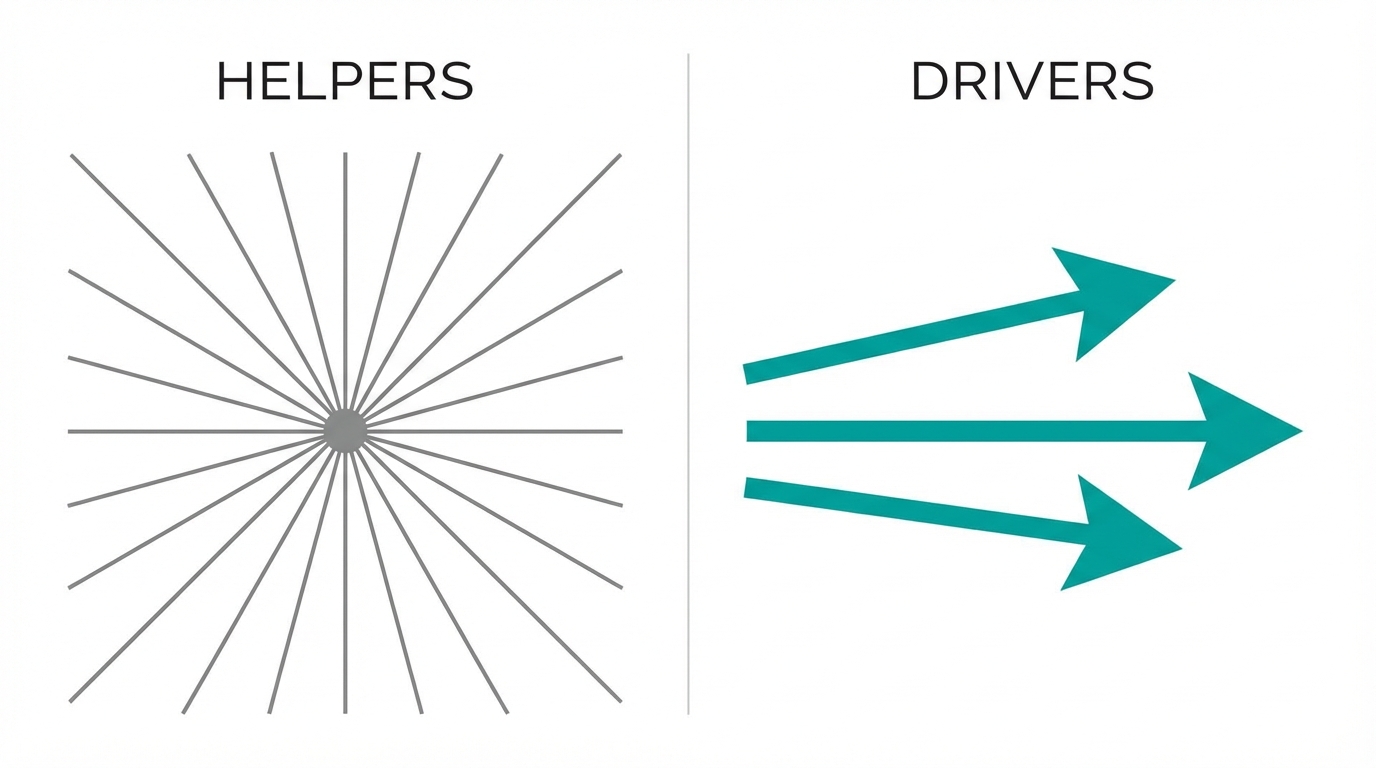
One of the biggest mistakes founders make is hiring "helpers" when they should be hiring "drivers." A helper is someone who says, "Tell me what to do, and I'll do it." While this sounds helpful, it actually gives you a new, more difficult job: management. If you have ten helpers, you now have to spend 40 hours a week directing their work, checking their progress, and fixing their mistakes. This is a common trap when scaling a business to 8 figures. You feel busy, but the business isn't actually moving forward without your constant input. Drivers, on the other hand, take ownership of a metric or a function. They build the map, they don't just follow it. They are what the A-Method for Hiring describes as high-performance individuals who drive results.
To identify if you have a team of helpers or drivers, look at your inbox. Are people asking you for permission, or are they informing you of results? A driver is a functional leader who is "send and delete." This means you can forward them an email regarding a massive problem in their department and immediately delete it from your mind, knowing it will be handled better than if you did it yourself. If you are still managing your own creator outreach or influencer spreadsheets, you haven't found a driver yet. Investing in Stormy AI for finding UGC creators and automating outreach with hyper-personalized emails can help your team transition into drivers by giving them the AI-powered tools they need to take full ownership of influencer marketing and UGC production.
The Functional Leader Playbook: Who to Hire and When
Every business essentially does three things: they make stuff, they sell stuff, and they fulfill stuff. As you grow, you need a leader for each of these "engines." Knowing how to hire a leadership team starts with identifying which of these areas is currently your primary constraint. If you have more leads than you can handle, your constraint is fulfillment. If your product is great but nobody knows about it, your constraint is marketing or sales. You should hire a functional leader to own the area where you are the biggest bottleneck.
Step 1: The Head of Marketing
This person should own the "Growth Engine." They aren't just posting on social media; they are managing the budget across Meta Ads Manager, optimizing conversion rates, and scaling customer acquisition. They should be responsible for the cost per acquisition (CPA) and the volume of new leads. If they are constantly asking you what the next campaign should be, they are a helper, not a functional leader. A true Head of Marketing will proactively suggest using Stormy AI to set up an autonomous AI agent that discovers and outreaches to creators on a daily schedule, because they understand that creative volume is the primary lever for performance in 2024.
Step 2: The Head of Sales
If your business relies on a sales team, a Head of Sales is critical. This leader owns the scripts, the CRM, the training, and most importantly, the quota. Your job as the founder is to set the target; their job is to figure out how to hit it. They should be looking at data from Google Ads to understand lead quality and adjusting the sales process accordingly without you having to sit in on every sales call.
Step 3: The Head of Product or Fulfillment
This leader ensures that what you sold actually gets delivered. They own the customer experience and the operational systems. If customers are complaining or churn is high, this functional leader is the one who diagnoses the issue and implements the fix. They should be obsessed with efficiency and systemization, ensuring that the "Manufacturing Engine" of the business runs like a well-oiled machine.
The "Send and Delete" Test for High-Leverage Hires

How do you know if you’ve actually succeeded in hiring functional leaders? It comes down to the "Send and Delete" test. When a problem arises—say, a drop in performance on Apple Search Ads—do you feel the need to log in and look at the campaigns yourself? Or can you forward the notification to your Head of Marketing and trust that it will be solved? A high-leverage hire is someone who actually makes you feel a slight fear that they might leave because they have become so transformative to the business. You no longer hope they do a good job; you rely on the fact that they are better at their specific function than you ever were.
This emotional shift is the hallmark of scaling a business to 8 figures. When you reach this level, your role shifts to coaching your leaders and ensuring they have the resources they need. If your marketing lead needs a higher budget for creator-led content, your job is to evaluate the ROI and provide the capital, or suggest they use Stormy AI to track all creator posts and analyze campaign performance automatically. You are now the coach, not the player. This is how you move from 80-hour workweeks to a business that generates revenue while you sleep or take a vacation.
Mapping Your Value Creation Engine
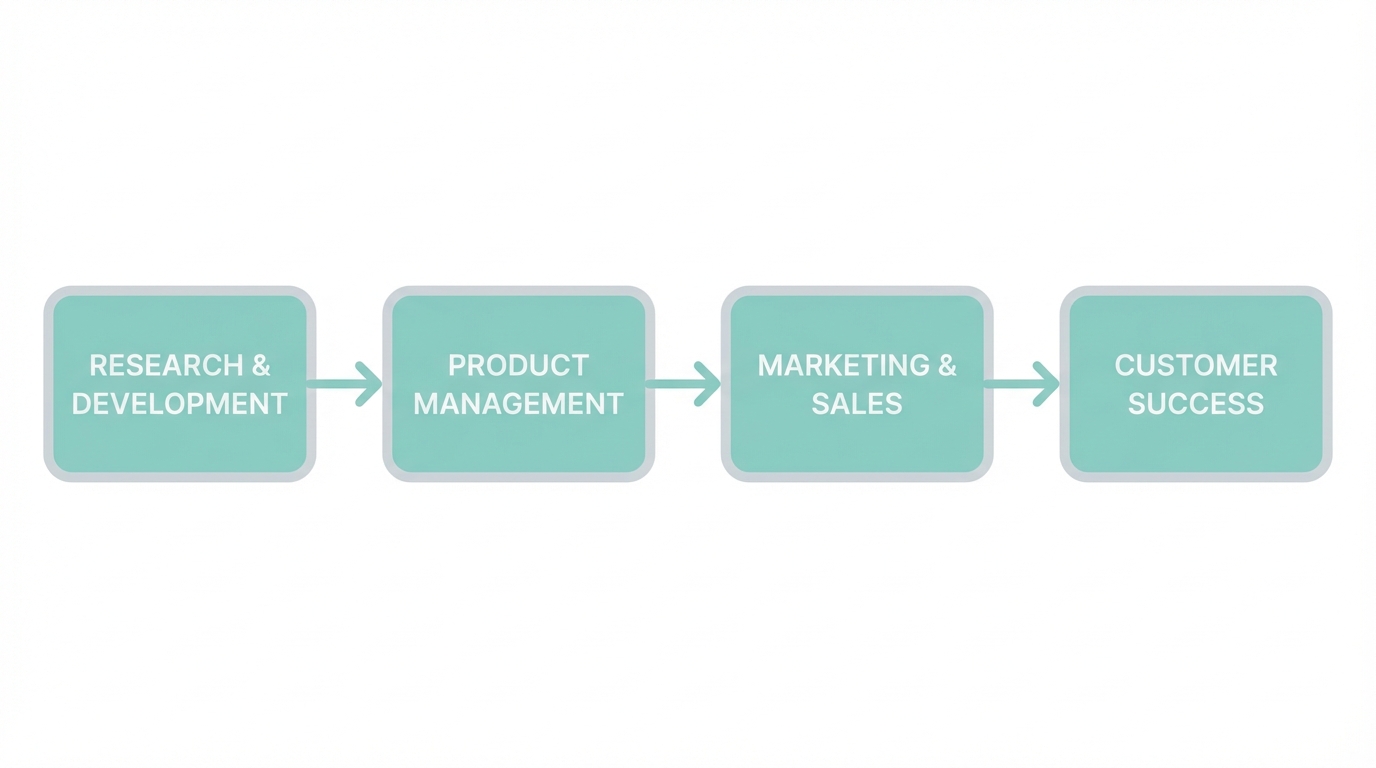
Before you can hire the right leaders, you must visualize how your business actually creates value. Many founders make the mistake of documenting every single process, which leads to bloated manuals that no one reads. Instead, focus on mapping your "Value Engines." Use a whiteboard and sticky notes or tools like Lucidchart to flowchart exactly how a customer goes from being unaware of your brand to becoming a loyal fan. This is called business process mapping, and it is the foundation of entrepreneurial leadership.
- The Growth Engine: Map out every step from a Facebook Ad click to an email signup, to the first purchase. Who owns each box? What is the metric for success?
- The Fulfillment Engine: Map out what happens the second a purchase is made. How is the product delivered? How is the customer onboarded? Where are the leaks in the bucket?
- The Retention Engine: How do you get them to come back? If this isn't on your map, it isn't happening in your business.
By visualizing these engines, you can identify where the "orphaned activities" are—tasks your team is doing that don't actually contribute to a sticky note on the map. If you are spending hours on an email newsletter that doesn't drive awareness, sales, or fulfillment, stop doing it. Use data from Google Ads and other analytics platforms to validate every step of your map. Once the map is clear, you can assign functional leaders to own specific sections of it, ensuring total accountability.
Building Systems to Attract A-Players
A common complaint among founders is, "I can't find any good people." But talent is a market like any other. If you want to hire "10s," you have to build a company that a "10" would want to work for. A-players and high-level functional leaders do not want to work for a "messy" founder who manages by whim and has no clear systems. They want to work in an environment where expectations are clear, metrics are transparent, and they have the autonomy to drive results. They want to use the best tools available, whether that's Meta Ads Manager for scaling or Stormy AI for creator discovery.
Your goal should be to build a company that doesn't require rockstars to function, because that is exactly the kind of company rockstars want to join. When you have a clear business process map and a scorecard that tracks the metrics that actually matter, you create a professional environment that attracts top-tier talent. Scaling a business to 8 figures is impossible with a team of people just like you; you need people who are better than you at the things you aren't meant to be doing. This transition requires patience and the willingness to live below your means to afford the high salaries that true functional leaders command. But the payoff is a business that is an asset, not a burden.
Conclusion: Breaking the Bottleneck
The journey from 7 to 8 figures is less about working harder and more about thinking differently. You must stop viewing yourself as the source of all value and start viewing yourself as the architect of a system. By hiring functional leaders who are "drivers" rather than "helpers," you free yourself from the day-to-day grind and allow the business to grow beyond your personal capacity. Start today by mapping your growth engine, identifying your biggest constraint, and making your first "send and delete" hire. Whether you are optimizing your Google Ads or scaling your creator outreach with Stormy AI, remember that your ultimate goal is to become the least valuable person in the room—because that is when your business becomes truly priceless.