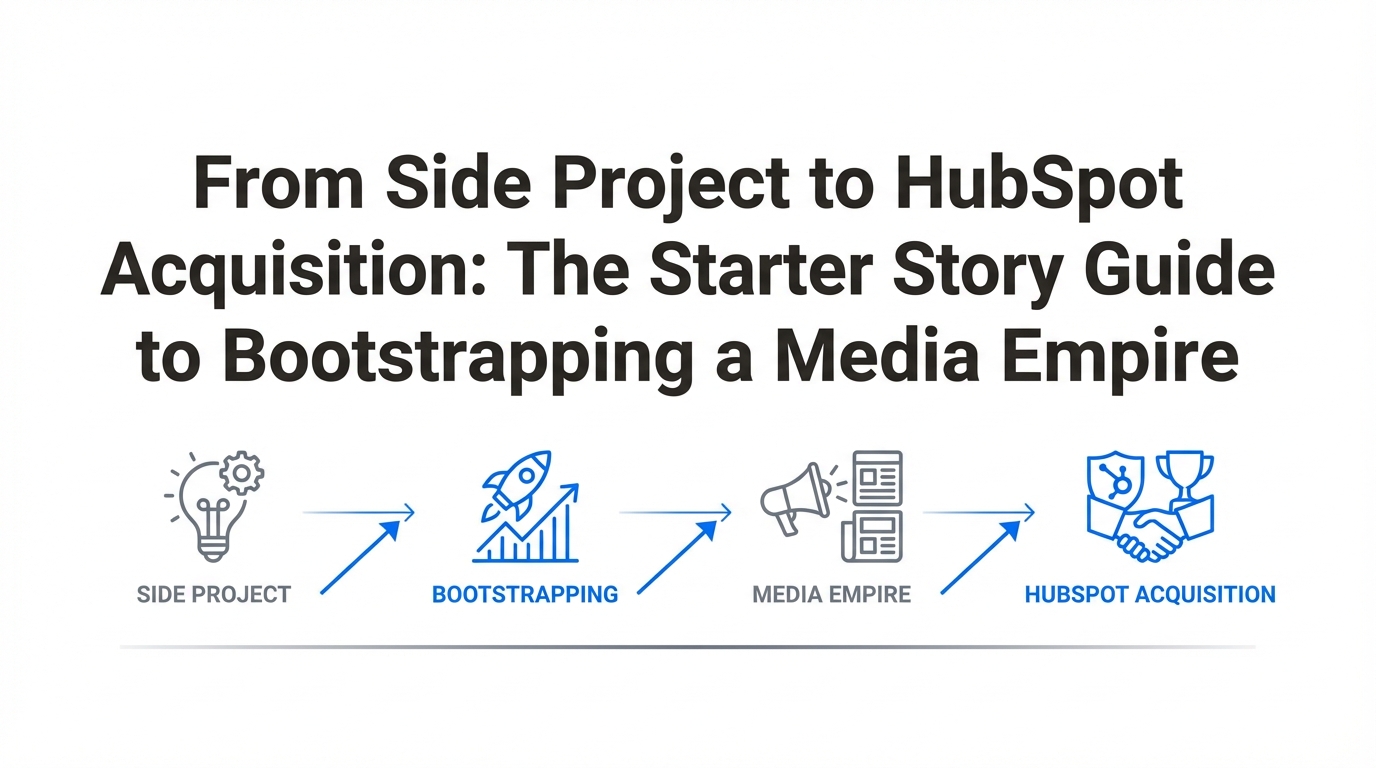
In the high-stakes world of venture capital and hyper-growth, the narrative of Starter Story stands as a masterclass in the opposite: bootstrapping a business from a 6:00 AM coffee shop routine into a multi-million dollar media empire. When Pat Walls recently announced the HubSpot acquisition strategy that saw his company join the ranks of a public giant, it wasn't just a financial win; it was the culmination of nearly a decade of consistent, unglamorous effort. This guide deconstructs the Starter Story founder story to provide a clear entrepreneurship growth strategy for solo founders looking to scale a side project without sacrificing their equity or their vision.
The Early Days Playbook: Moving from Zero to the First $1,000
Every legendary business has a humble origin point. For Pat Walls, it wasn't a Silicon Valley garage, but a now-closed Starbucks in New York City. At the time, Walls was working a six-figure developer job at a startup—a position many would consider the peak of career stability. Yet, he felt the pull of ownership. The entrepreneurship growth strategy he employed wasn't about a grand launch; it was about deep work, a concept popularized by author Cal Newport. He committed to two hours of uninterrupted work every single morning before his 9-to-5 began.
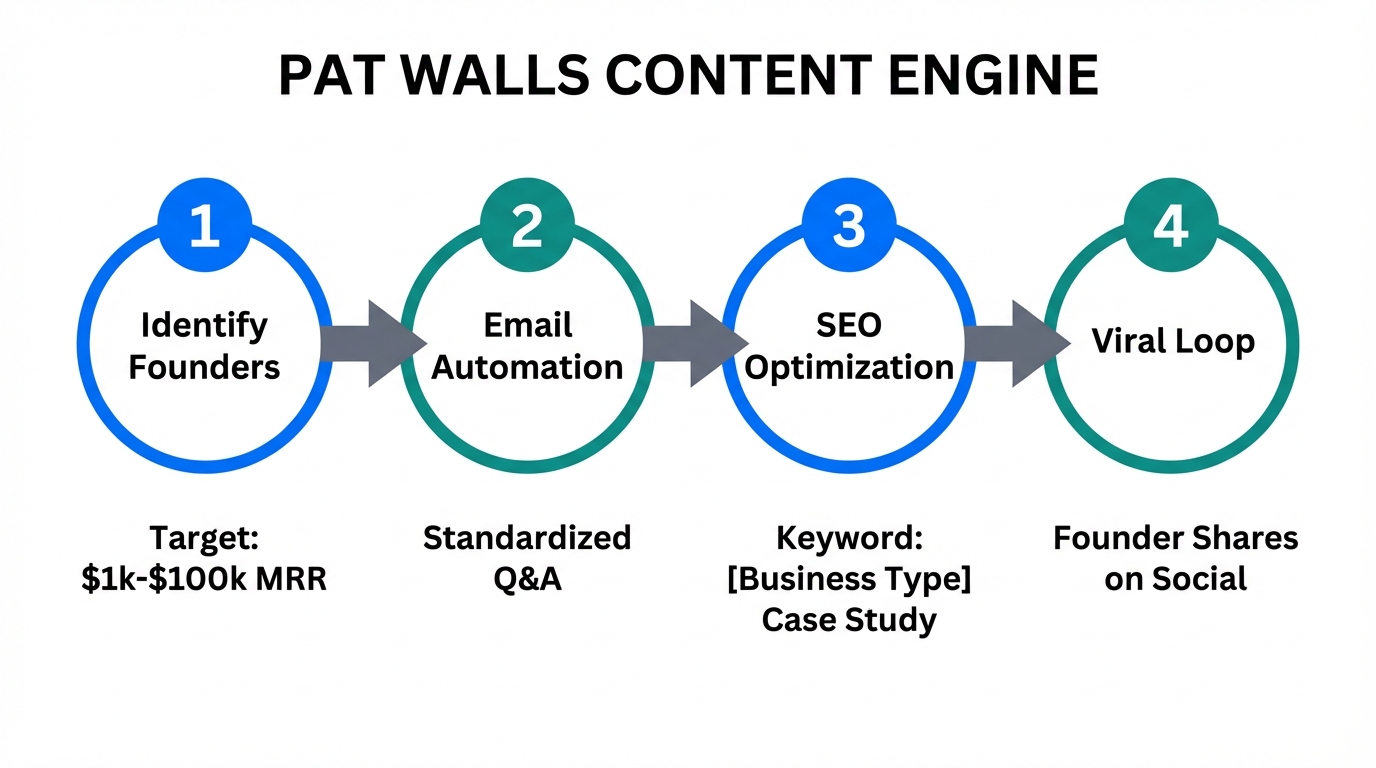
During these early hours, he wasn't just 'working'; he was executing on the core functions of what would become a media powerhouse: coding the initial site, conducting interviews with founders, and sending cold emails. Success in scaling a side project often comes down to this unrelenting consistency. While others were sleeping, Walls was refreshing Stripe to see a few hundred dollars trickle in. Those small wins are the fuel required to survive the 'trough of sorrow' that every bootstrapper faces.
The Philosophy of 'Just Keep Shipping'
One of the most critical aspects of bootstrapping a business is the ability to manage the 'messy middle.' Walls describes months where nothing moved and months where everything broke. The difference between those who fail and those who reach an exit is the willingness to keep shipping. Whether it was a new content format or a site optimization using tools like Framer or Webflow, the goal was to accumulate momentum. Over time, the revenue starts to tick up not because of a single 'lucky break,' but because of the compounded effect of showing up every day for years.
"It never exploded overnight. It just accumulated, and slowly people started to notice. The goal was to believe in myself over a long enough number of days for it to compound."Transitioning from Operator to Owner: The First Hire
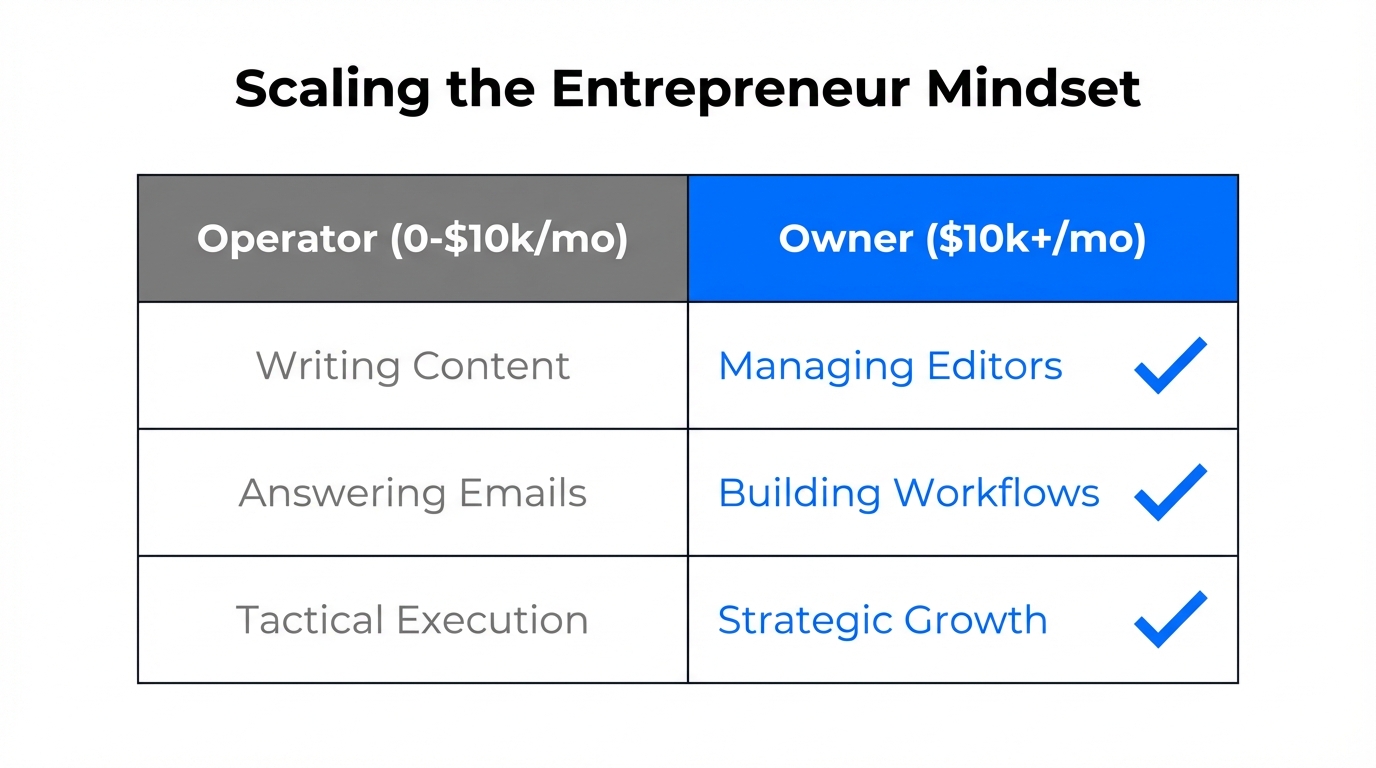
There comes a point in scaling a side project where the founder’s time becomes the primary bottleneck. For Starter Story, that moment arrived when the project began feeling like a 'real company.' Walls’ first hire was his sister, a move that shifted the business from a solo operation to a collaborative effort. Hiring is often the scariest step for a bootstrapper because it involves fixed costs and the delegation of quality control.
To successfully transition from operator to owner, you must identify tasks that are repetitive but essential. For a content-heavy business, this often includes outreach, formatting, and basic editing. By offloading these tasks to a freelance network or a dedicated assistant, you can return to high-level strategy and growth initiatives. If you are managing a high volume of creator or founder outreach, tools like Stormy AI can help source and manage these relationships at scale, ensuring your inbox doesn't become the graveyard of your growth.
| Phase | Primary Focus | Key Metric |
|---|---|---|
| The Side Hustle | Product-Market Fit & Deep Work | First $1,000 Revenue |
| The Operator | Consistency & Systems | $10k - $20k Monthly Revenue |
| The Owner | Hiring & Entrepreneurship Growth Strategy | Scalable Profit Margins |
Avoiding the 'Identity Trap' and Founder Bottlenecks
As a business grows, a subtle but dangerous shift occurs: the founder’s identity becomes inextricably linked to the brand. Walls noted that he wasn't just 'Pat' anymore; he was the 'Starter Story guy.' While this brand equity is valuable, it can become a psychological cage. If the business cannot function without your daily presence, you haven't built an asset; you've built a high-paying job.
To avoid this, you must intentionally build systems that do not rely on your personal brand or manual labor. This is especially true for marketing and outreach. Many founders spend hours manually finding influencers or partners. Leveraging an AI-powered creator discovery platform like Stormy AI allows the business to maintain its growth trajectory even when the founder steps away. This decoupling of the founder from the process is what makes a business 'sellable' when a company like HubSpot comes knocking.
"I asked myself: am I still building, or am I just holding on? If I really want this thing to grow beyond me, then I have to let it go."Managing Growth Fatigue over a 10-Year Horizon
Most entrepreneurs underestimate the time it takes to reach a significant exit. According to data from Crunchbase, the average time to exit for successful startups is often 7 to 10 years. The Starter Story founder story spanned nearly a decade. Maintaining momentum over such a long horizon requires a specific mental framework to combat growth fatigue. There will be seasons where you want to sell just because you are tired, and seasons where you'd never dream of letting go.
To manage this, focus on mission alignment. When your work is tied to a larger purpose—such as inspiring the next generation of founders—the daily grind feels less like a chore and more like a contribution. This long-term perspective is vital when navigating the complexities of an acquisition. You aren't just looking for the highest bidder; you are looking for the partner that will allow your 'baby' to reach its full potential.
The Mechanics of the HubSpot Acquisition Strategy
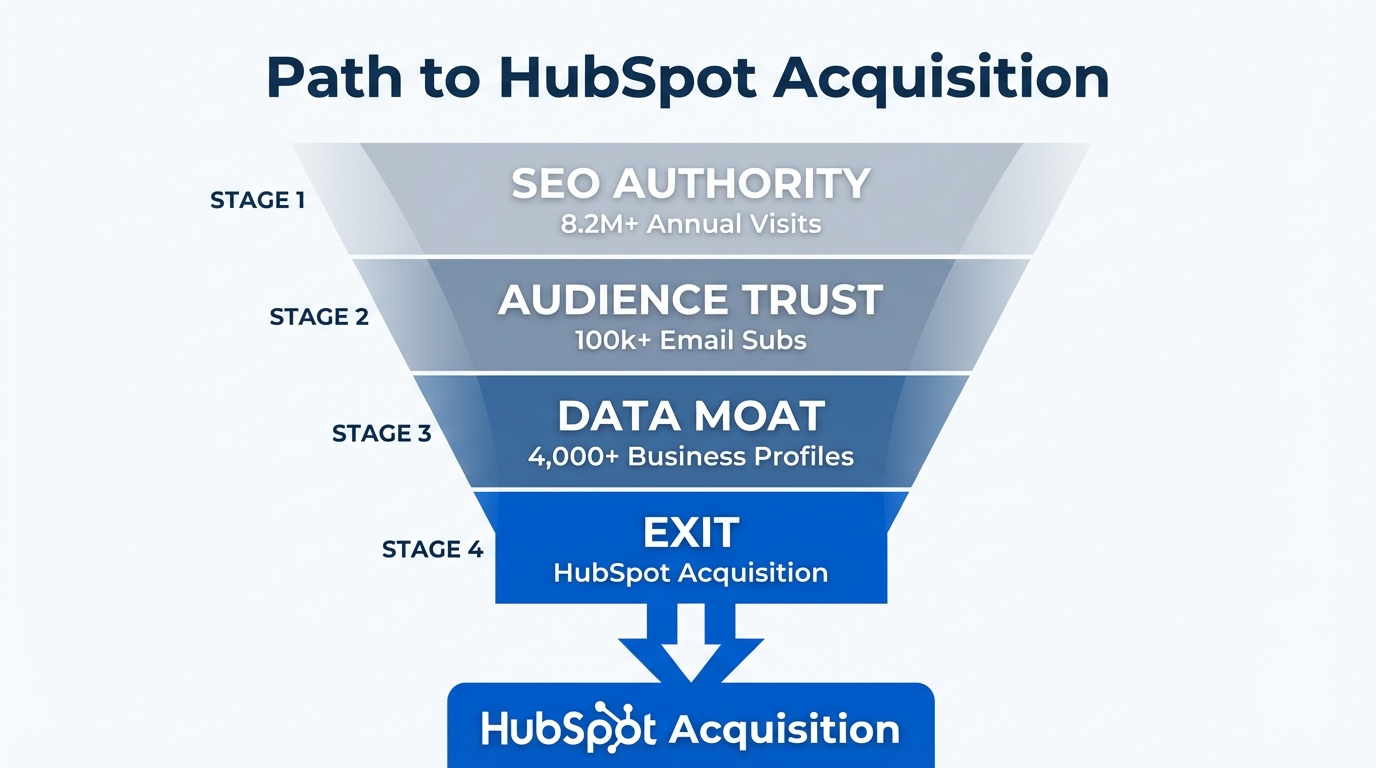
When the HubSpot acquisition strategy was finally executed, the focus was surprisingly not just on the numbers. While the payout was 'life-changing,' the real driver was strategic alignment. HubSpot, a leader in CRM and inbound marketing, wanted to scale what Starter Story had already built without changing its DNA. For a bootstrapped founder, this is the 'goldilocks' scenario.
If you are building with an exit in mind, keep your growth stack clean and efficient. Use industry-standard tools for your operations, such as Google Ads for traffic and Shopify for any physical or digital products. This makes the due diligence process much smoother for the acquiring company. They aren't just buying your revenue; they are buying your processes, your team, and your mission.
Why Alignment Matters More Than Money
- Resource Scaling: A larger parent company provides the capital for better production and bigger experiments.
- Mission Preservation: Alignment ensures the brand you built stays true to its original audience.
- Team Stability: A good deal protects the employees who helped you build the company through platforms like Deel or Gusto.
- Long-term Impact: Joining a platform like HubSpot allows your content to reach millions more than you could reach alone.
The Ultimate Entrepreneurship Growth Strategy
The journey from a Starbucks in NYC to a HubSpot acquisition is proof that bootstrapping a business is a viable path to massive success. It doesn't require venture capital or a massive team at the start. It requires consistency, deep work, and the courage to eventually let go. By building systems, hiring the right people, and focusing on long-term mission alignment, any side project can evolve into a media empire.
As you scale your own journey, remember that the tools you choose define your efficiency. Whether you are using Notion to organize your thoughts or an AI agent to handle your outreach, the goal is to build something bigger than yourself. Pat Walls' story isn't about one lucky break—it's about the compound interest of showing up. Start today, keep shipping, and your life could be entirely different in just a few years.