In the world of high-stakes entrepreneurship, there is a distinct difference between building a million-dollar business and architecting a billion-dollar moonshot. While the former often relies on incremental improvements or local arbitrage, the latter is usually the result of a massive shift in infrastructure costs. We are currently witnessing a generational collapse in the cost of reaching orbit, thanks to SpaceX. This isn't just a win for satellite companies; it is the foundation for a new economic framework that identifies billion dollar startup ideas before the rest of the market even sees the opportunity.
The SpaceX Derivative Framework: Second-Order Effect Analysis
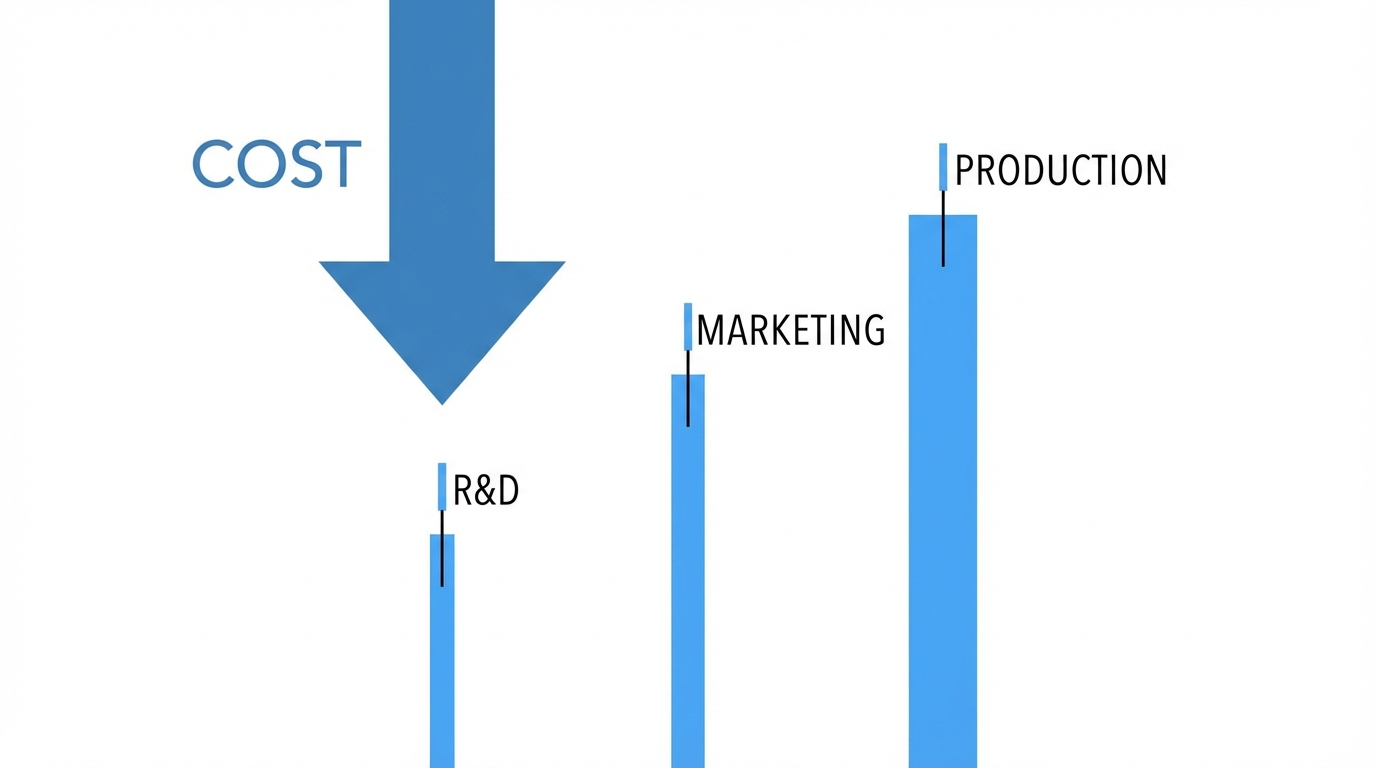
The core thesis of the SpaceX Derivative Framework is simple: every time an infrastructure cost drops by an order of magnitude (10x), it creates an inevitable vacuum for new service providers. For decades, the cost of sending a kilogram of payload into space was prohibitively expensive, limited primarily to nation-states and massive aerospace conglomerates. Today, as SpaceX drives the cost-per-kilo to orbit lower than ever before, we are seeing the birth of the commercial space industry opportunities that were previously considered science fiction.
When infrastructure becomes cheap, the bottleneck shifts from access to utilization. For example, once Starlink proved that low-Earth orbit (LEO) could be used for global high-speed internet, the infrastructure was set. The moonshot business strategy now involves identifying what else becomes possible when the launch cost is no longer the primary hurdle. This is the 'Second-Order Effect.' You don't build the rocket; you build the business that couldn't exist without the rocket.
The Varda Model: A Case Study in Orbital Manufacturing

One of the most compelling examples of this framework in action is Varda Space Industries. Varda identified a specific pharmaceutical problem: certain drugs crystallize differently in zero gravity, leading to higher yields and more effective treatments. On Earth, gravity interferes with the molecular structure during the manufacturing process. In space, you can 'turn off' gravity.
Previously, this would have been impossible because the cost of the mission would outweigh the value of the drug. However, by leveraging SpaceX's falling launch costs, Varda can manufacture high-value pharmaceuticals in orbit and return them to Earth. This is a perfect future technology trend for 2025 and beyond—using the unique environment of space to solve Earth-bound industrial problems. Similarly, Impulse Space, founded by SpaceX's first employee Tom Mueller, is building the logistics layer to move material between different orbits, further de-risking the entire ecosystem.
Predicting the 'Planet Labs' of the Moon
While Mars remains the long-term goal for interplanetary colonization, the Moon is the immediate industrial frontier. Unlike Mars, the Moon is always accessible and Earth-facing, meaning communication and emergency return paths are simplified. As the Artemis missions prepare to return humans to the lunar surface, a new data and logistics gap is emerging.
Think about Planet Labs, which revolutionized Earth observation by taking constant, high-resolution imagery of our planet. The 'Planet Labs of the Moon' is an inevitable billion-dollar company. Whether it is lunar mining, high-definition live-streaming of lunar activity, or building nuclear power plants to sustain habitats, the commercial space industry needs a localized service layer. The startup that figures out how to provide food, water, or energy as a service on the lunar surface—effectively becoming a contractor for NASA and SpaceX—will achieve venture capital scale rapidly.
The Humanoid Labor Boom: Teleoperation and Automation

The same logic of falling costs applies to the robotics industry. We are currently seeing a boom in humanoid robotics, driven by the convergence of LLMs (Large Language Models) and advanced computer vision. Companies like Tesla with their Optimus robot and Boston Dynamics are proving that the hardware for general-purpose robots is nearly ready for prime time.
The immediate opportunity isn't necessarily fully autonomous AI, but teleoperation. Teleoperation allows a human to wear a VR headset or a motion-capture suit and control a robot remotely. This has massive implications for industrial automation. Imagine a Navy SEAL or a firefighter performing a high-risk mission from a safe warehouse, or a technician repairing a nuclear reactor via a robot that mirrors their every move. By removing the risk to human life, we unlock a level of industrial efficiency that was previously unthinkable. The first company to weaponize or fully militarize these humanoid robots for defense will likely be a lightning rod for both controversy and massive investment rounds.
The KPhone Strategy: Counter-Positioning Against Giants

Not every moonshot requires leaving the atmosphere. Sometimes, the moonshot is a business strategy focused on reclaiming human attention. As we become more 'iPad kids' and 'phone addicts,' there is a growing demand for 'dumbphones' or niche gadgets that offer a curated experience. This is the KPhone (Kid's Phone) concept: hardware that is explicitly 'anti-Apple.'
Apple's brand is built on sleek, minimalistic, titanium perfection. A startup can counter-position by building quirky, fun, and ruggedized hardware that deliberately lacks an App Store. For parents, a device that allows for communication and AI learning (like identifying plants or animals) but blocks the dopamine-fueled infinite scroll of TikTok or Roblox is a high-value product. Because Apple will never 'nerf' their own ecosystem, this creates a protected niche for a new hardware player. When building such niche brands, using tools like Stormy AI can help source and manage UGC creators to reach specific demographics like millennial parents on social media.
Step 1: Shift Your Mindset to Venture Scale
To build a moonshot, you must stop thinking about lifestyle businesses. A lifestyle business aims for steady cash flow; a moonshot aims for a total market transformation. You must be comfortable with the idea that you will either build a billion-dollar entity or 'light a billion dollars of other people's money on fire' in the pursuit of a breakthrough. This requires a different level of psychological resilience and a commitment to hiring elite technical talent.
Step 2: Identify the Infrastructure Anchor
Identify which major player is currently lowering costs in your sector. If you are in space, it's SpaceX. If you are in AI, it's OpenAI or Anthropic. If you are in logistics, it might be the expansion of autonomous trucking via Waymo. Your business should be the 'derivative' of their success.
Step 3: Build the Logistics or Security Layer
Don't try to out-train GPT-5. Instead, build the cybersecurity for AI companies that protects their model weights. These 'weights' are the most valuable digital assets in the world, and protecting them like Fort Knox is a massive unaddressed market. Similar to how Chainalysis built a massive business on top of the crypto ecosystem without needing a token, you can build a massive business on top of AI infrastructure by providing the essential security or vetting layers.
Conclusion: The Era of the Big Idea
The next decade will be defined by those who can look past the immediate noise and identify the long-term trends in infrastructure. Whether it is manufacturing drugs in space, deploying humanoid security guards, or building the 'KPhone' for the next generation, the opportunities are vast for those willing to take venture-scale risk. By applying the SpaceX Derivative Framework, you can move from small-scale thinking to identifying the billion-dollar moonshot ideas that will define the 2030s. Don't just build an app; build the future.