In the rapidly evolving landscape of 2026, the battle for consumer attention isn't won in the Meta Ads Manager or Google Ads dashboard anymore—it's won in the editing suite. As algorithms on platforms like TikTok and Instagram have become almost entirely autonomous, creative has officially become the new targeting. But with this shift comes a massive operational hurdle: creative fatigue. When your assets stop performing, your CPA (Cost Per Acquisition) skyrockets before you even realize there's a problem.
Enter the era of "Agentic Marketing." Tools like OpenClaw, the premier open-source framework for automating paid media with over 300,000 GitHub stars, are changing how brands handle performance auditing. By deploying specialized AI agents—often nicknamed "Lobsters" by the community—growth teams are moving from manual spreadsheet updates to self-healing ad accounts. In this guide, we will explore how to use the OpenClaw Creative Analyst to detect CTR decay and automate asset rotation to keep your campaigns profitable 24/7.
Why 'Creative is the New Targeting' in the 2026 Algorithmic Landscape
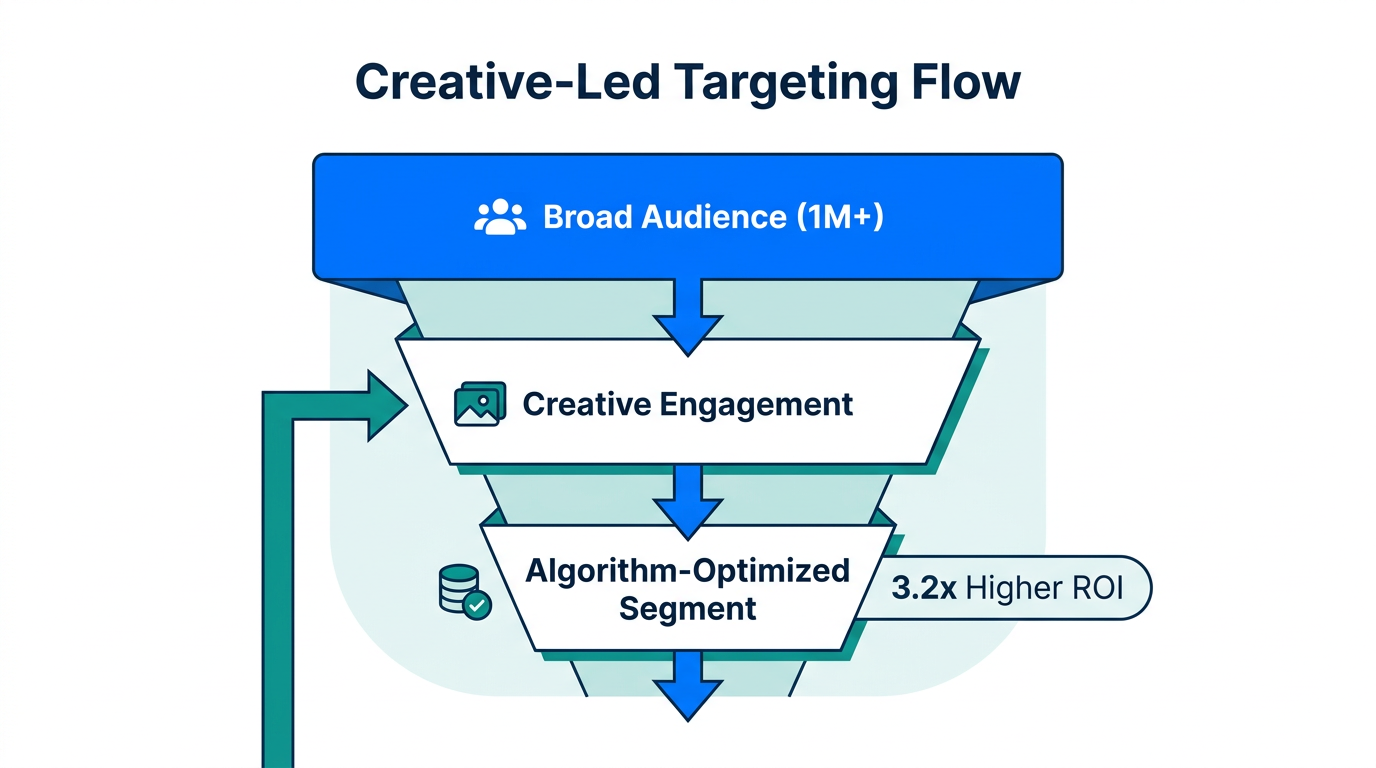
In 2026, targeting narrow interests or lookalikes is largely a thing of the past. Ad platform AI is now so sophisticated that it finds your audience based on how they interact with your content, not your manual settings. This means that if your creative isn't hitting the mark, your targeting fails. According to IAB Europe, 85% of marketing companies have now pivoted to agentic models to handle this complexity.
"Creative is the new targeting. If you aren't rotating assets based on fatigue signals, you're overpaying for attention." — Nikhil Kumar, Growth Marketer.The problem is that human media buyers cannot monitor asset-level decay in real-time across multiple platforms. This is where ad fatigue automation becomes a competitive necessity. By the time a human notices a 20% drop in CTR, the brand has already wasted thousands of dollars. The goal for 2026 is to move toward AI creative auditing where the system detects the "slope of decay" and pauses the ad before it hits the breaking point.
Using the OpenClaw Creative Analyst to Monitor Fatigue Signals
The OpenClaw Creative Analyst is a specialized skill designed to sit on top of your ad accounts and monitor asset-level fatigue signals. Unlike traditional reporting tools that just show you what happened, this agent predicts what will happen next by analyzing the rate of change in Click-Through Rate (CTR) and Return on Ad Spend (ROAS).
How the Creative Analyst Skill Works
- CTR Decay Detection: The agent tracks the daily performance of every individual video and image. If a winning asset shows a 15% decline in CTR over a 72-hour window, the agent flags it.
- Frequency Capping: It monitors frequency at the creative level, ensuring your audience isn't seeing the same hook so many times that they begin to experience "banner blindness."
- Automated Testing: You can set the agent to automatically swap a fatigued asset with a fresh one from your "Reserve Library," ensuring the automated ad testing cycle never stops.
By using OpenClaw's local-first architecture, brands can keep their sensitive performance data on their own VPS (Virtual Private Server) like DigitalOcean, ensuring total privacy while the "Lobster" agents work around the clock.
| Metric | Manual Auditing | OpenClaw Agentic Auditing |
|---|---|---|
| Audit Frequency | Weekly / Monthly | Real-Time (Every 15 mins) |
| Action Speed | Hours to Days | Seconds |
| Fatigue Detection | Reactive (after ROAS drops) | Proactive (predictive CTR decay) |
| Data Privacy | SaaS Cloud (shared) | Self-Hosted (private) |
Case Study: Stormy AI Research Proves Automated Auditing Reduces Waste
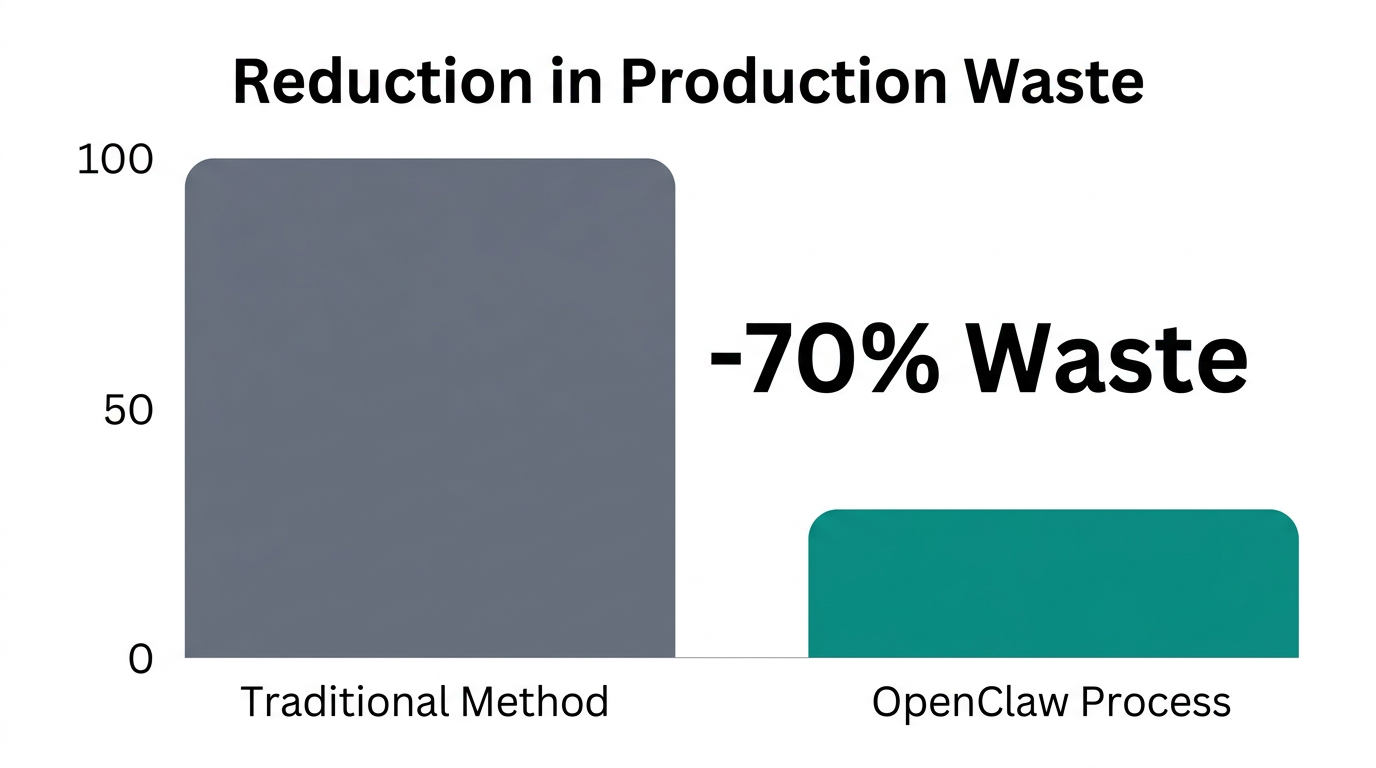
Recent data-driven research from Stormy AI, a leading platform for AI-powered creator discovery and influencer management, has revealed the staggering cost of manual creative management. The study found that brands relying on human-led audits typically suffer from a 25-40% "efficiency gap" caused by delayed asset rotation.
The research, highlighted in the Stormy AI Agentic Ad Ops Guide, found that companies implementing performance auditing tools like OpenClaw reduced their production waste by a massive 70%. Because the agents identify exactly which creative hooks are failing, production teams stop filming "vibe-based" content and start producing data-backed iterations that actually convert.
"The era of the manual PPC agency is over; the era of the 'Agent Architect' has begun." — Peter Steinberger, Creator of OpenClaw.By integrating creator-led content from platforms like Stormy AI into an automated OpenClaw workflow, brands can source hundreds of high-quality UGC (User-Generated Content) assets and let the AI agent determine which ones deserve the most spend. This synergy between AI-powered creator discovery and automated ad testing is the gold standard for growth in 2026.
Setting up 'Read-Only' Health Scores in Slack
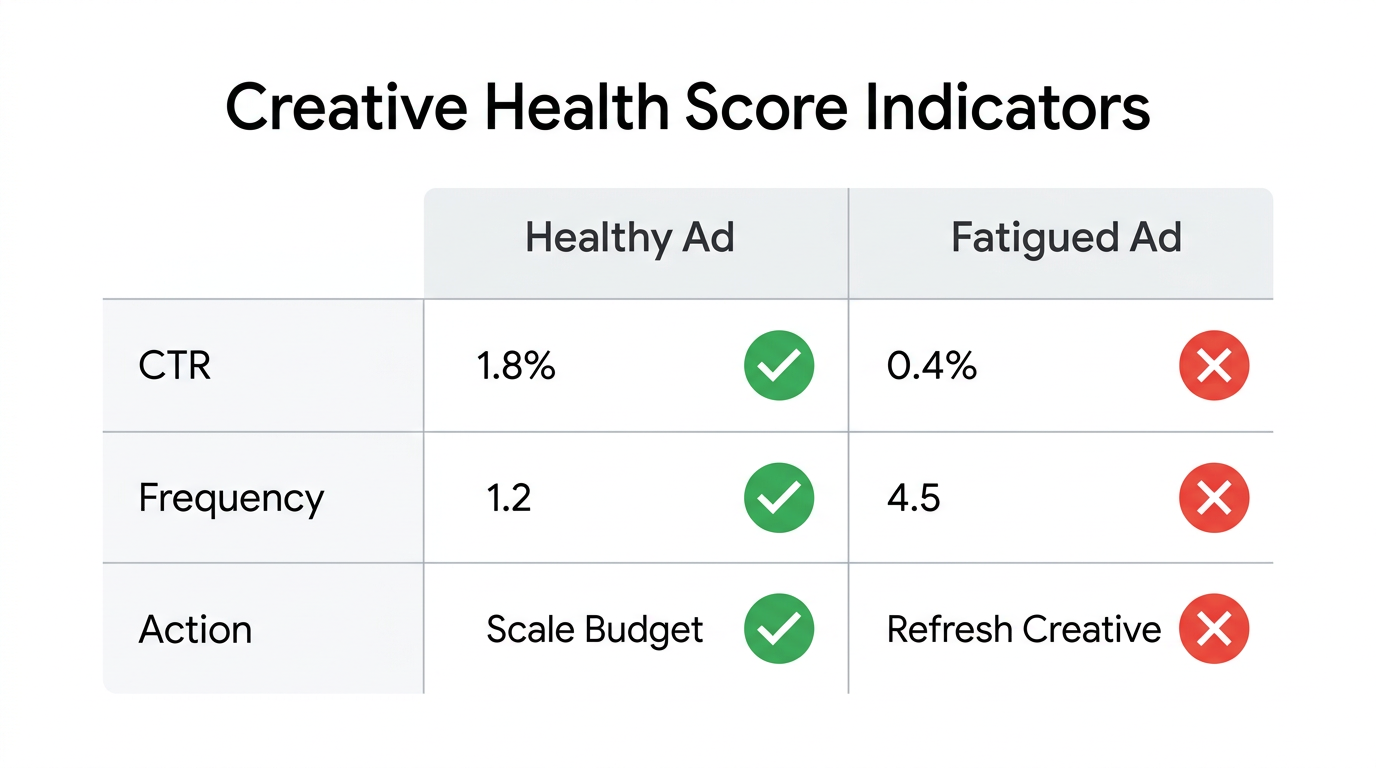
One of the biggest mistakes marketers make when starting with AI agents is giving them "Write" access on day one. To build trust, the best practice is to deploy the Performance Auditor skill as a "Read-Only" agent first.
Step 1: Connect to your Ad Accounts
Using the Ad Context Protocol (AdCP), you can allow your OpenClaw agent to read data across 100+ different tools—including Meta Ads Manager and Google Ads—through a single, unified interface.
Step 2: Configure the Slack Integration
Instead of the agent making changes, set it up to send a weekly or daily "Health Score" to a dedicated Slack channel. This report should highlight:
- Structural Issues: Broken conversion pixels or tracking gaps.
- Low Quality Scores: Assets that are dragging down your account health.
- Budget Pacing: Warnings if you are likely to exhaust your monthly budget prematurely.
Step 3: The 'Human-in-the-Loop' Protocol
Use SOUL.md files to implement a protocol where the agent drafts a suggested change (e.g., "Pause Ad A and Scale Ad B") and sends a "Draft Approval" message to Slack. This maintains control while leveraging the speed of AI creative auditing.
Automating the 'Overlap Tax' Removal with Audience Architect
Targeting isn't just about who you reach; it's about who you don't reach. 26% of ad budgets are currently wasted on ineffective targeting and slow manual optimizations, often due to "Audience Overlap." This happens when your campaigns compete against each other for the same users, driving up your own costs on platforms like Shopify stores and direct-to-consumer funnels.
The Audience Architect skill in OpenClaw solves this by automatically detecting overlap. It can:
- Detect when two ad sets are bidding for the same segment.
- Suggest new "Custom Intent" segments by analyzing real-time search volume trends.
- Automatically exclude recent purchasers across both Google and Meta simultaneously to prevent the dreaded "overlap tax."
By pairing these targeting optimizations with ad fatigue automation, you ensure that every dollar of your budget is working toward new conversions rather than redundant impressions.
"The move toward 'Self-Healing' accounts means agents automatically fix conversion tracking gaps before the human team even knows there's a leak."The OpenClaw Playbook: Step-by-Step Setup
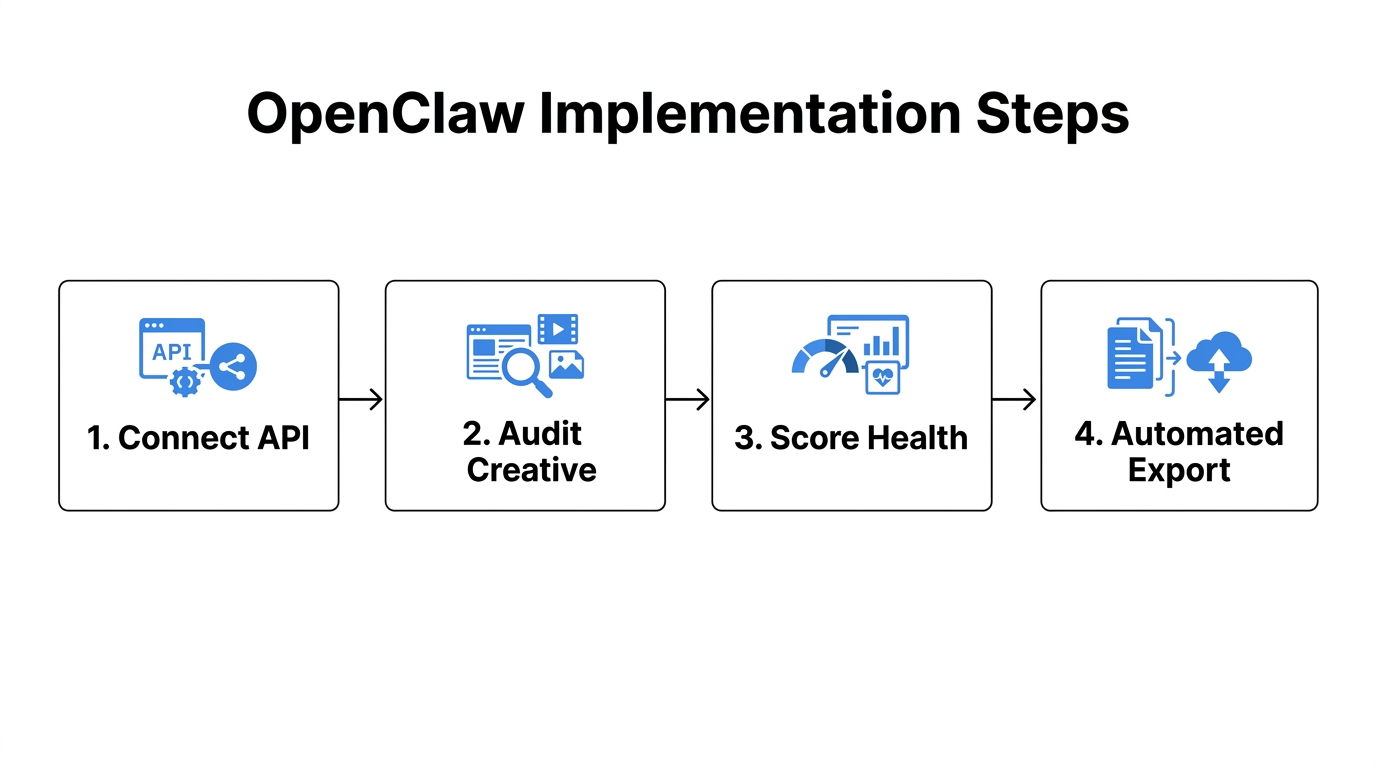
Ready to deploy your first "Lobster"? Follow this clear playbook to set up your automated creative auditing system.
- Provision a VPS: OpenClaw is "Local-First." Deploy it on a server using DigitalOcean or Hetzner so it can run 24/7 without your laptop being open.
- Secure Your Keys: Use
openclaw secretsto store your API keys for Meta, Google, and TikTok. Never hard-code API keys directly into your script files. - Install the Performance Auditor: Load the auditor skill from ClawHub. Run it in read-only mode for the first 14 days to establish a performance baseline.
- Connect to Slack/Telegram: Set up real-time alerts for creative fatigue signals and CTR decay.
- Source Fresh Assets: Use a platform like Stormy AI to discover and outreach to UGC creators, building a library of assets that the agent can pull from when fatigue is detected.
Conclusion: The Future of Creative Performance
By 2034, the market for AI in marketing is projected to reach $217.33 billion. We are no longer in the era of manual bid adjustments and weekly reporting calls. To stay competitive in 2026, you must transition to a system where creative fatigue is detected and solved autonomously.
Using the OpenClaw Creative Analyst combined with the high-quality creator sourcing capabilities of Stormy AI allows brands to scale without the burnout. Start by deploying a read-only auditor today, protect your data with a self-hosted VPS, and stop the 70% production waste that is currently eating your margins. The "Lobsters" are ready to work—are you ready to let them?