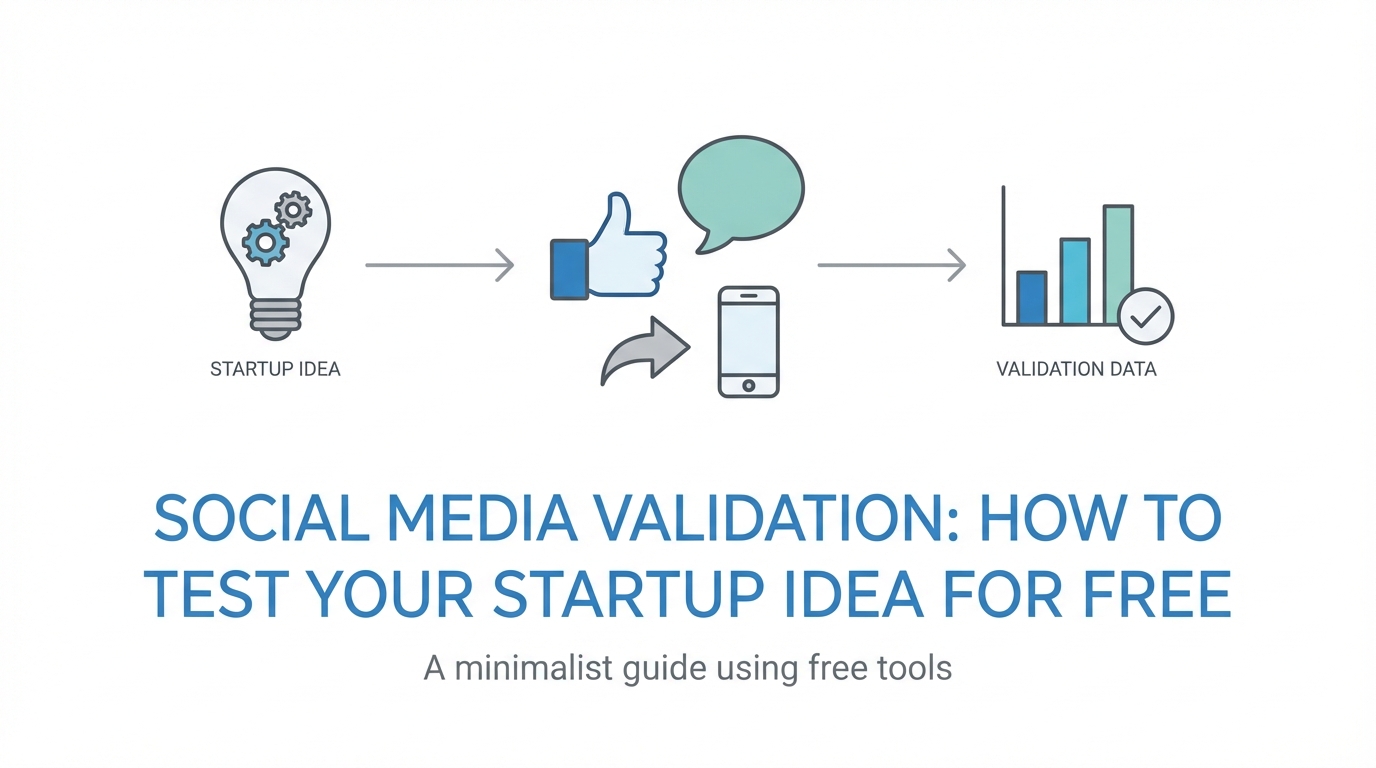
Most startup founders are taught that success begins with a revolutionary idea. In reality, a great idea is a liability until it is validated. Traditional market research often involves expensive focus groups or months of building in a vacuum, only to launch to the sound of crickets. According to data from Failory, nearly 90% of startups fail, often due to a lack of market need. But what if you could bypass the guesswork using the digital breadcrumbs your audience is already leaving behind? Social media is no longer just a megaphone for broadcasting; it is the ultimate laboratory for startup validation techniques. By leveraging existing platforms, you can transform a fuzzy concept into a seven-figure business model in as little as 40 days with minimal capital.
Defining Success: KPIs Over Vanity Metrics

When founders look at Twitter or Instagram, they often fall into the trap of chasing view counts. In the world of social media analytics for business, views are considered vanity metrics. A million people can see your post, but if nobody takes action, your product-market fit is non-existent. To truly understand how to validate a business idea, you must focus on engagement ratios—specifically the depth of the interaction.
A high-signal KPI for validation is the Retweet-to-Like ratio. While a 'Like' is a passive acknowledgement, a 'Retweet' or 'Share' is a public endorsement of value. According to the Rival IQ Social Media Benchmark Report, engagement rates vary wildly by industry, but if a post achieves a 20% retweet-to-like ratio, it indicates you have struck a nerve. This ratio suggests that your audience doesn't just agree with you; they feel the information is so vital they must share it with their own network. This level of advocacy is the first quantitative green light for any new venture.
The Viral Litmus Test: Analyzing High-Signal Content

Validation begins by observing where the market is already leaning. For example, during the rise of generative AI, founders noticed an influx of viral threads on X. However, much of this content was superficial. The gap between 'generic trash' and 'actionable insight' is where a multi-million dollar opportunity lives. To perform your own litmus test, don't start with a poll. Start with a statement of value.
When the founder of YouProbablyNeedaRobot.com first conceptualized his community, he didn't ask for permission. He tweeted his thesis on AI and productivity. The resulting explosion of notifications served as a product market fit guide in real-time. If your audience responds with intense curiosity to a simple text post, you have successfully validated the demand before spending a single dollar on development. This approach allows you to iterate on the fly, pivoting your messaging based on which specific 'hooks' generate the most aggressive engagement.
The Qualitative Data Goldmine: Beyond the Multiple Choice
Once you have quantitative proof of interest, you need to understand the 'why.' Many entrepreneurs use basic polls, but these limit the respondent to your preconceived notions. To find your Minimum Viable Product (MVP), a concept popularized by The Lean Startup methodology, you must use open-ended questions. Platforms like Typeform are essential here. By asking a simple question like "What is most interesting to you about [Topic]?", you allow the market to write your product roadmap for you.
Conventional wisdom says people skip open-ended questions. However, if your validation phase was successful, your audience will be eager to share their pain points. In the case of the AI community startup, the open-ended responses revealed a recurring theme: companies needed help implementing AI into their specific workflows. This insight shifted the business from a simple community to a productized agency model. Analyzing this qualitative data requires categorizing responses into 'pain buckets'—find the most frequent bucket, and you have found your first revenue stream.
Transitioning from Social Followers to Owned Media

Social media is 'rented' space. To build a sustainable business, the most critical step in startup validation techniques is transitioning followers into an email list. An email address is a higher-friction 'buy-in' than a follow. It represents a direct line of communication and a willingness to engage further with your brand. During the validation phase, your social media posts should always lead to a capture mechanism via providers like beehiiv or Substack.
Tools like Stormy AI can be incredibly helpful at this stage for sourcing the right UGC creators and influencers to drive this traffic. Once you have a validated concept, you can use AI-powered search to find creators who align with your niche and have them direct their audiences to your lead magnet. This scales the validation process from a single viral tweet to a predictable flow of potential customers. Managing these relationships through a specialized creator CRM ensures that your outreach remains personalized as your community grows from dozens to thousands.

Manufacturing Scarcity: The 'Free for Now' Strategy
Scarcity is a psychological trigger that forces a decision. In the early stages of a startup, your greatest enemy is indifference. By using the phrase "Free for now, but not forever," you create a sense of urgency. This tactic leverages the psychological principle of loss aversion—people are more motivated to avoid losing access to a future premium tool than they are to gain a new one today.
This approach 10x's sign-up rates because it rewards early adopters and validates their 'insider' status. It also gives you a natural path to monetization. You aren't 'surprising' users with a bill later; you are fulfilling a promise made during the validation phase. This transparent scarcity helps build a community of 60,000+ members, as seen with YouProbablyNeedaRobot.com, by creating a 'gold rush' mentality around your expertise.
Non-Obvious Marketing: The $90 Growth Hack
Standard marketing advice suggests running Facebook or Google Ads. However, for a bootstrapping founder, these channels are often too expensive and saturated. Effective market research on social media includes identifying 'non-obvious' promotional opportunities. This might mean finding a viral experiment, such as the HustleGPT challenge by Jackson Greathouse Fall, and identifying where the attention is already concentrated.
By purchasing a $65 ad slot in a trending thread, one founder achieved 1.3 million impressions for a total marketing spend of only $90. This level of ROI is only possible when you pay attention to the cultural zeitgeist of social platforms. Instead of competing for keywords on Google Ads, look for creators who are running experiments or building in public. Platforms like Stormy AI allow you to vet these creators for audience quality and engagement fraud before committing your budget, ensuring your small investment reaches real people.

Iterative Building: From Curiosity to Seven Figures

The final step in this product market fit guide is the transition from community to product. Validation is not a one-time event; it is a 40-day cycle of listening, building, and refining. Once your qualitative data points to a specific problem—like businesses needing AI implementation—you build a 'productized' version of that solution. This means creating a repeatable service or software that addresses the core pain point identified in your surveys.
As you scale, tracking the performance of these efforts is vital. Using platforms to monitor mentions and engagement across TikTok and YouTube allows you to see which features are resonating. The goal is to move from a simple curiosity to a profitable business by continuously feeding user feedback back into the development loop. By the time you hit year one, what started as a $90 experiment can easily become a seven-figure agency if you remain disciplined about following the data over your own intuition.
The Path Forward
Validating a startup idea doesn't require a massive capital injection or a complex business plan. It requires the humility to ask your audience what they need and the technical discipline to measure their response. By focusing on engagement ratios, capturing email leads, and leveraging non-obvious marketing opportunities, you can de-risk your entrepreneurial journey. Remember: find audiences who share questions, create communities to answer them, and build products to help them at scale. The roadmap is already there in the data—you just need to pay attention.