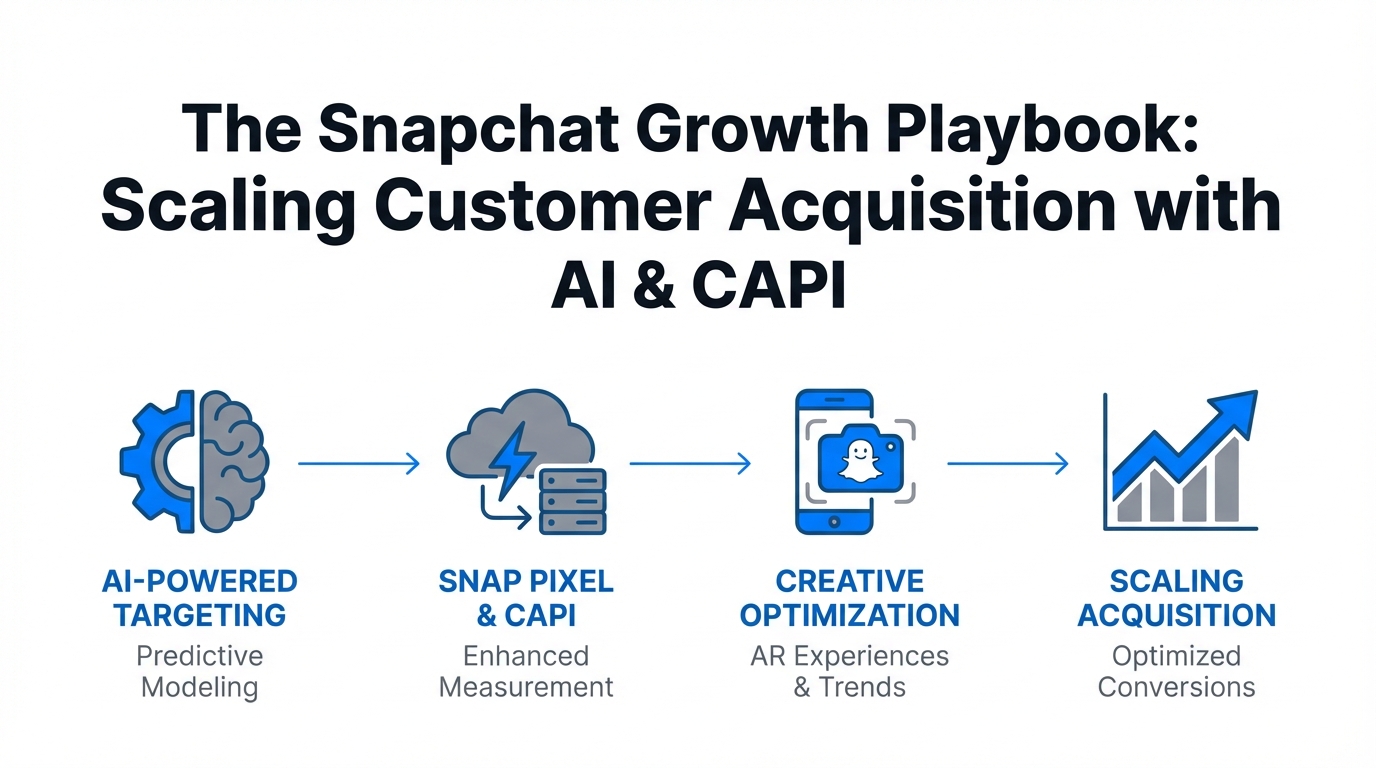
In the rapidly evolving landscape of digital advertising, the old playbooks are being rewritten by a new generation of users and a sophisticated layer of technical infrastructure. For years, performance marketers viewed Snapchat as the "experimental" channel—a place to spend leftover budget once Meta and Google were saturated. However, as we move through 2025, that narrative has shifted entirely. With nearly 1 billion Monthly Active Users (MAU) and a dominant foothold in the attention spans of Gen Z and Gen Alpha, Snapchat has become a primary engine for high-velocity customer acquisition.
But scaling on this platform isn't about simply reposting Instagram Reels. It requires a sophisticated approach to Snapchat customer acquisition that blends high-fidelity data tracking through the Snapchat Conversions API with AI-driven creative automation. This playbook explores how modern brands are moving beyond the manual dashboard to build automated, server-side growth engines that lower Cost Per Lead (CPL) and maximize lifetime value.
The 2025 Demographic Shift: Why Snapchat is No Longer Optional
If your brand is targeting anyone under the age of 35, the math is simple: you cannot ignore a platform that captures over 75% of Gen Z and Millennials in major markets like the UK and the US. Growth is particularly explosive in emerging markets, with India now boasting over 250 million users. But it's not just the sheer volume of users—it's the intent behind the scroll. Snapchatters are historically more engaged with their inner circle, making them 34% more likely to purchase a promoted product compared to other platforms, provided the content feels like a natural extension of their daily conversations.
To capture this audience, brands are moving away from polished, high-production commercials toward "native-first" creative. This means content that looks like it was filmed by a friend on an iPhone—raw, fast-paced, and authentic. Snapchat ROAS optimization in 2025 is less about the size of your production budget and more about the speed of your creative testing cycles.
The Technical Foundation: Snapchat Conversions API (CAPI)
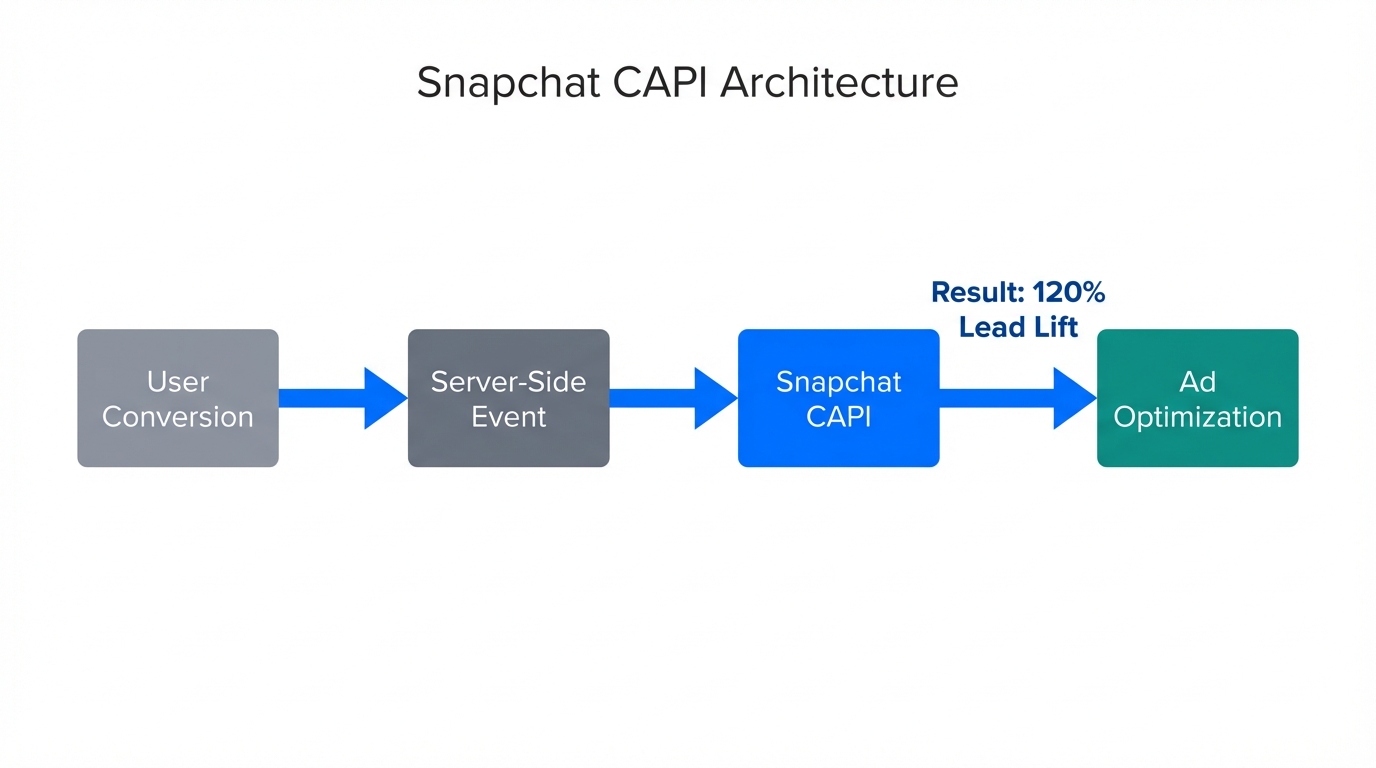
The single biggest mistake growth teams make is relying solely on the browser-based Snap Pixel. In an era of strict privacy controls and signal loss, client-side tracking is no longer sufficient for scaling Snapchat ads. To see a true 120% lift in qualified leads, as seen in recent real estate case studies like Rakez, you must implement the Snapchat Conversions API (CAPI).
CAPI allows your server to communicate directly with Snapchat’s servers, bypassing the limitations of web browsers. This ensures that every purchase, sign-up, or app install is accurately attributed to your campaigns. When your data is clean, Snapchat’s machine learning can optimize more effectively, leading to lower acquisition costs and better performance for Dynamic Product Ads (DPAs).
"The Conversions API is the bridge between fragmented browser data and a high-performance growth engine. Without it, you're bidding blind in a highly competitive auction."
| Feature | Snap Pixel (Browser) | Snapchat CAPI (Server-Side) |
|---|---|---|
| Data Accuracy | Subject to ad blockers/cookie loss | High accuracy; immune to browser limits |
| Conversion Lift | Baseline performance | Up to 120% lift in qualified leads |
| Attribution Window | Often shortened by OS updates | Persistent and reliable |
| Optimization Speed | Slower due to missing signals | Rapid; feeds Smart Bidding daily |
Scaling with the Snap Pixel and Lookalike Audiences
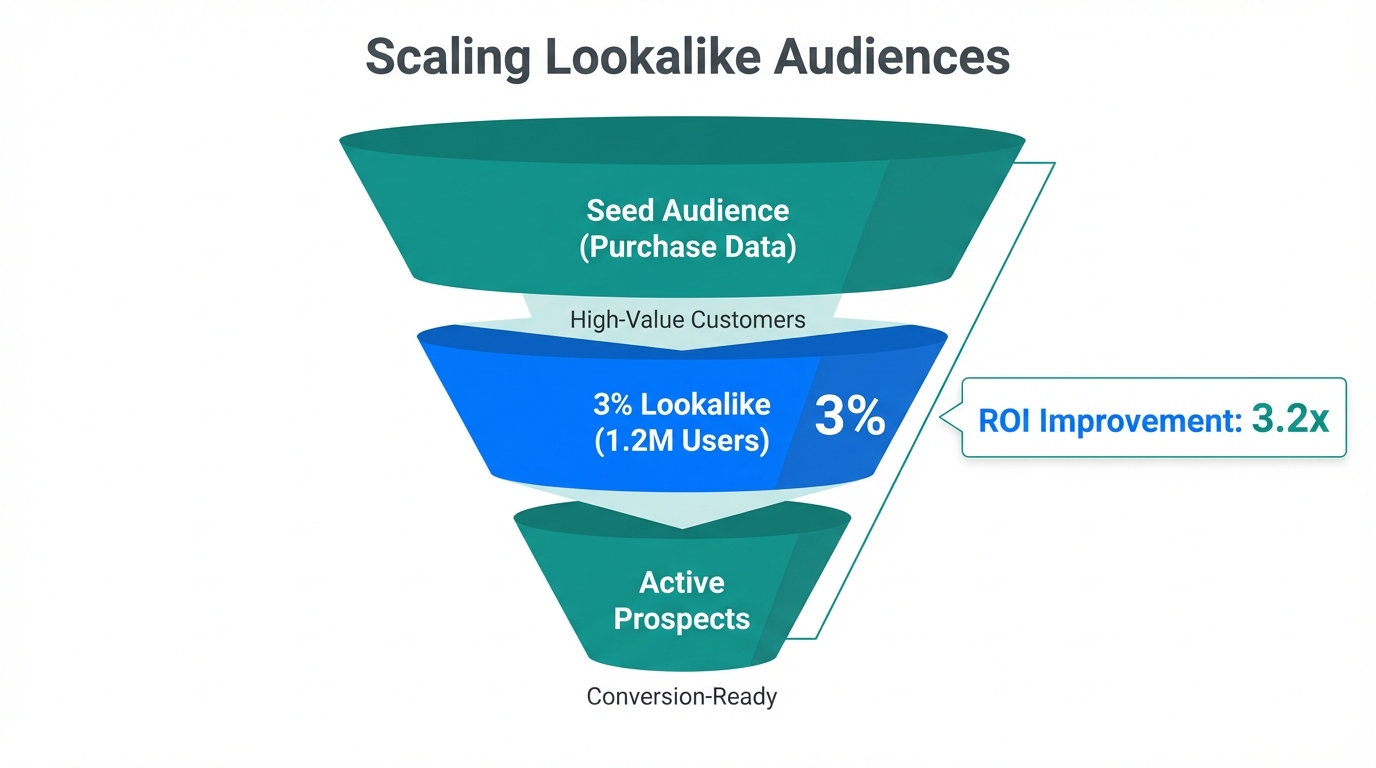
Once your CAPI is live, the next step in a robust Snapchat e-commerce strategy is leveraging your data to build Lookalike Audiences. The Snap Pixel acts as the "brain" of your campaign, identifying the specific behaviors of your most profitable customers. By feeding this data back into the system, you can create "seed" audiences of high-LTV users.
Successful brands like GOAT have utilized this data-driven approach to drive over 75,000 app installs in just three months. By focusing on goal-based bidding—where the algorithm optimizes for the highest lifetime value rather than the lowest initial click cost—they achieved an LTV 20% higher than their initial targets. This is the difference between "buying traffic" and "acquiring customers."
To scale effectively, consider these three Lookalike tiers:
- Similarity (1-2%): Targets users who most closely match your existing customers. Best for immediate ROAS.
- Balance (5%): A mix of reach and precision. Best for steady scaling.
- Reach (10%): Broad targeting to find new pockets of potential customers. Best for brand awareness and top-of-funnel growth.
The AI-Powered Growth Loop: Automating with Claude Code
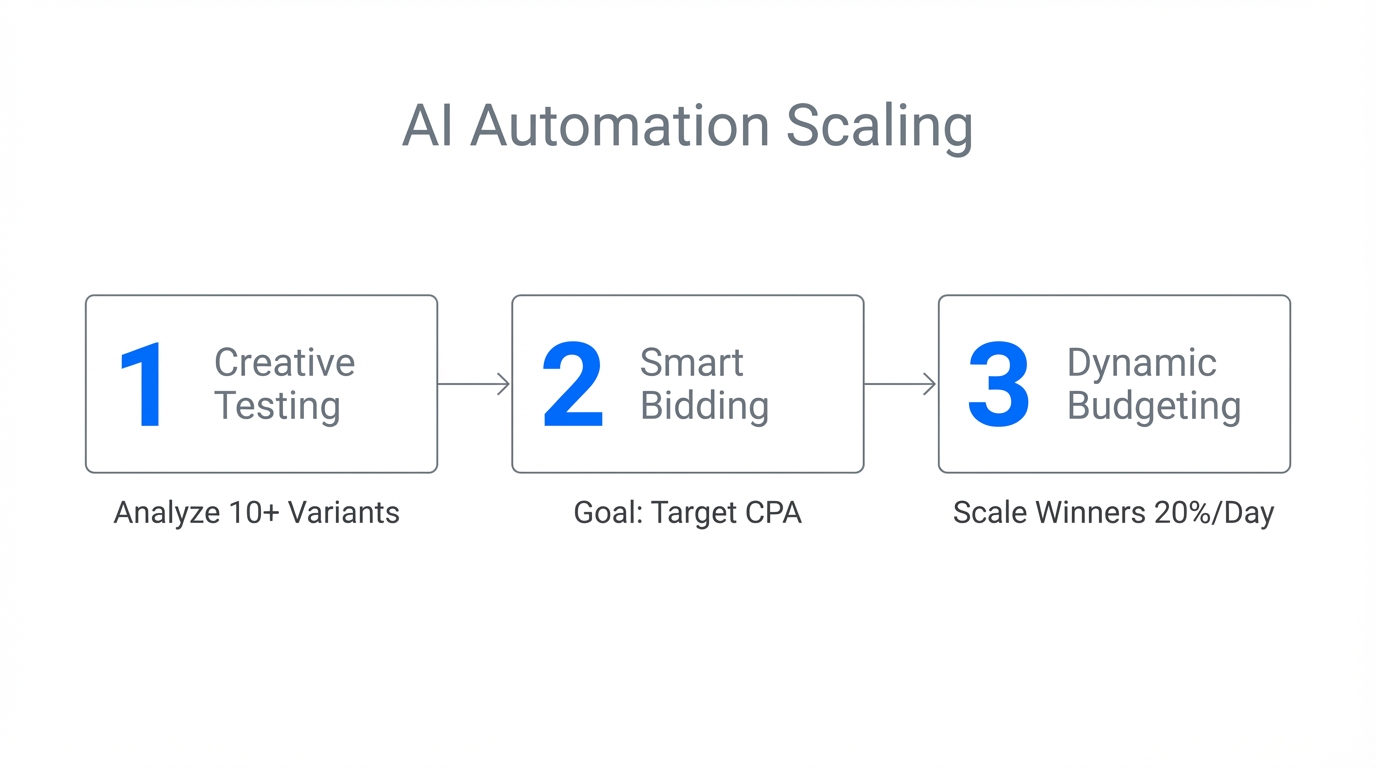
The future of Snapchat ROAS optimization lies in "Action AI." Instead of manually adjusting bids in the Ads Manager every morning, top-tier growth agencies are using agentic workflows. Tools like Claude Code allow marketers to interact directly with the Snapchat Ads API through a terminal environment.
By using the Model Context Protocol (MCP) and servers like Insightful Pipe, you can grant an AI agent permanent access to your campaign performance. This allows for real-time optimization loops that no human could manage. For instance, you can command an AI to monitor your CPC every hour and automatically pause ad sets that exceed a certain threshold, protecting your budget while you sleep. This shift from manual management to API-driven automation can reduce campaign setup time from eight hours to just two, according to Digital Applied.
To fuel these automated campaigns with high-quality content, platforms like Stormy AI can help source and manage UGC creators at scale, ensuring your "native-first" creative library is never empty. Pairing AI sourcing with AI-driven ad management creates a closed-loop system where the best creators are identified, their content is uploaded via API, and the performance is optimized in real-time.
Creative Immersion: AR Extensions and Lens Studio
Snapchat is the undisputed leader in Augmented Reality (AR). For CPG and retail brands, AR is no longer a gimmick—it is a conversion tool. By using Snapchat Lens Studio, brands can create immersive experiences that allow users to "try on" makeup, visualize furniture in their homes, or interact with a brand in a playful way.
Take the example of Domino's, which used a humor-first AR filter strategy to reach 800,000 unique users. This didn't just build brand awareness; it significantly boosted purchase intent by making the brand a part of the user's creative expression. With the introduction of Smart Bidding for AR Extensions in mid-2025, brands can now optimize their AR spend specifically for down-funnel conversions rather than just "plays" or "shares."
"AR isn't just a filter; it's a storefront. In 2025, the brands that win on Snapchat are the ones that let users experience the product before they even click 'Buy'."
Common Mistakes in Snapchat Customer Acquisition
Even with the best AI and CAPI setup, your strategy will fail if you ignore the fundamentals of the platform. Snapchat is a unique ecosystem with its own set of unwritten rules.
- Recycling Content from Other Platforms: Posting a TikTok with the watermark still visible is a fast-track to low engagement. Snapchat users expect camera-native content that feels exclusive to the app.
- Missing the 2-Second Hook: On Snapchat, users scroll at lightning speed. If your brand or value proposition isn't front-and-center within the first two seconds, you've lost the impression.
- The "Desktop Mindset": According to Neil Patel, one of the biggest reasons for high bounce rates is sending mobile users to a landing page that isn't optimized for speed. If your page takes more than 3 seconds to load, your ROAS will plummet.
- Broad Targeting Without a Pixel: Running ads without the Snap Pixel or CAPI is effectively burning money. You need that data feedback loop to refine your audience over time.
The Growth Playbook: A Step-by-Step Implementation
Scaling on Snapchat requires a balanced attack of technical precision and creative authenticity. If you are ready to take your Snapchat customer acquisition to the next level, follow this sequence:
Step 1: Audit Your Infrastructure
Ensure your Snap Pixel is firing correctly on all key conversion events. Immediately begin the integration of the Snapchat Conversions API to fortify your data against signal loss.
Step 2: Source Native Creators
Ditch the studio-grade commercials. Use tools like Stormy AI to discover creators who understand the Snapchat aesthetic. Focus on 6-second vertical videos with strong hooks and clear calls to action.
Step 3: Implement AI Automation
Move your workflow into the terminal. Use AI agents to monitor performance metrics like CTR and ROAS, and set up automated rules for bidding and budget management. This allows you to scale 24/7 without manual intervention.
Step 4: Expand with AR and DPAs
Once your core campaigns are profitable, layer on AR Lenses for brand immersion and Dynamic Product Ads for retargeting. Use measurement tools like Fospha to plan for peak seasons and ensure your attribution is accurate across the entire customer journey.
Snapchat has evolved into a powerhouse for performance marketing. By embracing the Snapchat Conversions API, leveraging AI for automation, and staying true to the platform's native creative style, you can unlock a massive, highly engaged audience that is ready to convert.