The Snapchat Renaissance: Why Programmatic Matters Now
Snapchat has evolved into a powerhouse for performance marketing, recently hitting a staggering 474 million Daily Active Users (DAU) and approaching nearly 1 billion Monthly Active Users, according to MediaPost. This growth is particularly explosive in emerging markets like India, where the platform has surpassed 250 million users. For brands targeting younger demographics, the opportunity is unparalleled: over 75% of Gen Z and Millennials are active on the platform, and in the UK, it holds the highest market penetration for both Gen Z and Gen Alpha, as reported by Rock Kitchen Harris.
"Snapchatters are 34% more likely to buy a promoted product after seeing an ad on the platform compared to other social networks, provided the creative feels native to the ecosystem."
Despite this massive reach, many advertisers fail because they treat Snapchat like a secondary version of Instagram. To succeed at scale, you need high-volume, native-first creative and real-time optimization. This is where Snapchat ads management through agentic workflows becomes a competitive necessity. You cannot manually manage 500+ ad variations and expect to maintain a positive ROAS; you need automated media buying systems that can sense performance shifts and react in milliseconds.
Step 1: Building Infrastructure with Model Context Protocol (MCP)
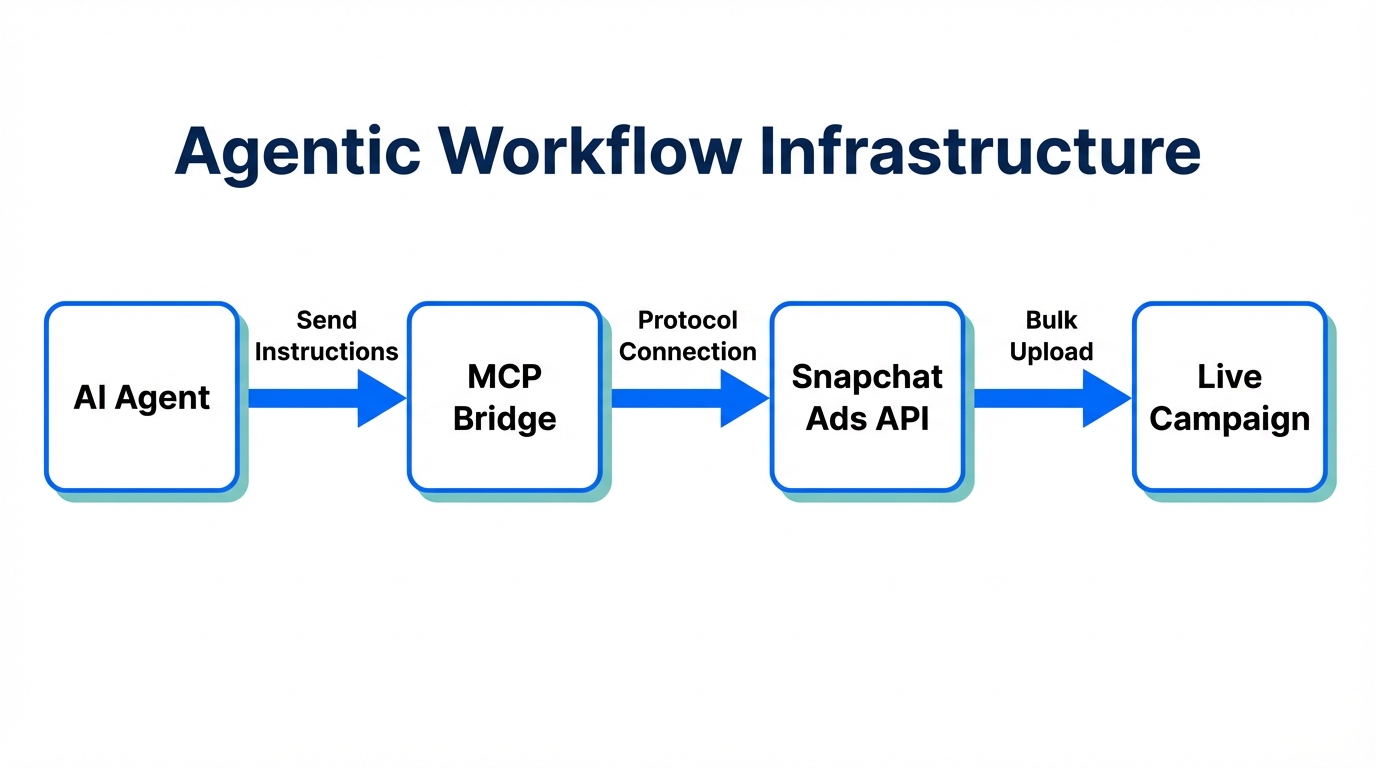
The foundation of an agentic workflow is connectivity. Traditionally, AI models like Claude or GPT-4 lived in a vacuum, unaware of your live campaign data. The Model Context Protocol (MCP) changes this by creating a secure bridge between your AI agent and the Snapchat Ads API. By installing an MCP Server, such as those offered by Insightful Pipe, you allow your AI to pull real-time metrics like CTR, Swipe-up rates, and ROAS directly into its environment.
This setup eliminates the "Context Death Spiral," where marketers spend hours exporting CSVs and re-pasting them into AI prompts. Instead, your agent has permanent, read-write access to your campaign history. You can now issue complex commands in your terminal like: "Analyze the last 7 days of performance and identify which creative hooks are decaying in the 18-24 female segment."
Step 2: Multivariate Creative Generation and Testing
On Snapchat, creative fatigue happens faster than on almost any other platform. Users scroll with incredible speed, meaning your first 2 seconds are make-or-break. To combat this, elite teams use AI marketing agents to script and organize multivariate testing plans. Instead of producing one "perfect" ad, the goal is to produce 20 "native" variations.
Using a tool like Claude Code, you can point the AI at a folder of your raw assets—perhaps UGC sourced from creators—and have it generate endemic scripts. If you are scaling a mobile app, you might use Stormy AI to source creators who specialize in the fast-paced, selfie-mode style that thrives on Snap, then use your agentic workflow to automate the briefing and script generation process. The agent can analyze your top-performing TikTok or Instagram Reels and "translate" them for Snapchat, stripping away watermarks and adjusting the pacing for a 6-second vertical format.
Step 3: Reducing Setup Time from 8 Hours to 2 Hours
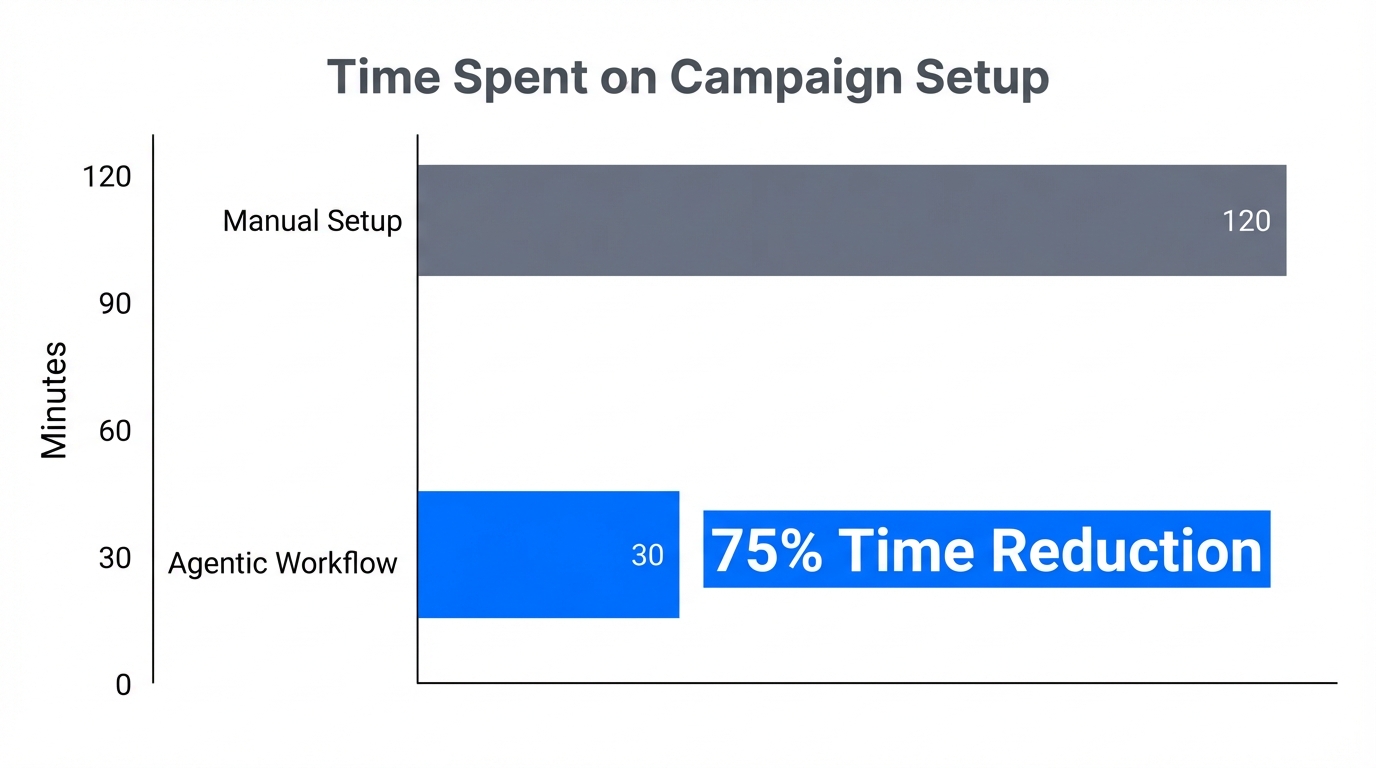
The most tedious part of Snapchat ads management is the manual upload process: creating ad sets, setting targets, and uploading media files one by one. By moving to an API-driven programmatic approach, brands are seeing a 75% reduction in campaign setup time. Research from Digital Applied suggests that what used to take a full workday for a media buyer can now be condensed into just 2 hours of oversight.
| Workflow Component | Manual Dashboard Management | Agentic/API Workflow |
|---|---|---|
| Campaign Creation | 45-60 mins (Manual input) | 5 mins (Scripted) |
| Creative Variation Upload | 2-3 hours (One by one) | 15 mins (Batch API upload) |
| A/B Testing Setup | 1 hour (Manual tagging) | Instantly (Programmatic) |
| Reporting & Data Sync | Daily export (CSV) | Real-time (MCP/API) |
This efficiency allows your team to focus on high-level strategy and creative direction rather than administrative data entry. For e-commerce brands running Dynamic Product Ads (DPAs) on Shopify, this level of Snapchat ads API automation is critical for keeping catalogs synced and ensuring that out-of-stock items aren't burning your ad spend.
Step 4: Implementing the 'Ralph Wiggum' Optimization Loop
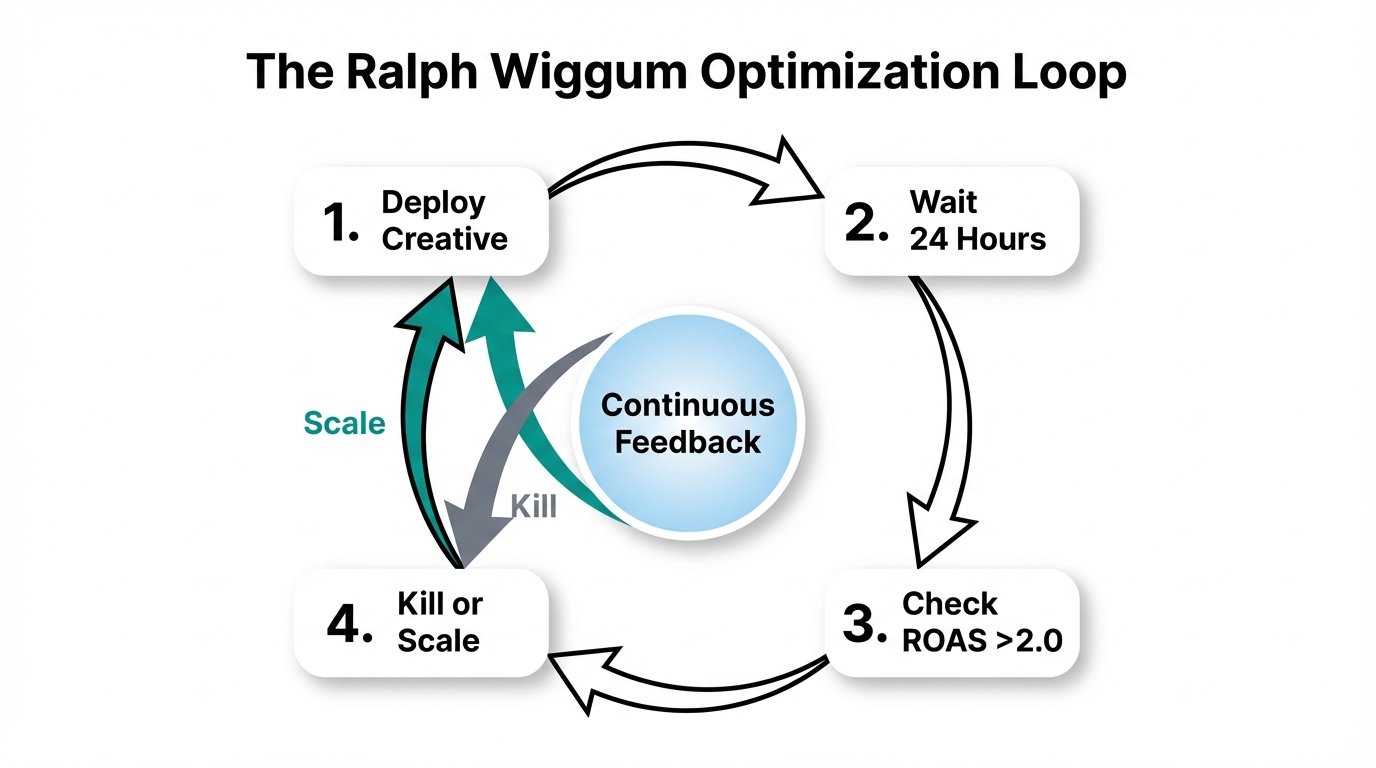
The core of Snapchat campaign optimization in 2025 is the "While Loop" methodology, colloquially known as the Ralph Wiggum loop. This is an autonomous monitoring script that acts as a 24/7 budget protector. The logic is simple but powerful: while the campaign is running, the AI agent constantly checks specific performance thresholds.
For example, you can program an agent with a command like: claude --plan "Check Snapchat CPC every hour; if CPC > $5.00, pause the ad set and notify the team via Slack." This prevents the dreaded "weekend spend spike" where a campaign goes off the rails while the media buyer is offline. This level of automated media buying ensures that your budget is always flowing toward the highest-performing assets by integrating with tools like Slack for instant alerts.
"The future of media buying isn't about better buttons in a dashboard; it's about building agents that never sleep and never miss a CPC spike."
Step 5: Leveraging 2025 Smart Bidding and Budget Tools
In mid-2025, Snap introduced significant upgrades to its native AI capabilities, including Smart Bidding and Smart Budget. According to Birch Performance, these tools use machine learning to predict which users are most likely to convert based on real-time signals. When paired with an external agentic workflow, you get a "hybrid" optimization strategy: Snap's native AI handles the intra-day bidding, while your agent handles the cross-campaign budget allocation and creative rotation.
Furthermore, the introduction of generative AI tools for AR Extensions allows brands to create immersive lenses without high technical barriers. This is a game-changer for CPG brands like Domino's, which recently used AR filters to reach 800,000 unique users and significantly boost purchase intent. By using the Snapchat Lens Studio in conjunction with programmatic scripts, you can deploy these interactive experiences at scale.
Common Pitfalls in Snapchat Ad Automation
Even with the best AI marketing agents, several common mistakes can tank your performance. First and foremost is the "Recycling Content" error. Many marketers try to save time by reposting TikToks or Reels that still have the original app's watermark. Snapchat's algorithm—and its users—prefer camera-native content. If you are sourcing UGC via Stormy AI, ensure you are getting clean, raw files that can be edited specifically for the Snap environment.
Another critical failure is missing the 2-second hook. As noted by Neil Patel, if your value proposition or brand isn't clear within the first 2 seconds, the user has already swiped. Finally, never ignore the Snap Pixel. Without the pixel, you cannot run effective Lookalike Audiences or optimize for deep-funnel events like "Purchase" or "App Install."
The Path Forward: Scaling Without Friction
The transition from manual to programmatic media buying is no longer optional for brands that want to lead in the Gen Z market. By implementing Snapchat ads API automation, you remove the human friction from the campaign lifecycle—from discovery and creation to deployment and optimization. Start by setting up your MCP server, move your creative briefings into an agentic terminal like Claude Code, and implement basic budget protection loops.
The goal is to reach a state of autonomous growth, where your AI systems handle the repetitive tasks of Snapchat ads management while you focus on the creative vision and the next big market opportunity. In 2025, the winner isn't the one with the biggest team; it's the one with the smartest agents.