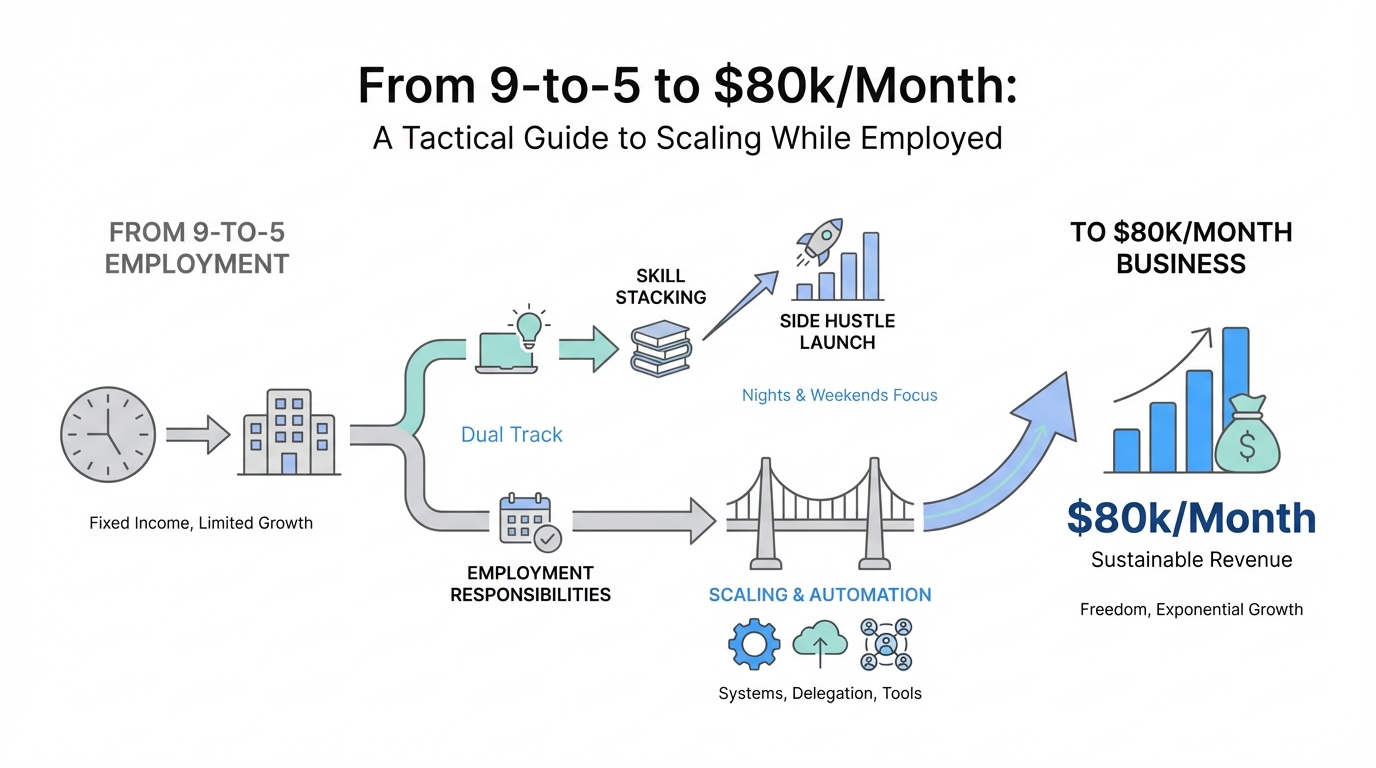
The dream of quitting a corporate job to build a million-dollar empire is often painted as a reckless leap of faith. We are told to burn the boats, quit the day job, and survive on ramen until the vision comes to life. But for many modern entrepreneurs, the smartest path isn't a leap—it is a gradual bridge. Building a high-revenue business while maintaining the security of a full-time salary is not only possible; it is a tactical advantage that allows for aggressive experimentation without the fear of financial ruin. By mastering the art of how to start a side hustle while working full time, you can build a foundation so solid that by the time you actually resign, your 'side project' is already outperforming your career.
The $80,000 Safety Net: Why You Should Wait to Quit


Most founders quit their jobs as soon as their side income matches their salary. Brett, the founder of Designjoy, took a radically different approach. He didn't quit his job when he hit $5,000 a month, or even $20,000. He waited until his business was generating $80,000 per month. This extreme safety-net strategy, documented by Starter Story, highlights a crucial lesson in risk management: the best time to quit is when staying at your job actually costs you more in opportunity than it provides in security.
When you are growing a business while employed, the 9-to-5 salary acts as a subsidized R&D fund. You aren't pressured to take on 'bad' clients just to pay rent. This allows you to say no to projects that don't fit your niche and yes to high-margin, scalable opportunities. For those in the influencer marketing or UGC space, this means you can spend time using Stormy's AI search to find the perfect creator niche rather than rushing into a low-quality partnership out of desperation. The security of a paycheck allows for the patience required to find a winning business model.
Maximizing the '9-to-5' Window: Productivity in the Gaps
One of the biggest hurdles of freelance side hustle tips is time management. How do you find 40 hours a week for a business when you already work 40 hours for a boss? The secret lies in 'dead time.' Many corporate roles are filled with passive activities—Zoom calls where you are a spectator, long email threads, and administrative downtime. Brett famously admitted to completing his Designjoy design requests during his team's Zoom calls. While this requires a high level of focus, it illustrates the importance of utilizing every minute of your day.
To make this work, you must adopt an asynchronous workflow. If your business relies on constant meetings, it will fail while you are employed. By using tools like Trello or Airtable to manage tasks, you remove the need for real-time communication. This is where Stormy AI for influencer vetting and fake follower detection becomes a game-changer for those building marketing agencies; instead of spending hours manually vetting profiles, you can get a full quality report in seconds during a coffee break, keeping the momentum going without needing a dedicated 4-hour block of time.
The Product Hunt Launch Strategy: Zero-Budget Growth
Getting your first clients is often the most expensive part of a startup, but it doesn't have to be. A well-executed Product Hunt launch strategy can generate thousands of visitors and your first dozen paying customers for zero dollars. Brett built his initial Webflow site on a Saturday and launched it on Product Hunt the next day. The 'productized service' model—selling a service like a subscription—is highly attractive to Product Hunt's audience of tech-savvy early adopters.
How to Launch Your Service in 24 Hours
- Niche Down: Don't just be a 'marketer.' Be the person who creates 'UGC for TikTok Ads.' Find the one thing you are fastest at and bundle it.
- Build a Landing Page: Use a tool like Webflow to create a simple, one-page site that explains your pricing and the 'unlimited' nature of your subscription.
- Automate the Intake: Set up a Stripe subscription link and a Trello board. When someone pays, they get access to the board. No proposal, no contract, no friction.
If you are looking to scale this outreach beyond the initial launch, you can utilize Stormy's AI outreach to contact potential partners or creators who can help amplify your launch. The platform's ability to send hyper-personalized emails means you can run a sophisticated PR campaign for your side hustle while you are technically 'at the office.'
Overcoming the 'Shooting Star' Mentality
Many entrepreneurs suffer from what is known as imposter syndrome—or the 'shooting star' mentality—the fear that their current success is a fluke and will disappear as quickly as it arrived. This is a primary reason why people hesitate on when to quit your job for your business. Brett stayed at his job for three and a half years because he was 'insecure' about the longevity of his $1.3 million-a-year business. He viewed his success as something that could dissipate at any moment.
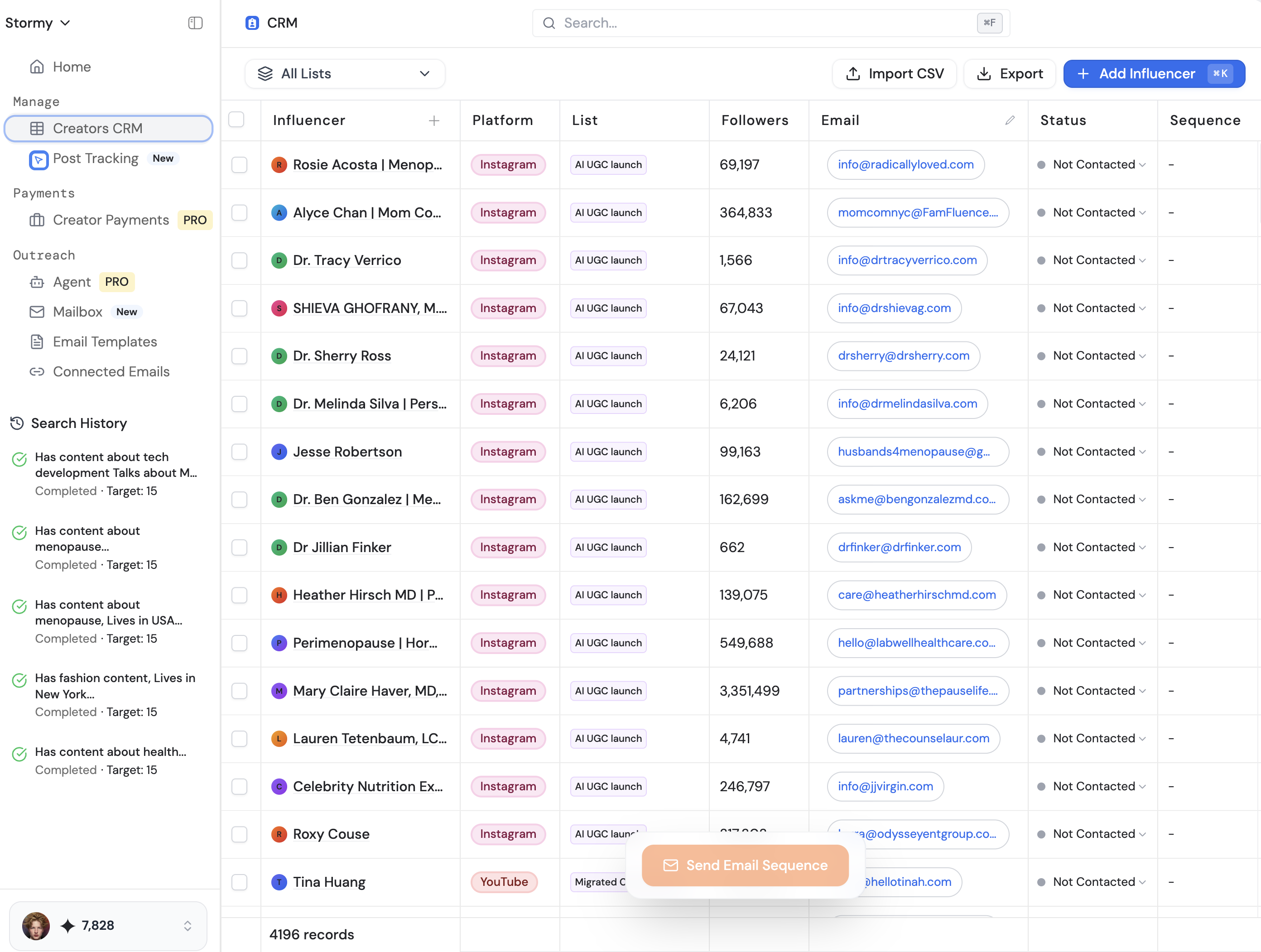
To overcome this, you need to move from 'freelancing' to 'systems.' When you have a repeatable system for getting leads and delivering work, the fear fades. If you're running an influencer-led brand, having a Creator CRM is essential for this transition. Using Stormy's creator CRM allows you to track every interaction and negotiation, turning a chaotic side hustle into a predictable business machine. Once you see the data—the open rates, the conversion rates, and the recurring revenue—the 'shooting star' begins to look a lot more like a permanent fixture.
The Double Revenue Effect: The Power of Full-Time Focus

There is a psychological phenomenon that occurs when you finally quit your job: the Double Revenue Effect. Brett noted that the very month he left his 9-to-5, his revenue doubled. Why? Because when you remove the 'safety net' of a job, your brain shifts from maintenance mode to growth mode. All the energy previously spent navigating corporate politics and attending pointless Zoom calls is suddenly redirected into your own venture.
Scaling to this level requires keeping a close eye on your performance metrics. You can't just 'hope' for growth; you have to track it. For those utilizing social media marketing, Stormy's post tracking and analytics provide the data needed to see exactly which campaigns are driving ROI. When you can see that a specific creator's post led to a 20% spike in subscriptions, you know exactly where to reinvest your newfound time and capital. Full-time focus allows you to iterate twice as fast, turning a successful side hustle into a market leader.
The Playbook: Scaling While Employed
If you are ready to start this journey, follow these steps to build your own high-revenue productized service without risking your primary income.
Step 1: Identify Your 'Fast' Skills
Don't sell what you're merely 'good' at; sell what you are fast at. If it takes you four hours to write an article but only 30 minutes to design a YouTube thumbnail, sell thumbnails. Speed is the only way to manage multiple clients while working a 9-to-5. Review the tools you already use, like Figma or Adobe Creative Cloud, and find your competitive edge.
Step 2: Build the Minimal Viable Stack
Keep your overhead low. Brett's entire business costs only $176 per month to run. Use free versions of tools whenever possible. Your stack should include a landing page, a payment processor, and a project management tool. Avoid complex legacy CRMs; instead, opt for AI-native tools that automate the heavy lifting. [Source: How to Build an MVP]
Step 3: Launch and Iterate
Don't spend months 'planning.' Spend six hours building and launch on a Sunday. Use the feedback from your first three clients to refine your pricing. If you find yourself spending too much time on outreach, set up an AI agent. You can configure Stormy's autonomous AI agent to discover and outreach to potential clients or collaborators daily while you sleep, ensuring your pipeline stays full even when your day job is demanding.
Conclusion: Building Your Own Bridge
Building a $1.3 million business while working a 9-to-5 isn't about working harder; it's about working smarter. By productizing your service, embracing asynchronous communication, and leveraging AI tools to handle discovery and outreach, you can bypass the traditional 'starving artist' phase of entrepreneurship. Whether you are aiming for $8,000 or $80,000 a month, the strategy remains the same: use your job to fund your freedom, and use AI to scale your time. When you finally decide to quit, it won't be a leap of faith—it will be the most logical move you've ever made. Ready to find the creators that will help scale your side hustle to the next level? Start using Stormy's AI search today and build your empire from the comfort of your current desk.