In the last 12 months, the founders utilizing the Noise platform have generated a staggering 2.5 billion views on TikTok. To many marketing teams, that number sounds like a statistical anomaly—a stroke of lightning-in-a-bottle luck. But for Nick Weber, the founder of Noise, this volume is the result of a deliberate shift from treating influencer marketing as an art form to treating it as a high-velocity distribution science. By moving away from the traditional 'boutique' model of hiring a handful of creators and moving toward a 'mass distribution' model involving 50,000+ creators, brands are finally solving the problem of unpredictable organic reach.
The Failure of the 10-Creator Model: Why Small-Scale Campaigns Are High-Risk
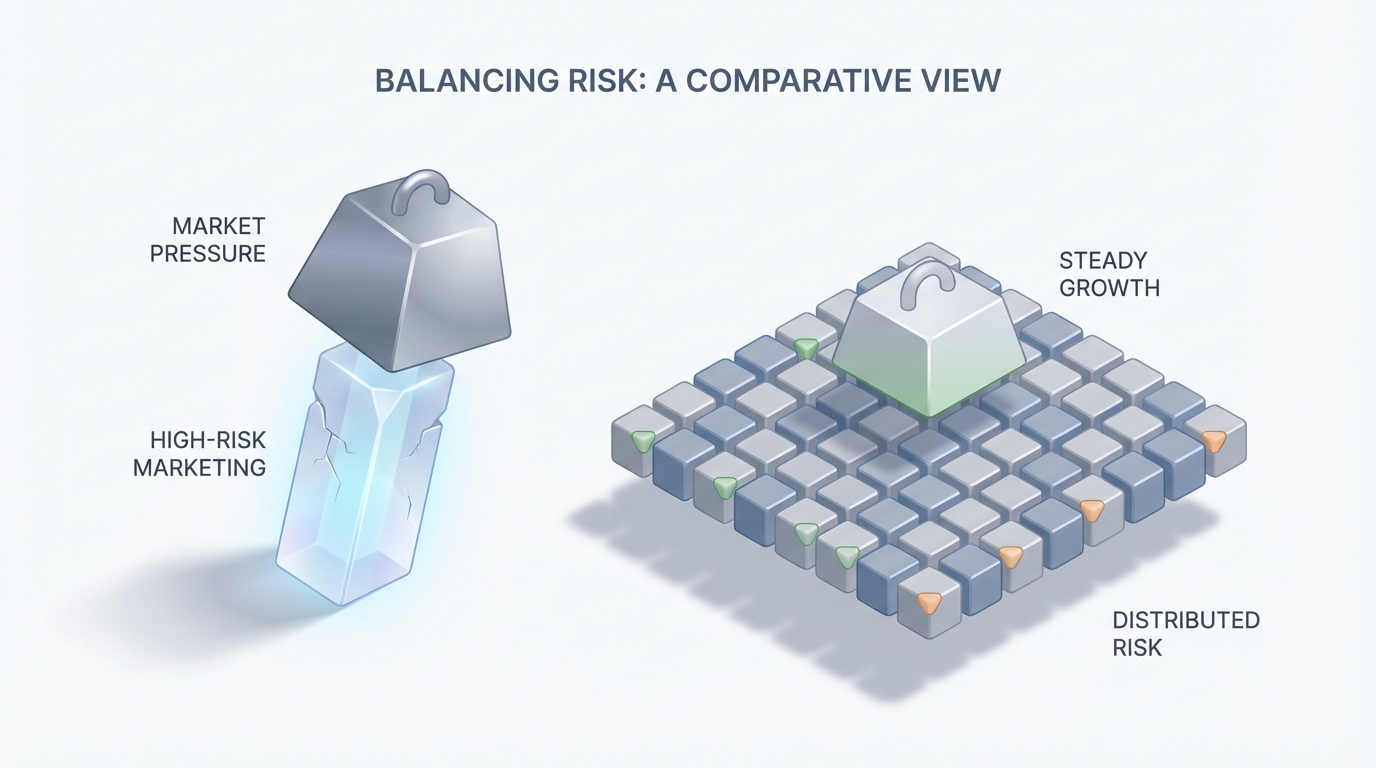
Most brands approach TikTok with a legacy mindset. They identify five to ten 'perfect' creators, pay them high retainers, and ask them to post twice a week. On paper, this looks like a controlled, high-quality campaign. In reality, it is a high-stakes gamble on the TikTok lottery. The platform’s algorithm is notoriously fickle; a video that takes ten hours to produce might get 1,000 views, while a raw, five-second clip hits 10 million.
When you only have ten creators, you only have ten 'tickets' in the lottery. If those specific videos don't catch the algorithmic wave, your entire monthly budget is effectively wasted. This 'boutique' approach fails to account for the variance inherent in short-form video. Reliance on a small pool of creators creates a single point of failure. If their style doesn't resonate that week, or if the hook is slightly off, the campaign's ROI vanishes. To succeed on modern social platforms, brands must stop trying to pick winners and start building a machine that ensures winning is a statistical certainty.
Implementing the 'Shots on Goal' Effect: Mitigating the TikTok Lottery

Nick Weber describes his solution as the 'Shots on Goal' effect. The philosophy is simple: if you have 100,000 pieces of content going out across 50,000 accounts, it becomes mathematically difficult not to hit a viral outlier. Instead of asking ten people to be creative, the Shots on Goal model asks 50,000 people to execute a proven distribution playbook.
"We call it the shots on goal effect where just by naturally having a 100,000 pieces of content out there a day at least, you're going to get something that hits. And if it doesn't hit, it's going to quickly tell you why through analytics," explains Weber.
This volume acts as a hedge against the algorithm. When you operate at this scale, you aren't just looking for one viral hit; you are building a 'massive ground game' of hundreds of thousands of posts that generate 500 to 2,000 views each. While 500 views might seem insignificant to a traditional influencer agency, when multiplied across 50,000 creators, it results in millions of high-intent impressions that convert into downloads at a fraction of the cost of traditional Meta ads.
The Eggs Theory and the Science of the Hook
One of the most profound discoveries in the Noise platform’s journey is what Weber calls the 'Eggs Theory.' While analyzing high-performing slideshows for a health-tech brand, the team noticed a bizarre pattern: the most viral images consistently featured eggs. Whether they were hard-boiled, scrambled, or aesthetically plated, eggs were the common denominator in millions of views.
This wasn't random luck. It was a lesson in visual relatability. Eggs are universally understood, affordable, and healthy. In a world of over-produced, AI-perfected content, the image of a simple egg triggers a subconscious 'this is for me' response in viewers interested in clean eating. This discovery highlights that virality has less to do with high production value and much more to do with identifying 'micro-hooks'—tiny, seemingly random details that bridge the gap between a viewer's life and a product.
The team applied similar psychological nuances to text hooks. They found that a video starting with the phrase "Don't get a second job" went viral, while the exact same video starting with "Everybody needs a side hustle" flopped. Why? Because the former provides a solution to a pain point without making assumptions about the viewer’s current status, while the latter feels like an unsolicited lecture. At scale, these minor tweaks in sentiment are the difference between a $0.08 install and a $5.00 install.
The Two-Pronged Playbook: Viral UGC vs. Retargeting Slideshows
Scaling to 50,000 creators requires a sophisticated content strategy. The Noise platform utilizes two distinct playbooks running simultaneously to drive both awareness and conversion:
1. High-Effort Viral UGC
This content is designed for mass awareness. These are 'premium' videos where creators use their faces, follow trending audio, and utilize 'soft' calls-to-action (CTAs). The goal here is to hit the 'millions of views' milestone. These videos often don't even mention the product by name until the final seconds, or they use 'implicit' marketing—showing the app in use without a hard sales pitch.
2. Mass Distribution Slideshows (The Retargeting Machine)
While the UGC drives awareness, thousands of simple slideshows act as a manual 'retargeting' campaign. These have 'hard' CTAs and are pushed out by the thousands. Weber has found that if a user sees a viral video about an app and then subsequently swipes past five different slideshows about that same app, the cumulative effect drives a download. The slideshows aren't meant to go viral on their own; they are meant to scoop up the demand generated by the viral outliers.
Automating 100,000 Unique Pieces of Content
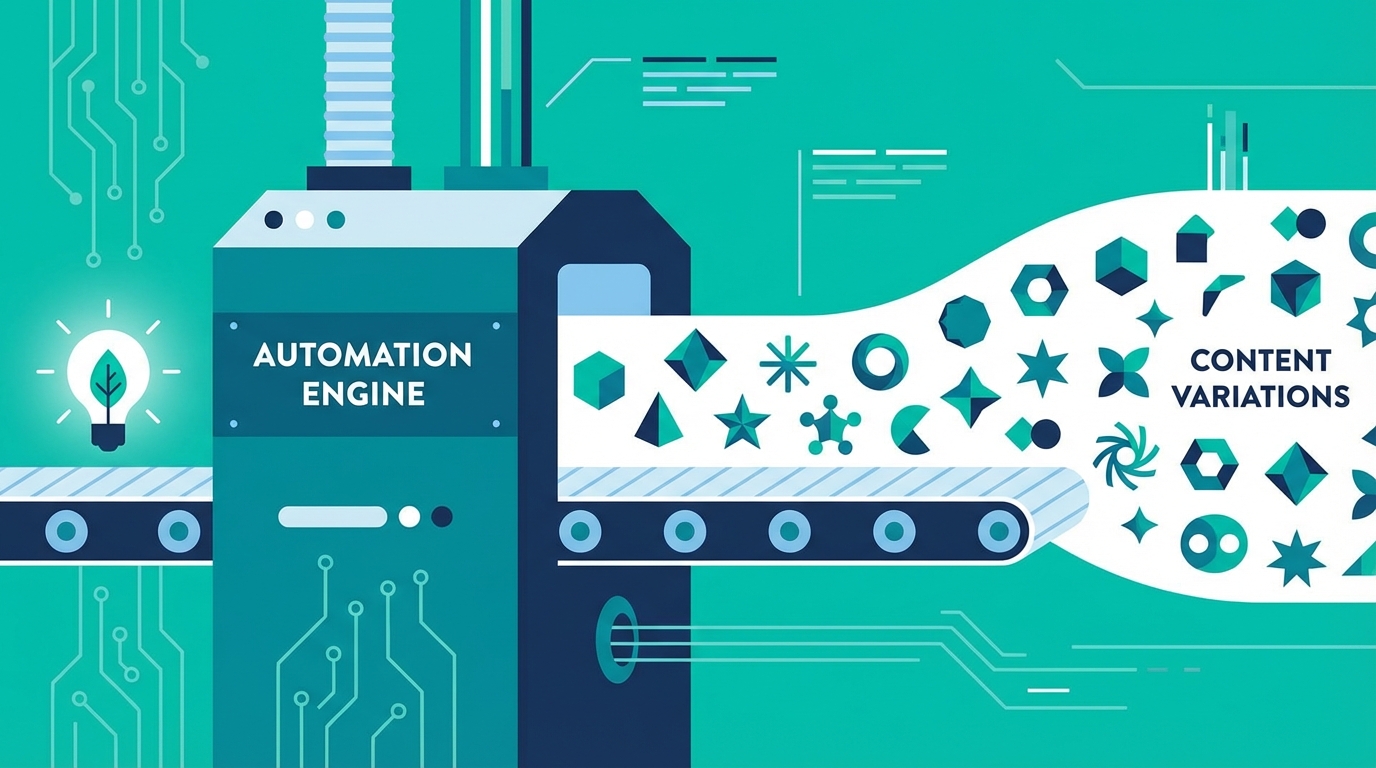
The biggest hurdle to mass distribution is the platform's 'duplicate content' filters. You cannot have 50,000 people post the exact same video file. To bypass this, the process must be automated. The Noise system allows brands to upload a single asset and then programmatically creates thousands of unique variations. By randomizing:
- Hook images and background clips
- In-app text overlays (which are pasted by the user to signal organic activity)
- Captions and descriptions
- Hashtag combinations
By giving creators specific instructions to add their own text inside the TikTok app rather than 'baking' it into the video, the platform sends a signal to the algorithm that the content is a fresh, organic creation from a real user. This 'randomized programmatic distribution' allows a single brand message to reach millions of unique feeds without ever being flagged as spam.
Shifting from Creator-Led Ideation to Brand-Led Distribution
For years, the industry standard has been to ask creators for their 'authentic' ideas. In a mass distribution model, this is a bottleneck. Instead, the brand becomes the scientist, and the creators become the laboratory. The brand identifies a viral format—perhaps a 'Roast Me' style AI interaction or a 'Secret Santa' drama—and builds a playbook around it.
Weber suggests using tools like Reddit to find 'confirmed popular' concepts. If a thread in the 'Roast Me' subreddit is trending, an AI app can create a format where the AI 'roasts' the user. The brand provides the assets, the script, and the hook, and the 50,000 creators simply execute. By taking the 'creative' burden off the creator, brands can ensure their messaging remains consistent while still riding the wave of existing viral trends.
The Economics of Mass Scale: $0.08 to $0.30 CPI
The ultimate goal of this shift is to escape the rising costs of Meta and Google ads. While Facebook ads have become a battle of rising CPMs, the mass organic distribution model offers an 'unfair advantage.' Weber reports that by using the Shots on Goal effect, brands are seeing Cost Per Install (CPI) rates as low as $0.08 to $0.30.
This is achieved by paying creators on a CPM basis rather than through flat-fee retainers. Brands set their own CPM based on their target acquisition cost. Because the platform incentivizes creators for every view they get, the creators are motivated to post frequently and follow the playbooks that are proven to work. The result is a self-optimizing system where the best formats get the most views, and the brand only pays for the attention that actually converts.
Conclusion: Growth as a Science, Not an Art
The era of the 'boutique' influencer campaign is closing for brands that need to scale. To achieve 2.5 billion views, you don't need to be an artistic genius; you need to be a distribution scientist. By implementing the Shots on Goal effect—moving from 10 creators to 50,000, automating content variations, and utilizing a two-pronged strategy of viral UGC and retargeting slideshows—brands can turn the TikTok lottery into a predictable, high-yield growth engine. The data is clear: volume doesn't just increase reach; it decreases cost, mitigates risk, and provides the ultimate hedge against the ever-changing social media algorithm.