Scaling Your Shopify Brand with OpenClaw: A 2026 Guide to AI-Driven Order Management
Discover how Shopify Plus merchants are using OpenClaw AI agents to automate inventory, reduce fulfillment errors, and reclaim 10+ hours per week in 2026.
In 2026, the gap between a growing Shopify brand and a truly scaling enterprise isn't just about marketing spend—it's about operational autonomy. With Shopify now powering over 5.7 million active stores and holding nearly 30% of the U.S. market, the competition has shifted from who can find the best products to who can fulfill them the most efficiently. Traditional human-heavy operations are buckling under the weight of modern consumer expectations, leading many high-volume merchants to turn to OpenClaw, an open-source AI agent harness that acts as a 24/7 digital employee.
As we navigate this new era of Agentic Commerce, the goal is no longer just to 'manage' orders but to delegate the entire lifecycle of fulfillment, inventory synchronization, and customer logistics to autonomous systems. This guide explores how to deploy an OpenClaw order management system to transform your Shopify operations from a manual bottleneck into a self-optimizing engine.
Why Traditional OMS is Failing in 2026: The Shift to Unified Commerce
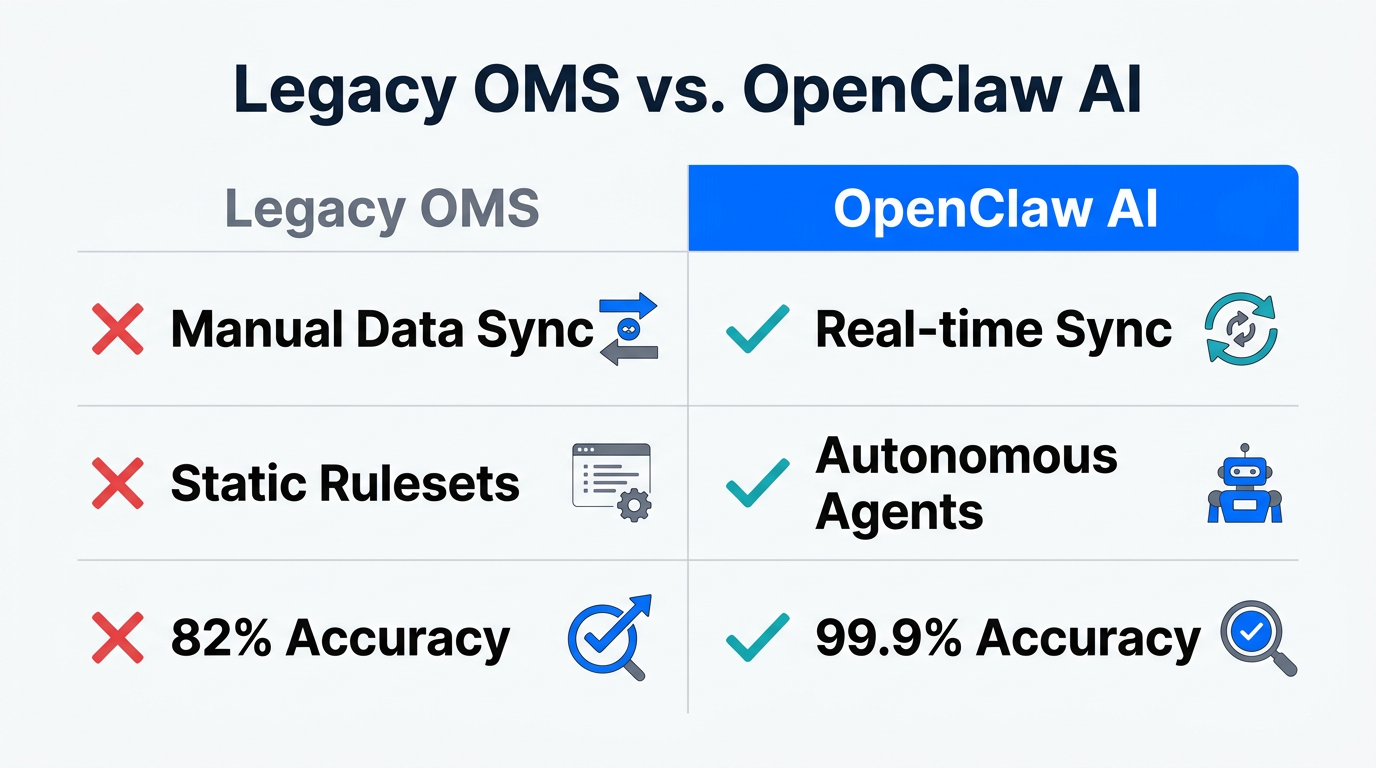
For years, Order Management Systems (OMS) were static databases. They recorded what was bought and where it was supposed to go. However, the global OMS market, projected to hit $1.9 billion this year, has undergone a radical transformation. We have moved beyond "omnichannel" into Unified Commerce—a state where inventory, pricing, and fulfillment logic are synchronized in real-time across every touchpoint via a single AI-driven layer.
"In 2026, a static OMS is a liability. If your system can't predict a stockout before it happens and autonomously re-route a shipment to avoid a delay, you aren't managing operations—you're just watching them fail."
Traditional systems lack the reasoning capabilities required to handle 2026-level complexity. When a customer asks "Where is my order?" (WISMO), these queries still account for 40–60% of total support volume, costing brands $5–$6 per human-handled ticket. OpenClaw changes this by providing a reasoning engine that doesn't just read data but understands intent and executes complex multi-step workflows across your tech stack.
Deploying OpenClaw on a VPS: 24/7 Autonomous Operations
To run a truly autonomous ecommerce operation, you cannot rely on local machines or browser-based tools that shut down when you close your laptop. Professional Shopify Plus merchants are deploying OpenClaw (also known as Clawbot) on Virtual Private Servers (VPS) using platforms like Tencent Cloud Lighthouse. This setup ensures your "digital employee" is online 24/7, processing orders while your human team sleeps.
The Privacy and Security Advantage
Unlike third-party SaaS tools that ingest your data into their proprietary models, a self-hosted OpenClaw instance gives you full control. By using Docker containers on your own VPS, you isolate the AI agent from your primary business data, granting it only the "scoped permissions" it needs to function. This is critical for GDPR and CCPA compliance in 2026.
- Scalability: As your order volume spikes during BFCM, your VPS can scale resources to handle increased API calls.
- Persistence: Long-running tasks, such as cross-referencing tracking numbers across 15 different carriers, won't time out.
- Customization: You can choose your preferred LLM backend, whether it's Claude 3.5 for complex reasoning or GPT-4o for speed.
Inventory Automation: Setting Up Your Digital Warehouse Manager
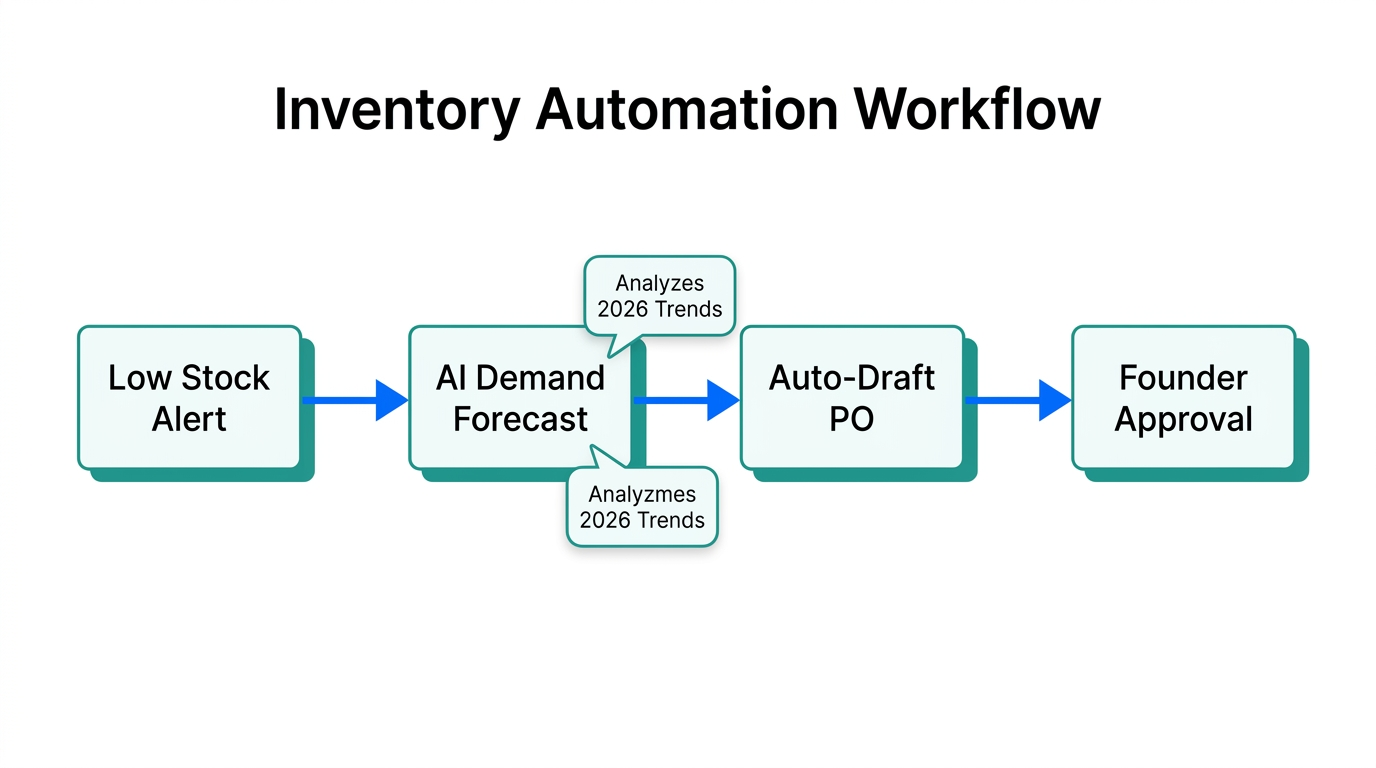
One of the most powerful use cases for Shopify inventory management in 2026 is the proactive synchronization of stock across multiple warehouses. Using the Composio Shopify Connector, OpenClaw can monitor your store's heartbeat in real-time through the Model Context Protocol (MCP).
The Setup Playbook:
- Connect via MCP: Use Shopify's native Model Context Protocol to let OpenClaw "read" your product levels without writing custom API code.
- Define Thresholds: Set logic such as "If SKU-A falls below 50 units in Warehouse East, check Warehouse West for surplus."
- Automate Communication: Connect OpenClaw to your team's communication hub. Instead of checking a dashboard, your ops manager receives a Slack or Microsoft Teams alert: "SKU-A is low. I have prepared a draft transfer order from West to East. Reply 'Approve' to execute."
| Feature | Manual Workflow | OpenClaw AI Workflow |
|---|---|---|
| Stock Monitoring | Daily manual checks | Real-time 24/7 monitoring |
| Restock Alerts | Delayed/Email-based | Instant Slack/Teams notifications |
| WISMO Support | $5.00 per ticket | <$0.10 per ticket |
| Data Privacy | Shared with SaaS vendors | 100% self-hosted & secure |
"The future of ecommerce isn't found in a better dashboard; it's found in the agent that makes the dashboard unnecessary."
Avoiding the 'Hype Trap': Managing Financial Risks
While the allure of 100% autonomy is strong, Shopify operations automation comes with inherent risks. AI models can occasionally "hallucinate," leading to errors that hit your bottom line. For instance, an agent might misinterpret a shipping zone and apply a flat $0 rate to an international heavy-goods order.
Moreover, when an AI agent edits an order—perhaps adding a free gift based on a loyalty trigger—it can sometimes bypass tax and shipping recalculations. According to ClickPost, failing to re-trigger Shopify’s native engines during order edits is a leading cause of audit issues for Plus merchants this year.
Another often-overlooked cost is API usage. Frequent, complex reasoning loops can lead to hundreds of dollars in LLM fees if not optimized. Merchants should use specialized connectors like Adzviser to fetch data efficiently, reducing the token count required for each operation.
Reclaiming Founder Time: The 10-Hour Efficiency Gain
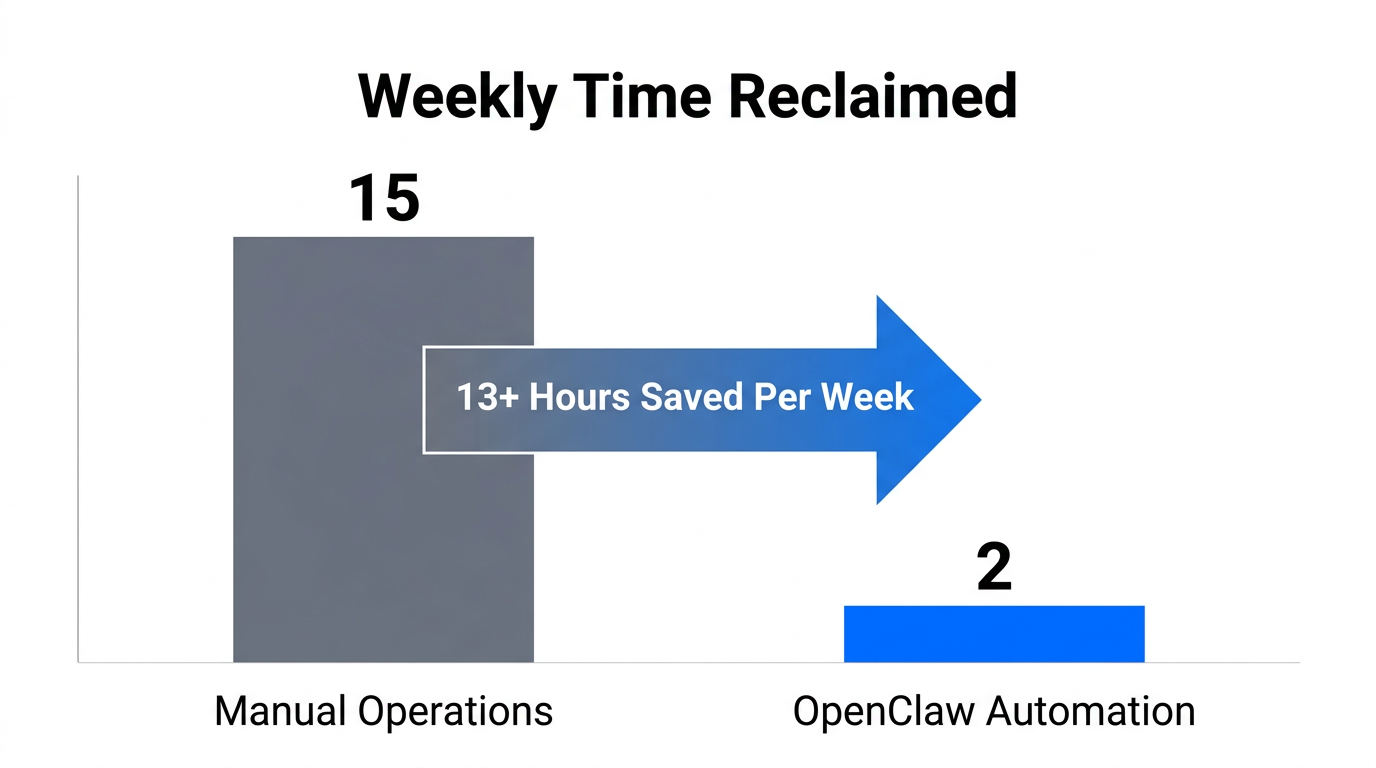
The ultimate metric for AI agents for ecommerce scaling isn't just cost—it's time. A recent case study involving a mid-market Shopify Plus merchant showed that by delegating multi-warehouse monitoring and customer service lookups to OpenClaw, the founder reclaimed over 10 hours per week. This is time that can be reinvested into high-leverage activities like product development or influencer strategy.
For example, while OpenClaw handles the "boring" logistics, brands can focus on growth by using platforms like Stormy AI to discover and outreach to new creators. Scaling a brand in 2026 requires a dual-engine approach: an AI agent like OpenClaw to manage the back-office (Defense), and an AI platform like Stormy AI to drive new customer acquisition through UGC and influencer marketing (Offense).
Success Story: From 4 Hours to 4 Minutes
One DTC brand reported that by integrating OpenClaw with a WhatsApp bridge, they reduced their average support response time from 4 hours to under 4 minutes. This didn't just save money; it increased their Customer Satisfaction (CSAT) score from 3.2 to 4.4, directly impacting their repeat purchase rate and long-term LTV.
Conclusion: The Autonomous Future
The transition to autonomous ecommerce operations is no longer a luxury reserved for the top 1% of brands. In 2026, tools like OpenClaw have democratized sophisticated order management, allowing lean teams to operate with the efficiency of a global logistics giant. By hosting your own agent on a VPS, setting strict scoped permissions, and maintaining human oversight on financial triggers, you can scale your Shopify brand without the linear increase in headcount that used to be required.
As you automate your operations, remember that the goal is to free your human talent for creativity and strategy. Use OpenClaw to handle the repetitive, and use platforms like Stormy AI to handle the discovery of the creators who will tell your brand's story to the world. The future of Shopify is automated, agentic, and incredibly fast.