In 2026, the ecommerce landscape has moved beyond the era of manual optimization. We are now living in the age of Agentic Commerce, where the distance between a customer’s intent and a delivered package is shrinking to near zero. If you are still manually managing your inventory levels or drafting product descriptions from scratch, you are competing with a ghost. Today, top-performing brands are leveraging Shopify Magic to not just assist in operations, but to autonomously drive growth. The shift is clear: we have moved from reactive dashboards to declarative commerce, where merchants define the outcome and AI executes the workflow.
As of early 2026, Shopify has reported a staggering 11x increase in AI-driven orders and a 7x rise in AI-originated traffic. This isn't just a trend; it's a fundamental restructuring of how money moves online. For Shopify merchants, scaling revenue this year requires a dual-pronged strategy: capturing the surge of AI-assisted shoppers and ensuring your back-end fulfillment is intelligent enough to handle the velocity without breaking. This playbook will walk you through the precise steps to automate your growth using the latest in AI order fulfillment and generative commerce tools.
The 11x Surge: Capturing AI-Driven Traffic in 2026
The numbers don't lie. The AI e-commerce market is on a trajectory to hit $16.8 billion by 2030, and 2026 is the inflection point where consumer behavior has officially tilted toward automation. According to recent data from Shopify, approximately 64% of shoppers now expect to use AI agents to assist with their purchases. These aren't just chatbots; these are sophisticated agents that compare prices, check real-time stock, and execute checkouts on behalf of the user.
To capture this traffic, your store must be "Agent-Ready." This means having clean data structures and utilizing Universal AI Shopping Carts. New standards like the Model Context Protocol (MCP) allow third-party AI agents to understand your bundles, discounts, and subscription tiers instantly. If your store's metadata is messy, these AI shoppers will simply bypass your brand for a competitor whose site is easier for their agent to parse.
"AI is no longer a luxury or a 'nice-to-have'—it is the baseline expectation for operational efficiency in 2026." — Tobi Lütke, CEO of ShopifyBrands that lean into this shift are seeing 87% positive revenue impact from AI implementations. The goal for this year is to ensure that when an AI agent searches for a solution on behalf of a customer, your products are the ones it selects. This requires a robust ecommerce growth strategy centered on data clarity and automated discovery.
From Reactive Management to Declarative Commerce
For years, Shopify merchants have been "operators." They look at a report, see that inventory is low, and then create a purchase order. In 2026, the most successful brands have transitioned to Declarative Commerce. In this model, you don't manage the steps; you declare the goal. For example, instead of setting manual reorder points, you tell your AI system: "Maintain a 20% buffer on all top-selling SKUs and prioritize the fastest shipping route for any order over $100."
This shift transforms your team from manual laborers into data scientists. By using AI to analyze Shopify reports instantly, brands like Ridge have removed internal bottlenecks that once took specialists days to resolve. Now, AI agents handle the triage, routing, and inventory sync in the background, allowing the human team to focus on creative strategy and brand building.
| Traditional Commerce | Declarative Commerce (2026) |
|---|---|
| Manual inventory tracking | Predictive inventory allocation via AI |
| Reactive customer support | 93% automated resolution for tracking queries |
| Static product descriptions | Dynamic Shopify Magic generated content |
| Manual warehouse routing | AI-driven smart routing to nearest hub |
To feed this declarative engine with the right traffic, many brands are turning to influencer-led acquisition. Platforms like Stormy AI allow you to discover and outreach to creators who can drive the high-intent traffic that AI agents then convert. By pairing autonomous discovery on the front end with declarative commerce on the back end, you create a self-scaling revenue machine.
Implementing Shopify Magic: The 2026 Workflow
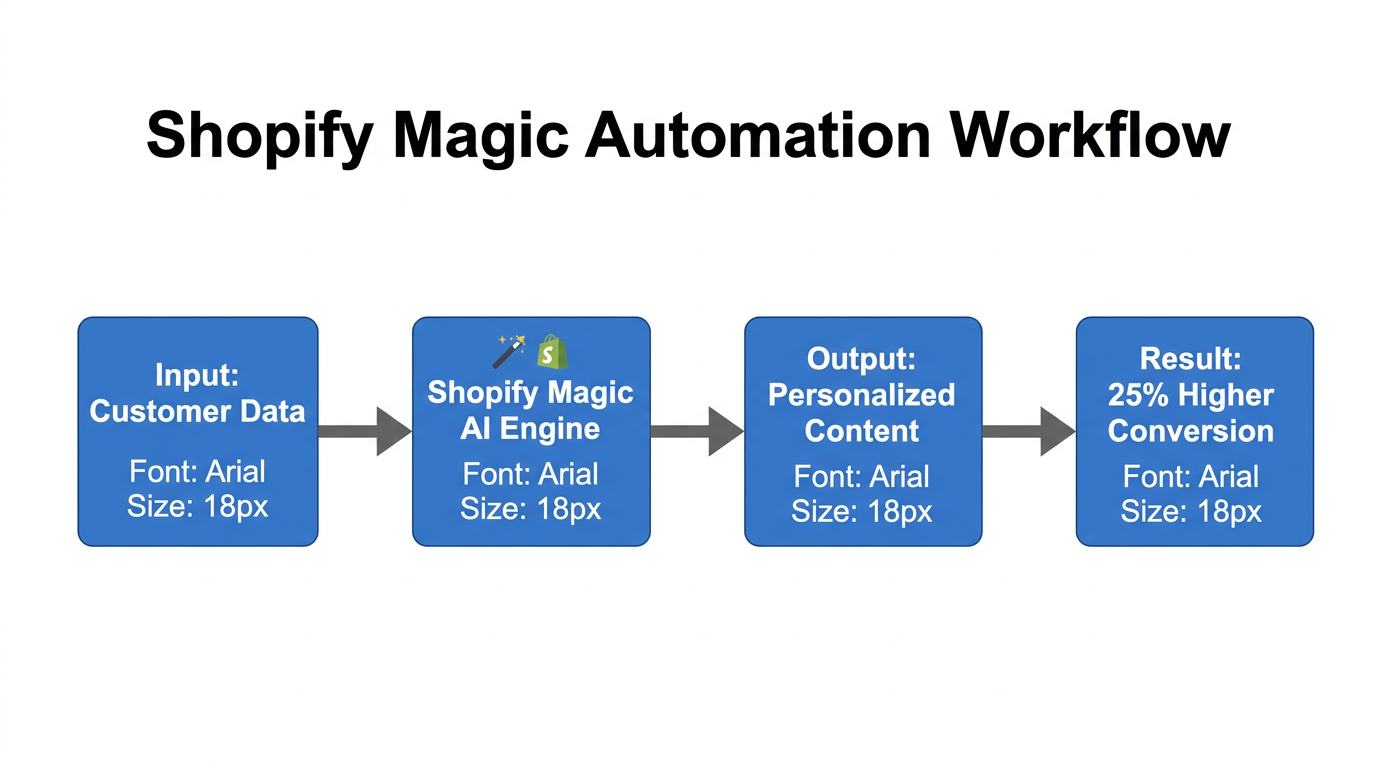
Shopify Magic has evolved into a comprehensive suite of generative AI tools that handle everything from high-conversion product descriptions to automated customer support. In 2026, the workflow for a product launch looks radically different than it did two years ago. Using Shopify Magic, merchants can now generate entire marketing campaigns—including email sequences, social captions, and landing page copy—based on a single product photo.
Step 1: Automated Content Creation
Use the generative AI features to draft SEO-optimized descriptions that don't just describe the product, but sell the benefits based on real-time search trends. The AI analyzes what customers are currently searching for and injects those high-intent keywords naturally into your copy.
Step 2: AI-Powered Support & Conversions
Integrate tools like Zipchat AI or Gorgias to handle the influx of "Where is my order?" (WISMO) queries. In 2026, AI agents can resolve up to 93% of customer questions without human intervention. This frees your support team to handle high-value white-glove interactions that actually move the needle on LTV (Lifetime Value).
"The ROI of AI in fulfillment comes from removing workflow friction. The most valuable work happens behind the scenes: triage, routing, and inventory sync."AI Order Fulfillment: Solving the Logistics Bottleneck
Scaling revenue is impossible if your fulfillment can't keep up. AI order fulfillment in 2026 is defined by Predictive Inventory Allocation. Instead of waiting for an order to come in, AI analyzes social media trends, local weather patterns, and historical data to decide where your stock should live *before* the customer even hits 'Buy'.
By using the Shopify Flow app, you can set up a "Trigger-Condition-Action" model for your logistics:
- Trigger: A new order is placed in the New York area.
- Condition: The SKU is available in both the NJ and CA warehouses.
- Action: AI automatically routes the order to the NJ warehouse and tags it for "Next-Day Delivery" because the customer is a VIP.
Furthermore, the rise of Robotic Warehousing has changed the game for small and medium businesses. Shopify’s collaborative robotics (like the "Chuck" robots from 6 River Systems) are now accessible to more merchants through the Shopify Fulfillment Network (SFN). This technology reduces picking errors and expedites packing, allowing you to meet the "next-day delivery" standard that 2026 consumers demand.
Success Stories: $30k/Week Savings with AI
The transition to shopify ai automation 2026 isn't just theoretical. Real brands are seeing massive returns on their investment in automation and AI logistics.
Doe Beauty: The Efficiency Powerhouse
By utilizing AI-driven inventory management, Doe Beauty optimized their global supply chain to anticipate demand shifts. This implementation saved the brand $30,000 per week in shipping and storage costs and reclaimed four hours of manual work every single day for their operations team.
Incu: 300% Year-Over-Year Growth
Fashion brand Incu automated their inventory restocking using AI. By ensuring that high-demand items were never out of stock through predictive reordering, they saw a 300% increase in sales. The AI identified which SKUs were gaining velocity on TikTok before the human team even noticed the trend, allowing them to stock up just in time.
| Brand | AI Strategy | Result |
|---|---|---|
| Doe Beauty | Inventory Optimization | $30k saved/week |
| Incu | Predictive Restocking | 300% YoY Sales Boost |
| Ridge | AI Support Agents | 60% of tickets automated |
| Eco Home | Seasonal Forecasting | 15% reduction in surplus |
The 2026 Playbook: 5 Steps to Scale
Ready to implement an ecommerce growth strategy built for the AI age? Follow these sequential steps:
Step 1: Clean Your Data
AI agents are only as good as the data they consume. Ensure your SKU names, inventory counts, and warehouse locations are consistent across all platforms. Use Make.com to sync data between your ERP and Shopify if you have multiple warehouses.
Step 2: Deploy Shopify Magic for Content
Audit your current product pages. Use Shopify Magic to update descriptions, add alt-text to images, and generate FAQ sections based on common customer questions. This improves both SEO and the "readability" of your site for AI shopping agents.
Step 3: Automate Order Routing
Install an app like Order Fulfillment Guru to manage multi-vendor or multi-warehouse routing. Set rules to automatically assign orders to the location nearest the customer to save on shipping time.
Step 4: Implement AI Fraud & Risk Checks
Don't let manual review slow down your fulfillment. Use AI to instantly fulfill "Low Risk" orders while tagging "High Risk" orders for human review. This maintains speed for 99% of your customers while protecting your bottom line.
Step 5: Launch an AI Agent for Discovery
Scale your top-of-funnel by automating your creator partnerships. Using sophisticated tools ensures a steady stream of traffic for your automated storefront to convert, allowing you to scale without increasing headcount.
Common Mistakes: When Not to Automate
While AI is powerful, over-automation can be a silent killer. One of the biggest mistakes in 2026 is automating a broken process. If your manual fulfillment logic is flawed, AI will only produce bad results at scale. Always optimize the workflow manually before handing the keys to an AI agent.
Additionally, avoid Tech Silos. If your support team is using Gorgias but your warehouse is on a legacy ERP that doesn't talk to Shopify, your AI agents will "hallucinate" shipping dates, leading to customer frustration. Ensure your entire stack—from Alloy Automation to your 3PL—is fully integrated.
Conclusion: The Future is Declarative
Scaling Shopify revenue in 2026 requires a shift in mindset from manager to architect. By leveraging Shopify Magic to handle content and AI order fulfillment to handle logistics, you free yourself to focus on the high-level strategy that drives brand value. The 11x increase in AI orders is a tidal wave—you can either learn to surf it using declarative commerce or get swept away by more agile competitors. Start by cleaning your data, automating your most repetitive tasks, and using AI-powered platforms like Stormy AI to keep your growth engine fueled with fresh, high-converting traffic.