In the high-stakes landscape of 2026, the difference between a Shopify brand hitting an eight-figure plateau and scaling to a $100M powerhouse lies in the efficiency of its supply chain. We have moved past the era of 'gut-feeling' restocking. Today, Shopify predictive inventory strategies are the backbone of global commerce. As logistics costs rise and consumer expectations for same-day delivery become the norm, brands are turning to AI to solve the oldest problem in retail: having the right product, in the right place, at the exact moment a customer hits 'buy'.
The Death of Reactive Logistics: Why 2026 Demands Predictive AI
For years, ecommerce was reactive. A product sold out, a purchase order was cut, and the brand waited weeks for replenishment while losing potential revenue. In 2026, that model is a relic. According to recent data from McKinsey, AI-enabled supply chains are now producing 5% to 20% savings in total logistics costs. These savings aren't just coming from cheaper shipping; they are the result of route optimization and advanced demand prediction.
The shift to ecommerce demand forecasting is driven by the sheer volume of data available. Modern merchants aren't just looking at past sales; they are integrating AI that monitors social trends, weather patterns, and even 'agentic' shopping behavior. Shopify President Harley Finkelstein recently noted that orders originating from AI search (like ChatGPT and Gemini) increased 15x over the last year. If your inventory system isn't talking to these AI signals, you are essentially flying blind.
"The future of commerce isn't just about showing up in a search bar; it’s about having the inventory positioned before the AI agent even suggests the purchase to the user."The $100M Blueprint: Lessons from Boll & Branch’s ERP Integration
When studying brands that have successfully crossed the $100M threshold, Boll & Branch stands as the gold standard. Their secret? They didn't treat Shopify as a standalone silo. Instead, they successfully integrated an AI-driven ERP (Enterprise Resource Planning) system directly with their Shopify Plus storefront. This allowed them to optimize a complex supply chain through automated inventory tracking that scales across multiple global regions.
For a brand scaling toward $100M, manual spreadsheets are the enemy of growth. Boll & Branch’s model focuses on real-time visibility. When a marketing campaign goes viral, the ERP identifies the spike and adjusts the replenishment triggers across the entire network. This level of AI inventory management ensures that high-growth periods don't lead to the dreaded 'out of stock' badge, which can tank conversion rates and hurt SEO rankings. In fact, research from Anchor Group suggests that while AI-driven chat delivers 4x higher conversions, those gains are only realized if the fulfillment engine can keep pace.
| Strategy Phase | Manual Process (Traditional) | Predictive Process (2026) |
|---|---|---|
| Demand Forecasting | Historical average of last 3 months | AI SKU-level analysis of trends + marketing spend |
| Replenishment | Monthly bulk orders | Smart buying tables with daily dynamic triggers |
| Stock Allocation | Centralized hub distribution | Regional warehouse allocation based on heatmaps |
Smart Buying Tables: Automating SKU-Level Demand Forecasting
The heart of Shopify supply chain strategy in 2026 is the 'Smart Buying Table.' Tools like Prediko and Assisty have revolutionized how merchants interact with their suppliers. These platforms don't just tell you what you have; they tell you exactly what to buy by accounting for seasonal trends, lead times, and upcoming marketing pushes.
By forecasting at the SKU level, brands can avoid the 'overstock' trap that kills cash flow. For instance, if you're planning a massive influencer push, you can feed that data into your AI-driven replenishment tool. Platforms like Stormy AI are essential here; by identifying high-engagement creators and predicting the reach of a campaign, marketing teams can provide the logistics team with a high-signal 'demand spike' forecast. This integration between influencer discovery and inventory management is what separates the winners from the losers in 2026.
"Inventory is a liability until it's sold. Smart buying tables turn that liability into a precision instrument for growth."Implementing these tables allows for dynamic replenishment. Instead of ordering 10,000 units and hoping for the best, the AI calculates the 'economic order quantity' based on current warehouse velocity and shipping costs. This is particularly vital as last-mile delivery now accounts for nearly 40% of total logistics spend in North America, according to Maersk.
Regional Allocation: Reducing Holdings by 30% Without Losing Sales
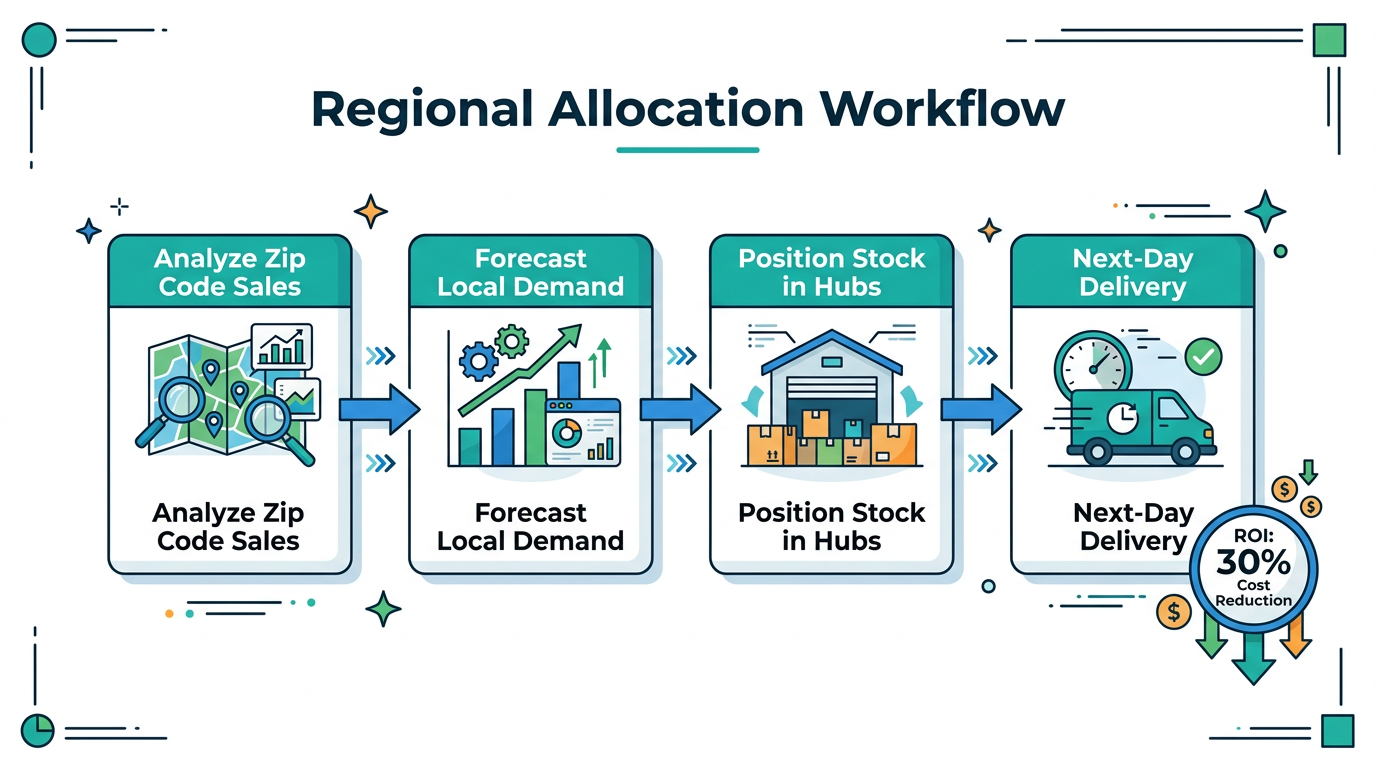
One of the most effective ways to reduce inventory holdings by 30% is through regional warehouse allocation. Rather than keeping all your eggs in one basket, AI analyzes historical data to decide where stock should live before the order is even placed. This minimizes transit time and drastically cuts down on shipping surcharges.
Using data heatmaps, a merchant might find that 40% of their orders for a specific SKU come from the Tri-State area, while 20% come from Southern California. A Shopify predictive inventory system will automatically suggest shifting stock from a central hub to regional 3PLs near those clusters. This isn't just about speed; it's about margin protection. By reducing the distance a package travels, you lower the carbon footprint and the shipping cost simultaneously. Brands like Doe Beauty have utilized Shopify Flow and AI tools to manage this global stock, reportedly saving $30,000 per week in manual labor and logistics inefficiencies.
The Blind Automation Trap: Balancing AI with Human Resilience
While the allure of 'set it and forget it' logistics is strong, blind automation is a dangerous trap. Automating shipping rules without testing edge cases—like remote island deliveries or oversized items—can lead to massive surcharges that eat your margins. As Bintime and other experts warn, ignoring the nuances of data privacy and carrier-specific limitations can lead to both legal and financial headaches.
Ken Kralick, CEO of Qualibooth, emphasizes that while AI allows businesses to respond 30–40% faster to disruptions, the most resilient brands maintain a layer of human oversight. Octavian Dumitrescu of Dyver.AI puts it bluntly: "Automation isn’t just about efficiency; it’s about resilience." This means your Shopify supply chain strategy should include 'circuit breakers'—manual review steps for orders over a certain value or for shipments to regions with known logistics volatility.
To maintain this resilience, consider the following checklist:
- Test Edge Cases: Regularly audit your AI’s carrier selection logic for 'dead zones' or high-surcharge zip codes.
- Monitor Data Health: Ensure your product taxonomy is clean. AI cannot 'see' messy data, and inconsistent tags will lead to forecasting hallucinations.
- Centralize Governance: Avoid tool fragmentation. Using Gorgias for support and Loop Returns for post-purchase is great, but ensure they all feed into a central data warehouse to prevent conflicting inventory updates.
"The goal is 'Agentic Commerce'—where AI handles the heavy lifting, but humans define the boundaries of the brand's resilience."The Growth Stack: Integrating Marketing and Supply Chain
Scaling to $100M requires every department to speak the same language. If your marketing team is running a 50% off flash sale but the logistics team hasn't been alerted to the predicted SKU volume, the campaign is a failure before it starts. In 2026, the integration of marketing discovery tools and inventory forecasting is the ultimate competitive advantage.
By using an AI agent like Stormy AI to automate creator outreach and campaign scheduling, brands can generate a predictable stream of demand. When you know exactly when 50 influencers will be posting about your newest SKU, you can use smart buying tables to ensure the regional warehouses are stocked and ready. This creates a seamless 'click-to-door' experience that builds massive brand loyalty.
Finally, don't forget the post-purchase experience. Using AI agents like those from eesel AI to handle 'Where is my order?' (WISMO) queries can reduce support tickets by 50%, allowing your team to focus on high-level strategy rather than tracking packages. When your inventory is predictive, your shipping is optimized, and your customer service is automated, scaling to $100M isn't just a goal—it's an inevitability.
Final Checklist for 2026 Scaling:
- Transition from 3-month averages to AI-driven SKU-level forecasting.
- Integrate your Shopify store with an AI-ready ERP for real-time stock visibility.
- Deploy regional warehouse heatmaps to reduce holdings by 30%.
- Audit your product metadata to ensure AI agents can correctly identify and purchase your stock.
- Bridge the gap between influencer marketing (Stormy AI) and supply chain replenishment.