In 2026, the days of managing your store through reactive spreadsheets and manual stock counts are officially over. The global AI in supply chain market is projected to reach $13.81 billion this year, according to Precedence Research, and for Shopify merchants, this isn't just a trend—it's a survival requirement. As high-volume brands move toward agentic commerce, the difference between growth and stagnation lies in how you automate the messy back office. This guide outlines the Sense-Plan-Execute framework, a strategy designed to reduce inventory costs by 25% while putting your supplier communications on autopilot.
The Sense-Plan-Execute Framework for 2026
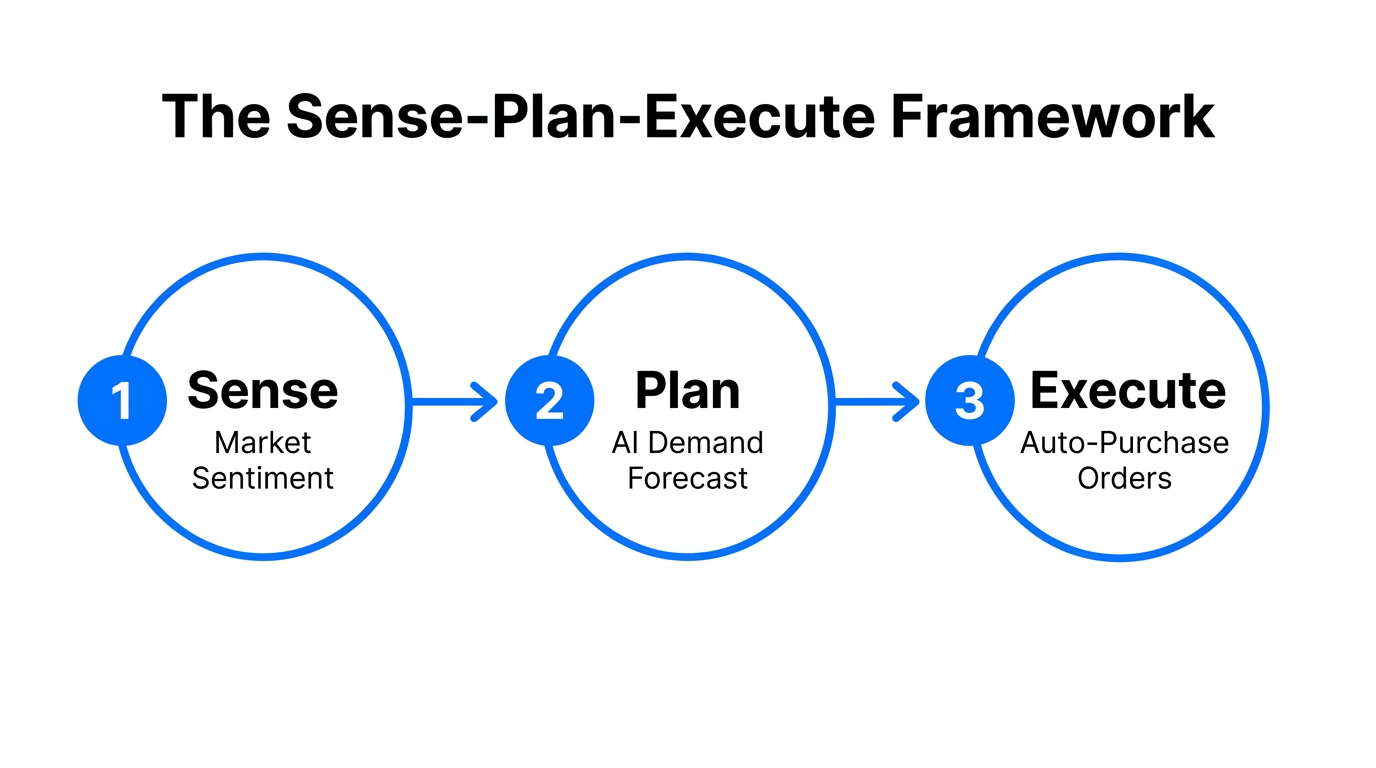
Traditional inventory management was linear: you looked at what you sold last month and guessed what you’d need next month. In 2026, we use a circular, autonomous workflow. This methodology, adopted by top-tier retailers, relies on an AI ecommerce employee like Stormy AI to monitor data streams and trigger actions without human intervention.
This framework is built on three pillars: Sensing demand before it hits the books, Planning scenarios based on real-time variables, and Executing the purchase order (PO) lifecycle automatically. When an AI agent handles the "Execute" phase, it frees up the founder to focus on brand and product development.
Phase 1: Sensing Demand with Sidekick Pulse and Sentiment
The first shift in 2026 is moving away from "static" data. Waiting for a sales report to tell you a SKU is trending is too late. Shopify’s latest Sidekick Pulse rollout has transformed the platform from a dashboard into a proactive monitor. Pulse identifies demand spikes before they manifest in your Shopify Admin by tracking customer journey patterns and regional anomalies.
Modern practitioners go a step further by integrating sentiment analysis. If a specific SKU's mentions surge by 20% on TikTok or Instagram, that is a "Sense" event. While traditional systems ignore social chatter, your AI workflow should flag this as a potential stockout risk. By the time the sales hit, your automated purchase orders should already be in your supplier's inbox.
"The difference between winners and losers in 2026 is 'pilot purgatory.' Only companies scaling AI to enterprise-wide operations see the 20% cost reductions promised by the tech."
Phase 2: AI Demand Planning and Floating Reorder Points
Once you've sensed a trend, you need a plan. Tools like Prediko and Cogsy allow for complex "Scenario Modeling." Instead of fixed reorder points (e.g., "reorder when stock hits 50"), we now use Floating Reorder Points. These are reorder thresholds that adapt in real-time based on lead time variance, weather patterns, and shipping delays.
| Feature | Traditional (Manual) | AI-Driven (2026) |
|---|---|---|
| Forecasting | Static (Historical sales) | Dynamic (Sales + Trends + Weather) |
| Reordering | Fixed Min/Max | Adaptive "Floating" Points |
| Accuracy | 70% Average | 90%+ Accuracy |
| Efficiency | High manual labor | 60%–70% time saved |
For example, if your supplier in Vietnam is experiencing a 4-day delay due to seasonal typhoons, Stormy AI can detect the shipping lag from your Inventory Planner dashboard and automatically raise your safety stock levels for that specific vendor. This prevents the "Safety Stock Efficiency Gap" where brands hold too much capital in slow-moving items. According to Forthcast, AI-driven demand planning can free up an average of $200,000 in working capital for mid-sized brands.
The Foundation: Fixing Your Product Data Hygiene
AI is only as good as the data it consumes. The biggest hurdle in shopify inventory management in 2026 is "GIGO"—Garbage In, Garbage Out. If your product attributes (weight, dimensions, HS codes, or variant names) are inconsistent, your forecasting will fail. Research from Qualimero shows that merchants spend nearly 40% of their AI implementation time just cleaning legacy data.
Steps to Audit Your Data Hygiene:
- Standardize Variant Names: Ensure all SKUs follow a strict [Brand]-[Product]-[Color]-[Size] format. Shopify now supports up to 2,048 variants per product, so use this to eliminate "ghost SKUs."
- Audit Lead Times: Update your supplier records with actual historical lead times rather than the "best case" scenario written in your contracts.
- Remove Obsolete SKUs: Archive any product that hasn't sold in 12 months to prevent the AI from trying to forecast "dead" stock.
"Adding AI to a fragmented supply chain just automates confusion at a higher speed. Clean your data before you build your agents."
Phase 3: Executing with Automated Purchase Orders
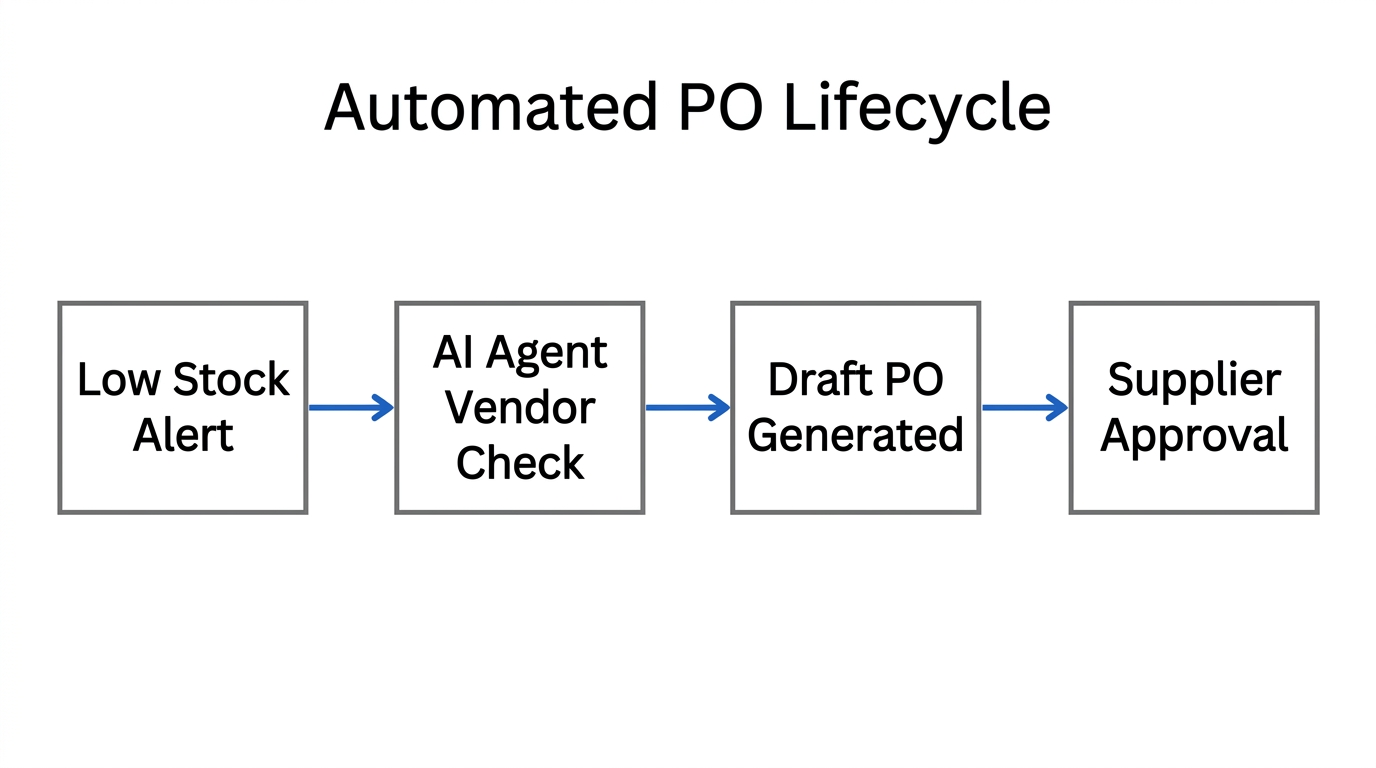
This is where the "AI Employee" concept comes to life. You no longer need to manually draft emails to suppliers. By connecting Shopify Flow with an agent like Stormy AI, you can automate the entire PO lifecycle based on your demand plan.
Step-by-Step: Setting Up the Automation Playbook
- Define the Trigger: Use Prediko to calculate your "Predicted Stockout Date." In Shopify Flow, set a trigger for when that date is less than your Lead Time + 5 days (the safety buffer).
- Generate the Draft: Have Stormy AI pull the suggested restock quantity from your shared workbook and generate a draft PO in Shopify.
- Supplier Outreach: Stormy AI then drafts a personalized email to your supplier with the PDF attached. It checks for vendor-specific constraints (e.g., minimum order quantities) before sending.
- Follow-up: If the supplier doesn't acknowledge the PO within 48 hours, Stormy AI sends a polite follow-up. This proactive chasing reduces the 43% of stockouts caused by simple vendor delays.
The ROI of Agentic Ops: Metrics That Matter
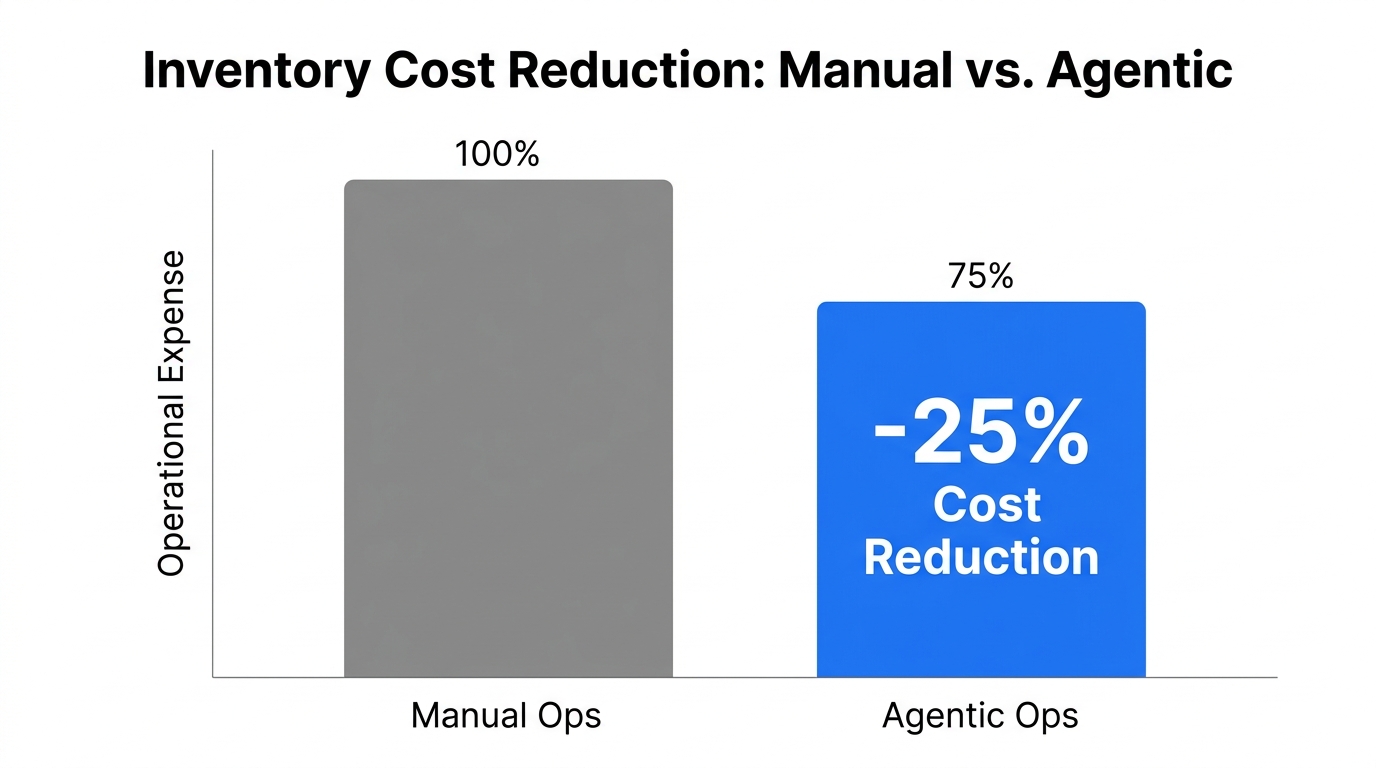
Scaling a brand in 2026 requires understanding the financial impact of these automations. The cost of failure is high; every $1B spent on digital transformation this year results in $97M of wasted capital due to poor implementation, according to Third Stage Consulting. However, for those who get it right, the gains are exponential.
By shifting to an ai demand planning model, brands like Incu have seen a 300% YoY sales boost simply by ensuring high-demand items are never out of stock. Furthermore, because Stormy AI monitors your Amazon Ads and Meta Ads spend alongside your inventory, it can automatically signal your marketing team to pause ads for products that are at risk of stocking out, saving you thousands in wasted clicks.
@idempotent directive in the Shopify GraphQL API (introduced in the April 2026 update) to prevent double-adjustments during high-volume flash sales. Source: Fudge AI.The Bottom Line for Shopify Operators
The 2026 playbook is simple: stop acting like a data entry clerk and start acting like a system architect. By implementing the Sense-Plan-Execute workflow, you transform your inventory from a liability into a competitive advantage. Using Stormy AI to handle the monotonous tasks of supplier follow-ups, inventory monitoring, and PO generation allows your human team to focus on what AI cannot do: creative strategy and relationship building. Start by cleaning your data, connect your first shopify flow automation, and let your AI employee handle the rest.