The Ultimate 2026 Shopify AI Tech Stack: Integrating Sidekick, Gorgias, and Klaviyo
Build a high-performance 2026 Shopify store with our guide to best Shopify AI apps, comparing Shopify Sidekick vs Gorgias and mastering Klaviyo AI automation.
In 2026, the ecommerce landscape has shifted from simple automation to Agentic Commerce. We are no longer just using bots that talk; we are employing AI agents that act. According to Cubeo AI, the global AI in ecommerce market is set to reach $10.5 billion by the end of this year, with 84% of businesses ranking AI as their highest strategic priority. However, there is a massive maturity gap: while almost everyone uses some form of AI, only 7% have reached fully scaled deployment. For the modern operator, the challenge isn't finding AI—it's building a lean, integrated stack that doesn't collapse under its own weight.
The 4-6 App Rule: Why Less is More in 2026
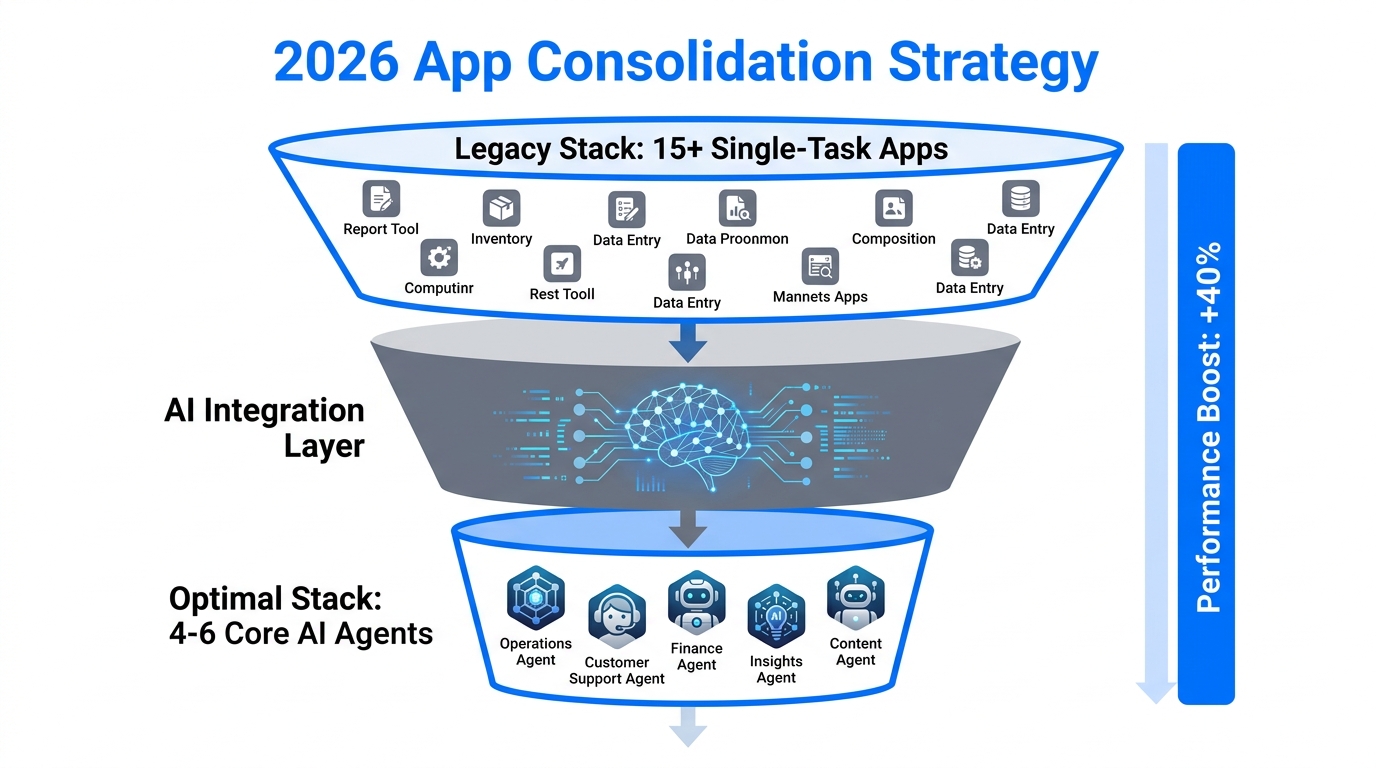
One of the biggest mistakes Shopify merchants make in 2026 is "app bloat." Every new AI tool promises a 10x return, but exceeding 6 specialized systems often leads to fragmented data silos where your support agent doesn't know what your marketing agent just sent. Industry experts at Digital Applied have found that the most successful "Plus" merchants stick to a core stack of 4-6 deep integrations.
When your stack is lean, your AI ecommerce employee, like Stormy AI, can more effectively monitor the "messy middle" of your back office. While your core apps handle customer-facing CX, an agent like Stormy acts as the connective tissue—monitoring inventory levels in Shopify, tracking ad performance in Meta Ads, and updating your internal spreadsheets without requiring another dozen apps to talk to each other.
Native AI vs. Specialized Agents: Sidekick vs. Gorgias
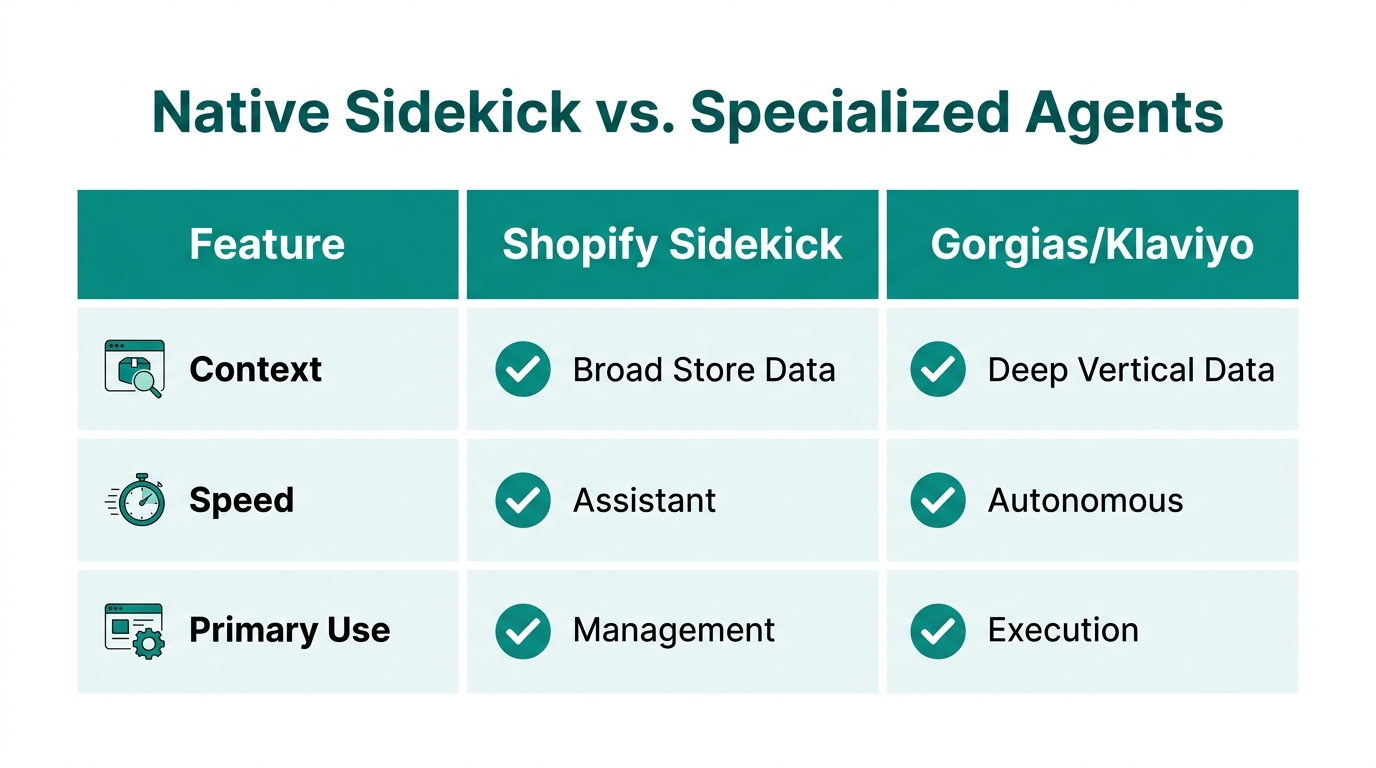
A common debate this year is whether to rely on Shopify Sidekick (the free, built-in assistant) or invest in Deep Resolution tools like Gorgias. Sidekick is an incredible generalist for store tasks—it can generate reports, edit themes, and summarize sales data within the Shopify Admin. However, for AI customer support for Shopify, it often lacks the specialized "act" capabilities needed for complex resolutions.
| Feature | Shopify Sidekick | Gorgias / Fin AI |
|---|---|---|
| Cost | Free (Included in plans) | Paid ($10 - $300+/mo) | Primary Use | Store Admin & Reporting | Customer Support & Tickets | Resolution Depth | Shallow (Status checks) | Deep (Refunds, edits, swaps) | Multi-Platform | Shopify Only | Email, SMS, Social, Chat |
In 2026, support economics have become a game of First Contact Resolution (FCR). AI-native platforms like Gorgias are achieving 55–70% FCR at a cost of just $1–$3 per resolution, compared to the $13.50+ average for human-assisted contacts [source: Intercom CS Trends]. While Shopify Sidekick is great for the merchant, tools like Gorgias are designed to protect the customer experience. This is why the Shopify Sidekick vs Gorgias comparison is less about competition and more about division of labor: use Sidekick to manage your store, and use a dedicated agent for your customers.
"Shoppers assisted by AI chat convert at 12.3%, compared to a dismal 3.1% for unassisted shoppers—that is a 4x multiplier you cannot ignore."
The Shopify Flow v4 Playbook: Native Automation vs. Zapier
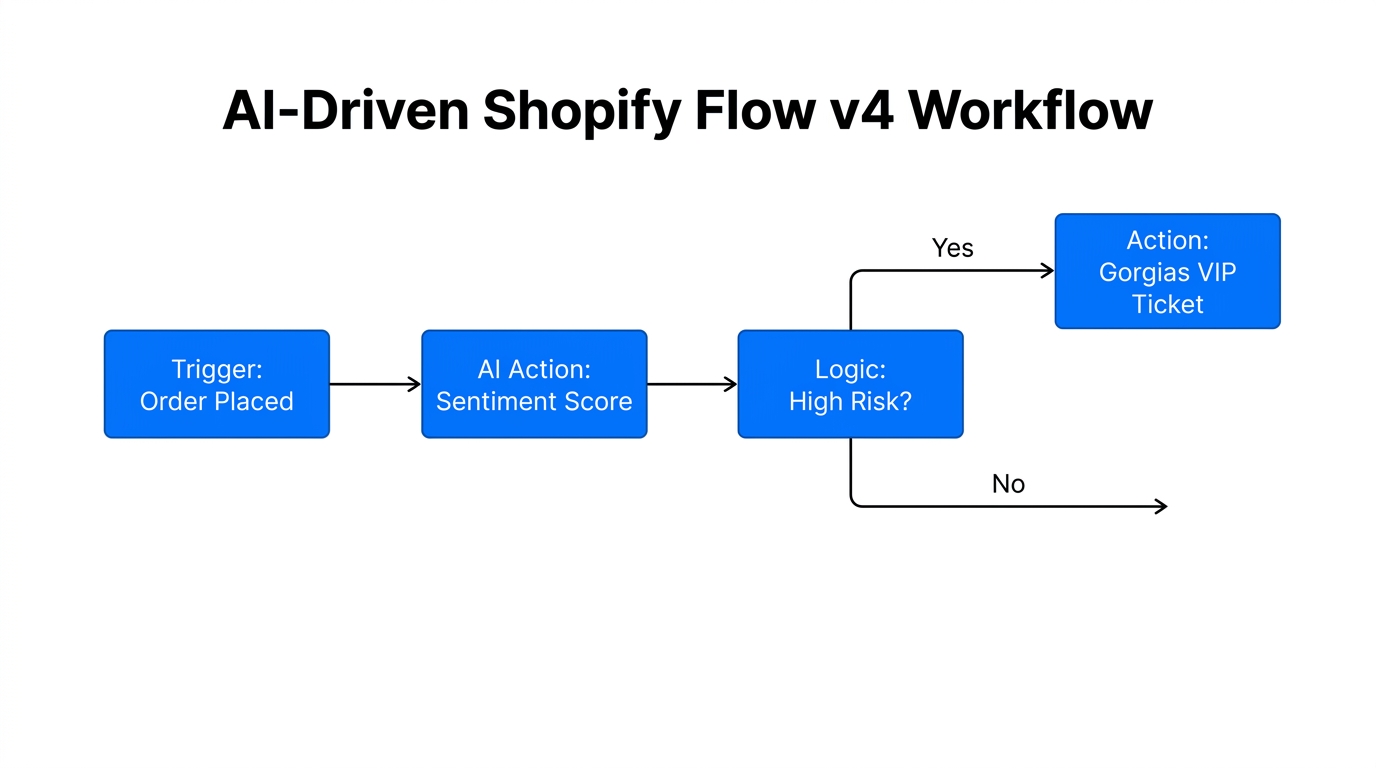
For years, Zapier was the king of ecommerce automation. But in 2026, Shopify Flow v4 has fundamentally changed the game. With the addition of multi-branch logic and 30-day time delays, Flow now handles complex "drip" internal operations that used to require expensive third-party subscriptions. When comparing Shopify Flow vs Zapier 2026, the rule of thumb is: if the data stays in your store, keep it in Flow.
Step-by-Step: Setting Up a 2026 Loyalty Flow
- Trigger: Order Paid.
- Logic: Check if Customer Total Spent > $1,000.
- Action: Add a "VIP" tag and send a notification to your Slack channel.
- Delay: Wait 14 days.
- Condition: Check if the customer has placed a second order. If not, trigger a personalized video greeting via a connected AI creative tool.
For workflows that must leave the Shopify ecosystem—such as syncing to a custom ERP or complex accounting software like QuickBooks—Zapier remains the better choice. However, for the lean operator, Shopify Flow is now powerful enough to handle 90% of internal store logic for free.
Predictive Retention: The Klaviyo AI Automation Guide
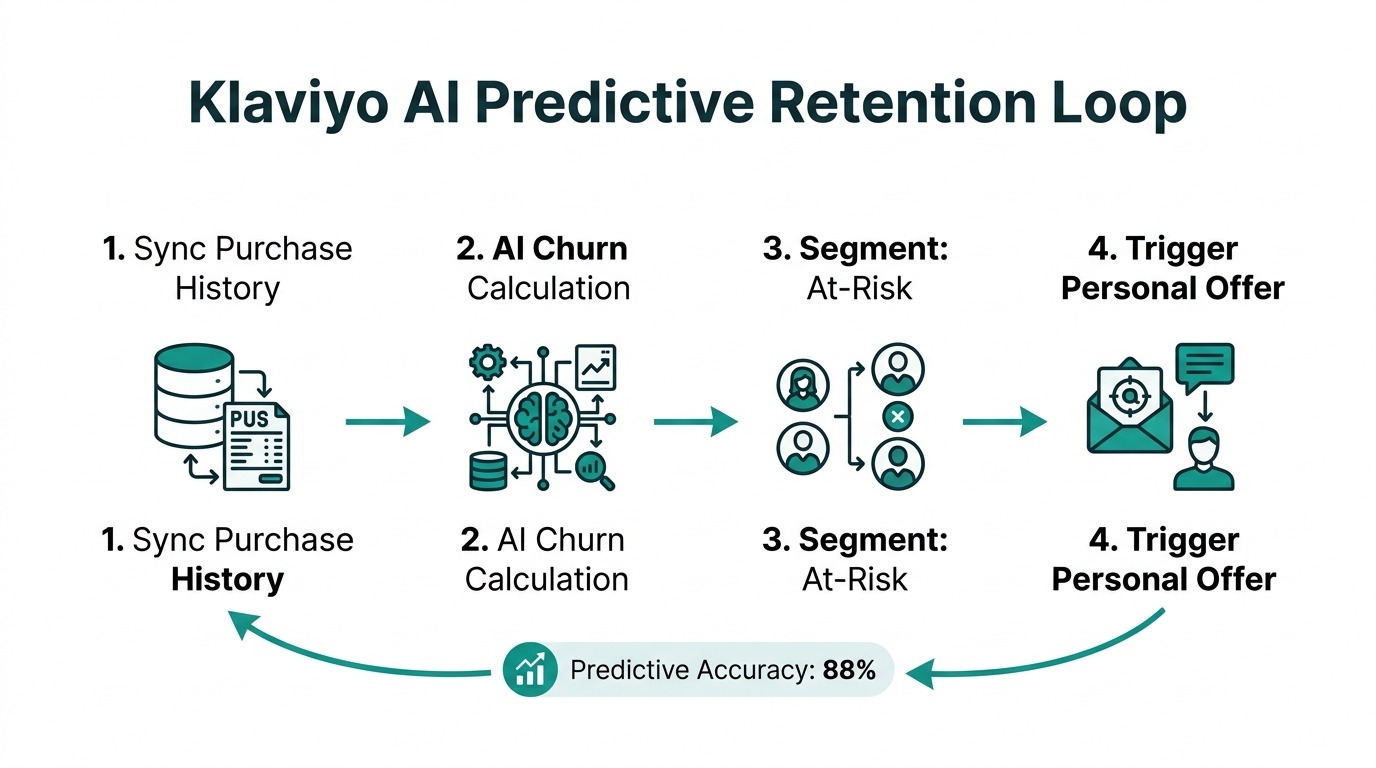
Marketing in 2026 is no longer about "blasting" an email list; it is about Behavioral AI. As search volume on traditional platforms has declined by 25%, brands are shifting toward GEO (Generative Engine Optimization) [source: Search Engine Land] and hyper-personalized retention. Klaviyo has stayed ahead by integrating predictive segmenting into their core platform.
Instead of manual segmentation, 2026's Klaviyo AI automation guide focuses on "Exit Intent" and "Cart Hesitation." Using Behavioral AI, your store can detect when a user is likely to bounce and trigger an immediate, one-to-one SMS offer via Postscript or Klaviyo SMS. This proactive engagement helped drive $262 billion in global retail revenue during the last holiday season, according to Ringly.io.
You can even ask Stormy AI to pull your weekly Klaviyo performance reports and drop them into a shared workbook, highlighting which AI-driven segments are generating the highest ROAS so you can reallocate your budget in real-time.
"2026 is the year of the normal person. Brands are optimizing for the group chat and the private message, not the public social media story."
Legal and Data Security: Protecting Your Store in 2026
With great power comes great liability. In 2025 and 2026, we saw the rise of "Privacy Zombie Claims." Merchants are increasingly being targeted by class-action lawsuits under the California Invasion of Privacy Act (CIPA) [source: JD Supra]. These lawsuits claim that AI tracking pixels "intercept" user data before the customer has actually granted consent. According to the Los Angeles Business Journal, data privacy is now the #1 legal threat for AI-native brands.
To mitigate this, ensure your best Shopify AI apps 2026 are configured with strict "Human-in-the-Loop" thresholds for high-value transactions. For example, Stormy AI can be set to handle routine follow-ups but escalate to a human the moment a customer mentions a refund over $500 or a legal dispute.
The 2026 Implementation Playbook
If you are looking to modernize your store today, don't try to automate everything at once. Follow this 90-day pilot strategy recommended by Shopify's automation guides:
- Days 1-30: Workflow Audit. Identify "mentally interruptive" tasks. If they are predictable, use Shopify Flow. If they are messy and multi-lingual, use an AI Agent.
- Days 31-60: Clean Data Foundation. Adopt the Universal Commerce Protocol (UCP). Ensure your product titles and specs are structured so LLMs can read them via a llms.txt file.
- Days 61-90: The Pilot. Select one KPI—like Support Resolution Rate—and train your agent on historical data before a full rollout.
As Shopify Sidekick and other tools become more autonomous, the role of the merchant shifts from doer to director. By choosing the right specialized agents and using a teammate like Stormy AI to handle the boring back-office spreadsheets and follow-ups, you can run a 2026 brand with a fraction of the traditional headcount.
Conclusion: The Lean, AI-Native Future
The Ultimate 2026 Shopify AI Tech Stack is not about having the most apps; it is about having the right agents. By balancing the free power of Shopify Sidekick and Flow with deep resolution tools like Gorgias and predictive engines like Klaviyo, you create a seamless loop of discovery, conversion, and retention. Keep your stack lean, protect your data, and let your AI employees do the heavy lifting while you focus on brand strategy.