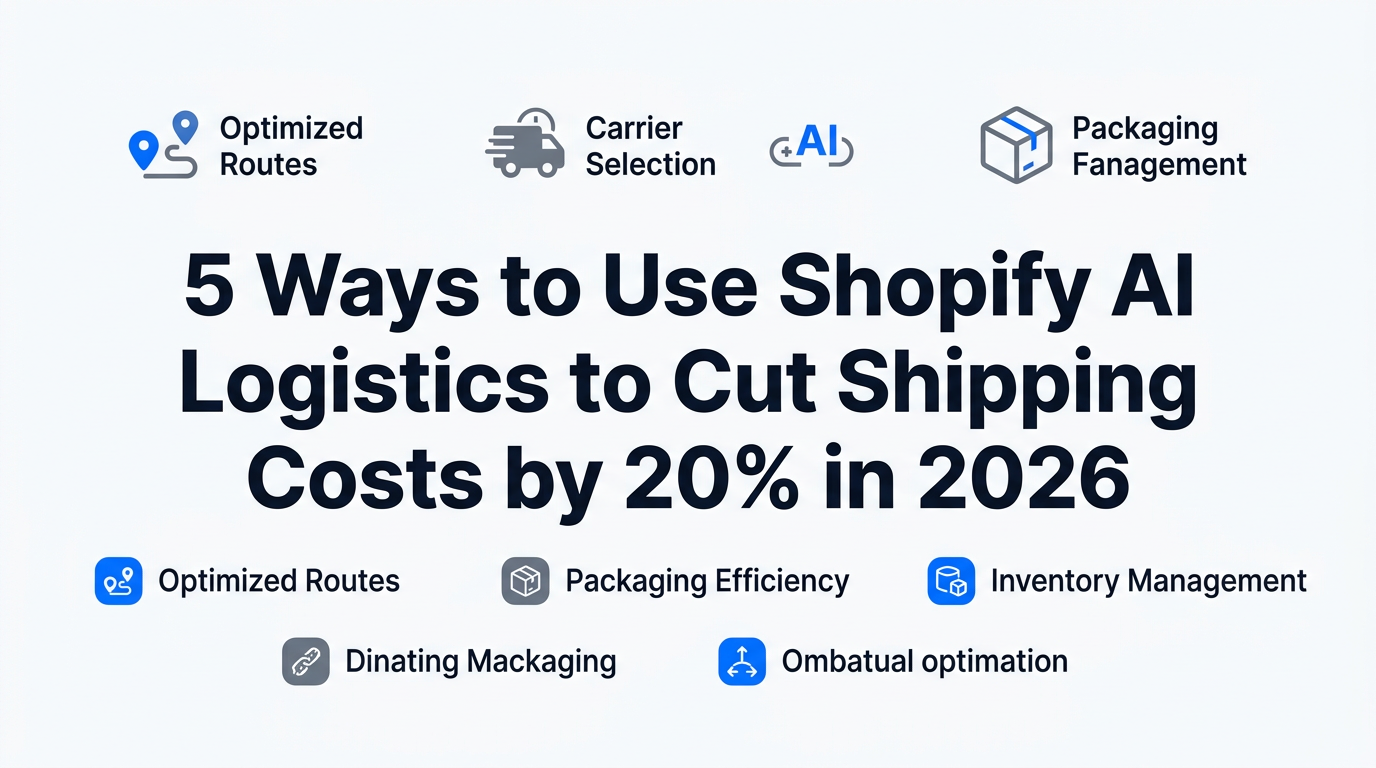
In 2026, the ecommerce landscape has shifted from a battle of storefronts to a battle of back-ends. With global shipping rates fluctuating and consumer expectations for "instant" delivery reaching an all-time high, Shopify AI logistics has become the primary lever for maintaining profitability. Research from McKinsey highlights that AI-enabled supply chains are now producing 5% to 20% savings in total logistics costs through advanced route optimization and predictive demand modeling. For a mid-sized merchant, that 20% reduction isn't just a margin booster—it’s the difference between scaling and stagnating.
This year, "automation" is no longer about simple email triggers; it is about Agentic Commerce. As Shopify President Harley Finkelstein recently noted, the Universal Commerce Protocol (UCP) has created the "common rails" for AI agents to handle everything from browsing to checkout. But the real magic happens after the customer hits 'buy.' To succeed in 2026, you must leverage these autonomous systems to handle the complex, expensive reality of moving physical goods across the globe.
1. Implement Dynamic Carrier Selection for Real-Time Cost Efficiency
Static shipping rates are a relic of the past. In 2026, the most successful brands use ecommerce shipping optimization tools that select carriers dynamically for every single order. This isn't just about finding the cheapest rate; it’s about analyzing real-time transit performance and carrier reliability at the exact moment of purchase. By using a tool like PH MultiCarrier Shipping Label, merchants can set up rules-based logic that auto-selects the best carrier based on weight, destination, and current network congestion.
"The key to 2026 logistics is moving from reactive to predictive. If a winter storm hits the Midwest, your AI should reroute parcels through regional hubs before the delay even happens."
Dynamic selection allows you to bypass the "one-size-fits-all" approach of sticking with a single carrier like UPS or FedEx. Instead, your Shopify shipping automation can pivot between regional players and national giants to shave dollars off every label. This is particularly effective for merchants dealing with mixed inventory—where some items are light and air-mail friendly, while others are bulky and require ground freight. AI agents now analyze these variables in milliseconds, ensuring you never overpay for a priority service when a regional carrier can meet the same window for 30% less.
2. Addressing the 40% Last-Mile Cost with AI Route Optimization
The final leg of a product's journey—the last mile—remains the most expensive part of the supply chain. According to data from Maersk, last-mile delivery now accounts for as much as 40% of total logistics spend in North America. AI is the only tool powerful enough to optimize these complex routes at scale. By embedding AI into your fulfillment logic, you can move products to regional warehouses before an order is even placed.
This predictive inventory allocation uses historical data to decide where stock should live. If your AI detects a spike in interest for a specific SKU in Southern California—perhaps driven by a local influencer campaign discovered via Stormy AI—it will trigger a restock to a nearby 3PL hub. This drastically reduces the distance a package travels, cutting both carbon emissions and transit costs. Experts like Ken Kralick, CEO of Qualibooth, emphasize that AI-enabled predictive analytics allow businesses to respond 30–40% faster to supply chain disruptions than those relying on manual oversight.
| Logistics Metric | Manual Operation | AI-Optimized (2026) |
|---|---|---|
| Inventory Holdings | Baseline | 20-30% Reduction |
| Last-Mile Cost | 40% of Spend | 25-30% of Spend |
| Response to Disruptions | Days/Weeks | Hours (30-40% faster) |
| Fulfillment Errors | 3-5% Avg | <0.5% with AI Vetting |
3. The Playbook: Setting Up Shopify Flow and AI Triggers
To truly reduce shipping costs in 2026, you need to automate the "edge cases" that usually require human intervention. Shopify Flow, combined with AI-logic apps, allows you to build a resilient infrastructure that handles remote deliveries and oversized items without blinking. For example, you can set a trigger that identifies if a shipping address is in a high-surcharge zone (like a remote island or a rural mountain pass) and automatically switches the packaging to a lighter, more compact eco-mailer to offset the cost.
Step 1: Define Your Thresholds
Identify your most expensive shipping scenarios. Is it international orders over 5lbs? Or domestic orders to specific zip codes? Create a list of these high-cost triggers in your Shopify shipping automation dashboard.
Step 2: Connect AI-Driven Inventory Tools
Use tools like Prediko or Assisty to forecast demand at the SKU level. These tools feed data back into Shopify Flow, allowing the system to hold or release orders based on the most cost-effective fulfillment location currently available.
Step 3: Automate Post-Purchase Logic
Use AI agents like eesel AI or Gorgias to handle "Where is my order?" (WISMO) queries. These queries typically make up 30-50% of support tickets. By automating the response with real-time tracking data, you free up your team to focus on logistics strategy rather than customer service fire-fighting.
"Automation isn’t just about efficiency; it’s about resilience. AI makes stores less dependent on manual intervention during market shifts." — Octavian Dumitrescu, CEO of Dyver.AI
4. Case Study: How Doe Beauty Saved $30,000 Per Week
One of the most compelling examples of Shopify AI logistics in action is the story of Doe Beauty. As a brand scaling rapidly, they faced a common nightmare: global inventory fragmentation and rising shipping surcharges. By integrating Shopify Flow with AI-driven inventory management tools, they moved away from a centralized warehouse model to a distributed network.
The results were staggering. Doe Beauty reported saving $30,000 per week in shipping costs alone, while also reclaiming four hours of manual data entry every single day. Their AI system automatically detected when stock levels were low in specific regions and initiated transfers before customers saw an "out of stock" message. This proactive approach not only saved money but also improved delivery speed, leading to a significant boost in customer lifetime value (LTV).
Similarly, brands like Boll & Branch have used AI-driven ERPs to support growth to $100M+ in revenue, proving that these systems are essential for enterprise-level scale. When your logistics are automated, you can reinvest those savings into high-impact growth channels, such as partnering with creators found through AI search engines like Stormy AI.
5. Review of Essential 2026 Logistics Tools
To implement the strategies above, you need a modern tech stack. The following tools are the industry leaders for Shopify merchants in 2026, offering deep AI integration and robust automation capabilities.
| Tool Name | Primary Function | Key 2026 Feature |
|---|---|---|
| Shippo | Multi-carrier Labels | AI-powered rate auditing and instant carrier switching. |
| Sendcloud | European & Global Shipping | Automated customs documentation for international AI buyers. |
| Loop Returns | Reverse Logistics | Hyper-personalized returns that route items to the nearest facility for resale. |
| PH MultiCarrier | Shipping Logic | Complex rule automation for oversized and remote deliveries. |
When selecting your stack, beware of tool fragmentation. Implementing five different AI apps for support, SEO, and shipping with no central governance leads to conflicting data and "hallucinations" in customer updates. Ensure your tools can communicate through a central hub like Shopify’s core engine to maintain a single source of truth.
"The future belongs to the merchants who can turn their supply chain into a competitive advantage. In 2026, logistics is the new marketing."
Conclusion: The AI Logistics Advantage
Cutting shipping costs by 20% in 2026 is not an impossible dream—it is a technical requirement for survival. By moving from manual carrier selection to dynamic AI-driven routing, optimizing the last mile through predictive allocation, and using Shopify Flow to handle edge cases, you can drastically improve your bottom line. Success requires clean data, high-signal metadata for AI agents, and a willingness to automate the most tedious parts of your operation.
As you optimize your back-end, don't forget that logistics efficiency creates the budget for front-end growth. Brands that save $30k a week on shipping are the ones dominating TikTok and YouTube with massive creator campaigns. To start finding the creators who will drive your next wave of orders, explore the AI-powered discovery tools at Stormy AI and turn your logistics savings into market share.