Success this year requires a paradigm shift. We are moving from "AI Automation"—where tools help humans—to "AI Elevation," where agentic AI performs end-to-end workflows like budget reallocation and creative testing without needing a single human prompt. This guide provides a high-level execution playbook for mastering Google Performance Max (PMax) and Meta Advantage+ to drive Shopify growth in this hyper-automated environment.
The 2026 Data Imperative: Beyond Cookies
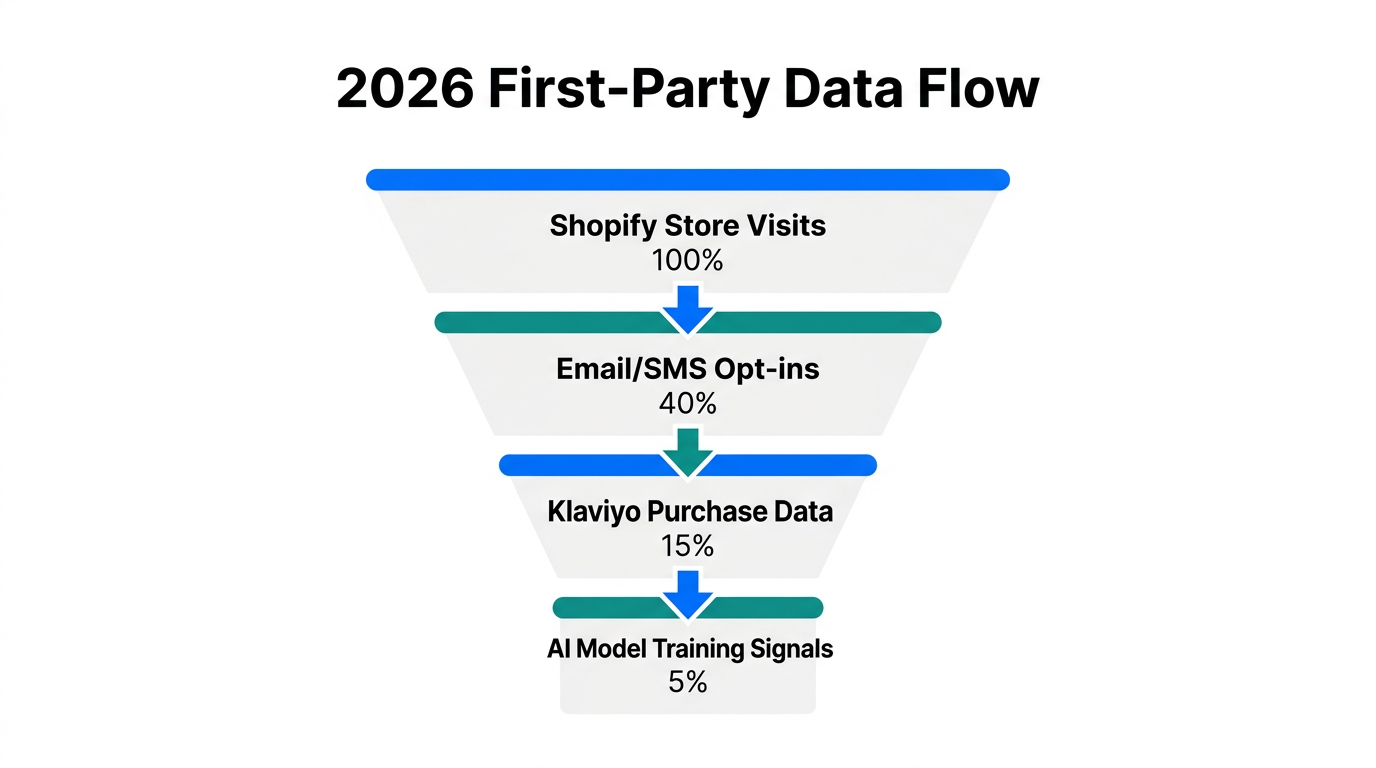
Before diving into bidding strategies, we must address the foundation: First-party data. With the total deprecation of third-party cookies now a distant memory, tracking accuracy depends entirely on your own infrastructure. Brands that rely on browser-side tracking are seeing data gaps of up to 40%.
To survive, Shopify stores must implement server-side tracking using tools like wetracked.io to capture backend revenue directly. By sending this data to Meta’s Conversions API (CAPI) and Google Enhanced Conversions, you ensure the algorithms have the "fuel" they need to find high-intent buyers. Without this "Structural Speed," as expert Neil Kettleborough calls it, even the best AI bidding strategy will fail.
The "High-Priority" Google Performance Max Strategy

Google Performance Max (PMax) has become the centerpiece of Shopify ads optimization in 2026. However, the most successful brands have moved away from "all-in-one" PMax campaigns, which often act as a "black box" that hides inefficiencies. The modern winner is the Hybrid Priority Model.
Instead of letting PMax handle your entire catalog, experts at Stan Consulting recommend running a High-Priority "Standard Shopping" campaign for your top 20 high-margin products alongside PMax. This allows you to maintain granular control over your bestsellers while letting PMax’s machine learning explore the long-tail keywords for the rest of your catalog.
| Campaign Type | Best For | Level of Control |
|---|---|---|
| Standard Shopping | Top 20% high-margin bestsellers | Highest (Manual bidding/negatives) |
| Performance Max | Catalog discovery & cross-channel | Medium (ML-driven) |
| PMax (Asset-Only) | Remarketing & Brand Awareness | Low (Creative-focused) |
Stopping Branded Search Cannibalization
One of the most common e-commerce bidding strategies mistakes in 2026 is allowing PMax to bid on your own brand name without exclusions. While this inflates your ROAS (Return on Ad Spend) and makes reports look beautiful, it often results in zero incremental growth. You are simply paying Google for clicks you would have received for free through organic search.
"Allowing PMax to bid on your brand name is a vanity metric trap. It inflates your performance numbers while siphoning budget away from actual customer acquisition."
Always use Brand Exclusions in PMax. If you want to protect your brand name, do it through a dedicated, low-cost Standard Search campaign where you can control the messaging and the spend precisely.
Meta Advantage+ Tips: Scaling with Machine Learning Signals
On the Meta side, Advantage+ Shopping Campaigns (ASC) have replaced the complex funnel structures of the past. In 2026, we no longer build manual segments for "Top of Funnel" or "Bottom of Funnel." Instead, we provide the algorithm with Machine Learning Signals.
Scaling Meta ads today is about Creative Diversification. Brands that use AI to generate, test, and iterate creative automatically are seeing CAC drops of up to 27%. The algorithm needs "creative fuel" to find different pockets of audiences. For example, a video-based UGC (User Generated Content) ad might appeal to a Gen Z audience on TikTok-style placements, while a static lifestyle image captures a different demographic in the Instagram feed.
To feed these hungry AI systems, many forward-thinking brands are turning to platforms like Stormy AI. By using AI-powered search to find high-quality UGC creators and automating the outreach process, brands can maintain the weekly creative cycles necessary to keep Meta's Advantage+ campaigns from fatiguing. Managing these relationships in a creator CRM ensures that your best-performing creators are consistently producing new assets for your ad sets.
Integrating Klaviyo AI Data for Predictive Targeting
Your Shopify store's data is more than just a record of the past; it is a predictor of the future. Integrating Klaviyo AI data with your ad platforms is a masterclass move for Shopify ads optimization 2026.
By syncing Klaviyo’s Predictive Analytics segments (such as "Likely to Buy Again" or "High Predicted LTV") directly into Meta and Google as Seed Audiences, you are giving the AI platforms a much higher quality starting point for their lookalike models. Instead of asking Meta to find people who look like *everyone* who bought a $10 item, you are asking it to find people who look like your top 5% of customers.
Case Study: How Travelpro Mastered Attribution
The luggage brand Travelpro provides a perfect example of why attribution modeling is critical. For years, the brand relied on "Last Click" attribution, which suggested their social ads were underperforming. However, after implementing Triple Whale’s attribution model, they discovered a startling reality.
They found that 20% of their purchases were actually influenced by PR channels (like *NYT Wirecutter*) and top-of-funnel social awareness that never received credit in a last-click world. By shifting their focus to Total Ecosystem ROAS and Marketing Efficiency Ratio (MER), they were able to reallocate budget from low-impact habits to high-impact signals. This move allowed them to scale their Meta Advantage+ campaigns with confidence, knowing that the "View-Through" impact was real.
"2026 is about building balanced channel mixes and reallocating spend based on real performance signals instead of habit." — Mia Healy, Triple Whale
Common Scaling Mistakes to Avoid in 2026

Even with the most advanced AI tools, human errors can still sink your Shopify performance. Watch out for these three critical pitfalls:
1. App Bloat and Core Web Vitals
Every single-use Shopify app you install adds JavaScript that slows down your site. In 2026, Google uses Core Web Vitals as a direct ranking factor for ad quality scores. If your page takes more than 3 seconds to load, your bounce probability increases by 90%. Ensure your store is lean and fast to maintain a high Ad Rank.
2. The "Desktop-Only" Design Trap
With mobile-first traffic accounting for 79% of all Shopify store visits, designing for desktop first is a recipe for failure. In 2026, buttons must be at least 44x44 pixels to avoid "fat-finger" bounce rates. If your mobile conversion rate is significantly lower than your desktop rate (the current average is 1.2% mobile vs 1.4% desktop, according to TechnologyChecker), you have a UX problem, not an ad problem.
3. Ignoring View-Through Conversions
Up to 95% of ad impact in 2026 happens when users see but don't click an ad. If you only optimize for clicks, you will cut your most profitable top-of-funnel budgets. Use tools like Layerfive to track the full customer journey, including the touchpoints that don't result in an immediate click.
The Future of Shopify Ads Optimization
Mastering Shopify ads optimization in 2026 requires a delicate balance between total AI trust and strategic human oversight. By leveraging Google Performance Max for its broad reach, Meta Advantage+ for its creative-first scaling, and first-party data tools like Klaviyo and Triple Whale for precision, you can build a growth engine that thrives in the algorithmic era.
Remember: The AI is your operator, but you are the architect. Shield your brand from cannibalization, keep your site speed high, and never stop feeding the machine with high-quality, UGC-driven creative. Start by auditing your current PMax campaigns for brand exclusions and implementing server-side tracking today to ensure your brand is ready for the $1 trillion year ahead.