The ecommerce landscape in 2026 is no longer about who has the best dashboard; it is about who has the fastest agents. With global retail ecommerce sales projected to hit $7.41 Trillion this year, accounting for nearly 22% of all retail transactions, the manual 'check-and-adjust' workflow of 2024 is officially dead. Today, high-growth brands are moving toward 'Agentic Commerce'—a paradigm where AI does not just visualize data, but executes on it. Whether you are managing a lean Shopify store or a 9-figure omnichannel powerhouse, the goal in 2026 is to transition from retrospective reporting to autonomous budget rebalancing and signal sending.
As of 2026, the global ecommerce analytics market has surged to $30.32 Billion, driven by 84% of businesses ranking AI as their top technology priority. Leading this charge are two titans: Triple Whale, which now tracks over $82 Billion in GMV, and Northbeam, which oversees $25 Billion in annual ad spend. This playbook outlines how to integrate these tools with an AI ecommerce employee like Stormy AI to create a fully autonomous growth engine that scales spend, fixes signals, and manages the back-office fallout.
The Rise of Agentic Budgeting: Triple Whale Moby
In 2026, Triple Whale has evolved from a Shopify-centric dashboard into an operating system powered by Moby Agents. These are not simple 'if-this-then-that' rules; they are strategic advisors capable of executing complex tasks based on real-time profitability data. For most performance marketers, the primary use case is automating creative fatigue detection and budget rebalancing.
To set this up, you must configure Moby to monitor your Marketing Efficiency Ratio (MER) at the account level. When creative fatigue sets in—defined by a 20% drop in ROAS below your 30-day average—Moby can automatically shift budget from the underperforming campaign to your 'evergreen' winners. This prevents the 'overcounting' issue where the Meta Ads Manager might claim higher performance than your bank account shows. Brands like Hat Club have already used this centralized data to save over 10 hours per week in manual reporting and improved media efficiency by 30%.
"AI is no longer experimental in 2026; it's how brands protect margins. Brands needed real-time strategic advisors, not just data tools." — AJ Orbach, CEO of Triple Whale.
Bypassing 2026 Pixel Limitations with Northbeam Apex
The primary challenge this year remains the 'Signal Crisis.' With privacy-first regulations and the total phase-out of 3rd-party cookies, standard pixels are often missing 40% of conversion data. Northbeam Apex addresses this by feeding 1st-party attribution data directly back into Google Ads and Meta algorithms.
By sending server-side signals, Northbeam Apex ensures that the ad platforms' machine learning models are training on true conversion data rather than the fragmented signals captured by a browser. Following their $15 Million growth investment, Northbeam's modeling has become the gold standard for high-spend brands that require deterministic attribution across diverse channels like Connected TV (CTV) and YouTube. In fact, many brands using Northbeam found that true incremental lift from Meta was only 65-80% of what the platform reported, allowing them to trim waste and reinvest in top-of-funnel scaling.
The 2026 Vertical Scaling Framework: 10-20% Every 48 Hours
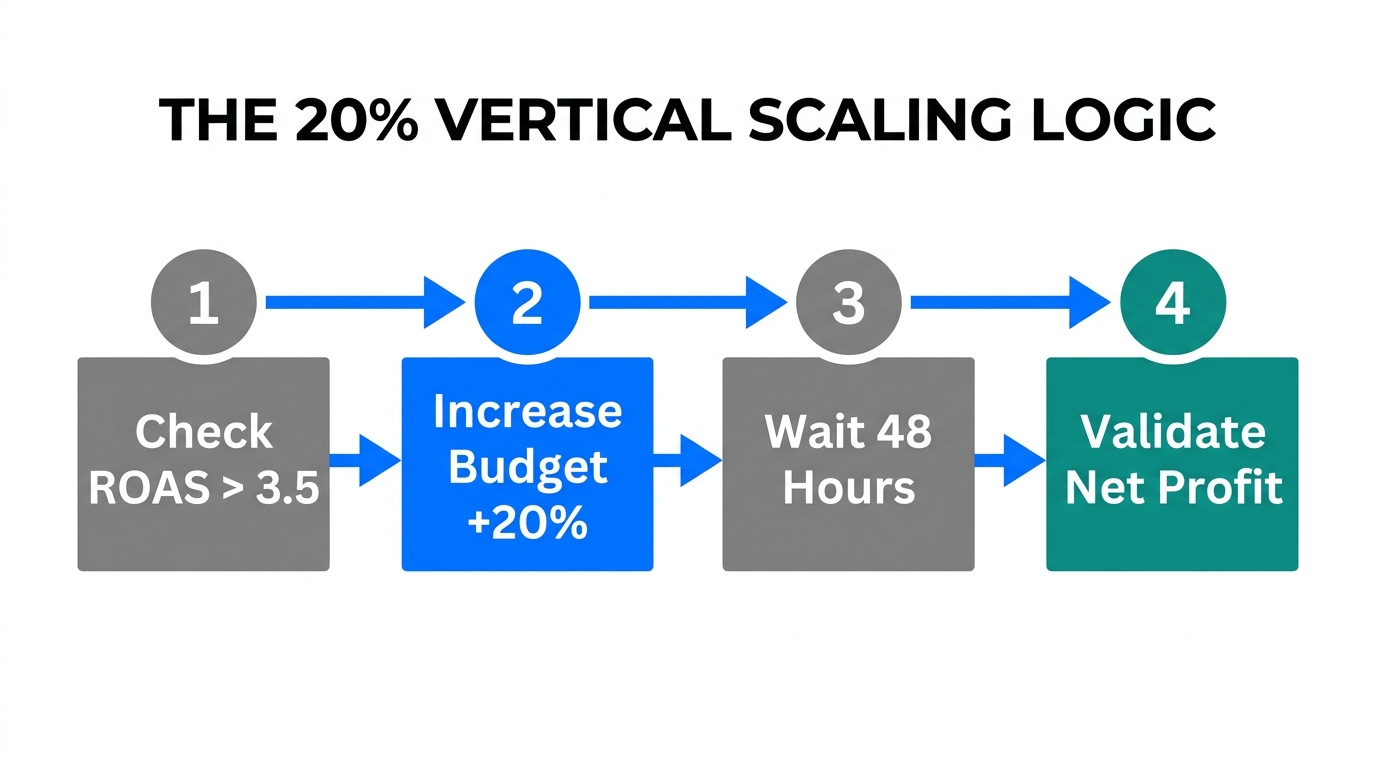
Scaling ad spend in 2026 requires a delicate balance. Aggressive jumps can reset the 'learning phase' of modern AI ad models, while slow scaling leaves revenue on the table. The industry standard has shifted to a Vertical Scaling Framework based on stable CPA benchmarks.
Step 1: Define Your Stability Window
Before any budget increase, your CPA must remain within 10% of your target for a minimum of 7 consecutive days. Use Northbeam's MMM+ (Media Mix Modeling) to verify that this revenue is actually incremental and not just 'stealing' from organic or branded search.
Step 2: Execute the 10-20% Increase
Once stability is confirmed, increase the daily budget by 10% to 20%. In 2026, we do this every 48 to 72 hours. This rhythm is fast enough to capture momentum but slow enough to allow the TikTok Ads Manager and Meta algorithms to adjust their bidding strategies without spiking CPMs.
Step 3: Monitor with Moby Agents
Set a Triple Whale Moby Agent to 'Watchdog' mode. If the scaling attempt causes ROAS to dip more than 15% below the previous window, the agent should automatically revert the budget to the previous level and flag the performance marketer via Slack.
| Scaling Metric | Triple Whale Benchmarks | Northbeam Benchmarks |
|---|---|---|
| Recommended Increase | 10-15% | 15-20% |
| Stability Check | 72 Hours | 48 Hours |
| Primary Signal | Blended ROAS | Incremental CPA |
| Scaling Limit | 2x Weekly | 3x Weekly |
Closing the Loop: Automating the Back Office with Stormy AI
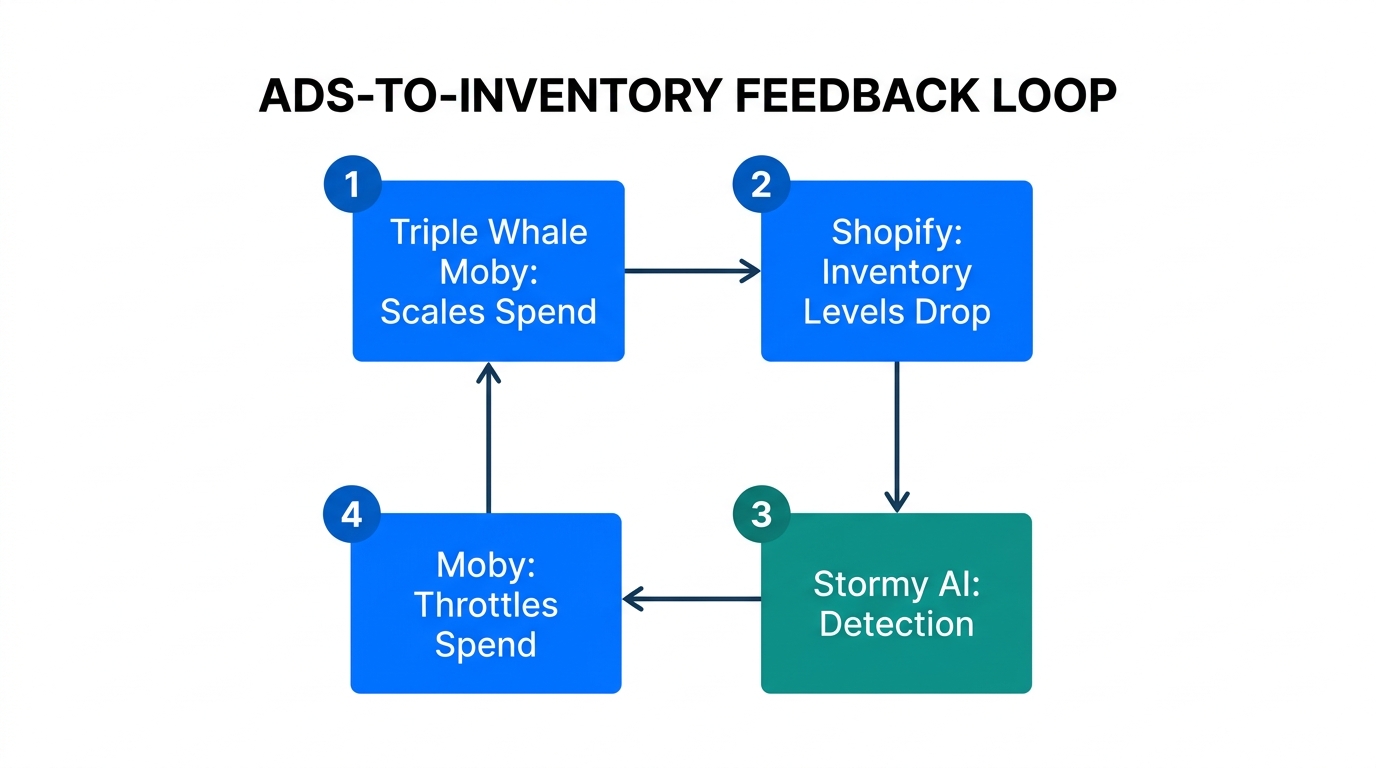
Scaling ads successfully creates a massive secondary problem: the messy back office. When your ads scale 150%, your inventory levels plummet, your suppliers get overwhelmed, and your support inbox explodes. This is where Stormy AI, your AI ecommerce employee, takes over.
Instead of manually checking spreadsheets, you can ask Stormy AI to monitor your ad spend in real-time. For example, when Stormy detects that your 'Moby Agents' have scaled a SKU's budget by 50% over the last week, it automatically checks your Shopify inventory levels. If a stockout risk is detected, Stormy AI drafts a restock purchase order and emails it to your supplier, asking for a confirmed lead time.
Furthermore, Stormy AI handles the increased creator and affiliate volume that often accompanies scaling. While you scale the top-of-funnel, Stormy AI tracks creator affiliate posts on TikTok Shop, updates your creator CRM, and sends polite follow-up emails to creators who haven't posted their promised content. This ensures that your 'Vertical Scaling' isn't just an ad spend exercise, but a holistic business expansion.
"The key to scaling in 2026 isn't just better ads; it's an AI teammate like Stormy AI that ensures your supply chain doesn't break when your marketing succeeds."
Case Study: HexClad's 150% Growth Strategy
A prime example of automated scaling is HexClad. By utilizing Northbeam to transition from fragmented tools to a single 'source of truth,' HexClad achieved 150% growth for consecutive years. They moved away from platform-reported metrics and focused entirely on a 'Hard MER' target.
By automating their top-of-funnel scaling and using server-side signals to optimize Meta, they were able to maintain efficiency while pushing millions in monthly spend. When you combine this level of ad automation with an AI ecommerce employee to handle the resulting fulfillment issues and supplier follow-ups, you create a business that can scale without adding more human headcount.
Choosing the Right Stack for 2026
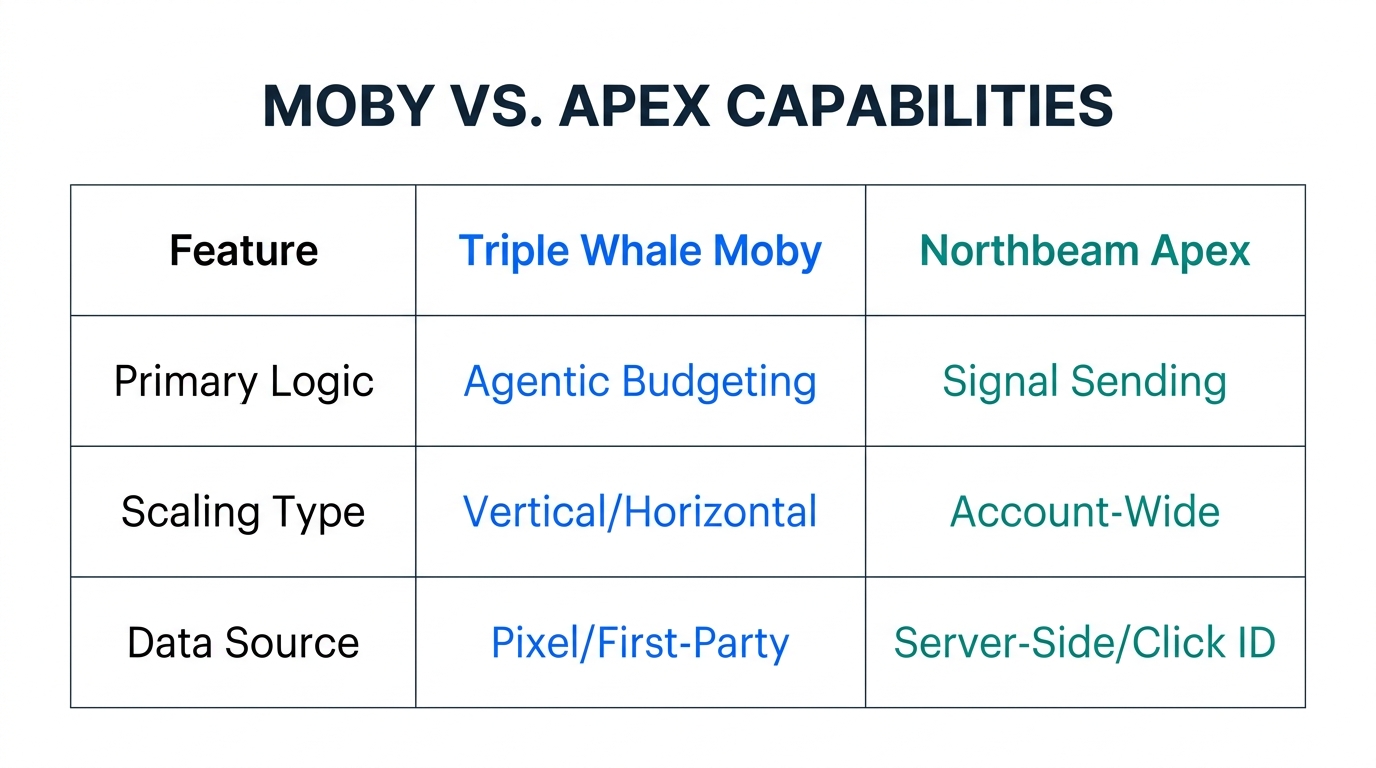
Picking between Triple Whale and Northbeam depends on your revenue scale and complexity. Both are essential tools, but they serve different 'flavors' of growth.
| Feature | Triple Whale (2026) | Northbeam (2026) |
|---|---|---|
| Best For | Shopify Brands ($1M-$40M) | Omnichannel ($40M+) |
| Pricing Basis | GMV / Revenue-based | Traffic / Pageviews |
| Setup Speed | 1-2 Days (Plug & Play) | 1-2 Weeks (Technical) |
| Core Philosophy | Operator Simplicity | Modeling Precision |
| AI Agents | Moby (Task-Focused) | Apex (Signal-Focused) |
If you are a high-AOV brand with low pageviews but high revenue, Northbeam's pricing model might actually be more cost-effective. Conversely, for a fast-moving Shopify store looking for a mobile-friendly 'all-in-one' profitability view, Triple Whale remains the market leader. Regardless of your choice, integrating these with a task-runner like Stormy AI is what separates the legacy brands from the autonomous ones.
The Path to Autonomous Growth
In 2026, the performance marketer's job is no longer to pull the levers, but to audit the agents. By configuring Triple Whale Moby for rebalancing, Northbeam Apex for signal integrity, and Stormy AI for back-office operations, you can build a system that grows while you sleep. The tools to build a multi-million dollar brand with a skeleton crew are now at your fingertips—you just have to let the agents take the wheel.